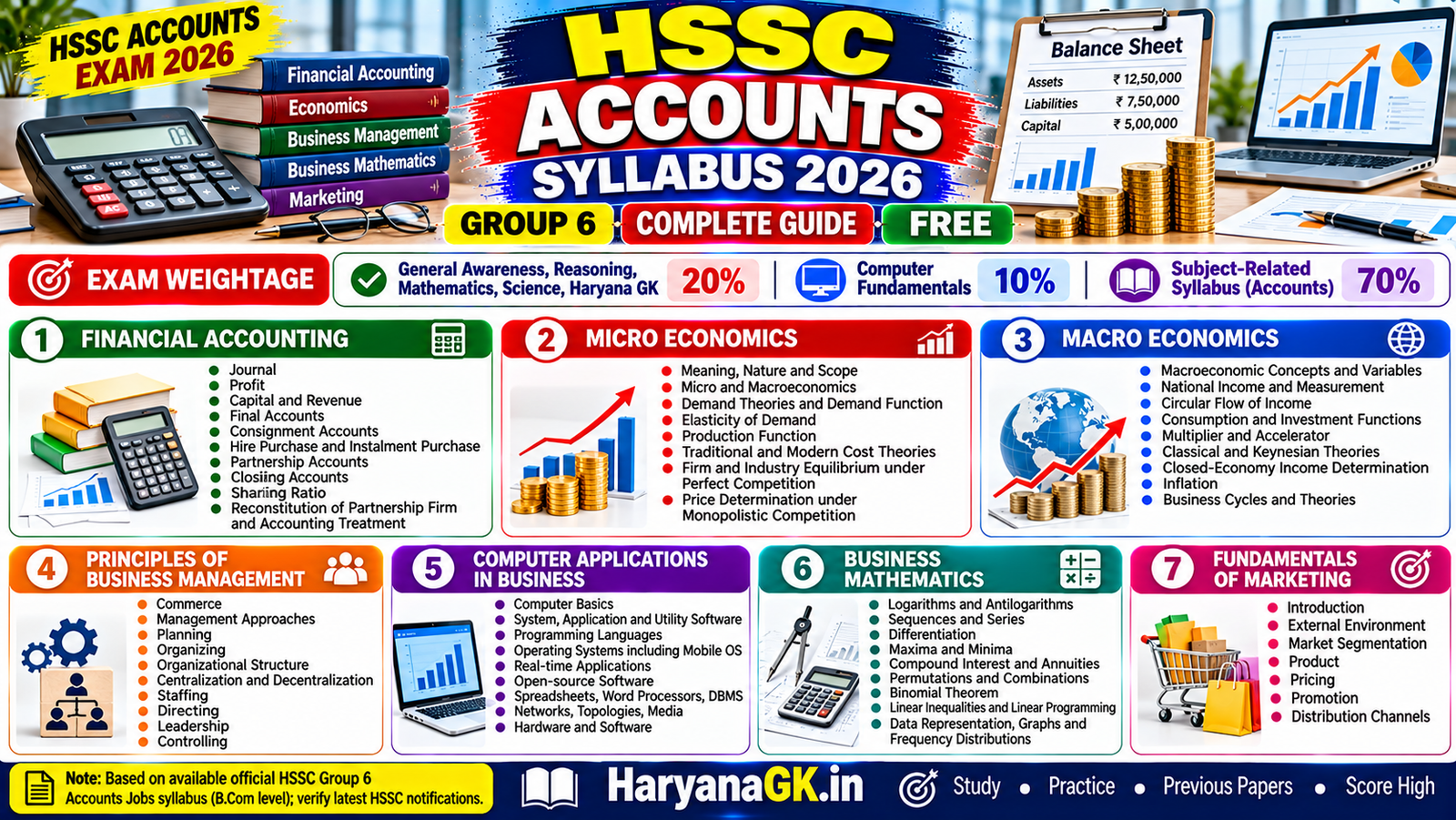
HSSC Accounts Syllabus 2026 covers Group 6 recruitment for Accounts posts under the Haryana Staff Selection Commission. This HSSC Accounts Syllabus guide breaks down the exam pattern and the full subject-wise topic list, straight from the official syllabus published at hssc.gov.in, so you know exactly what to study before you open a single PDF.
HSSC Accounts Syllabus Exam Pattern
Group 6 recruitment follows the standard two-stage HSSC process. Stage one is the Common Eligibility Test (CET) — 100 questions, 100 marks, roughly 90–105 minutes, covering general awareness, reasoning, Hindi, English and quantitative aptitude. Clearing CET plus the socio-economic criteria stage qualifies you for the group-specific written exam, which is where the HSSC Accounts Syllabus below actually applies.
The HSSC Accounts Syllabus for the written exam splits into weighted parts:
- General awareness, reasoning, mathematics, science, history (including Haryana-related history), current affairs, literature, geography, civics, environment, culture, etc.—20% weightage
- Computer terminology, fundamentals, word software, Excel software, PowerPoint, internet, web browsing, communication, emails, downloading and uploading data on websites, etc.—10% weightage
- Subject-related syllabus — 70% weightage
HSSC notes on the official document that this weightage is tentative and may vary, so treat it as a study-time guide rather than a locked question count.
HSSC Accounts Syllabus 2026 (Subject-Wise)
The subject-specific block of the HSSC Accounts Syllabus spans the following areas. Here is the complete breakdown.
FINANCIAL ACCOUNTING
Financial accounting, journal, profit, capital and revenue, Final Accounts, Consignment Accounts Hire purchase and instalment purchase system, partnership account, closing the accounts, sharing ratio, reconstitution of partnership firm, modes & accounting treatment
MICRO ECONOMICS
Meaning, nature and scope of economics, micro- and macroeconomics, Theories of demand, Nature of demand function, elasticity of demand, Production function, Theory of costs: traditional and modern, equilibrium of firm and industry under perfect competition, price determination under monopolistic competition
MACRO ECONOMICS
Macro Economics: concept, nature, scope, and variables; national income: concept and measurement; circular flow of income (four core sectors); consumption function; investment function; multiplier, concepts and importance; principle of acceleration, Classical & Keynesian theory of income, output and employment; income determination in a closed economy, Inflation: meaning, types, theories, causes, effects and remedial measures, Business cycle: meaning and phases; Hicks & Samuelson’s theory measures for business cycles.
PRINCIPLES OF BUSINESS MANAGEMENT
Introduction to Commerce: Concept, Introduction to Management, Approaches to Management, Planning, Organising, Organisational Structure, Decentralisation and Centralisation, Staffing: Meaning, Importance & Scope of Staffing, Directing, Leadership, Controlling
COMPUTER APPLICATIONS IN BUSINESS
Introduction to Computers: Computer Software: Introduction, Types of Software: System, Application and Utility Software; Programming languages; Introduction to operating systems: types and function of operating systems; Real-time applications; operating systems for tabs, mobile phones, Android, etc.; open-source software: an overview; application software: spreadsheets, word processors, database management software; networks: basic types of networks, topologies, media, hardware and software required for networking
BUSINESS MATHEMATICS
Logarithms, anti-logarithms, sequences and series, Differentiation: Idea of simple derivative of different functions (excluding trigonometrical functions); Rules of differentiation (simple standard forms), maxima and minima of functions of one variable (including 2nd or 3rd order derivatives) relating to cost, revenue and profit, Compound Interest and Annuities, Permutations and Combinations, Binomial Theorem, Linear Inequalities, Linear programming formulation of equation, Data representation and interpretation, Diagrammatic and graphic representation of data, types of diagrams, graphs of frequency distribution
FUNDAMENTALS OF MARKETING
Introduction, external environment, market segmentation, product, pricing, promotion, distribution channel
E-COMMERCE
Introduction to the Internet, Information Technology and Business, Types of information systems: Transaction Processing System (TPS), Management Information System (MIS), Introduction to E-commerce, E-commerce and the World Wide Web, E-commerce Application Services, E-commerce Models: B2B, B2C, C2C; electronic data interchange: benefits, components of EDI, EDI implementation, security issues in e-commerce, M-commerce and e-governance: an overview
BUSINESS ENVIRONMENT OF HARYANA
Haryana economy: nature, characteristics and problems; concept of economic development; State of the Haryana economy since its inception: Income, population, health & nutrition, declining sex ratio, Haryana agriculture: nature, cropping pattern, role of agriculture in Haryana economy, Measures for development in agriculture, crop insurance, Agriculture credit: agriculture finance, types of agriculture finance; credit needs of farmers; sources of credit: institutional and non-institutional sources; NABARD; rural indebtedness: causes, consequences and debt relief measures; Micro, small & medium enterprises (MSME) in Haryana: meaning, role, performance and challenges; SEZ, growth of MNCs in Haryana, role of HSIIDC, HFC, HAFED, HKVIB, Haryana budget: objectives and policies, sources of revenues and its utilisation
CORPORATE ACCOUNTING
Accounting for share capital & debentures, book building, concept & process; issue of right and bonus shares; buyback of shares; redemption of preference shares; issue and redemption of debentures, Final accounts of companies (excluding computation of managerial remuneration), amalgamation of companies, Valuation of goodwill; valuation of shares: concepts and calculation – simple accounts of holding companies, relevant provisions of Accounting Standard 21, Accounts of banking organisations, Accounts of insurance companies, Liquidation of companies
BUSINESS STATISTICS
Introduction of statistics, Collection of data, Measure of central tendency: mean, median, mode, harmonic mean and geometric mean; measure of dispersion; index numbers; tests of adequacy; times series; decomposition; determination of trend; Computation of seasonal indices by sample averages, Simple Correlation: concept, types: multiple and partial; linear and non-linear; scatter diagram, Methods: Karl Pearson’s coefficient of correlation, Spearman’s rank correlation, concurrent deviation method; Probable and standard errors, regression analysis, probability; concepts and approaches; addition and multiplication laws of probability; conditional probability, probability distributions, Poisson and normal distributions
BUSINESS LAWS
Law of Contract (1872, Special Contracts, Sale of Goods Act 1930, Remedies: Unpaid Seller and His Rights, Buyer’s Remedies, Auction Sale, Consumer Protection Act) 2019, Negotiable Act 1881, Indian Partnership Act, 1932, Limited Liability Partnership Act, 2008, Information Technology Act, 2000, RTI Act, 2005: important provisions
COMPANY LAW
Company, promotion and incorporation of companies; promoters: legal position, duty, liability and remuneration; company and pre-incorporation contracts; incorporation procedure, Memorandum of Association, Articles of Association, Share Capital: types, issue and allotment of shares and debentures; share certificate and share warrant; reduction of share capital; buy-back of shares, Transfer & transmission of shares and debentures; depository system; borrowing powers and debentures, Membership in companies; Company management and administration; Directors: legal position, qualification, appointment, removal; Powers, duties & liabilities of directors; managerial remuneration; key management personnel, Company Secretary: Role, appointment, duties, liabilities, rights and dismissal, Meetings, winding up: meaning, modes of winding up: procedure and consequences of winding up
INDIAN FINANCIAL SYSTEM
Introduction: nature and role of financial system, Components of the financial system: Financial markets and financial instruments: money and capital markets, SEBI: its formation, role and recent developments, The Debt Market: meaning, features, participants, instruments; private, PSUs & government securities market, Financial institutions: Reserve Bank of India: organisation, management and functions; credit creation and credit control, Commercial banks: meaning and functions, structure and recent developments in commercial banking in India; e-banking, NPA’s in commercial banks, payment banks, and development banks: concept, objectives and functions; recent developments in development banking
RURAL MARKETING
Rural Marketing: meaning, nature, characteristics, opportunities and challenges to rural markets in India; Socio-cultural, economic, demographic, technological and other environmental factor affecting rural marketing; rural consumer behaviour; segmentation of rural market; strategies for rural marketing; rural marketing mix; difference in rural and urban market; problems in rural marketing; Strategies for rural marketing, Product planning, pricing, promotion and management of distribution channels for marketing of durables and non-durables in rural areas; Planning and organising personnel selling in rural markets; Innovation in the rural market: e-commerce in rural markets, e-chaupal & other similar initiatives in rural markets
COMPUTER-ISED ACCOUNTING SYSTEM
Introduction: installation of Tally, ERP9 – Licensing configurations – Tally Vault Password – Security Control in Tally, ERP9 – Splitting Company Data – Backup and Restore, Accounting: voucher entry, budget, cost centre, balance sheet, profit and loss account, currency, debit note, credit note, interest calculation, Inventory: stock item, sales order, purchase order, delivery note, rejection out, Computerised Tax Liability Calculation, Payroll: Salary Accounting – Introduction to Payroll – Payroll Masters – Payroll Vouchers – Overtime, Payment – Gratuity – Advanced Payroll Transactions Basic Salary, Overtime, Bonus, Gratuity, Loan, ESI, Provident Fund, Pension, Commission
ENTREPRENEURSHIP DEVELOPMENT
Entrepreneur: meaning, scope, role and functions of an entrepreneur and business Feasibility study: preparation of feasibility reports; economic, technical, financial and managerial feasibility of project; selection of factory location; demand analysis and market potential measurement; capital and project costing; working capital requirements; source of finance; profit and tax planning, Government support and incentives to new enterprises; the role of the govt., promotional agencies and institutions in entrepreneurship development; entrepreneurship development programmes; Start-up India; Skill India
ACCOUNTING AND REPORTING STANDARDS
Accounting standards, accounting standards interpretations and guidance notes on various accounting aspects issued by ICAI and their applications; An overview of international accounting standards; International financial reporting standards, Corporate financial reporting: issues and problems with special reference to published financial statements, interim reporting, segment reporting and social reporting, Valuation: concept and need; valuation of tangible fixed assets; valuation of intangibles; valuation of liabilities; valuation of shares; valuation of business, Developments in financial reporting: value added statement, economic value added, market value added, shareholders value added
COST ACCOUNTING
Introduction, cost concepts & classification, materials, inventory control, labour, methods of wage payment, overheads, methods of costing, standard costing and variance analysis: material and labour, Cost control and cost reduction; cost audit; an overview of cost audit standards
FINANCIAL MANAGEMENT
Financial management, financial planning and forecasting, sources of finance, Cost of capital, Capital structure decisions: meaning and determinants of capital structure; theories of capital structure Capital budgeting decisions, working capital management
GOODS AND SERVICES TAX
GST: meaning, taxable person, registration: procedure and documents required, Levy and collection of GST, Time and place of supply of goods and services, value of taxable supply Computation of input tax credit and transfer of input tax credit Tax invoice credit and debit note Various returns to be filed under GST, payment of tax including TDS, interest provisions on delayed payment, Offences and penalties
INCOME TAX
Introduction to income tax: concept, tax management, Basis of charges, Heads of income: income from salary, house property; profit and gains from business and profession, capital gains and other sources; clubbing and aggregation of income; Provisions regarding set-off and carry forward of losses, deductions under sections 80C to 80U in computing total income, Computation of total income and tax liability of an individual and H.U.F. Computation of total income and tax liability of a firm, Deduction of tax at source; advance payment of tax, Income tax authorities and their powers, Procedure for assessment; different types of returns, Procedure of filing e-return and revised return, Recovery and refund of tax, penalties and prosecutions, appeals and revision
AUDITING
Introduction, types of audits, audit process, Methods of audit work, Vouching, audit of limited companies, Investigation: meaning, nature, procedure and objectives, investigation and due diligence, Professional ethics of auditing
SUPPLY CHAIN MANAGEMENT
Supply chain management (SCM): concept, scope and importance; approaches to SCM; role of SCM in afirm and economy; SCM and marketing mix; SCM as a coordination function; integrated SCM: total cost concept; Strategic SCM: SCM strategy, implementation and management; interrelationship of SCM and marketing, Elements of SCM: transportation: considerations in selecting the right mode; multimodal transportation; warehousing: types, site selection and management; customer service – strategy and practices; distribution, channel design, Information system in SCM; ERP and SCM; recent developments in SCM – third/fourth party logistics
INDIAN ECONOMY
Indian economy: features, size; natural resources: land, water, forest and energy; infrastructure: importance & types, infrastructure development programmes in India, important issues; agriculture: features, importance, agricultural production and productivity, rural indebtedness, agricultural marketing, agricultural finance, agricultural policy, new development in agriculture: contract farming, organic farming and corporate farming; industrial development during the planning period; industrial policy; national manufacturing policy; micro, small and medium enterprises (MSME): importance, problems and Govt. Policy; large-scale industries: iron & steel, cement and petrochemicals; service sector in India: growth and contribution of services, major areas of the service sector in India, Foreign trade of India: composition and direction, Problems of the Indian economy: population, poverty, unemployment, inflation, unequal distribution of income and wealth, inter-state disparities in the pattern of development
FUNDAMENTALS OF THE STOCK MARKET
Security markets: primary and secondary markets; primary market: role and functions; methods of selling securities in the primary market; new financial instruments; SEBI guidelines for public issues; stock exchanges; listing of securities in stock exchanges; trading mechanism; screen-based trading; internet-based trading; National Stock Exchange and Bombay Stock Exchange: role, organisation and management; listing procedure; SEBI (Depositories and Participants) Regulations 1996; SEBI (Custodian of Securities) Regulations, 1996; National Securities Depository Ltd. (NSDL), Derivative trading: future and opinions: concept, meaning and importance, methods of trading, valuation of options, Raising funds from international markets: FITs, Euro issues, ADRs, GDRs and FDI; SEBI guidelines
MANAGEMENT ACCOUNTING
Management accounting, management reporting, Analysis of financial statements, ratio analysis, Cash flow and funds flow statements, Absorption V/S variable costing, Budgeting and budgetary control
FUNDAMENTALS OF INSURANCE
Introduction to insurance, contract of life insurance, Fire insurance, marine insurance, Accident and motor insurance, Insurance intermediaries – role of agents and procedure for becoming an agent; cancellation of licence; revocation/suspension/termination of agent appointment; code of conduct; unfair practices
HUMAN RESOURCE MANAGEMENT
Human resource management, human resource planning, job analysis, recruitment, selection, induction and internal mobility, transfer, demotion, Training, training methods: on-the-job and off-the-job methods, Performance appraisal
BUSINESS ENVIRONMENT
Business environment, environmental and organisational scanning, economic systems, economic planning in India, role of government, Foreign investment, foreign exchange market: an overview
RETAIL MANAGEMENT
Retailing, planning the location of a retail institution: trading area analysis, deciding the most desirable type of location, choosing a general location, choosing and evaluating a particular site, material handling, Organisational structure in retail institutions; classification of retail institutions; store-based and non-store-based retail organisations; process of setting up a retail organisation, Store management: blueprinting operations, deciding store layout, energy management, security issues; applications of information technology in retailing, Trends in retailing in India: FDI in retail
CORPORATE GOVERNANCE
Corporate governance: concept, structure and principles of corporate governance; models of corporate governance; process and regulation; parties to corporate governance; mechanism and controls; requirements of effective corporate governance; insider trading; rating agencies; whistleblowing; shareholder’s protection; corporate governance in India: initiatives and present position; issues & problems in corporate governance; corporate disclosure practices; globalisation and corporate governance in India; corporate governance reforms, Organisational structure: Board of directors: composition and their role, powers and responsibilities; board meetings; board committees and their functions; SEBI norms; independent director, Corporate governance and CSR; corporate governance and ethics; ICAI guidelines for corporate governance
INDUSTRIAL LAWS
Industrial Relations, Factories Act, 1948, Trade Union Act, 1926, The Employees’ Compensation Act, 1923, Industrial Disputes Act, 1947, The Payment of Wages Act, 1936
आधिकारिक स्रोत
इस पेज का सिलेबस हरियाणा कर्मचारी चयन आयोग (HSSC) के आधिकारिक दस्तावेज़ से लिया गया है। ताज़ा संस्करण और भर्ती सूचनाएँ hssc.gov.in/examsyllabus पर देखें।
दूसरे सभी HSSC पदों के सिलेबस और भर्ती प्रक्रिया हमारे HSSC गाइड पेज पर एक जगह दिए गए हैं।