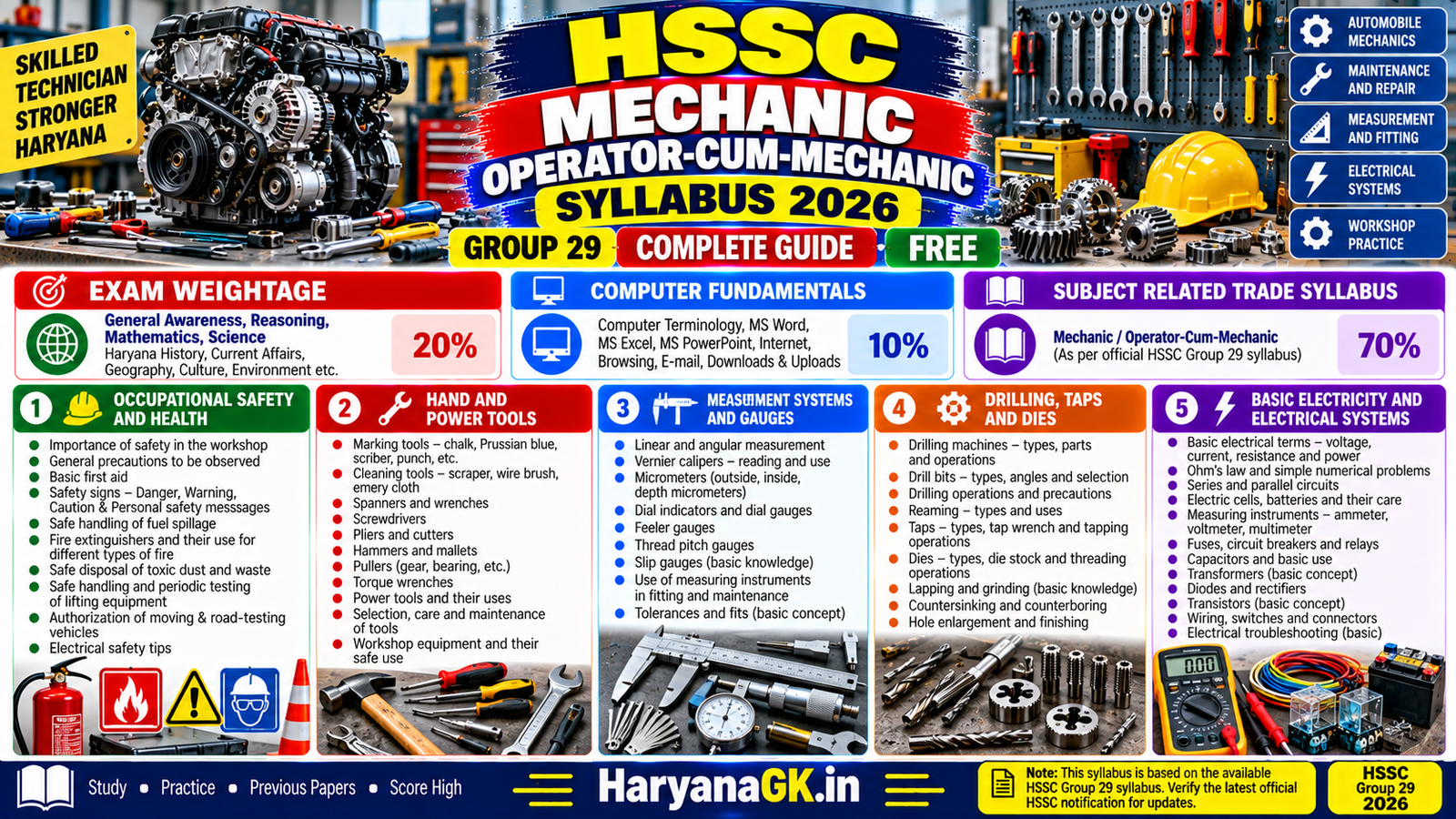
The HSSC Mechanic Operator-cum-Mechanic Syllabus 2026 covers Group 29 recruitment for Mechanic Operator-cum-Mechanic posts under the Haryana Staff Selection Commission. This HSSC Mechanic/Operator-cum-Mechanic Syllabus guide breaks down the exam pattern and the full subject-wise topic list, straight from the official syllabus published at hssc.gov.in, so you know exactly what to study before you open a single PDF.
| HTET Previous Year Exam Papers |
HTET Previous Year Sample Exam Papers 2024 – 2014  |
HSSC Mechanic Operator-cum-Mechanic Syllabus Exam Pattern
Group 29 recruitment follows the standard two-stage HSSC process. Stage one is the Common Eligibility Test (CET) — 100 questions, 100 marks, roughly 90–105 minutes, covering general awareness, reasoning, Hindi, English and quantitative aptitude. Clearing CET plus the socio-economic criteria stage qualifies you for the group-specific written exam, which is where the HSSC Mechanic/Operator-cum-Mechanic Syllabus below actually applies.
The HSSC Mechanic/Operator-Cum-Mechanic Syllabus for the written exam splits into weighted parts:
- General awareness, reasoning, mathematics, science, history (including Haryana-related history), current affairs, literature, geography, civics, environment, culture, etc.—20% weightage
- Computer terminology, fundamentals, word software, Excel software, PowerPoint, internet, web browsing, communication, emails, downloading and uploading data on websites, etc.—10% weightage
- Subject-related syllabus — 70% weightage
HSSC notes on the official document that this weightage is tentative and may vary, so treat it as a study-time guide rather than a locked question count.
HSSC Mechanic / Operator-cum-Mechanic Syllabus 2026 (Subject-Wise)
The subject-specific block of the HSSC Mechanic / Operator-cum-Mechanic Syllabus covers the following areas. Here is the complete breakdown.
Importance of safety and general precautions to be observed in the shop. Basic first aid, safety signs for danger, warning, caution & personal safety messages. Safe handling of fuel spillage and fire extinguishers used for different types of fire.
Safe disposal of toxic dust, safe handling and periodic testing of lifting equipment, and authorisation of moving & road-testing vehicles. Electrical safety tips.
Marking scheme, marking material – chalk, Prussian blue.
Cleaning tools – scraper, wire brush, Emery paper, description, care and use of surface plates, steel rule, measuring tape, and try square. Callipers – inside and outside. Dividers, surface gauges, scriber, punches-prick punch, centre punch, pin punch, hollow punch, number and letter punch.
Chisel-flat, cross-cut. Hammer-ball pein, lump, mallet. Screwdrivers – blade screwdriver, Phillips screwdriver, ratchet screwdriver. Allen key, bench vise & C-clamps, spanners, ring spanner, open-end spanner & the combination spanner, and universal adjustable open-end spanner.
Sockets & accessories, pliers – combination pliers, multi-grip, long-nose, flat-nose, nippers or pincer pliers, side cutters, tin snips, circle pliers, external circle pliers.
Air impact wrench, air ratchet, wrenches, torque wrenches, pipe wrenches, car jet washers Pipe flaring & cutting tool, pullers, gear and bearing
Systems of measurement: Description, care & use of micrometres – outside and depth micrometres, micrometre adjustments, Vernier callipers, telescope gauges, dial bore gauges, dial indicators, straightedge, feeler gauge, thread pitch gauge, vacuum gauge, and tire pressure gauge.
Drilling machine: Description and study of bench-type drilling machine, portable electrical drilling machine, drill-holding devices, work-holding devices, and drill bits.
Taps and Dies: Hand taps and wrenches, calculation of tap drill sizes for metric and inch taps. Different types of die and die stock. Screw extractors. Hand reamers, different types of hand reamers, drill size for reaming, lapping, lapping abrasives, type of laps.
Basic electricity: Electricity principles, ground connections, Ohm’s law, voltage, current, resistance, power, and energy. Voltmeter, ammeter, ohmmeter, multi-meter, conductors & insulators, wires, shielding, length vs.
resistance, resistor ratings, fuses & circuit breakers, ballast resistor, stripping wire insulation, cable colour codes and sizes, resistors in series circuits, parallel circuits and series-parallel circuits, electrostatic effects, capacitors and their applications, capacitors in series and parallel, Description of chemical effects, batteries & cells, lead-acid batteries & sealed maintenance-free (SMF) batteries, magnetic effects, heating effects, thermo-electric energy, thermistors, thermocouples, electrochemical energy, photovoltaic energy, piezoelectric energy, electromagnetic induction, relays, solenoids, primary & secondary windings, transformers, stator and rotor coils,
Basic electronics: Description of semiconductors and solid-state devices – diodes and transistors.
Introduction to Hydraulics & Pneumatics: Definition of Pascal’s law, pressure, force, and viscosity. Description, symbols and application in automobiles of internal & external gear pumps, single-acting, double-acting & double-ended cylinders
Pressure relief valve, non-return valve, and flow control valve are used in automobiles. Pneumatic Symbols, Description and Function of Air Reciprocating Compressor. Function of Air Service Unit (FRL-Filter, Regulator & Lubricator),
Classification of vehicles on the basis of load as per the Central Motor Vehicle Rule, wheels, final drive, fuel used, axles, position of engine and steering transmission, and body and load.
Brief description and uses of vehicle hoists – two post and four post hoists, engine hoists, jacks, and stands
Introduction to Engine: Description of internal & external combustion engines, classification of IC engines, principle & working of 2&4-stroke diesel engines (compression ignition engines (C.I.)), principle of spark ignition engines (SI), differentiation between 2-stroke and 4-stroke, C.I. engine and S.I. engine, direct injection and indirect injection, technical terms used in engines, engine specifications, different types of starting and stopping methods of diesel engines, and procedure for dismantling of diesel engines from a vehicle.
Petrol Engine Basics: 4-stroke spark-ignition engines, engine cams & camshafts, engine power transfer, scavenging, piston components, intake & exhaust systems, gasoline fuel systems, stoichiometric ratio, air density, fuel supply system, type of petrol and diesel combustion chambers, type of valve operating mechanism, valve-timing diagram, concept of variable valve timing, timing belts & chains, description & functions of different types of pistons, piston rings and piston pins and materials, common troubles and remedies.
Compression ratio, Description & function of the connecting rod, description & function of the crankshaft, camshaft, engine bearings, description & function of the flywheel and vibration damper, crankcase & oil pump, gear timing mark, chain sprockets, chain tensioner, etc.
Function of clutch & coupling units attached to flywheel, Description of cylinder block, cylinder block construction, and different types of cylinder sleeves (liners),
Need for cooling systems, heat transfer method, vehicle coolant properties, different types of cooling systems,
Need for lubrication system, functions of oil, viscosity and its grade as per SAE, oil additives, synthetic oils, the lubrication system, splash system, pressure system, lubrication system components,
Intake system components Description and function of air cleaners, Different type of air cleaner, Exhaust system components,
Diesel Fuel Systems Description and function of diesel fuel injection, fuel characteristics,
Emission Control: – Vehicle emissions standards – Euro and Bharat II, III, IV, V Sources of emission, types of emissions: Characteristics and Effect of Hydrocarbons, Hydrocarbons in Exhaust Gases, Oxides of Nitrogen, Particulates, Carbon Monoxide, Carbon Dioxide, Sulphur Content in Fuels Description of evaporation emission control, catalytic conversion, closed loop, crankcase emission control, exhaust gas recirculation (EGR) valve, controlling air-fuel ratios, charcoal storage devices, and diesel particulate filter (DPF).
Selective Catalytic Reduction (SCR), EGR vs SCR,
Description of charging circuit operation of alternators, regulator unit, ignition warning lamp troubles and remedies in charging system.
Description of starter motor circuit, constructional details of starter motor solenoid switches, common troubles and remedies in starter circuit,
Troubleshooting: Causes and remedies for engine not starting – mechanical & electrical causes, high fuel consumption, engine overheating, low power generation, excessive oil consumption, low/high engine oil pressure, and engine noise.
Unit, Fractions Classification of unit system Fundamental and derived units: F.P.S., C.G.S., M.K.S. and SI units Measurement units and conversion Factors, HCF, LCM, applications of the Pythagoras theorem and related problems Ratio and proportion Ratio and proportion – Direct and indirect proportions Percentage – Changing percentage to decimal and fraction,
Mass, Weight, Volume and Density Mass, Related Problems,
Work, power, energy, HP, IHP, BHP and efficiency Potential energy, kinetic energy,
Heat & Temperature and Pressure Concept of heat and temperature, effects of heat, difference between heat and temperature, boiling point & melting point, scales of temperature, Celsius, Fahrenheit, Kelvin, and conversion between scales of temperature
Heat & Temperature – Temperature measuring instruments, types of thermometer, pyrometer and transmission of heat – Conduction, convection and radiation.
Mensuration Area and Perimeter of Square, Rectangle, Triangle, Circle, Semi-Circle, Circular Ring, Sector of Circle, and Volume of Solids – Cube, Cuboid, Cylinder, Sphere, and Hollow Cylinder.
Introduction: Study of different major components of a vehicle
Clutches & Manual Transmissions – Clutch principles, Manual transmissions, Automated Manual Transmission (AMT),
Final Drive & Drive Shafts – Basic layouts Front-wheel drive layout, rear-wheel drive layout, four-wheel drive layout, all-wheel drive layout, 4WD vs AWD, front-wheel drive,
Automatic transmissions, hydraulic system & controls,
Steering Systems,
Suspension systems, lubrication system,
Wheels & Tyres-Wheel types, Braking systems,
Importance of Diagnostic Trouble Code (DTC), ignition principles and Faraday’s laws, charging system, starting system,
Accessories: horn circuit, wiper circuit, power window components and circuit. Power door lock circuit, automatic door lock circuit, remote keyless entry system circuit, antitheft system, immobiliser system.
Description and function of airbags, seatbelts, vehicle safety systems, crash sensors, Seat belt pretensioners, tyre pressure monitoring systems Integrated communications, Proximity sensors,
Introduction to hybrid & electronic vehicles, hydrogen fuel cell vehicles, heating, ventilation, and air conditioning (HVAC) legislation, Vehicle heating, ventilation & cooling systems,
Introduction to Electric Vehicle Technology, EV Terminology Comparison of electric vehicles with IC engine vehicles based on emissions, range, and fuel type. Types of electric vehicle, BEV, HEV, PHEV and FCEV,
आधिकारिक स्रोत
इस पेज का सिलेबस हरियाणा कर्मचारी चयन आयोग (HSSC) के आधिकारिक दस्तावेज़ से लिया गया है। ताज़ा संस्करण और भर्ती सूचनाएँ hssc.gov.in/examsyllabus पर देखें।
दूसरे सभी HSSC पदों के सिलेबस और भर्ती प्रक्रिया हमारे HSSC गाइड पेज पर एक जगह दिए गए हैं।