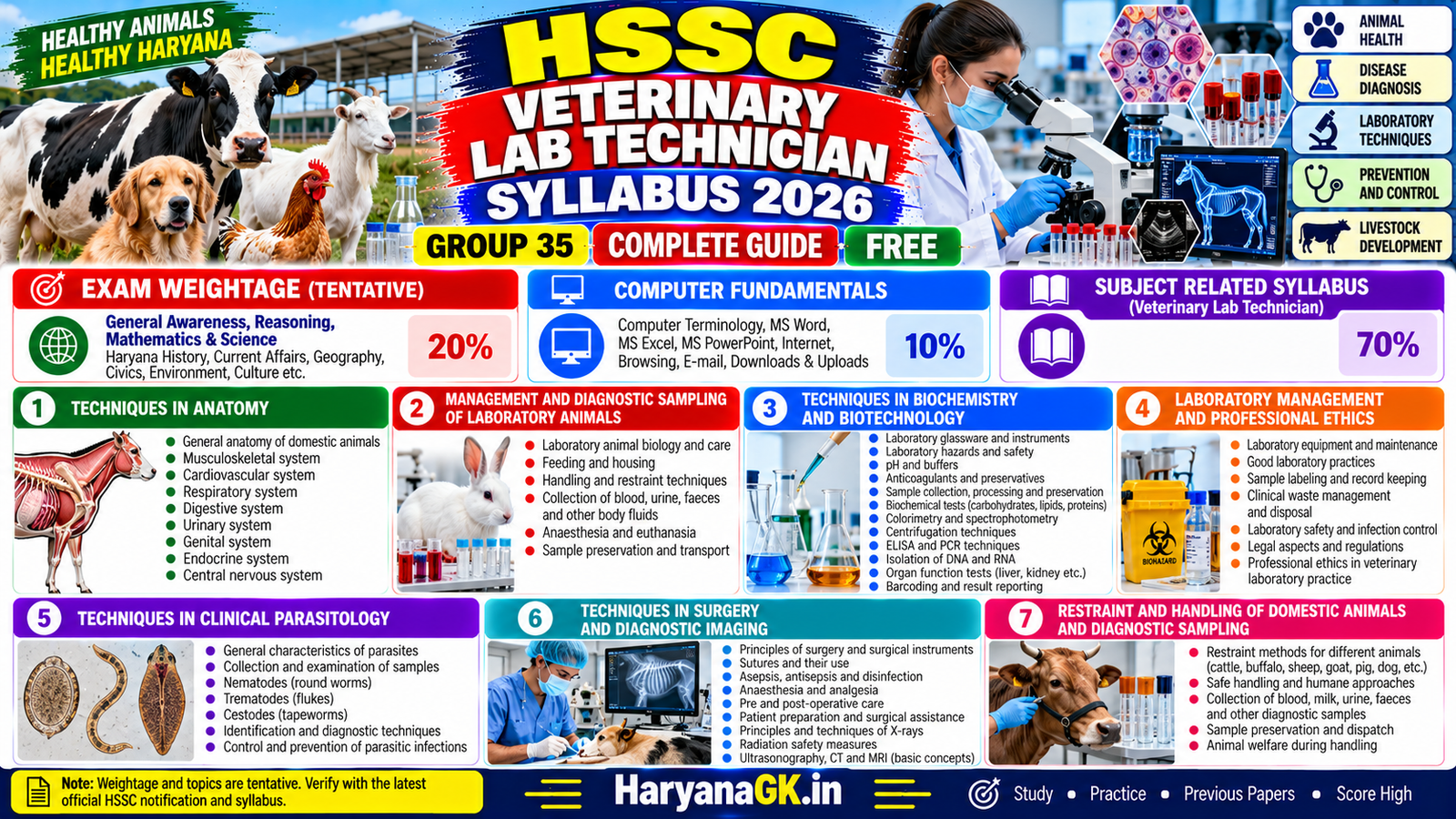
The HSSC Veterinary Lab Technician Syllabus 2026 covers Group 35 recruitment for Veterinary Lab Technician posts under the Haryana Staff Selection Commission. This HSSC Veterinary Lab Technician Syllabus guide breaks down the exam pattern and the full subject-wise topic list, straight from the official syllabus published at hssc.gov.in, so you know exactly what to study before you open a single PDF.
HSSC Veterinary Lab Technician Syllabus Exam Pattern
Group 35 recruitment follows the standard two-stage HSSC process. Stage one is the Common Eligibility Test (CET) — 100 questions, 100 marks, roughly 90–105 minutes, covering general awareness, reasoning, Hindi, English and quantitative aptitude. Clearing CET plus the socio-economic criteria stage qualifies you for the group-specific written exam, which is where the HSSC Veterinary Lab Technician Syllabus below actually applies.
The HSSC Veterinary Lab Technician Syllabus for the written exam splits into weighted parts:
- General awareness, reasoning, mathematics, science, history (including Haryana-related history), current affairs, literature, geography, civics, environment, culture, etc.—20% weightage
- Computer terminology, fundamentals, word software, Excel software, PowerPoint, internet, web browsing, communication, emails, downloading and uploading data on websites, etc.—10% weightage
- Subject-related syllabus — 70% weightage
HSSC notes on the official document that this weightage is tentative and may vary, so treat it as a study-time guide rather than a locked question count.
HSSC Veterinary Lab Technician Syllabus 2026 (Subject-Wise)
The subject-specific block of the HSSC Veterinary Lab Technician Syllabus spans the following areas. Here is the complete breakdown.
Techniques in Anatomy Introduction to the gross anatomy of different organs of the musculoskeletal, cardiovascular, respiratory, digestive, urinary, genital, endocrine and central nervous systems of animals. Management and Diagnostic Sampling of Laboratory Animals Biology of different laboratory animals; feeding, watering and management of laboratory animals. Animal behaviour, capture and restraint of laboratory animals.
Collection of blood, urine, faeces and other body fluid samples in different laboratory animals. Anaesthesia and Euthanasia of laboratory animals. Techniques in Biochemistry and Biotechnology Introduction to laboratory, glassware, plastic ware and instruments. Minimum requirements to start a laboratory. Hazards in a clinical biochemical laboratory. Preparation and standardisation of acids and alkalis, concept of pH – preparation of buffer, colourimetric and electrometric determination of pH. Anticoagulants and preservatives. Sample collection: blood, urine, other sample types, dangerous samples, sampling errors, etc. Sample processing and preservation. The use of biochemical tests, specialised tests, automation and computerisation. Colorimetry and spectrophotometry.
Centrifuges and centrifugation. Qualitative and quantitative tests and identification of carbohydrates, lipids and proteins. Estimation of blood, urine, semen, saliva, milk and tissue biochemical constituents. Biotechnological/molecular biology techniques, ELISA, PCR, etc. Nucleic acid and antibody-based assays, isolation of RNA and DNA. Organ function tests. Concept of barcoding. Data entry and presentation of results. Reference ranges. Laboratory Management and Professional Ethics Laboratory equipment and gadgets. Laboratory practices, glass and plastic wares. Various signs and labels and their uses. Disposal of clinical waste. Laws and ethics governing clinical laboratories.
Techniques in Clinical Parasitology: Parasitology overview, Nematode parasites, Trematode parasites, Cestode parasites, Parasitology overview, Nematode parasites, Trematode parasites, Cestode parasites. Techniques in Surgery and Diagnostic Imaging Introduction, general surgical principles, and suture materials used in veterinary practice. Sterilisation (asepsis-antisepsis), their application in veterinary surgery, disinfection, and de-germination. Definition of common terms in relation to anaesthesia.
Injectable and inhalation anaesthetics. Preparation of the patient and positioning. Local anaesthetics, introduction to diagnostic imaging, production of X-rays, X-ray equipment, exposure factors, image formation, radiographic film quality, radiation safety, contrast radiography, diagnostic ultrasonography, nuclear medicine, computed tomography, and magnetic resonance imaging. Restraint and Handling of Domestic Animals and Diagnostic Sampling Indications for restraint, animal behaviour, capture and restraint of horse, cattle, buffalo, camel, sheep, goat, pig, dog, cat and birds. Collection of blood, urine, faeces and other body fluid samples in different animal species. Occupational Hazards and Environmental Management Basics of ecology and ecosystems, preservation of species. Biodiversity, nature and animal conservation.
Forest conservation, water resource management. Soil, water air and noise pollution. Biosafety, climate change and global warming. Global warming and population. The Ozone Layer and Climate Change, Energy Security. Stress on the environment, society and resources. Natural Disasters. Emerging diseases and their management strategies. Solid waste management. Legislation to protect the environment. Role of non-conventional sources of energy in environmental protection.
Techniques in Histology: Introduction to cells, tissues, epithelium, and glands. Basic histological arrangement of tunics of different visceral organs. Different types of fixatives for histology. Techniques in Pharmacology Introduction and classification of drugs and poisons. Metrology, pharmaceutical calculations and calculation of doses, route of drug administration, drug, and dosage forms. Safe storage of different classes of drugs and pharmaceutical processes. Physicochemical properties of commonly used drugs, drug hazards and safety. Techniques in Physiology Collection of blood. Preservation of defibrinated blood. Enumeration of erythrocytes and leukocytes.
Leukocytic differential count, platelet count. Estimation of haemoglobin, haematocrit, erythrocyte sedimentation rate, coagulation time, bleeding time, erythrocyte fragility, blood grouping. Counting of rumen flora motility and estimation of volatile fatty acids and ammonia in rumen fluid. Bacterial and protozoal count in rumen fluid. Physical and chemical analysis of urine and its interpretation in health and disease condition. Estimation of acidity in urine. Demonstration of various kidney function tests, creatinine clearance rate, urea clearance rate, and glucose tolerance test. Sperm motility, sperm concentration, and live and dead sperm count. Demonstration of estimation of progesterone and oestrogen by radioimmunoassay.
Techniques in Clinical Microbiology Introduction to microbiology. Collection transport, storage/preservation and processing of samples for microbiological work. Specimen collection from living and dead animals for important microbial diseases of livestock and poultry. Isolation and identification of bacterial fungi and handling of bacterial and fungal cultures. Cell culture and embryonated egg inoculation for virus isolation and other virological work. Handling of virus cultures, Introduction to the immune system, immunity, antigens and antibodies. Preparation of bio-reagents for immunological work. Serological, immunological and molecular tests for microbiological diseases. OIE prescribed tests for infectious disease.
Methods of bacterial and viral vaccine production, formulation, and quality control testing of vaccines. Collection Processing and Analysis of Clinical Samples Hands on practice for collection of blood, urine, faeces, tissues and other body fluid samples in different animal species. Preservation and dispatch of the specimen for laboratory diagnosis. Haematological examination; biochemical examination of blood, plasma/serum, urine and other body fluids. Blood and faecal examination for parasites, microbiological examination of milk, meat, water, air, etc. All preparations of aseptic surgery.
Analysis of feed for toxic compounds, etc. Zoonosis, Public Health and Epidemiology Epidemiological terms, representation of data, collection, preservation and dispatch of specimens for laboratory examination. Animal-associated injuries, bacterial zoonosis, mycotic zoonosis, parasitic zoonosis, and viral diseases. Importance of safe water, hygienic milk and meat products, bacteriological examination of milk, meat, air and sewage. Cleaning, sterilisation and disinfection in food establishments.
Techniques in Feed Analysis Different standard solutions are used in nutritional evaluation. Different systems of feed evaluation, the proximate system of analysis and its limitations. Sampling Procedures. Introduction, evolution of computers, components of a computer, hardware vs software, system vs applications software, bits and bytes, input and output devices, RAM/ROM, and secondary storage devices. Microsoft Windows, Windows Desktop, working with Windows, exploring the control panel, common accessories, applications, Windows Explorer, MS Office,
The Internet and its applications, like email and browsing, various browsers like WWW (WORLD WIDE WEB), hyperlinks, and HTTP (HYPER TEXT TRANSFER PROTOCOL); FTP (FILE TRANSFER PROTOCOL) basics of networking—LAN, WAN, dairy and meat technology Sampling of milk, estimation of fat, solid not fat and total solids, COB, alcohol, acidity, pH, specific gravity, sediments and dye tests, and detection of adulteration and preservatives in milk.
Microbiological examination of milk and its products, pasteurisation of milk, and preparation of milk products. Methods of humane slaughter of animals and preparation of abattoir by-products. Wool sampling and its evaluation. Preservation and evaluation of meat and its products, preparation of meat and poultry products. Candling, evaluation and preservation of shelled eggs and its products. Slaughtering techniques used for various types of birds. Slaughtering and evisceration of different kinds of birds. Estimation of dressing percentage and yield. Grading of dressed chicken/poultry. Microbiological sampling of meat, poultry products and eggs.
Techniques in Clinical Pathology Introduction and Importance of Clinical Pathology. Introduction to the fundamentals of blood and urine analysis. Introduction: Objectives, definition, requirements, and steps in post-mortem technique. Technique of post-mortem examination for various species of animals, including poultry. Post-mortem changes and post-mortem lesions of important diseases. Writing of the postmortem report. Collection, preservation and dispatch of specimens for laboratory diagnosis. Post-mortem examination of Vetra-legal cases. Brief introduction of the processing of tissues for histopathological examination: Grossing, paraffin wax embedding, blocking, cutting and staining
आधिकारिक स्रोत
इस पेज का सिलेबस हरियाणा कर्मचारी चयन आयोग (HSSC) के आधिकारिक दस्तावेज़ से लिया गया है। ताज़ा संस्करण और भर्ती सूचनाएँ hssc.gov.in/examsyllabus पर देखें।
दूसरे सभी HSSC पदों के सिलेबस और भर्ती प्रक्रिया हमारे HSSC गाइड पेज पर एक जगह दिए गए हैं।