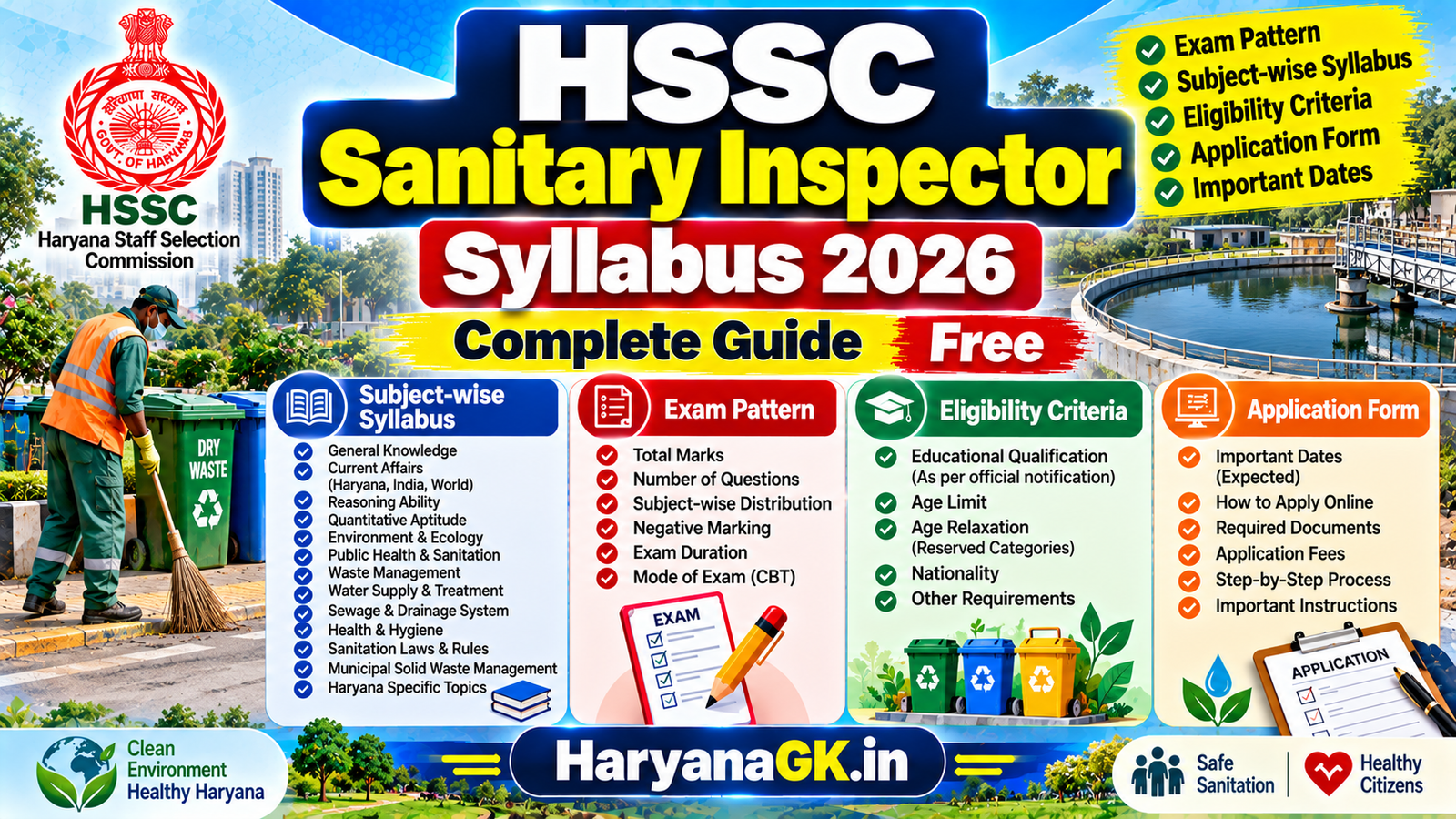
The HSSC Sanitary Inspector Syllabus 2026 covers Group 36 recruitment for Sanitary Inspector posts under the Haryana Staff Selection Commission. This HSSC Sanitary Inspector Syllabus guide breaks down the exam pattern and the full subject-wise topic list, straight from the official syllabus published at hssc.gov.in, so you know exactly what to study before you open a single PDF.
HSSC Group D – Previous Year Solved Papers
Practice HSSC Group D previous year solved question papers, shift-wise, with instant answers and explanations after every question.
| Exam Date | Shift | Solved Paper |
|---|---|---|
| 10 November 2018 | Shift 1 | Attempt Quiz |
| 10 November 2018 | Shift 2 | Attempt Quiz |
| 11 November 2018 | Shift 1 | Attempt Quiz |
| 11 November 2018 | Shift 2 | Attempt Quiz |
| 17 November 2018 | Shift 1 | Attempt Quiz |
| 17 November 2018 | Shift 2 | Attempt Quiz |
| 18 November 2018 | Shift 1 | Attempt Quiz |
| 21 October 2023 | Shift 1 / Morning | Attempt Quiz |
| 21 October 2023 | Shift 2 / Evening | Attempt Quiz |
| 22 October 2023 | Shift 1 / Morning | Attempt Quiz |
| 22 October 2023 | Shift 2 / Evening | Attempt Quiz |
HSSC Sanitary Inspector Syllabus Exam Pattern
Group 36 recruitment follows the standard two-stage HSSC process. Stage one is the Common Eligibility Test (CET) — 100 questions, 100 marks, roughly 90–105 minutes, covering general awareness, reasoning, Hindi, English and quantitative aptitude. Clearing CET plus the socio-economic criteria stage qualifies you for the group-specific written exam, which is where the HSSC Sanitary Inspector Syllabus below actually applies.
The HSSC Sanitary Inspector Syllabus for the written exam splits into weighted parts:
- General awareness, reasoning, mathematics, science, history (including Haryana-related history), current affairs, literature, geography, civics, environment, culture, etc.—20% weightage
- Computer terminology, fundamentals, word software, Excel software, PowerPoint, internet, web browsing, communication, emails, downloading and uploading data on websites, etc.—10% weightage
- Subject-related syllabus — 70% weightage
HSSC notes on the official document that this weightage is tentative and may vary, so treat it as a study-time guide rather than a locked question count.
HSSC Sanitary Inspector Syllabus 2026 (Subject-Wise)
The subject-specific block of the HSSC Sanitary Inspector Syllabus spans the following areas. Here is the complete breakdown.
Food (definition) & function of food & introduction of nutrition & nutrients. Classification of food, their sources, nutrient diets, proteins, fat, vitamins & minerals – sources, function, deficiency, excess & daily requirement. Balanced diet – definition & importance Factors to be considered in planning meals. Nutrient requirements of different age groups Diet survey, family assessment – clinical examination of all members – height & weight BMI [body mass index], head circumference, and blood test for Hb.
Nutrition education malnutrition causes prevention, low birth weight (LBW), causes of LBW, prevention of LBW, and special care to be given to malnourished children. Therapeutic Diet: Introduction for balanced diet, weight-reducing diet – low-fat diet, bland diet, cirrhosis of liver, renal stone Food Preservation: definition & methods, household & industrial methods of preservation, self-line, and pasteurisation: methods, types & importance. Refrigeration: Prevents spoilage. Water and its properties and the causes of water pollution.
WHO’s definition for environmental sanitation. Safe and whole, some water. Sources of water. Various uses of water and its needs. Waterborne diseases. Conservation sources of water. Quality of water. Physical, chemical and biological standard for portable water. Public health aspect of very hard water. Steps of disinfection of the well. Sources and nature of pollution of water. Purification of water: i) Large Scale ii) Small Scale, Prepare a sanitary well and tube well. Plumbing system and its maintenance. Water supply and storage system at the community and domestic levels. Pot method of chlorination. Swimming pool. Water testing labs.
Night soil disposal Sewage is liquid waste containing human excreta. Numerous impacts of night soil on the environmental factors. Faecal-borne disease due to unsanitary disposal of night soil. Different types of latrines in use, the principle of the construction of sanitary latrines and their uses. i) Borehole ii) Dug well iii) RCA iv) Septic tank latrines. Solid waste disposal Source, generation, storage, collection and disposal methods of solid waste. Classification of solid waste in community. Polluting effects of different types of solid waste. System of collection of solid waste from the houses & streets. Sanitary transportation of solid waste. Sanitary processes of disposal of solid waste, such as composting, sanitary landfilling, incineration, etc.
Definition of Bio-Medical Waste – Sources of Biomedical Waste – Waste minimisation – BMW – segregation, collection, transportation, treatment and disposal (including colour coding) – Liquid BMW, Radioactive waste, Metals/Chemicals/Drug waste – BMW management and method of disinfection – Modern technology for handling BMW – Use of personal protective equipment (PPE) – Monitoring and controlling of cross-infection (protective devices) – Identifying the risk of biomedical waste e-waste: Introduction, toxicity due to hazardous substances in e-waste and their impacts, domestic e-waste disposal, e-waste management, technologies for recovery of resources from electronic waste, guidelines for environmentally sound management of e-waste, and occupational and environmental health perspectives of recycling e-waste in India. Air pollution: introduction of air pollution. Composition of air.
Sources and nature of air pollution. Effect of air pollution on health. Prevention and controlling methods for air pollution. Global warming and its impact. Concepts of temperature, humidity, radiation, thermal comfort, evaporation, etc. Methods of air purification. Air disinfection. Definition of ventilation. Concept and importance of adequate ventilation. Types of ventilation. Noise pollution introduction. Sources. Health Impacts. Preventive measures for controlling noise pollution. Liquid waste disposal Definition of liquid waste and its sources. Human waste management system. Various methods for liquid waste disposal. Pollution of water due to sewage. Health hazard associated with liquid waste. Sewers and their types.
Methods of laying sewers. Construction and maintenance of sewers. Sewer appurtenances. Trap’s introductions. Types of traps. Definition of plumbing. Plumbing tools and operations. Sewage disposal definition and types of sewage systems. Sewage farming and land treatment. Sewage disposal by biogas plant. Methods of disinfecting sewage. Sewage farming. Burial and Cremation Introduction Disposal of dead. Types of disposal methods. Methods of preservation of the dead. Commonly and less commonly used methods for disposal of dead. Basic requirements for burial and cremation grounds. Health hazards associated with unsanitary disposal of dead bodies. Soil sanitation: introduction and importance of soil. Classification of soil.
Classification from the viewpoint of importance in public health. Reason for excessive moisture in the soil. Reclamation of land. Soil health. Housing: General principle of healthy housing. Home sanitation. Utility services of house. Sanitary standards for the construction of a house. Food hygiene at home. Specification for healthy housing. Sanitation in fairs and festivals Sanitation management at fairs and festivals. Sanitary problems associated with human gatherings and temporary settlements.
Alternative emergency sanitary provisions to prevent sanitation crises for food, housing, water supply, and lighting. Disposal of community waste and prevention of outbreak of epidemics. Occupational Health Introduction Occupational environment measures. Occupational diseases. State the importance of safety and health in the workplace. State the role of employer, trade union and employees for the health and safety programme. Measures for health protection workers. Prevention of occupational diseases. Provision – benefit to employees. Occupational health in India.
Control of biological environment: introduction Study on insecticides, pesticides and disinfections. Sterilisation and disinfection of different articles. Various spraying equipment. Uses of rodenticides and larvicides. Principal of arthropod control, Definition of health Content of health education. Principal of health education. Health education opportunities for health inspectors in his workplace. Use of audio-visual aids and media.
Health education approach. Planning health education activities and education in relation to environmental sanitation. Awareness of the need for sanitation amenities. Health education material. Contribution of public health centres in health education. Utilising community resources for health education. Benefits of personal contract group meetings to provide health education. Definition of behavioural science.
Importance of behavioural science. Impact of behaviour on personal hygiene. Basic hygiene practices. Habits and customs affecting personal hygiene. Caring sense organs. Oral hygiene. Factors influencing human behaviour, change of behavioural pattern in different age groups. Interpersonal relations and defence mechanism. First-Aid The aim of first aid. Principles and practice of first aid. Contents of a basic first-aid box. CPR Types of dressing and bandages, Types of wounds. Miscellaneous conditions. Approach to a casualty. Psychological first aid. Handling multiple casualties.
Types of injuries like road accidents, factory accidents and disaster injuries. Transportation of victims and proper care are provided. Communicable diseases: definition and introduction to communicable diseases. Air-borne and transmission of diseases through contact. Symptoms of diseases. Elaborate on communicable diseases like swine flu, TB, AIDS, diphtheria, polio, measles, diarrhoea, etc. General measures for prevention and control of communicable diseases. Non-communicable diseases Introduction of non-communicable diseases. Explain in detail diseases like cancer, hypertension, cardiac disease, diabetes, etc. In detail, symptoms, prevention and control of non-communicable diseases. Immunity and immunisation Importance of immunity and immunisation Types, purpose and effect of immunisation. National immunisation schedule.
Measles, typhoid vaccines and the pentavalent vaccine. Disinfection and sterilisation Need of disinfection and sterilisation. Importance of disinfection and sterilisation in hospitals. Introduction and uses of various disinfection agents like halogen, KMnO₂ solution, and solid and liquid agents. Effective disinfectants like formaldehyde, sulphur, chlorine gases, etc. Use of UV radiation and ozone as disinfectants. Personal hygiene: the need and importance of personal hygiene in daily life. Factors influencing health and hygiene habits. Maintaining basic hygiene habits of skin, hair, oral, nails, etc.
Developing dental care, care of hands, washing, etc. Importance of regular exercise and nutritious food. Demography and health survey Definition and introduction of demography. Factors of demography. Various stages of demo. 1. High stationary 2. Early expending 3. Late expensing 4. The low stationary health survey includes birth rate, death rate, morbidity, IMR, MMR, etc. Population control measures. Definition, introduction and importance of acts. Indian Epidemic Disease Act. Explain endemic and pandemic with examples. Define epidemiology. Air and Water Pollution Control Act. Prevention of Food Adulteration Act. Birth and Death Registration Act. M.T.P. Act. Suppression of Immoral Traffic Act (SITA). Municipal and Local Body Acts related to the Housing Sanitation Act. Factory Act and ESI Acts
How to Prepare for the HSSC Sanitary Inspector Syllabus Exam
Start with the subject-specific block of the HSSC Sanitary Inspector Syllabus first — it carries the heaviest weightage and is where real differentiation between candidates happens, since general awareness and computer knowledge sections overlap with every other HSSC group. Work through each topic area systematically, and revisit the subject list above every week so nothing slips through before exam day.
Don’t skip the common portion either. Haryana-specific general awareness and basic computer knowledge are easy marks that candidates often under-prepare because they’re focused on the technical syllabus.
| HTET PRT Syllabus 2026 | |
| Subject | Syllabus Link |
| PRT Syllabus (All Subjects) | View Syllabus  |
| HTET TGT Syllabus 2026 (Subject-Wise) | |
| Subject | Syllabus Link |
| Art | View Syllabus |
| English | View Syllabus |
| Hindi | View Syllabus |
| Home Science | View Syllabus |
| Mathematics | View Syllabus |
| Music | View Syllabus |
| Physical Education | View Syllabus |
| Punjabi | View Syllabus |
| Sanskrit | View Syllabus |
| Science | View Syllabus |
| Social Studies | View Syllabus |
| Urdu | View Syllabus |
| HTET PGT Syllabus 2026 (Subject-Wise) | |
| Subject | Syllabus Link |
| Biology | View Syllabus |
| Chemistry | View Syllabus |
| Commerce | View Syllabus |
| Economics | View Syllabus |
| English | View Syllabus |
| Fine Arts | View Syllabus |
| Geography | View Syllabus |
| Hindi | View Syllabus |
| History | View Syllabus |
| Home Science | View Syllabus |
| Mathematics | View Syllabus |
| Music | View Syllabus |
| Physical Education | View Syllabus |
| Political Science | View Syllabus |
| Psychology | View Syllabus |
| Punjabi | View Syllabus |
| Sanskrit | View Syllabus |
| Sociology | View Syllabus |
| Urdu | View Syllabus |
Frequently Asked Questions: HSSC Sanitary Inspector Syllabus
What is the HSSC Sanitary Inspector Syllabus for Group 36?
The HSSC Sanitary Inspector Syllabus covers the weighted sections listed above, compiled directly from the official document published by the Haryana Staff Selection Commission.
Is the HSSC Sanitary Inspector Syllabus the same every year?
HSSC updates its syllabus documents periodically, and the weightage listed against each section is explicitly marked tentative by HSSC. Always check hssc.gov.in/examsyllabus for the latest version before you finalise your preparation.
Do I need to clear CET before attempting this exam?
Yes. HSSC recruitment follows the standard two-stage process: you first clear the Common Eligibility Test (CET), then sit for the group-specific written exam that follows the HSSC Sanitary Inspector Syllabus covered in this guide.
Official Notification and Source
This HSSC Sanitary Inspector Syllabus is compiled directly from the official Group 36 – Sanitary Inspector Syllabus published by the Haryana Staff Selection Commission. Always cross-check the latest version and any amendments against the official document before you finalise your preparation.
Download the official syllabus PDF and check current recruitment notices at hssc.gov.in/examsyllabus.
Explore Other HSSC Group Syllabus Guides
This HSSC Sanitary Inspector Syllabus guide is part of a growing set of subject-wise syllabus posts for every HSSC group. Browse the full set on the HSSC Syllabus tag page or the Syllabus category. For the full HSSC recruitment process, CET details and exam pattern, see the Haryana HSSC guide.