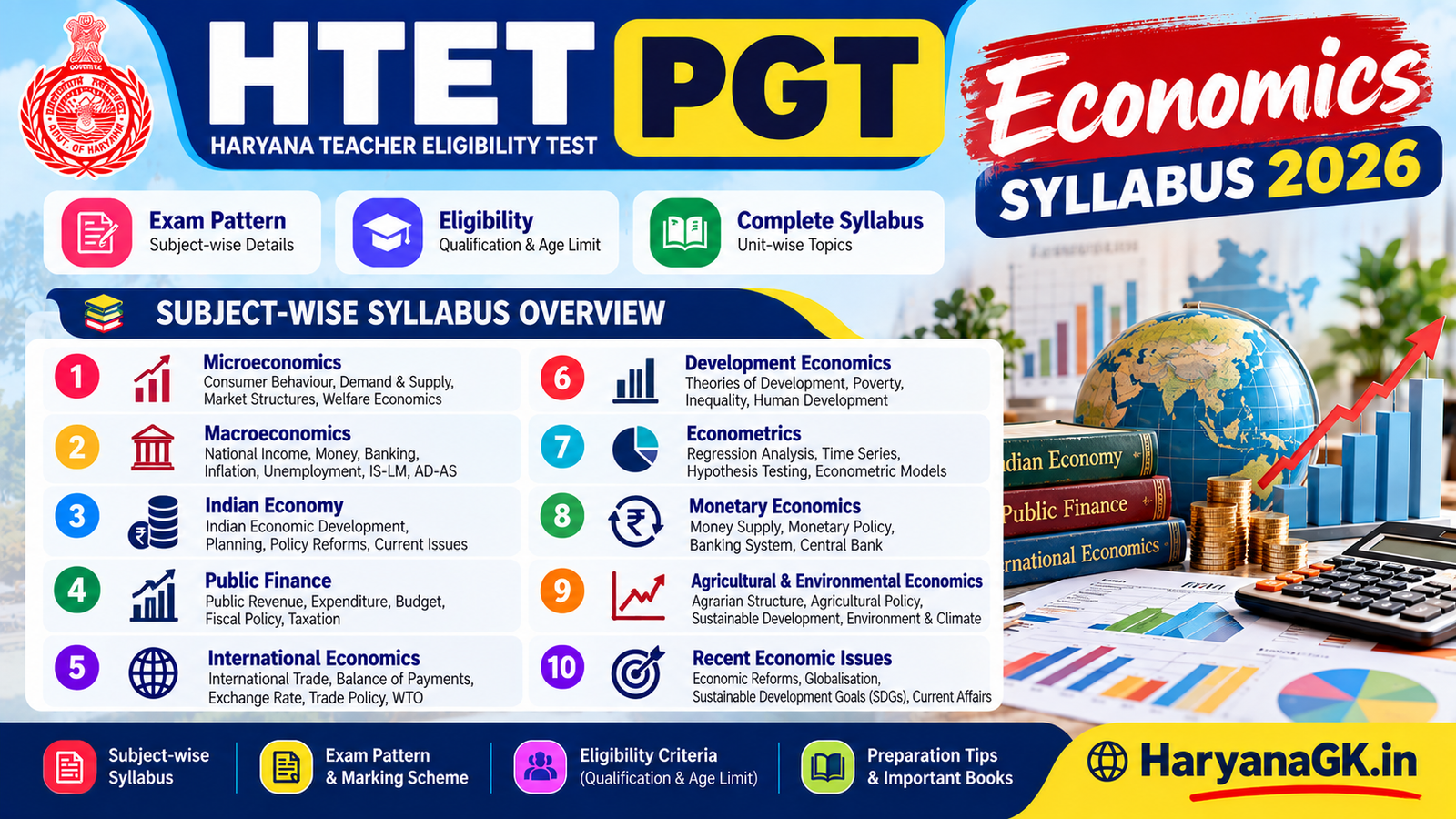
HTET PGT Economics Syllabus 2026: Subject-wise Syllabus, Exam Pattern and Eligibility
PGT Economics is arguably the most content-dense subject-specific paper in the entire HTET structure — it compresses Statistics for Economics, Indian Economic Development, Microeconomics and Macroeconomics (effectively the full Class 11-12 Economics curriculum) into one 60-mark section. Candidates who specialised in one branch during their M.A. (commonly macroeconomics or econometrics) need to budget real time for the other three, since none of them are optional here.
This guide covers the HTET PGT Economics syllabus exactly as BSEH has structured it, along with the exam weightage and the eligibility conditions for this paper.
HSSC Group D – Previous Year Solved Papers
Practice HSSC Group D previous year solved question papers, shift-wise, with instant answers and explanations after every question.
| Exam Date | Shift | Solved Paper |
|---|---|---|
| 10 November 2018 | Shift 1 | Attempt Quiz  |
| 10 November 2018 | Shift 2 | Attempt Quiz |
| 11 November 2018 | Shift 1 | Attempt Quiz |
| 11 November 2018 | Shift 2 | Attempt Quiz |
| 17 November 2018 | Shift 1 | Attempt Quiz |
| 17 November 2018 | Shift 2 | Attempt Quiz |
| 18 November 2018 | Shift 1 | Attempt Quiz |
| 21 October 2023 | Shift 1 / Morning | Attempt Quiz |
| 21 October 2023 | Shift 2 / Evening | Attempt Quiz |
| 22 October 2023 | Shift 1 / Morning | Attempt Quiz |
| 22 October 2023 | Shift 2 / Evening | Attempt Quiz |
HTET PGT Economics Exam Pattern and Weightage 2026
The paper has 150 multiple-choice questions for 150 marks, completed in two and a half hours, with one mark per question and no negative marking.
| Section | Number of MCQs | Marks |
|---|---|---|
| Child Development and Pedagogy | 30 | 30 |
| Languages (Hindi 15 + English 15) | 30 | 30 |
| General Studies (Quantitative Aptitude 10, Reasoning 10, Haryana GK 10) | 30 | 30 |
| Economics (Subject Specific) | 60 | 60 |
| Total | 150 | 150 |
Qualifying marks:
- General category candidates: 60% (90 marks)
- SC and differently-abled candidates of Haryana domicile: 55% (82 marks)
- SC and differently-abled candidates from other states: 60% (90 marks)
Topics come from the Class 9-12 syllabus prescribed by the Haryana Education Department, with the difficulty standard reaching postgraduate level.
Common Syllabus for HTET PGT (Child Development, Languages, General Studies)
These three sections are identical across every PGT subject and make up 90 of the 150 marks.
Child Development and Pedagogy
Covers the psychology of teaching and learning for the 14-17 age group, including Freud’s Psychosexual Development Theory, Erikson’s Theory of Psychosocial Development, Bandura’s Social Learning Theory, and the standard Piaget/Kohlberg/Vygotsky foundations.
Languages — Hindi and English
Each carries 15 marks: one unseen passage tested for comprehension, inference, grammar and verbal ability, combined with the pedagogy of language development.
General Studies — Haryana GK, Reasoning and Quantitative Aptitude
Haryana GK (10 marks) covers state history, current affairs, geography and welfare schemes. Reasoning (10 marks) spans verbal and non-verbal types. Quantitative Aptitude (10 marks) covers number systems, percentages, interest, mensuration and data representation.
HTET PGT Economics: Subject-Specific Syllabus
The 60-mark section spans four major areas.
Statistics for Economics
The meaning, definition, scope and central economic problem, including the Production Possibility Curve (PPC). Data collection — sources and methods, the National Sample Survey Organisation (NSSO), and the Census of India. Data presentation — geometric forms (bar and pie diagrams), frequency diagrams (histograms, polygons, ogives), and arithmetic line graphs (time series).
Measures of central tendency — arithmetic mean (simple and weighted), harmonic mean, geometric mean, median, mode, deciles, quartiles and percentiles. Measures of dispersion — range, quartile deviation, mean deviation, standard deviation, and relative dispersion. Correlation — scatter diagrams, Karl Pearson’s method, Spearman’s rank correlation, and the concurrent deviation method. Index numbers — their meaning, types, uses, the Consumer Price Index, Wholesale Price Index and AICPIN, time and factor reversal tests, and base shifting.
Indian Economic Development
The characteristics of the Indian economy before and after Independence. Economic planning — the Planning Commission, the characteristics and track record of the Five Year Plans, the Green Revolution, and NITI Aayog. New economic reforms — the New Economic Policy of 1991 and liberalisation, privatisation and globalisation (LPG).
Poverty — its types, data analysis of poverty in India, and poverty alleviation programmes. Rural development — various development programmes, agricultural credit, co-operative banks, agricultural marketing, and NABARD. Employment — types of unemployment and employment generation programmes. Infrastructure — energy, transport and communication, irrigation, health, and financial institutions. Sustainable development — its measurement and the role of the environment, including environmental pollution. GDP and national income concepts, alongside the Human Development Index (HDI), HPI and PQLI.
Microeconomics
The definitions, nature, scope and limitations of microeconomics, and the central economic problem — the PPC and its applications, capitalist, mixed and socialist economies, and opportunity cost. Consumer behaviour — cardinal and ordinal utility analysis, the budget line, indifference curves and their applications, consumer equilibrium, and the marginal rate of substitution.
Demand analysis — the law of demand, normal/inferior/Giffen goods, determinants and exceptions to the law of demand, price/income/substitution effects, and the Hicks and Slutsky theories and revealed preference approach. Elasticity of demand — its degrees, types and measurement, and the importance of price and income elasticity.
Production function — basic concepts, the law of returns to scale, the law of returns to a factor, economies and diseconomies of scale, and the marginal rate of technical substitution. Cost — classical and modern cost theory, short-run and long-run costs, and the relationships between various cost curves. Revenue — the concepts of revenue and their interrelationship.
Markets — perfect competition, the equilibrium of the firm and industry, the supply curve, market versus normal price, control versus support price, and the Food Availability Decline theory. Monopoly, monopolistic competition and oligopoly — their features, and comparisons across oligopoly and duopoly models.
Macroeconomics
The nature, scope and limitations of macroeconomics, and the distinction between stocks and flows. The circular flow of income — real and monetary flows across two-, three- and four-sector models, and withdrawals and injections. National income — the income, product and expenditure methods, national income accounting, nominal national income, real GDP, and the GNP deflator.
Money — its meaning, the concept of near-money, the functions of money, money supply and its determinants, the RBI’s role in controlling money supply, the functions of commercial and central banks, and credit creation. The determination of output and employment — AD-AS analysis, MPC, APC, APS, MPS, MEC, supply price, prospective yield, and the classical versus Keynesian approaches to employment and the consumption hypothesis.
Investment multipliers — their meaning, the relationship between MPC and the multiplier, and static versus dynamic multipliers. Deficient and excess demand — the inflationary gap and the roles of monetary, fiscal and foreign trade policy in managing it. Government budgets — their objectives and structure, budget receipts (tax and non-tax), budget expenditure, and budget deficits — their meaning, types and measurement.
Foreign exchange rates — their meaning, types and the theories explaining them. The Balance of Payments — its components, disequilibrium and methods to correct it, and the Balance of Trade — plus subject-related pedagogy.
Given that this syllabus genuinely spans four distinct branches of Economics as separate university-level subjects, it’s worth treating Statistics, Indian Economic Development, Microeconomics and Macroeconomics as four independent revision projects with their own timelines — rather than one combined “Economics” pass, which almost guarantees uneven coverage.
Visit bseh.org.in or htet.eapplynow.com for official Notification & Syllabus 2026
Who Is Eligible for HTET PGT Economics? Qualification Details
You need to satisfy all of the following:
- M.A. in Economics, Applied Economics or Business Economics, with at least 50% marks, along with a B.Ed. from a recognised university.
- Matric with Hindi or Sanskrit as a subject, or Senior Secondary/Graduation/Post Graduation with Hindi as one of the subjects.
- A consistent good academic record.
Worth noting: Applied Economics and Business Economics are explicitly accepted for PGT Economics — the opposite of PGT Commerce, which specifically excludes those same two specialisations. Candidates with either degree should apply for Economics, not Commerce.
What counts as “Good Academic Record”
For direct recruitment, “Good Academic Record” means averaging at least 50% marks across any three of your 10th, 12th, Graduation and Post-Graduation results — but you must separately have at least 50% marks in your Post-Graduation itself.
Relaxation for SC, BC and differently-abled candidates
Where the minimum qualifying mark is 50%, SC, BC and differently-abled candidates get a 5% relaxation, bringing it to 47.5%. Where the minimum is 45%, the relaxed figure is 42.75%, per the Supreme Court’s 2011 ruling in P.V. Indiresan vs Union of India.
A qualification detail worth checking twice
Only a B.Ed. recognised by the National Council for Teacher Education (NCTE) counts. For the B.Ed. (Special Education) route specifically, the course needs recognition from the Rehabilitation Council of India (RCI) instead.
Quizzes (Subject Wise)
Practice free HTET-pattern MCQ quizzes, subject by subject. Pick a subject below to start.
| Subject | Quiz |
|---|---|
| Haryana GK | Haryana GK HTET Online Quiz  |
| Math | Math Quiz – TGT/PGT HTET |
| Reasoning | Reasoning Quiz – HTET |
| English Grammar | English Grammar Quiz –1 |
| Hindi Grammar | Hindi Grammar Quiz – 15 Difficult Questions |
| Psychology | Psychology HTET PGT Quiz |
| Computer Science | Computer Science Practice Set |
| Child Development & Pedagogy | CDP Practice Set |
Frequently Asked Questions
Can an M.A. in Applied Economics or Business Economics apply for PGT Economics?
Yes — both are explicitly accepted alongside a standard M.A. Economics. This is the reverse of PGT Commerce, which specifically excludes these two specialisations.
Does PGT Economics cover both Microeconomics and Macroeconomics in equal depth?
Yes, both form substantial, independently detailed sections — Microeconomics through consumer behaviour, production and market structures, and Macroeconomics through national income, money supply and fiscal/monetary policy.
Is the Statistics for Economics portion mathematically demanding?
It covers standard descriptive statistics (central tendency, dispersion, correlation, index numbers) rather than advanced econometrics, but candidates should still be comfortable with the formulas and interpretation behind each measure.
How current does my Indian Economic Development knowledge need to be?
Fairly current — the syllabus explicitly includes NITI Aayog (which replaced the Planning Commission) and recent development programmes, so preparation should reflect current institutional names and policy frameworks, not just historical Five Year Plan data.
Given that this syllabus effectively asks you to be exam-ready across four separate branches of Economics, start early and track your progress branch by branch — Statistics, Indian Economic Development, Microeconomics and Macroeconomics — so you can spot and correct an imbalance in your preparation well before the exam.