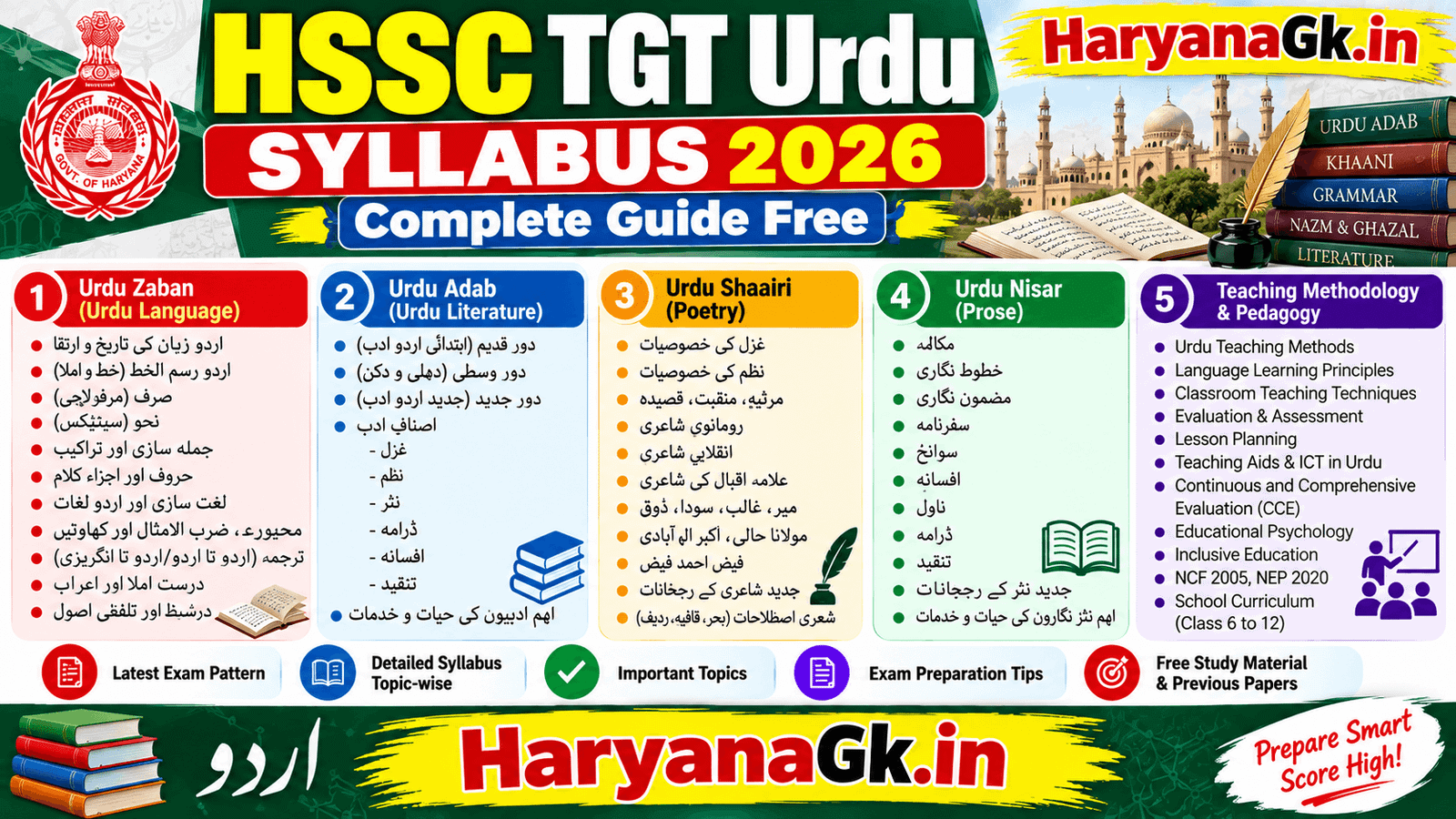
The HSSC TGT Urdu Syllabus 2026 covers recruitment for TGT Urdu posts under the Haryana Staff Selection Commission. This HSSC TGT Urdu Syllabus guide breaks down the exam pattern and the full subject-wise topic list, straight from the official syllabus published at hssc.gov.in, so you know exactly what to study before you open a single PDF.
HSSC TGT Urdu Syllabus Exam Pattern
यह भर्ती HSSC की दो-चरण प्रक्रिया से होती है: पहले साझा पात्रता परीक्षा (CET), फिर इस पद की लिखित परीक्षा, जिसका सिलेबस नीचे दिया है। CET का पूरा पैटर्न हमारे HSSC गाइड में है।
The HSSC TGT Urdu syllabus for the written exam splits into weighted parts:
- ENVIRONMENTAL AWARENESS — 10% weightage
- Haryana General Knowledge and Welfare schemes of the Haryana Government — 20% weightage
- Road Safety Awareness — 5% weightage
- Perspectives on Education and Leadership — 15% weightage
- URDU Language — 50% weightage
- Parts: 1. 2. 3 — 45% weightage
HSSC notes on the official document that this weightage is tentative and may vary, so treat it as a study-time guide rather than a locked question count.
HSSC TGT Urdu Syllabus 2026 (Subject-Wise)
The subject-specific block of the HSSC TGT Urdu syllabus spans the following areas. Here is the complete breakdown.
1. ENVIRONMENTAL AWARENESS
Introduction: Basics of ecology, ecosystem concept, and sustainable development; sources, advantages, and disadvantages of renewable and non-renewable energy, Rainwater harvesting, deforestation – its effects & control measures. (Weightage 10%)
Air and Noise Pollution:
Air Pollution: Source of air pollution. Effect of air pollution on human health, economy, Air pollution control methods, Noise Pollution: Source of noise pollution, Unit of noise, Effect of noise pollution, Acceptable noise level, Different methods of minimising noise pollution.
Water and Soil Pollution:
Water Pollution: Impurities in water, Cause of water pollution, Source of water pollution. Effect of water pollution on human health, Concept of DO, BOD, and COD. Prevention of water pollution- Water treatment processes, sewage treatment. Water quality standard,
Soil Pollution: Sources of soil pollution, Effects and Control of soil pollution, Types of Solid Waste – Household, Industrial, Agricultural, Biomedical, Disposal of Solid Waste, Solid Waste Management, E-waste, and E-waste Management. Impact of Energy Usage on the Environment: Global Warming, Greenhouse Effect, Depletion of Ozone Layer, Acid Rain. Eco-friendly material, recycling of material, concept of green buildings, concept of carbon credit & carbon footprint.
2. Haryana General Knowledge and Welfare schemes of the Haryana Government.
(Weightage 20%) Haryana history, current affairs, literature, geography, civics, environment, culture, etc., and welfare schemes run by the state government of Haryana and provisions there-in.
3. Road Safety Awareness
(Weightage 5%) Traffic Rules, importance of traffic rules, authority to implement traffic rules, punishment for violating traffic rules, authority to issue driving licences, procedure to get driving licences, classification of vehicles, traffic signs, knowledge of safety measures in vehicles.
4. Perspectives on Education and Leadership (Weightage 15%)
(a) Understanding the learner concept of growth, maturation and development; principles and debates of development; development tasks and challenges; domains of development: physical, cognitive, socio-emotional, moral, etc.; deviations in development and its implications; understanding adolescence: needs, challenges and implications for designing institutional support; role of primary and secondary socialisation agencies. Ensuring homeschool continuity.
(b) Understanding Teaching Learning Theoretical perspectives on Learning – Behaviourism, Cognitivism and Constructivism with special reference to their implications for: (i) The role of teacher (ii) The role of learner (iii) Nature of teacher-student relationship (iv) Choice of teaching methods (v) Classroom environment (vi) Understanding of discipline, power, etc.
Factors affecting learning and their implications for: (i) Designing classroom instructions, (ii) planning student activities and (iii) creating learning spaces in school. Planning and Organisation of Teaching-Learning; e-Perspectives in Education,
NEP-2020: Early Childhood Care and Education: The Foundation of Learning; Foundational Literacy and Numeracy; Curriculum and Pedagogy in Schools: Holistic & Integrated Learning; Equitable and Inclusive Education: Learning for All; Competency-based Learning and Education. Guiding Principles for Child Rights, Protecting and Provisioning for Rights of Children to Safe and Secure School Environment, Right of Children to Free and Compulsory Education Act, 2009, Historically studying the National Policies in Education with special reference to school education;
School Curriculum Principles: Perspective, Learning and Knowledge, Curricular Areas, School Stages Pedagogy & Assessment, (i) Concept of Syllabus and Curriculum, Overt and Hidden Curriculum (ii) Foundational Literacy and Numeracy, Early Childhood Care and Education (iii) Competency-based education, experiential learning, etc. (iv) Instructional Plans: -Year Plan, Unit Plan, Lesson Plan (v) Instructional material and resources (vi) Information and Communication Technology (ICT) for teaching-learning (vii) Assessment of learning, for learning and as learning: Meaning, purpose and considerations in planning each.
Enhancing Teaching and Learning Processes: Classroom Observation and Feedback, Reflections and Dialogues as a Means of Constructivist Teaching. (c) Creating a Conducive Learning Environment The concepts of diversity, disability and inclusion; the implications of disability as a social construct; types of disabilities – their identification and interventions; the concept of school mental health; and addressing the curative, preventive and promotive dimensions of mental health for all students and staff. Provisioning for guidance and counselling, developing school and community as learning resources. (d) School Organisation and Leadership: The leader is a reflective practitioner, team builder, initiator, coach, and mentor.
Perspectives on School Leadership: instructional, distributed, and transformative; vision building; goal setting and creating a school development plan; using school processes and forums for strengthening teaching and learning; the annual calendar; time-tabling; parent-teacher forums; school assembly; teacher development forums; using achievement data for improving teaching and learning; school self-assessment and improvement; and creating partnerships with community, industry, and other neighbouring schools and higher education institutes – forming learning communities. (e) Perspectives in Education NEP-2020: Early Childhood Care and Education: The Foundation of Learning; Foundational Literacy and Numeracy;
Curriculum and Pedagogy in Schools: Holistic & Integrated Learning; Equitable and Inclusive Education: Learning for All; Competency-based Learning and Education, Guiding Principles for Child Rights, Protecting and Provisioning for Rights of Children to Safe and Secure School Environment, Right of Children to Free and Compulsory Education Act, 2009, Historically studying the National Policies in Education with special reference to school education; School Curriculum Principles: Perspective, Learning and Knowledge, Curricular Areas, School Stages – Pedagogy & Assessment
URDU Language
(Weightage 50%) Parts: 1. 45%. 2. 15%. 3. 10%
Part One.
KNOWLEDGE OF SECONDARY AND SENIOR SECONDARY STANDARD ABOUT “URDU” SUBJECT 1- PROSE SECTION) حصہنثر (اسباق پر مبنیسوالات
- (A) – الف
- مصنفاق بالمجيد “سكونكينيند” #
- “Sukoon Ki Neend” Musannif: Iqbal Majeed.
- مصنف کنہیا لالکپور “غالب جديد شعراء کی مجلسمیں” #
- “Ghalib Jadeed Shuara Ki Majlis Me” Musannif: Kanhaiyya Lal Kapoor.
- مصنفا حمد جمال پاشا “كليما لدينا حمد کا خاكه” #
- “Kaleemuddin Ahmad Ka Khaka” Musannif: Ahmad Jamal Pasha.
- ب – ) B(
- مصنفیطر سبخاری سویرے جو کلانکه میریکھلی” #
- “Sawere Jo Kal Aankh Meri Khuli” Musannif: Patras Bukhari.
- مصنفہ عصمت چغتائی چوتھیکا جوڑا ” #
- “Chothi Ka Joda” Musannifa: Asmat Chughtai.
- ج – )C(
- مصنف منشی پریم چند “قولکا پاس” #
- “Qaul Ka Paas” Musannif: Munshi Premchand.
- مصنفر تنسنگھ کا ٹھکا گھوڑا ” #
- “Kaath Ka Ghoda” Musannif: Ratan Singh.
- مصنف حبيبتنوير “كارتوس” #
- “Kaartoos” Musannif: Habib Tanweer.
- د )D(
- مصنف میر باقر علید بلوی بہادر شاهکاباتهی ” #
- “Bahadur Shah Ka Hathi” Musannif: Meer Baqir Ali.
- مصنف فرحتکاکوری ” کہاوتونکیکهانی ” #
- “Kahawaton Ki Kahani” Musannif: Farhat Kakori.
2- POETRY SECTION) حصہ نظم ( منظومات پر مبنیسوالات
- (A) – الف
- جانثار اختر کی غزل “جبلگینز خمتوقاتلكود عاديجان” #
- “Jab Lagen Zakhm To Qatil Ko Dua Di Jae” Janisar Akhtar Ki Ghazal
- نظم طبا طبائیكینظم “گور غریباں” #
- “Gor-e-Ghareeban” Nazam Tabatabai Ki Nazm.
- فاطمہ شعر یکی نظم “یادنگر” #
- “Yaad Nagar” Fatima Shoora Ki Nazm.
- ب) B(
- خواجہ میر درد کی غزل “سماكها نتريو سعتكو باسکین و ارض” #
- “Arzo Sama Kahan Teri Wusat Ko Pasaken” Khawaja Meer Dard Ki Ghazal
- علامها قبالكينظم “شعا عاميد” #
- “Shuaa-e-Umeed” Allama Iqbal Ki Nazm.
- ج C(
- نظیر اکبر آبادی کی نظم “نیکی و ریدی” #
- “Naiki Or Badi” Nazeer Akbarabadi Ki Nazm.
- میرتقی میر کی غزل ہستیاپنی حباب کیسی ہی ” #
- “Hasti Apni Hubaab Kisi Hai” Meer Taqi Meer Ki Ghazal.
- د )D(
- تلوک چند محرو مکینظم “ہندو مسلمان” #
- “Hindu Musalman” Tilok Chand Mehroom Ki Nazm.
- اختر شیرانیکا گیت ایکدیها تیلز کیکا گیت” #
- “Ek Dehati Ladki Ka Geet” by Akhtar Sheerani.
3- قواعد Qawaid (
- فعلاورانکے کے اقسام، صفت، ضمیر، اسم #
- Ism, Zameer, Sifat, Feal, or Unke Aqsaam.
- سابق لاحقے، رموز اوقاف، سكنات و حرکات، حروف #
- Huroof, Harakaat o Sakanaat, Rumooz-e-Auqaaf, Sabiqe Lahiqe.
- مترادفا تا ور متضاد، واحد جمع، جنس، الفاظمعنى #
- Alfaz Maana, Jins, Wahid Jama, Mutaradifaat or Mutazaad.
- محاورے اور کہاوتیں #
- Muhawre or Kahawaten.
Part Two
KNOWLEDGE OF GRADUATION STANDARD ABOUT THE “URDU” SUBJECT.
- ارتقاء اور مختلفنا ولنگار اور ناولونکا تنقیدی جائزه و اردو میننا ولنگاری کا آغاز #
- ) پریم چند، مرزا با دیر سوا، ڈپٹینظیر احمد)
- Urdu Me Novelnigari Ka Aagaz o Irtiqa or Mukhtalif Novelnigar or Novelon ka Tanqeedi Jaaizah (Deputy Nazeer Ahmad, Mirza Hadi Ruswa, Prem Chand).
- ارتقاء اور مختلف فسانہا ور افسانہنگارو نکا تنقیدی مطالعه و اردو مینا فسانہ نگاری کا آغاز #
- احمد ندیم قاسمی، منٹو، راجند سنگهبیدی، پریمچند)
- Urdu Me Afsaananigari Ka Aagaaz o Irtiqa or Mukhtalif Afsaana or Afsaananigarin ka Tanqeedi Mutaala (Premchand, Rajender Singh Bedi, Manto, Ahmad Nadeem Qaasmi).
- اردو مینانشائیہنگاریکیروایت #
- رشید احمد صدیقی، پطرس بخاری، محمد حسین آزاد)
- Urdu Me Inshaiyanigari Ki Riwayat (Muhammad Hussain Azad, Patras Bukhari, Rasheed Ahmad Siddiqi)
- خودنویشتکیروایت و اردو مینسوانحنگاری #
- Urdu Me Sawaneh nigari or Khudnaweesht Ki Riwayat.
- ارتقاء و اردو زبان کا آغاز #
- Urdu Zubaan Ka Aaghaz o Irtiqa.
- اردو کے مختلف بستانونكا تنقیدی جائزه #
- Urdu Ke Mukhtalif Dabistaano Ka Tanqeedi Jaaizah.
- تعریف نثر یا صنفک اقسامو #
- Nasri Asnaaf Ke Aqsaam o Taareef.
- کا مطالعه “باغوبهار” کتاب #
- Kitaab “BAGH O BAHAAR” Ka Mutaala.
- نظم کے اصناف کی تعریف #
- Nazm Ke Asnaaf Ki Taareef.
- بيتغزل اور مقطعكي تعريف، حسن مطلع، مطلع ردیف، قافيه، شعر، مصرعه #
- Misra, Sher, Qafiya, Radeef, Matla, Husn e Matla, Bait e Ghazal or Maqta Ki Taareef.
- تلميحاور تجاہل عارفانہ صنعتو نپر مبنیسوالات، حسنتعليل، مبالغهتضاد، استعاره، تشبيه #
- Tashbeeh, Istiaara, Mubalagha, Tazaad, Husn e Taaleel, Talmeeh or Tajahul e Aarifana Sanaton Par Mabni Sawalat.
Part Three
TEACHING METHODS OF THE “URDU” SUBJECT
- اردو تدریس کی ضرورت اور اسکے مقاصد #
- Urdu Tadrees Ki Zaroorat Or Uske Maqaasid
- بهترینار د و مدرسکی خصوصیات #
- Behtreen Urdu Mudarris Ki Khusoosiyaat
- نظمونثر کے مختلف تدریسی طریقے #
- Nazm o Nasr Ke Mukhtalif Tadreesi Tareeqe.
- زبان کی چارو نمہارتون کا جائزہ اردو #
- Urdu Zubaan Ki Charon Maharaton Ka Jaaiza.
- اردو پڑھنا سکھانے کے طریقے #
- Urdu Padhna Sikhane Ke Tareeqe
- اردو لکھنا سکھانے کے طریقے #
- Urdu Likhna Sikhane Ke Tareeqe.
Important Note: The weightage as mentioned against the syllabus is tentative & may vary.
HSSC TGT उर्दू की तैयारी: भाषा-भाग और साझा खंड
HSSC TGT की लिखित परीक्षा में आपका विषय 50% वेटेज रखता है, पर बाकी 50% — पर्यावरण जागरूकता (10%), हरियाणा GK व सरकारी कल्याण योजनाएँ (20%), सड़क सुरक्षा (5%) और शिक्षा व नेतृत्व के परिप्रेक्ष्य (15%) — सभी TGT विषयों में समान है। कई उम्मीदवार विषय पर पूरा ज़ोर देकर यही 50% हल्के में ले लेते हैं, जबकि यहाँ के प्रश्न अपेक्षाकृत सीधे होते हैं।
उर्दू वाले भाग में भाषा, साहित्य और व्याकरण के प्रश्न आते हैं। इसका सबसे अच्छा आधार NCERT की उर्दू पाठ्य-पुस्तकें हैं, क्योंकि HSSC TGT का स्तर कक्षा 6 से 10 के आसपास रहता है।
- नज़्म, ग़ज़ल, मसनवी जैसी विधाओं की परिभाषाएँ और प्रमुख शायरों के नाम एक सूची में रखें।
- क़वायद (व्याकरण) — इस्म, फ़ेल, सिफ़त, मुहावरे — का रोज़ थोड़ा अभ्यास करें।
- हरियाणा GK और सरकारी योजनाओं के लिए राज्य सरकार की आधिकारिक वेबसाइट की “योजनाएँ” सूची देखें।
- सड़क सुरक्षा और पर्यावरण वाले खंड छोटे हैं; इन्हें परीक्षा से दो सप्ताह पहले एक बार पूरा दोहराएँ।
आधिकारिक स्रोत
इस पेज का सिलेबस हरियाणा कर्मचारी चयन आयोग (HSSC) के आधिकारिक दस्तावेज़ से लिया गया है। ताज़ा संस्करण और भर्ती सूचनाएँ hssc.gov.in/examsyllabus पर देखें।
दूसरे सभी HSSC पदों के सिलेबस और भर्ती प्रक्रिया हमारे HSSC गाइड पेज पर एक जगह दिए गए हैं।