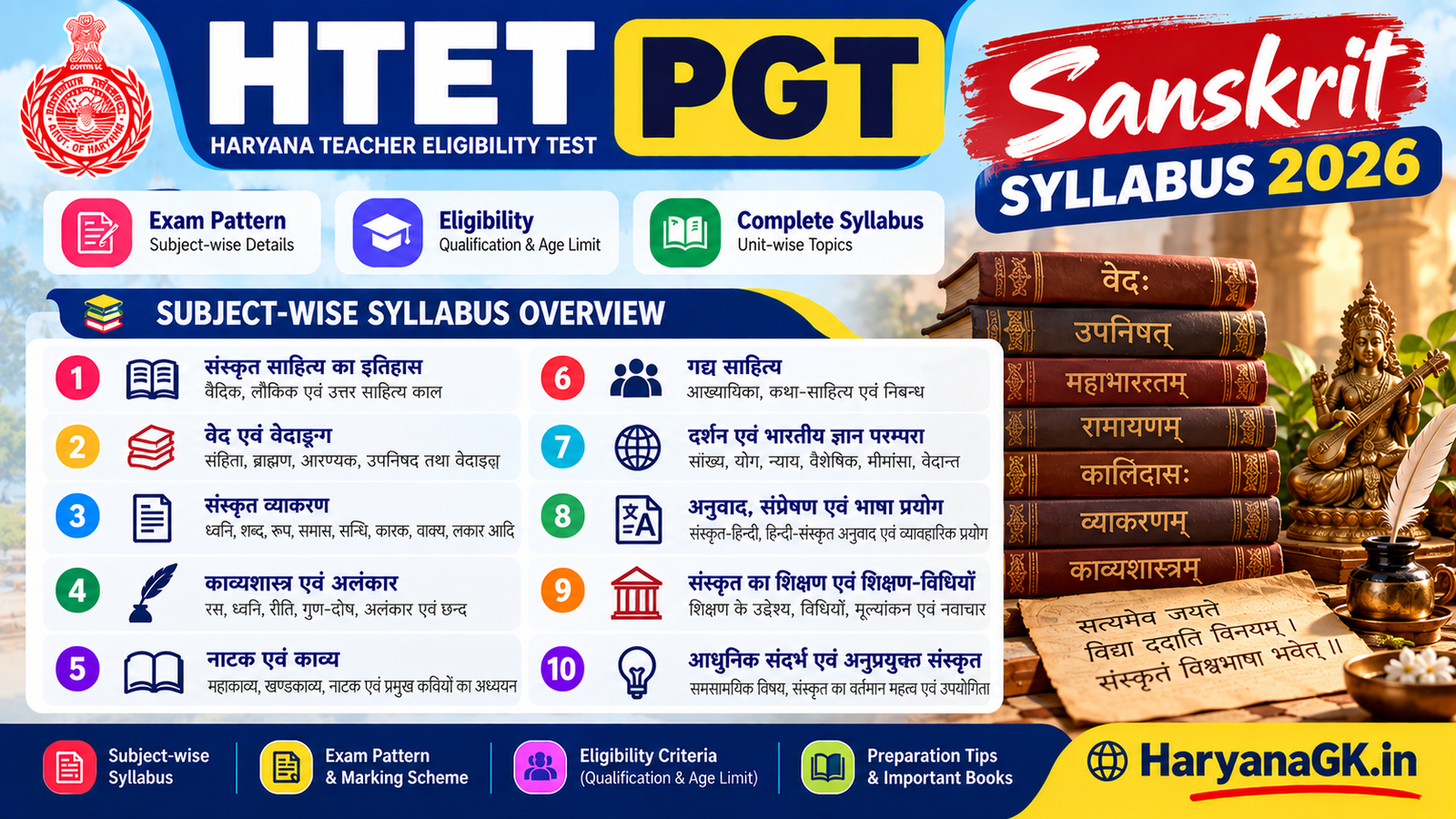
HTET PGT Sanskrit Syllabus 2026 Subject-wise Syllabus, Exam Pattern and Eligibility
An extensive Sanskrit literature history section covering all four Vedas, the major Upanishads and Puranas, and a list of approximately 35 classical works by name, ranging from the Ramayana and Mahabharata to Kalidasa’s plays and Vishakhadatta’s Mudrarakshasa make PGT Sanskrit the most text-dense subject-specific syllabus in the entire HTET structure. This is in addition to the sutra-based grammar that TGT Sanskrit already requires.
This guide covers the HTET PGT Sanskrit syllabus exactly as BSEH has structured it, along with the exam weightage and the eligibility conditions for this paper.
| HTET Previous Year Exam Papers with Answer Keys | ||
| Sr No. | Year of Exam | Download Link |
| 1 | 2024 | Download PDFs.  |
| 2 | 2023 | Download PDFs. |
| 3 | 2022 | Download PDFs. |
| 4 | 2021 | Download PDFs. |
| 5 | 2020 | Download PDFs. |
| 6 | 2019 | Download PDFs. |
HTET PGT Sanskrit Exam Pattern and Weightage 2026
The paper has 150 multiple-choice questions for 150 marks, completed in two and a half hours, with one mark per question and no negative marking.
| Section | Number of MCQs | Marks |
|---|---|---|
| Child Development and Pedagogy | 30 | 30 |
| Languages (Hindi 15 + English 15) | 30 | 30 |
| General Studies (Quantitative Aptitude 10, Reasoning 10, Haryana GK 10) | 30 | 30 |
| Sanskrit (Subject Specific) | 60 | 60 |
| Total | 150 | 150 |
Qualifying marks:
- General category candidates: 60% (90 marks)
- SC and differently-abled candidates of Haryana domicile: 55% (82 marks)
- SC and differently-abled candidates from other states: 60% (90 marks)
Topics are from the Class 9-12 syllabus prescribed by the Haryana Education Department, with the difficulty standard reaching postgraduate level.
Common Syllabus for HTET PGT (Child Development, Languages, General Studies)
These three sections are identical across every PGT subject and make up 90 of the 150 marks.
Child Development and Pedagogy
Covers the psychology of teaching and learning for the 14-17 age group, including Freud’s psychosexual development theory, Erikson’s theory of psychosocial development, Bandura’s social learning theory, and the standard Piaget/Kohlberg/Vygotsky foundations.
Languages — Hindi and English
Each carries 15 marks: one unseen passage is tested for comprehension, inference, grammar and verbal ability, combined with the pedagogy of language development.
General Studies — Haryana GK, Reasoning and Quantitative Aptitude
Haryana GK (10 marks) covers state history, current affairs, geography and welfare schemes. Reasoning (10 marks) spans verbal and non-verbal types. Quantitative Aptitude (10 marks) covers number systems, percentages, interest, mensuration and data representation.
HTET PGT Sanskrit: Subject-Specific Syllabus
BSEH draws passage-based questions from four prescribed books — शेमुषी भाग 1 and 2, and शाश्वती भाग 1 and 2 — and organises the rest of the paper into three formal parts.
प्रथमो भागः (Part One) — Grammar Foundations
Questions on संज्ञा प्रकरण (technical-term grammar): इत्संज्ञा, प्रत्याहारसंज्ञा, उदात्त, अनुदात्त, स्वरित, संयोगसंज्ञा, सवर्णसंज्ञा, उच्चारणस्थानानि and प्रयत्नानि.
संधि questions reference named sutras — इको यणचि, अकः सवर्णे दीर्घः, आद्गुणः, वृद्धिरेचि, लोपः शाकल्यस्य, स्तोः श्चुना श्चुः, झलां जशोऽन्ते, विसर्जनीयस्य सः, ससजुषो रुः — covering both sandhi formation and its reverse breakdown. समासाः are tested per मध्यसिद्धान्तकौमुदी: केवलसमासः, अव्ययीभावसमासः, तत्पुरुषः, कर्मधारयः, द्विगुः, द्वन्द्वः and बहुव्रीहिः, including both compound formation and विग्रह (decomposition).
द्वितीयो भागः (Part Two) — Declensions, Conjugations and Karaka
शब्दरूप (noun declension) questions cover a specific named list of nominal stems across all three genders — कृष्ण, रमा, हरि, मति, पति, सखिन्, गुरु, वधू, आत्मन्, नदी, लक्ष्मी, धेनु, मातृ, पितृ, वारि, दधि, मधु, राजन्, मनस्, सर्व, तत्, एतत्, इदम्, अस्मद् and युष्मद्.
धातुरूप (verb conjugation) questions cover forms across the ten lakaras (tenses/moods) for specific named roots, split by पद (voice): परस्मैपदी roots (भू, पठ्, अस्, कृ, ज्ञा, शक्, पा, हन्, लिख्, चिन्त्), आत्मनेपदी roots (एध्, सेव्, लभ्, रुच्, मुद्, याच्), and उभयपदी roots (कृ, पच्, मन्).
प्रत्यय questions cover पूर्वकृदन्त, उत्तरकृदन्त, तद्धित and स्त्रीलिङ्ग प्रत्यय, referenced to मध्यसिद्धान्तकौमुदी sutras — an extensive list including क्त, क्तवतु, शतृ, शानच्, तव्यत्, अनीयर्, क्यप्, ण्यत्, क्त्वा, ल्यप्, तुमुन्, घञ्, मतुप्, टाप् and dozens more. This part closes with कारकप्रकरण (the karaka/case system) based on सिद्धान्तकौमुदी.
तृतीयो भागः (Part Three) — Chhandas, Alankara, Error Correction and Literary History
छन्दांसि: अनुष्टुप्, आर्या, इन्द्रवज्रा, उपजाति, वंशस्थम्, द्रुतविलम्बितम्, वसन्ततिलका, मालिनी, स्रग्धरा, शार्दूलविक्रीडितम्, शिखरिणी and मन्दाक्रान्ता — a longer list than TGT Sanskrit’s, adding आर्या and स्रग्धरा.
अलङ्काराः अनुप्रासः, यमकम्, श्लेषः, उपमा, अर्थान्तरन्यासः, उत्प्रेक्षा, अतिशयोक्तिः, दृष्टान्तः, सन्देहः, भ्रान्तिमान् and निदर्शना. This part also includes error correction in sentences built on कारक, प्रत्यय and समास, along with उपसर्ग, प्रत्यय, अव्यय, विशेषण-विशेष्य, and विलोम/पर्याय पद questions.
The literary history component is substantial and split in two:
वैदिकसाहित्यम् (Vedic literature)—a general introduction to all four Vedas (ऋग्वेदः, यजुर्वेदः, सामवेदः, अथर्ववेदः); named सूक्तानि (hymns) including अग्निः, पुरुषः, हिरण्यगर्भः, इन्द्रः, भूमिः and प्रजापतिः; संवादसूक्तानि (dialogue hymns) such as the यम-यमी, पुरुरवा-उर्वशी and शरमा-पणि dialogues and the शुनःशेप आख्यान; the eight named पुराणानि (अग्नि, ब्रह्म, विष्णु, वायु, पद्म, भागवत, स्कन्द, भविष्य); the eight named उपनिषदः (ईश, कठ, केन, बृहदारण्यक, तैत्तिरीय, मुण्डक, माण्डूक्य, श्वेताश्वेतर); and the six वेदाङ्गानि (शिक्षा, कल्पः, व्याकरणम्, ज्योतिषः, छन्दः, निरुक्तम्).
लौकिकसाहित्यम् (classical literature) — around 35 named classical works, including रामायणम्, महाभारतम्, श्रीमद्भगवद्गीता, Kalidasa’s अभिज्ञानशाकुन्तलम्, रघुवंशम् and कुमारसम्भवम्, Ashvaghosha’s बुद्धचरितम् and सौन्दरानन्दम्, Bharavi’s किरातार्जुनीयम्, Magha’s शिशुपालवधम्, Sriharsha’s नैषधीयचरितम्, Banabhatta’s कादम्बरी and हर्षचरितम्, Kalidasa’s मेघदूतम्, Jayadeva’s गीतगोविन्दम्, Dandin’s दशकुमारचरितम्, and dramas including Bhavabhuti’s उत्तररामचरितम्, Vishakhadatta’s मुद्राराक्षसम्, Bhasa’s स्वप्नवासवदत्तम् and Harsha’s रत्नावली and प्रियदर्शिका, alongside the story collections हितोपदेशः, पञ्चतन्त्रम् and कथासरित्सागरः. It closes with आधुनिकसंस्कृतकवयः (modern Sanskrit poets) — देवर्षिः कलानाथशास्त्री, भट्ट मथुरानाथशास्त्री, पं. पद्मशास्त्री and डॉ. प्रभाकरशास्त्री.
Given how much of Part Three is a named list — specific hymns, Puranas, Upanishads and roughly 35 classical texts — building a simple reference table (work, author, genre) will do more for your score than trying to memorise the list as continuous prose. Parts One and Two remain heavily sutra-dependent, so मध्यसिद्धान्तकौमुदी and सिद्धान्तकौमुदी should stay your primary grammar references, the same as at the TGT level.
Visit bseh.org.in or htet.eapplynow.com for official Notification & Syllabus 2026
Who Is Eligible for HTET PGT Sanskrit? Qualification Details
You need to satisfy all of the following:
- M.A. Sanskrit or Acharya with at least 50% marks from a recognised university, along with B.Ed. or Shiksha Shastri or a Language Teachers Course (L.T.C.)/Oriental Training (O.T.) in Sanskrit from a recognised university, conducted by the Haryana Education Department, or an equivalent qualification recognised by the Haryana Education Department.
- Matriculated with Hindi or Sanskrit as a subject, or senior secondary/graduation/post-graduation with Hindi as one of the subjects.
- A consistent good academic record.
As with TGT Sanskrit, the Acharya-plus-Shiksha Shastri route exists alongside the standard M.A.-plus-B.Ed. route, not instead of it — both qualify equally.
What counts as a “Good Academic Record”?
For direct recruitment, “Good Academic Record” means averaging at least 50% marks across any three of your 10th, 12th, Graduation and Post-Graduation results — but you must separately have at least 50% marks in your Post-Graduation itself.
Relaxation for SC, BC and differently-abled candidates
Where the minimum qualifying mark is 50%, SC, BC and differently-abled candidates get a 5% relaxation, bringing it down to 47.5%. Where the minimum is 45%, the relaxed figure is 42.75%, per the Supreme Court’s 2011 ruling in P.V. Indiresan vs Union of India.
A qualification detail worth checking twice
Only a B.Ed. recognised by the National Council for Teacher Education (NCTE) counts, except for the Shiksha Shastri/L.T.C./O.T. route, which needs to be either conducted by the Haryana Government or formally recognised as equivalent by the Haryana Education Department.
HSSC Group D – Previous Year Solved Papers
Practice HSSC Group D previous year solved question papers, shift-wise, with instant answers and explanations after every question.
| Exam Date | Shift | Solved Paper |
|---|---|---|
| 10 November 2018 | Shift 1 | Attempt Quiz  |
| 10 November 2018 | Shift 2 | Attempt Quiz |
| 11 November 2018 | Shift 1 | Attempt Quiz |
| 11 November 2018 | Shift 2 | Attempt Quiz |
| 17 November 2018 | Shift 1 | Attempt Quiz |
| 17 November 2018 | Shift 2 | Attempt Quiz |
| 18 November 2018 | Shift 1 | Attempt Quiz |
| 21 October 2023 | Shift 1 / Morning | Attempt Quiz |
| 21 October 2023 | Shift 2 / Evening | Attempt Quiz |
| 22 October 2023 | Shift 1 / Morning | Attempt Quiz |
| 22 October 2023 | Shift 2 / Evening | Attempt Quiz |
Frequently Asked Questions
Which textbooks does BSEH use to set PGT Sanskrit passage questions from?
शेमुषी भाग 1 and 2, and शाश्वती भाग 1 and 2 — a different pair of books from TGT Sanskrit’s रुचिरा and शेमुषी series, reflecting the senior-secondary level.
Does the PGT Sanskrit test specific verb and noun forms or just grammar rules in general?
Specific named forms. The syllabus lists particular noun stems (like हरि, नदी, राजन्) for declension practice and particular verb roots (like भू, पठ्, कृ) across all ten lakaras, split by परस्मैपदी, आत्मनेपदी and उभयपदी voice.
Is Vedic literature tested as seriously as classical Sanskrit literature?
Yes — both वैदिकसाहित्यम् and लौकिकसाहित्यम् are explicitly named sub-sections within the literary history component, with the Vedic section covering all four Vedas, named hymns, Puranas, Upanishads and Vedangas.
Can an Acharya degree substitute for an M.A. in Sanskrit?
Yes, BSEH’s eligibility wording explicitly accepts “M.A. Sanskrit/Acharya” as equivalent routes, provided the accompanying teacher-training qualification condition is also met.
Given this syllabus names roughly 35 classical works plus the full Vedic canon by title, start your literary-history preparation early and build it as a running reference list — author, genre, and one identifying fact per work — rather than leaving it for a final revision pass.