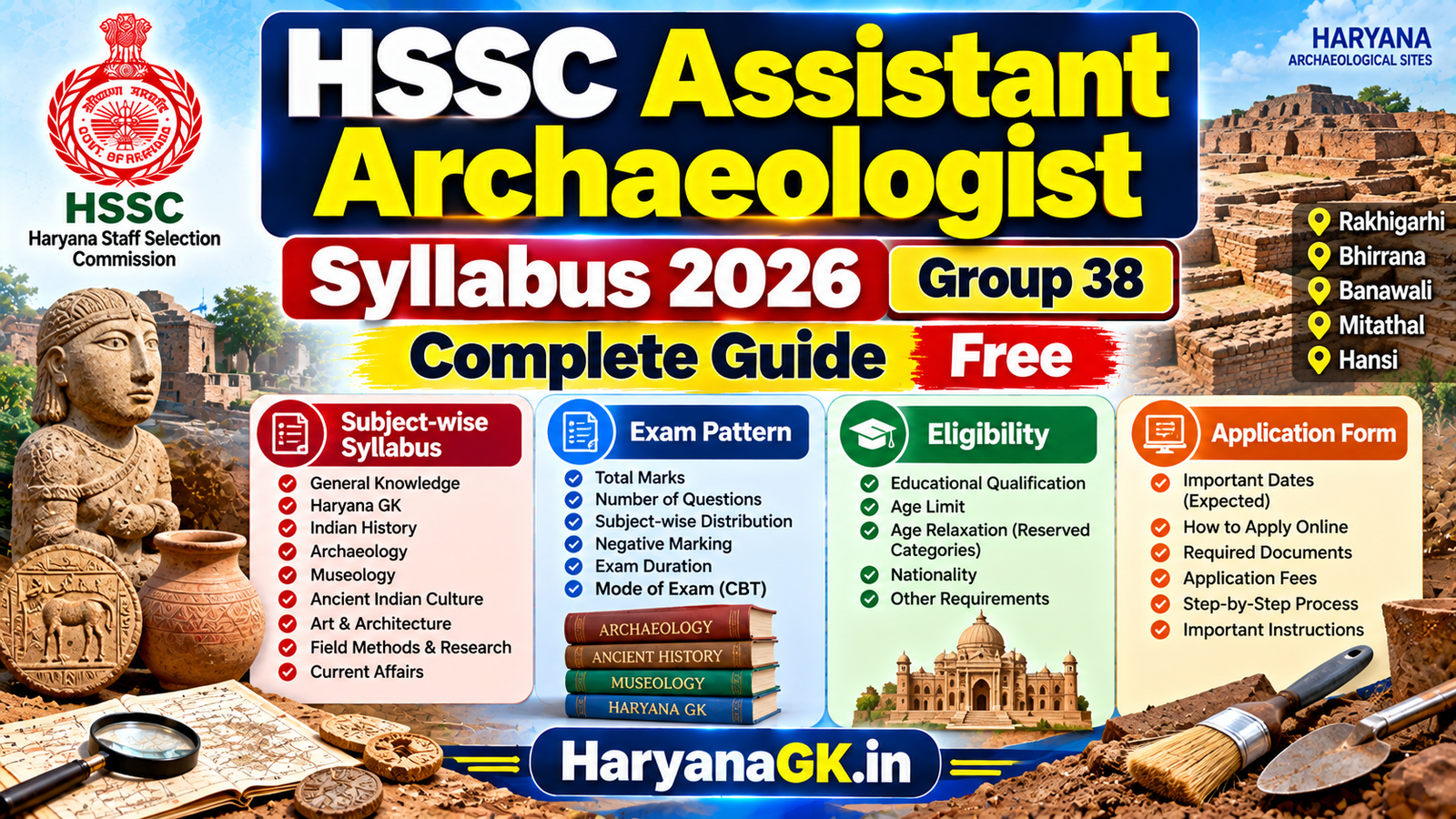
HSSC Assistant Archaeologist Syllabus 2026 – Group 38 Complete Guide Free
HSSC Assistant Archaeologist Syllabus 2026 The Haryana Staff Selection Commission is going to conduct the recruitment of Assistant Archaeologist posts under Group 38. This HSSC Assistant Archaeologist Syllabus guide has the exam pattern and the entire list of topics, subject-wise, from the official syllabus published on hssc.gov.in so you know exactly what to study before you open a single pdf.
HSSC Group D – Previous Year Solved Papers
Practice HSSC Group D previous year solved question papers, shift-wise, with instant answers and explanations after every question.
| Exam Date | Shift | Solved Paper |
|---|---|---|
| 10 November 2018 | Shift 1 | Attempt Quiz |
| 10 November 2018 | Shift 2 | Attempt Quiz |
| 11 November 2018 | Shift 1 | Attempt Quiz |
| 11 November 2018 | Shift 2 | Attempt Quiz |
| 17 November 2018 | Shift 1 | Attempt Quiz |
| 17 November 2018 | Shift 2 | Attempt Quiz |
| 18 November 2018 | Shift 1 | Attempt Quiz |
| 21 October 2023 | Shift 1 / Morning | Attempt Quiz |
| 21 October 2023 | Shift 2 / Evening | Attempt Quiz |
| 22 October 2023 | Shift 1 / Morning | Attempt Quiz |
| 22 October 2023 | Shift 2 / Evening | Attempt Quiz |
HSSC Assistant Archaeologist Exam Pattern Syllabus
Recruitment for Group 38 is same as the two-stage HSSC process. Stage one is the Common Eligibility Test (CET) – 100 questions, 100 marks, about 90-105 minutes, general awareness, reasoning, Hindi, English and quantitative aptitude. You are eligible for the group specific written exam if you clear CET along with the socio-economic criteria stage. And here the HSSC Assistant Archaeologist Syllabus below actually comes into play.
The HSSC Assistant Archaeologist Syllabus for the written exam has been divided into weighted sections:
General awareness, Reasoning, Mathematics, Science, History (including Haryana related history), current affairs, literature, Geography, Civics, Environment, Culture etc. – 20% weightage
Computer terminology, Basics, word software, excel software, Power point, internet, web browsing, Communication, emails, downloading and uploading data on websites etc – 10%
Subject related syllabus – 70 % weightage
This weightage is tentative and may change. Consider this as a guideline for study time, and not as a fixed number of questions. (HSSC Note on official document)
HSSC Assistant Archaeologist Syllabus 2026 (Subject Wise)
HSSC Assistant Archaeologist Syllabus subject-wise block deals with following topics. Here’s the full breakdown:
Historical Geography of Early India Early developments in historical geography, Geographical issues in early Indian literature, Epics and Archaeological Tradition, Historical Geography of Ashokan Sites, Chinese sources and Buddhist Archaeology.
Archaeology Nature of Archaeological Record Basic Field techniques in Archaeology Methods of Dating Role of Sciences in Archaeology Archaeological Background to the Study of Indian History Development of Archaeology South Asian Archaeology Religion and Art in Early India Evolution of religious ideas, Transition from Non-Iconic to Iconic, Evolution of Puranic religion and the major cults and their iconography, Changes in Buddhism and Jainism and their icons; Tantra, Temples.
Early Indian Social and Economic History People in India; An Anthropological introduction; Major division between caste, society and kin-based society, Stages in the Evolution of social stratification, Toward the emergence of early historical economy and society, Theory of Indian feudalism and ruralisation of economy,The nature of caste division in Deccan and South India.
Approaches to the Study of the Past of Ancient India Nature, Object, Scope and Philosophy of History, Concept of History in the Ancient World, Ancient Indian Historical Traditions, Historical Writings, Modern Approaches to the Study of the Ancient Indian Past, Role of Methodology in History, Tools and Techniques with Special Reference to India.
The Emergence of the State in India: Magadh Emergence of Territories: Geographical and archaeological background, Monarchies and republics, Mahajan-padas Territorial Expansion of Magadha up to Asoka Structure of the Empire: The Problem of Political Organization, Ideology of Empire Disintegration of the Empire Political Ideas and Institutions (From Middle of 2nd millennium BCE to 1300 CE) Recent trends in study of Early Indian States, Communities and Community organizations,Origin of State and its evolution since Vedic Times, Emergence of State and Saptanga Theory, Origin and Evolution of Kingship, Categories of States, Gana Samgha in Post , Idea of Mauryan State.
Gupta Period in Indian History Gupta Empire The political scenario of north India at the emergence of Gupta rule The Gupta kings and their political policies Weakening of the kingdom, its disintegration and fall Political structure of the Gupta state and its administrative machinery Major social and cultural institutions of the times:
Art and Culture The Vakatakas, Maitrakas, Maukharis- kingdom, rulers and political relations with contemporaries Gupta Empire Chola Polity Evolution of the Hypothe Deccan and South India between 300 BCE and 700 CE Transition from the Megalithic to the Historic Phase Tamil Heroic Poems and the Chiefdoms From Chieftain to Kingdom State Formation in the Deccan – Satavahanas and their Contemporaries Successors of Satavahanas – Western Kshatrapas, Ikshvakus Society and Economy of the Deccan and South India with focus on the Maritime Activities Evolution of the State in South India – the Agrarian Scenario, Land Grants Brahmanisation of Society in South India – Religions, Art and Literary Transitions South India from 700 A.D. to 1300 A.D. Survey of the Sources Political
History of South India: Outline of the Political History of South India from 550-850 A.D. Political condition of South India in the second half of the 9th century A.D. Structure of state and society in south India: The Chola state. History of Eastern India (700 CE-1300 CE) including Brahmaputra valley Geography, Political Developments of Eastern India: a) Bihar and Bengal b) Odisha c) Brahmaputra Valley Archaeology of Eastern India: 700 CE-1300CE.
Approaches to Archaeological Studies in India The Idea of the Orient, Role of Asiatic Society in pursuing the past,The Orientalist Constructions, The Early Surveys, Establishment of Archaeological Survey of India in 1861, Growth of Regional Identities and Local institutions.
Archaeology: Theories and Techniques What is theory in Archaeology? What is the relation between theory and method? Theory and Philosophy of science Early Development of theories since Age of Antiquarianism Early 20th century approaches New Archaeology and Processual approaches Post Processual Critique Development of archaeological field Concept of sites in archaeology Techniques of Exploration Merits and demerits of sampling in archaeological surveys Techniques of Excavation Stratigraphy and Section drawing Recording artefacts and features
Prehistory of South Asia Prehistory: Introduction Aims and Scope Beginning and main stages of development Principle approaches, The Quaternary Period Introduction to the Quaternary Subdivisions-Significance of the Pleistocene and Holocene periods Methods for reconstructing paleo-environment Global climate history during the Quaternary environments in India, Human Evolution and its Ramifications
Definition and Theories in Primate Evolution Hominoid and Hominid Evolution in Africa Evolution out of Africa The problem of Human evolution in global and Indian contexts, South Asian Stone Age Sequence The Lower Palaeolithic –Acheulian Culture- Tools, Typology and contexts and adaptations The Middle Palaeolithic- Tools, Typology and contexts and adaptations The Upper Palaeolithic- Tools, Typology and contexts and adaptations The Mesolithic- Tools, Typology and contexts and adaptations The Neolithic –Cultural Adaptations in India, Prehistoric Rock Art: Character and Chronology.
Protohistory of South Asia History of Proto-historical research in India- Changing trends and problems, Pre-Harappan Culture of India and Borderlands, The Mature-Harappan Culture- Origin, Political forms, Settlement and Subsistence patterns, Trade, Social and Economic life The Theory of Harappan “Decline” First urbanisation, The nature of the Late Harappan Cultures of Sind, Punjab, Haryana, U.P, Gujarat, The Chalcolithic cultures of Central and Western India The Chalcolithic cultures of Eastern India Early Food producing cultures in the Ganges valley The Iron Age problem- BRW Cultures, Megalithic cultures of the South.
Historical Archaeology of South Asia (Iron Age to Mediaeval) Concept and Development of Historical Archaeology: Debates on ‘Early Historic’ and ‘Early Medieval’ in Indian Archaeology Significance of Archaeological Record- Interface between Archaeological Record and Literature, Evolution of Archaeological Cultures: OCP and Painted Grey Ware Culture in India: Chronology, Distribution and Characteristics; Major excavated sites.
Early Iron Age Cultures in India: Archaeological and literary sources on beginning of iron––history of research––theories of origin of iron in India, Regional archaeological cultures of the Indian subcontinent (6th c. BCE to 12th c. CE): North-western India, Western India, Central India and Deccan, South India, Eastern, North-eastern India, The Northern Black Polished Ware (NBPW: chronology, distribution, characteristics, allied numismatic and settlement evidences) Archaeological evidence of Urbanism in early historic and early mediaeval India: history of research and debates––major excavated sites––evidence of settlement pattern and distribution; Major excavated sites in eastern India: Bengal, Bihar, Odisha, Archaeology of Buddhism: major sites related to early Buddhism––major monastic sites––monastic Buddhism in early mediaeval Eastern India and Deccan.
Ethnoarchaeology: Theories and Practices Importance of ethnoarchaeology in archaeological research Nature and interrelationship of archaeological and ethnographic records Principles of analogy in ethnoarchaeological research Ethnoarchaeology and reconstruction of past material culture Ethnoarchaeological Practice in South Asia- “Living Traditions” Ethnoarchaeological Studies Outside India Emerging concepts in Ethnoarchaeology.
Indian Epigraphy and Paleography Ashokan Edicts Study of Inscriptions of Historical and Cultural Importance Study of seals-sealings and their importance in Ancient Indian History Origin of writing and Script in Indian Context The Brahmi Script and its derivatives Regional variations The Kharosthi Script-an overview Transcription of early Brahmi from Roman Script Typological Survey of Inscriptions (300 CE-1200 CE)
Reading Inscriptions: Prasastis Reading Inscriptions: Land Grants Origin and antiquity of Coins in India, Methods of Coin making in Ancient India, the making of Coin, Study of Ancient Indian Coinage, Tribal Coins, Local Coins, Coins of City States, Coins of the Satavahanas, Coins of the Western Kshatrapas and Kardamaka Rulers, Coins of the Gupta Kings, Principal Early Mediaeval Coin, Coins of the Chalukyas of Badami, Kadambas, Cholas and Pandyas, Currency Systems in South India.
Society: Perception and Idea, Sources for Study of Social History-Literary, Archaeological, indigenous and Foreign, Concept of Varna and Jati- problem of Untouchability- Slavery system, Asrama- Concept, situation and Variation in Point of Time, Position of Women, Occupations and Education at Theoretical and Operational Levels. Labour in Ancient India, Samskaras, second urbanisation and urban life, Guilds early maritime trade up to 400 CE.
Gender Studies: Women in Ancient India Introduction Women in Early India Women in Maurya and Post Socio Cultural and Economic Status of Women in ancient India. Sources for the Study of Social History – A Survey of Early Mediaeval Society and Recent Study on Social Aspects, Concept of Varna-Jati from Interdisciplinary Perspectives, Rise of the New Professional Castes – Kayasthas and Rajput, Inter-Action between Socio Economic Classes in Early Mediaeval Period,
Educational System and Institutions: Brahmanical and Buddhist. Source Materials for the study of Economic History, Economic condition of India from 600 B.C to 400 B.C, Mauryan Economy, Agriculture, Process of cultivation, Crops, Irrigation and states interest, UNIT IV Trade and Commerce- Inland and Foreign, Industry and Trade Organisations- Revenue System. Economic History of India upto 400 CE Economic History of India 400 CE – 1300 CE The Economic History of India up to 1300 CE Trends and Perspectives, Ownership of land- System of Land grants and Agrarian Expansion in Guptas and Post- Gupta period, Agriculture and Craft Production, Trade and Market Centers in Gupta Period, Indian Feudalism.
Society: Perception and Idea, Varna-Jati, Samskaras, Labour in Ancient India, Urbanisation and Urban Life, Guilds, Maritime Trade. Vedic Religion and its Legacy An Introduction to Indian Religious History Early forms of Religion; Nature worship, Polytheism, Indus Religion, Concept of Gods in Rigveda. Evolution of Puranic and Hindu Religious Cults, Rituals and Ideas Approach to the study of later Vedic religion, Later Vedic gods and rituals, Upanishad, Saivism, Syncretic cults, Vaishnavism, Cult of Jagannatha Later sects of Vaishnavism; Gopala and Radha Madhava.
Religious and Cultural scenario at the time of the Mauryas, Sungas and Kushanas Buddhism – Spread of Buddhism in and outside India Later phase of Buddhism – Vajrayana and Tantrayana Origin and antiquity of Jainism, Historicity of the twenty four Tirthankaras, Historical background of the emergence of Jainism, Life and teaching of Parsvanatha and Mahavira,
Jaina Samgha: Hierarchy, Functions, Schism, Major sub-sects, Monastic organization, Spread and distribution of Jainism in Eastern India. Origin of Tantrism Pre Vedic and Vedic Development of Tantrism Tantrism in Mahayana Buddhism Survival of Tantrism Material Milieu Representation of Tantric Tradition in Religious Imagery.
Proto Historic Phase: Stambhas, Stupa and Rock-cut Architecture: Ideas on Space, Built forms and Terminology, Indus valley- town planning and structures, Religious Architecture a) Origin and development of Stupas from earliest times to 700 CE- Central India, Krishna Godavari delta region and North Western India b) Early Rock-cut caves: Evolution of Chaityagrihas and Viharas- Ajivikas (Barabar Hills); Theravada and Mahayana sects c) Jaina caves with special reference to Udayagiri and Khandagiri (Odisha) d) Brahmanical caves: Representative caves at Udaygiri (Madhya Pradesh), Aihole, Badami, Mahabalipuram, Elephanta and Ellora,
Temple Architecture (North India): Introduction- Origin of temple building in India- Early examples of religious architecture, Indian Vastuvidya and canonical styles- classifications and interpretations, Gupta temples- their types and characteristics, potentialities for future development, Nagara- Definitions, features, variations and key regions
a) Eastern India- Odisha (Bhubanesvar, Puri, Konark)
b) Central India- Khajuraho
c) Western India- Gop, Modhera etc.
d) Himalayan region- Kashmir valley and Himachal.
Temple Architecture (South India) Origin of temple building in South India- canonical texts, Dravida- definitions, features, variations and key centers
a) Beginnings- Badami, Aihole, Mahakuta, Pattadakkallu
b) Formation and crystallisation of Dravida style- Mahabalipuram, Kanchipuam
c) Expansion of Dravida style- Tanjavur, Gangaikonda, cholapuram, Darasuram etc.
d) Variations on the west coast- Chera temples
e) Deccan variations- the Andhra-Karnata style- later Chalukyas and Hoysalas f) Definition- scope of using different media Indus art, Mauryan art, Art of the Sunga period (Sanchi, Barhut and Bodhgaya) Art of Saka-Kushana period (Mathura and Gandhara) Vengi School of art, Gupta art (Mathura and Saranath) and Central India Post-Gupta art (Pallava, Rashtrakuta and Pala, Senas, Cholas and Hoysalas), Mural paintings with special reference to Ajanta, Bagh and Chola Murals Manuscript Paintings (Eastern and Western India of Early Mediaeval period). Sources Origin and development of image worship Fundamentals of iconography, Buddha and Bodhisattva, Adi Buddha and Pancajinas, Female deities in Buddhism: Prajnaparamita, Tara etc. Tirthankaras, Yaksha, Yakshini and Sasanadevatas Miscellaneous images: Srutadevis, Vidyadevis, Dikpalas etc.
Jain and Buddhist Iconography Brahmanical Iconography: Origin and development of image worship in early India, Brahmanical Iconography: important concepts and terminologies of iconography Major Brahmanical deities and their iconography- Vishnu, Siva, Devi, Surya and Ganapati, Vyantaradevatas- Yakshas, Nagas, Kinnaras etc. Other iconographic types such as grahas and Dikpalas
HSSC Assistant Archaeologist Syllabus Exam Preparation
Begin with the subject-wise block of HSSC Assistant Archaeologist Syllabus first – as it has the maximum weightage and the actual differentiation between candidates happens here, as the sections of general awareness and computer knowledge overlap with every other HSSC group. Work through each subject area in an orderly way and check your subject list every week to make sure nothing is missed before the day of the exam.
And don’t miss the common part. Candidates generally under-prepare for general awareness and basic computer knowledge pertaining to Haryana as they are focused on the technical syllabus and these are easy marks.
HSSC Assistant Archaeologist Syllabus: Frequently Asked Questions
What is HSSC Assistant Archaeologist Syllabus Group 38?
The above mentioned weightage sections are included in the HSSC Assistant Archaeologist Syllabus as per the official notification released by the Haryana Staff Selection Commission.
Does HSSC Assistant Archaeologist syllabus change every year?
HSSC revises its syllabus documents periodically and the weightage assigned to each section is explicitly marked as tentative by HSSC. Always check the latest version from hssc.gov.in/examsyllabus before you finalise your preparation.
Do I need to clear the CET before taking this exam?
Yes. The HSSC recruitment process is a typical two stage process, you need to clear the Common Eligibility Test (CET) and then you will have to appear for the group-specific written exam based on the HSSC Assistant Archaeologist Syllabus explained in this guide.
Official Notification and Source
The HSSC Assistant Archaeologist Syllabus is uploaded from the Official Group 38 – Assistant Archaeologist Syllabus published by Haryana Staff Selection Commission. Always check the latest version and amendments against the official document before you are done with your preparation.
Get official syllabus PDF and find current recruitment notices at hssc.gov.in/examsyllabus.
| HTET PRT Syllabus 2026 | |
| Subject | Syllabus Link |
| PRT Syllabus (All Subjects) | View Syllabus  |
| HTET TGT Syllabus 2026 (Subject-Wise) | |
| Subject | Syllabus Link |
| Art | View Syllabus |
| English | View Syllabus |
| Hindi | View Syllabus |
| Home Science | View Syllabus |
| Mathematics | View Syllabus |
| Music | View Syllabus |
| Physical Education | View Syllabus |
| Punjabi | View Syllabus |
| Sanskrit | View Syllabus |
| Science | View Syllabus |
| Social Studies | View Syllabus |
| Urdu | View Syllabus |
| HTET PGT Syllabus 2026 (Subject-Wise) | |
| Subject | Syllabus Link |
| Biology | View Syllabus |
| Chemistry | View Syllabus |
| Commerce | View Syllabus |
| Economics | View Syllabus |
| English | View Syllabus |
| Fine Arts | View Syllabus |
| Geography | View Syllabus |
| Hindi | View Syllabus |
| History | View Syllabus |
| Home Science | View Syllabus |
| Mathematics | View Syllabus |
| Music | View Syllabus |
| Physical Education | View Syllabus |
| Political Science | View Syllabus |
| Psychology | View Syllabus |
| Punjabi | View Syllabus |
| Sanskrit | View Syllabus |
| Sociology | View Syllabus |
| Urdu | View Syllabus |
See Other HSSC Group Syllabus Guides
This HSSC Assistant Archaeologist Syllabus post is one of the increasing list of subject wise syllabus posts for each group of HSSC. Check out the complete set on the HSSC Syllabus tag page or in the Syllabus category. Haryana HSSC guide for Complete process of HSSC recruitment process, CET details and exam pattern.
Keep in touch Follow us