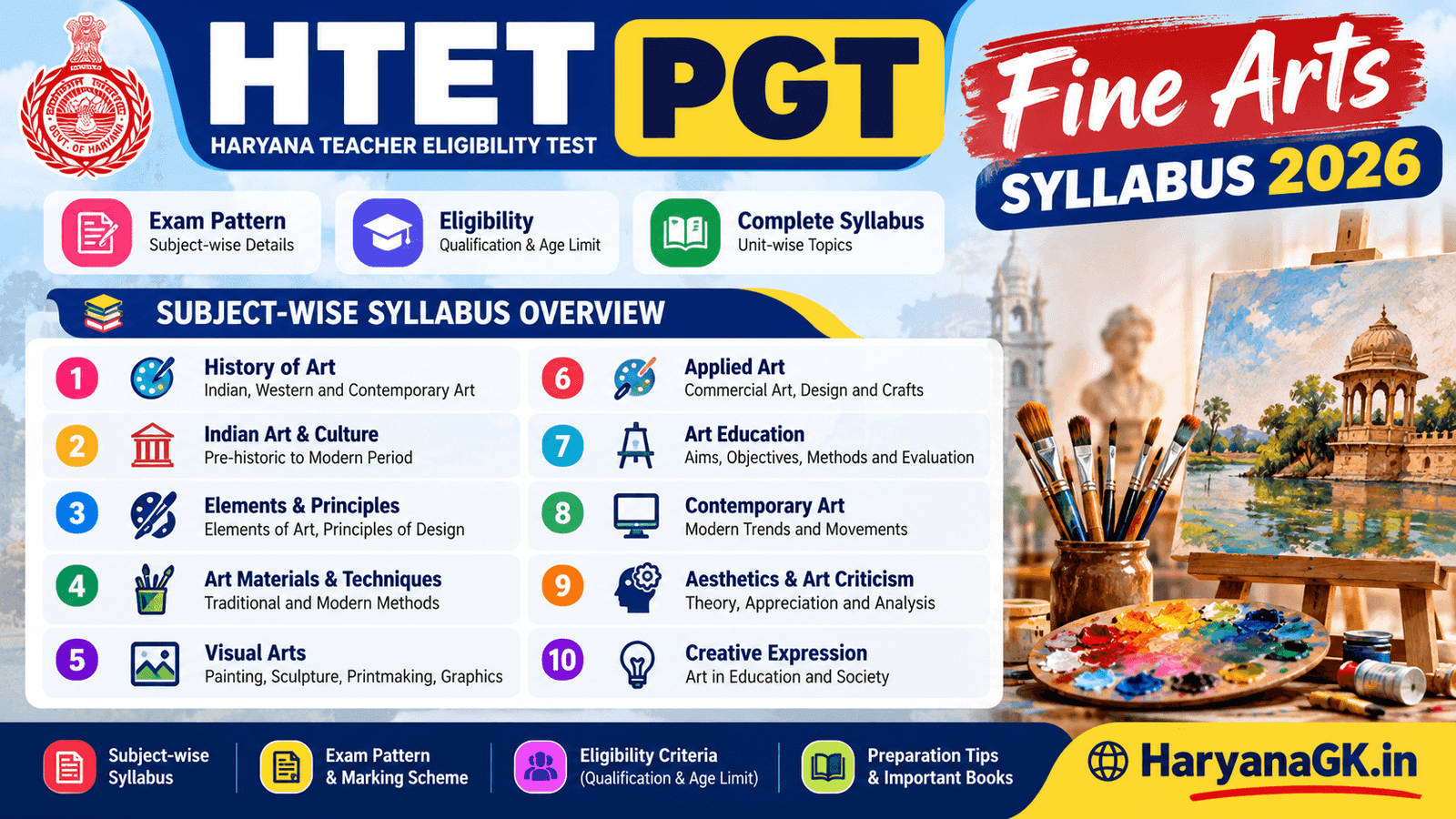
HTET PGT Fine Arts Syllabus 2026 – Subject-wise Syllabus, Exam Pattern and Eligibility
PGT Fine Arts extends TGT Art’s foundation into several media categories that only appear at this level — mural and multimedia art, graphic design, and applied art and architecture — alongside the same Shadanga principles and Indian art history timeline tested at the TGT level. Candidates with a painting- or sculpture-focused M.A. sometimes under-prepare the newer multimedia and applied-art portions.
This guide covers the HTET PGT Fine Arts syllabus exactly as BSEH has structured it, along with the exam weightage and the eligibility conditions for this paper.
HTET PGT Fine Arts Exam Pattern and Weightage 2026
The paper has 150 multiple-choice questions for 150 marks, completed in two and a half hours, with one mark per question and no negative marking.
| Section | Number of MCQs | Marks |
|---|---|---|
| Child Development and Pedagogy | 30 | 30 |
| Languages (Hindi 15 + English 15) | 30 | 30 |
| General Studies (Quantitative Aptitude 10, Reasoning 10, Haryana GK 10) | 30 | 30 |
| Fine Arts (Subject Specific) | 60 | 60 |
| Total | 150 | 150 |
Qualifying marks:
- General category candidates: 60% (90 marks)
- SC and differently-abled candidates of Haryana domicile: 55% (82 marks)
- SC and differently-abled candidates from other states: 60% (90 marks)
Topics come from the Class 9-12 syllabus prescribed by the Haryana Education Department, with the difficulty standard reaching postgraduate level.
Quizzes (Subject Wise)
Practice free HTET-pattern MCQ quizzes, subject by subject. Pick a subject below to start.
| Subject | Quiz |
|---|---|
| Haryana GK | Haryana GK HTET Online Quiz  |
| Math | Math Quiz – TGT/PGT HTET |
| Reasoning | Reasoning Quiz – HTET |
| English Grammar | English Grammar Quiz – 1 |
| Hindi Grammar | Hindi Grammar Quiz – 15 Difficult Questions |
| Psychology | Psychology HTET PGT Quiz |
| Computer Science | Computer Science Practice Set |
| Child Development & Pedagogy | CDP Practice Set |
Common Syllabus for HTET PGT (Child Development, Languages, General Studies)
These three sections are identical across every PGT subject and make up 90 of the 150 marks.
Child Development and Pedagogy
Covers the psychology of teaching and learning for the 14-17 age group, including Freud’s psychosexual development theory, Erikson’s theory of psychosocial development, Bandura’s social learning theory, and the standard Piaget/Kohlberg/Vygotsky foundations.
Languages — Hindi and English
Each carries 15 marks: one unseen passage tested for comprehension, inference, grammar and verbal ability, combined with the pedagogy of language development.
General Studies — Haryana GK, Reasoning and Quantitative Aptitude
Haryana GK (10 marks) covers state history, current affairs, geography and welfare schemes. Reasoning (10 marks) spans verbal and non-verbal types. Quantitative Aptitude (10 marks) covers number systems, percentages, interest, mensuration and data representation.
HTET PGT Fine Arts: Subject-Specific Syllabus
The 60-mark section moves from foundational theory through technique to Indian art history, with a broader range of media than the TGT-level syllabus covers.
Foundations of Art
An introduction to art, the principles of art and design, the Shadanga (the six classical limbs of Indian art theory), and the importance of art within culture.
Technique and Process
Traditional and modern artistic techniques, and the process and procedures involved across a wide range of media — painting, sculpture, applied art, graphic design, mural art, and multimedia art. This is noticeably broader than TGT Art’s technique section, which stops at painting, sculpture and applied art. This part also covers perspective and Indian folk art.
Indian Art History
The evolution of the Indian national flag and the history and development of Indian art from prehistoric times through to the contemporary period — including applied art, architecture and graphic design — plus subject-related pedagogy.
Because PGT Fine Arts explicitly adds mural art, multimedia art and architecture to the technique and history sections, candidates should treat these as genuinely new study areas rather than assuming TGT-level Art preparation covers them. The Shadanga principles and the pre-historic-to-contemporary art history timeline remain just as compact in the official wording as at the TGT level, so both still benefit from independent expansion during revision.
Visit bseh.org.in or htet.eapplynow.com for official Notification & Syllabus 2026
Who Is Eligible for HTET PGT Fine Arts? Qualification Details
You need to satisfy all of the following:
- M.A. Fine Arts with at least 50% marks, along with a B.Ed. from a recognised university.
- Matriculated with Hindi or Sanskrit as a subject, or senior secondary/graduation/post-graduation with Hindi as one of the subjects.
- A consistent good academic record.
What counts as a “Good Academic Record”?
For direct recruitment, “Good Academic Record” means averaging at least 50% marks across any three of your 10th, 12th, Graduation and Post-Graduation results — but you must separately have at least 50% marks in your Post-Graduation itself.
Relaxation for SC, BC and differently-abled candidates
Where the minimum qualifying mark is 50%, SC, BC and differently-abled candidates get a 5% relaxation, bringing it to 47.5%. Where the minimum is 45%, the relaxed figure is 42.75%, per the Supreme Court’s 2011 ruling in P.V. Indiresan vs Union of India.
A qualification detail worth checking twice
Only a B.Ed. recognised by the National Council for Teacher Education (NCTE) counts. For the B.Ed. (Special Education) route specifically, the course needs recognition from the Rehabilitation Council of India (RCI) instead.
HSSC Group D – Previous Year Solved Papers
Practice HSSC Group D previous year solved question papers, shift-wise, with instant answers and explanations after every question.
| Exam Date | Shift | Solved Paper |
|---|---|---|
| 10 November 2018 | Shift 1 | Attempt Quiz  |
| 10 November 2018 | Shift 2 | Attempt Quiz |
| 11 November 2018 | Shift 1 | Attempt Quiz |
| 11 November 2018 | Shift 2 | Attempt Quiz |
| 17 November 2018 | Shift 1 | Attempt Quiz |
| 17 November 2018 | Shift 2 | Attempt Quiz |
| 18 November 2018 | Shift 1 | Attempt Quiz |
| 21 October 2023 | Shift 1 / Morning | Attempt Quiz |
| 21 October 2023 | Shift 2 / Evening | Attempt Quiz |
| 22 October 2023 | Shift 1 / Morning | Attempt Quiz |
| 22 October 2023 | Shift 2 / Evening | Attempt Quiz |
Frequently Asked Questions
What does PGT Fine Arts cover that TGT Art doesn’t?
Mural art, multimedia art, and architecture (alongside applied art and graphic design) are explicitly named at the PGT level, extending beyond the painting, sculpture, and applied-art technique list used in TGT Art.
Is the Shadanga framework tested at both TGT and PGT levels?
Yes — it’s named in the Foundations of Art section at both levels, though PGT questions can be pitched at postgraduate difficulty even while covering the same core six principles.
Does PGT Fine Arts require an M.F.A., or is an M.A. sufficient?
The eligibility condition specifically names “M.A. Fine Arts” with at least 50% marks, plus a B.Ed. — check your specific degree nomenclature against this wording when confirming eligibility.
How much of this syllabus is practical technique versus art history theory?
Both carry real weight — the syllabus explicitly separates Foundations, Technique and Process, and Indian Art History as three distinct areas, so history and theory can’t be deprioritised in favour of technique alone.
Given how compactly BSEH has worded each syllabus line for a 60-mark paper, use each heading — especially mural/multimedia art and the pre-historic-to-contemporary art history timeline — as a starting point for deeper independent research rather than treating the official wording as the full extent of what’s testable.