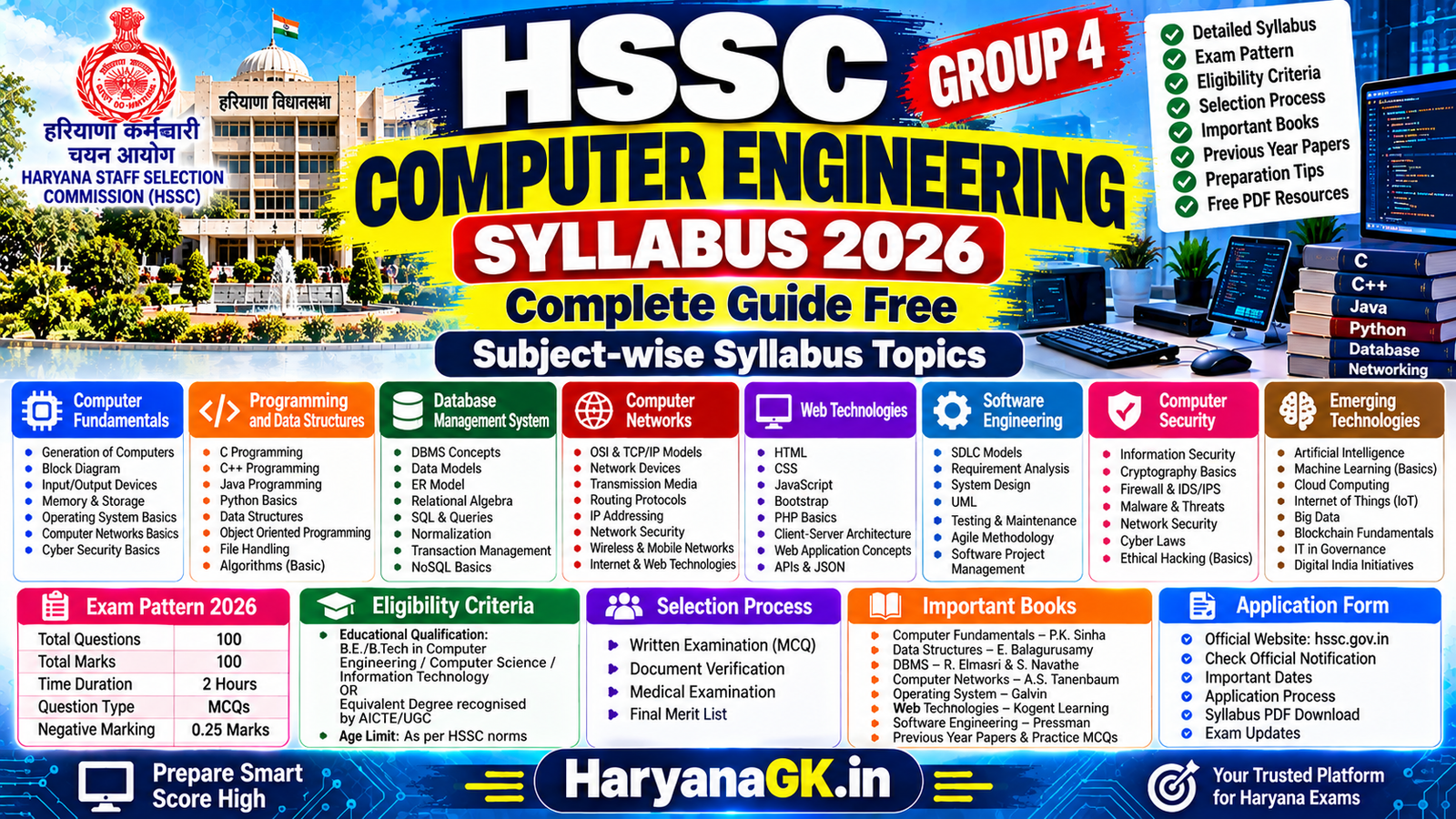
The HSSC Computer Engineering Syllabus 2026 covers Group 4 recruitment for Computer Engineering posts under the Haryana Staff Selection Commission. This HSSC Computer Engineering Syllabus guide breaks down the exam pattern and the full subject-wise topic list, straight from the official syllabus published at hssc.gov.in, so you know exactly what to study before you open a single PDF.
HSSC Computer Engineering Syllabus Exam Pattern
Group 4 recruitment follows the standard two-stage HSSC process. Stage one is the Common Eligibility Test (CET) — 100 questions, 100 marks, roughly 90–105 minutes, covering general awareness, reasoning, Hindi, English and quantitative aptitude. Clearing CET plus the socio-economic criteria stage qualifies you for the group-specific written exam, which is where the HSSC Computer Engineering Syllabus below actually applies.
The HSSC Computer Engineering Syllabus for the written exam splits into weighted parts:
- General awareness, reasoning, mathematics, science, history (including Haryana-related history), current affairs, literature, geography, civics, environment, culture, etc.—20% weightage
- Computer terminology, fundamentals, word software, Excel software, PowerPoint, internet, web browsing, communication, emails, downloading and uploading data on websites, etc.—10% weightage
- Subject-related syllabus — 70% weightage
HSSC notes on the official document that this weightage is tentative and may vary, so treat it as a study-time guide rather than a locked question count.
HSSC Computer Engineering Syllabus 2026 (Subject-Wise)
The subject-specific block of the HSSC Computer Engineering Syllabus spans the following areas. Here is the complete breakdown.
A) PROGRAMMING IN C
1. Algorithm and Programming Development 2. Program Structure 3. Control Structures 4 Pointers 5. Functions 6. Arrays and Strings 7. Structures and Unions
B) OPERATING SYSTEMS
1. Overview of Operating Systems 2. Process Management (Principles and Brief Concept) 3. Deadlocks (Principles and Brief Concept) 4. Memory Management Function (Principles and Brief Concept) 5. I/O Management Functions (Principles and Brief Concept) 6. File Management (Principles and Brief Concept) 7. Linux Operating System C) DIGITALELECTRONICS 1. Introduction 2. Number System 3. Codes and Parity 4. Logic Gates and Families 5. Logic Simplification 6. Arithmetic circuits 7. Decoders, Multiplexers, De-Multiplexers and Encoders 8. Latches and flip flops 9. Counters 10. Shift Register 11. A/D and D/A Converters 12. Semiconductor Memories D) MULTIMEDIA APPLICATIONS 1. Introduction to Multimedia Systems 2. Content and Project Planning, Designing and Development 3. Using Image Processing Tools 4. Multimedia Authoring Tools
E) DATA COMMUNICATION
1. Introduction 2. Data and Signals 3. Digital and Analogue Transmission 4. Multiplexing – FDM, WDM, TDM 5. Transmission media 6. Error Detection and Correction
F) DATA STRUCTURES USING C
1. Fundamental Notations 2. Arrays 3. Linked Lists 4. Stacks, Queues and Recursion 5. Trees 6. Sorting and Searching
G) OBJECT ORIENTATED PROGRAMMING USING JAVA
1. Introduction and Features 2. Language Constructs 3. Classes and Objects 4. Inheritance 5. Polymorphism 6. Abstract class & interface 7. Exception Handling
H) COMPUTER ORGANISATION
1. Hardware organisation of computer system 2. Memory organisation 3. I/O organisation 4. Architecture of multi-processor systems
I) MICROPROCESSORS AND PERIPHERAL DEVICES
1. Evolution of Microprocessor 2. Architecture of a Microprocessor (With reference to the 8085 microprocessor) 3. Instruction Timing and Cycles 4. Programming (with respect to the 8085 microprocessor) 5. Memories and I/O interfacing 6. Interrupts 7. Data Transfer Techniques 8. Peripheral devices 9. Architecture of the 8086 Microprocessor
J) DATABASE MANAGEMENT SYSTEM
1. Introduction 2. Database System Concepts and Architecture 3. Data Modelling using E.R. Model (Entity Relationship Model) 4. Relational Model: 5. Normalisation 6. Database Access and Security 7. MYSQL/SQL (Structured Query Language)
K) SOFTWARE ENGINEERING
1. Introduction to Software Engineering 2. Software Life Cycle Models 3. Software Planning 4. Requirement Analysis and Specification 5. Software Design and Implementation 6. Software Testing
L) COMPUTER NETWORKS
1. Networks Basics 2. Networking Models 3. TCP/IP Addressing 4. Network Architecture 5. Network Connectivity 6. Network Administration 7. Introduction to Wireless Networks. 8. Cloud Computing
M) COMPUTER PROGRAMMING USING PYTHON
1. Introduction 2. Basic Python Syntax 3. Language Components 4. Collections 5. Functions 6. Modules 7. Exceptions 8. Input and Output 9. Classes in Python 10. Regular Expressions
N) WEB DEVELOPMENT USING PHP
1. DEVELOPING PORTALS USING HTML 2. PHP 3. PHP and MySQL
O) NETWORK SECURITY
1. Introduction 2. Securing Data over Internet 3. Virus, Worms and Trojans 4. Firewalls 5. Intrusion Detection System (IDS)/IPS 6 Handling Cyber Assets – Configuration policy as per standards, Disposable policy 7. Virtual Private Network (VPN) 8. Disaster and Recovery
P) MOBILE APPLICATION DEVELOPMENT
1. Introduction to Mobile Computing, Wi-Fi, Bluetooth 2. Introduction to GSM, SMS, GPRS, and Mobile OS 3. Introduction to ANDROID 4. Views 5. Location-Based Service and SQLite
आधिकारिक स्रोत
इस पेज का सिलेबस हरियाणा कर्मचारी चयन आयोग (HSSC) के आधिकारिक दस्तावेज़ से लिया गया है। ताज़ा संस्करण और भर्ती सूचनाएँ hssc.gov.in/examsyllabus पर देखें।
दूसरे सभी HSSC पदों के सिलेबस और भर्ती प्रक्रिया हमारे HSSC गाइड पेज पर एक जगह दिए गए हैं।