Ask ten Group D aspirants what the HSSC Group D syllabus covers and most will rattle off the same list: Maths, Reasoning, English, Science, GK. Ask them about HSSC Group D Syllabus Weightage, how many marks each section is actually worth, and the room goes quiet. That gap between “I know the subjects” and “I know where the marks are” is exactly what separates a candidate who clears the cut-off from one who falls two or three marks short.
If you haven’t read the subject list yet, start with our HSSC Group D Syllabus 2026 – Complete Guide first. This article picks up from there and focuses on the part most guides skip: exactly how much each section is worth, the mistakes that cost the most marks, and a study plan built around that weightage.
Group D recruitment through HSSC covers posts like peon, chowkidar, mali, water carrier, and safaiwala across state government departments. It’s the highest-volume recruitment HSSC runs, which also makes it the most competitive purely on numbers. And one change matters for every single applicant this cycle: the extra socio-economic marks that some categories used to get on top of their written score have been withdrawn following recent court rulings. Whatever you score on the written CET paper is, for all practical purposes, your final number. There’s no cushion coming from anywhere else.
These three mistakes are exactly where most of the gap in HSSC Group D Syllabus Weightage understanding shows up in practice.
Three Mistakes That Cost Candidates the Most Marks
Before the syllabus checklist, it’s worth naming the patterns that show up again and again in Group D attempts.
Treating all sections as equal. They’re not. Haryana GK alone is worth a quarter of the paper, and it’s the section with the smallest, most fixed body of facts to learn. Spending equal hours on Reasoning and Haryana GK is a poor trade. Reasoning questions vary endlessly in phrasing, while Haryana GK facts don’t change week to week.
Leaving questions truly blank. HSSC’s OMR sheet includes a 5th bubble specifically for skipped questions. Miss it, and a completely blank question costs you 1 full mark, even though there’s no negative marking for a wrong guess. This single habit, fixed, has saved candidates real marks in past cycles.
Practicing untimed. Working through practice sets with no clock running builds false confidence. The real exam gives you 105 minutes for 100 questions, just over a minute each, and Quantitative Aptitude questions in particular eat far more time than test-takers expect when there’s no pressure forcing them to move on.
HSSC Group D Syllabus Weightage: Exam Pattern at a Glance
| Feature | Details |
|---|---|
| Mode | Offline, OMR-based |
| Questions | 100 MCQs |
| Total Marks | 100 |
| Duration | 105 minutes |
| Medium | English and Hindi |
| Difficulty | Senior Secondary (10+2) level overall; Hindi and English capped at Matric level |
| Wrong Answer Penalty | None |
| Fully Blank Question Penalty | 1 mark deducted |
Where the 100 Marks Actually Come From
HSSC splits the paper into two parts, and the split alone tells you how to plan your hours.
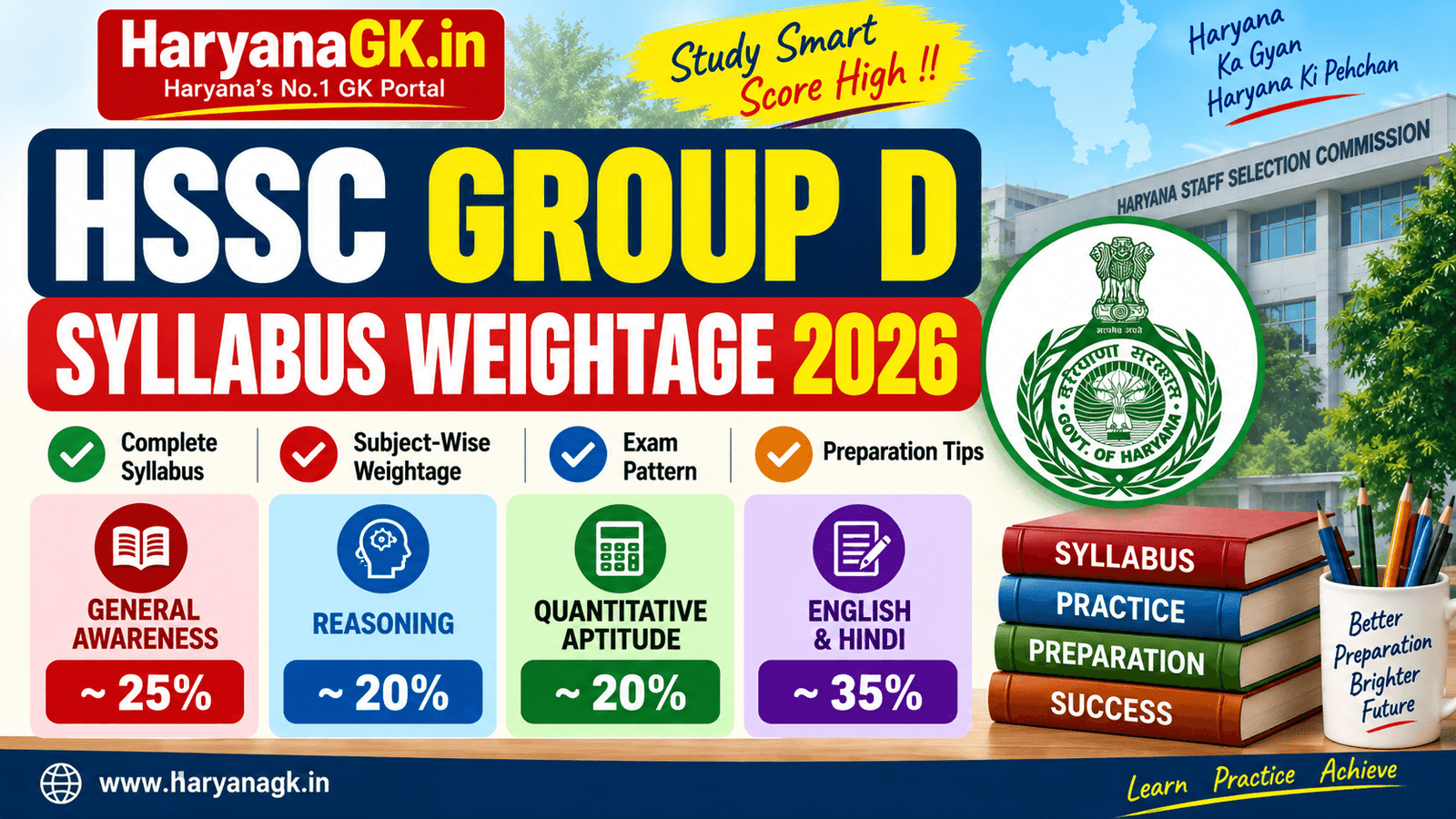
Part 1, General Awareness, General Science, Quantitative Aptitude, Reasoning, English, and Hindi, makes up 75% of the paper. Part 2 is Haryana General Knowledge on its own, worth the remaining 25%.
Put another way: one subject out of seven is worth a quarter of your total score. That’s not a coincidence HSSC is subtle about. It’s a clear signal that state-specific knowledge matters as much as broad general studies combined across multiple subjects.
HSSC Group D Syllabus Weightage: Subject-Wise Checklist
Go through each section below and rate yourself honestly, strong, shaky, or starting from scratch. That self-assessment should drive your next month of study more than any generic schedule.
Haryana General Knowledge (25% of the paper)
History topics include important historical sites, the old names districts carried before renaming, and the three Battles of Panipat. Get comfortable with dates and outcomes, not just names. Geography covers climate, the state’s rivers, and its share of the Aravalli and Shivalik ranges. Culture and society brings in art forms, literature, and local traditions. Current affairs and polity covers recent appointments, state policy announcements, awards given to people from Haryana, and how the state’s administrative structure is organized.
General Awareness & General Science
Current affairs here goes broader than Haryana: national and international events, important observance days, recent honors. Static GK pulls from Indian History, Geography, Polity, Economy, and major international organizations. Science stays at 10th-grade level: motion, electricity, and light in Physics; acids, bases, and the periodic table in Chemistry; life processes and common diseases in Biology.
Quantitative Aptitude
Number System, HCF and LCM, Simplification, Decimals and Fractions form the base layer. On top of that: Percentage, Ratio and Proportion, Average, Profit and Loss, Discount. Then Simple and Compound Interest, Time and Work, Time and Distance, and finally basic Mensuration and Data Interpretation.
Reasoning Ability
Analogies, Coding-Decoding, Blood Relations, and Direction Sense form one cluster. Number and Alphabet Series, Odd One Out, and Venn Diagrams form another. Visual Memory, Figural Classification, and general Problem Solving round it out.
English Language
Grammar: Tenses, Articles, Prepositions, Active/Passive Voice, Direct/Indirect Speech. Vocabulary: Synonyms, Antonyms, Idioms and Phrases, One-word substitution. Reading Comprehension and Spotting Errors close out the section.
Hindi Language (हिंदी व्याकरण)
व्याकरण में संज्ञा, सर्वनाम, विशेषण, क्रिया, कारक, लिंग, वचन, संधि और समास शामिल हैं। शब्दावली में पर्यायवाची, विलोम, मुहावरे एवं लोकोक्तियाँ, और वाक्यांश के लिए एक शब्द आते हैं। इसके साथ वाक्य शुद्धि और अपठित गद्यांश भी पूछे जाते हैं।
HSSC Group D Syllabus Weightage: Official Links
Skip the reuploaded copies floating around social media. These are the live HSSC pages and the official syllabus PDF:
| Resource | Official Link |
|---|---|
| HSSC Group D Syllabus 2026 (Official PDF) | hssc.gov.in/group_d/Syllabus_d.pdf |
| Full Exam Syllabus Listing (All Groups) | hssc.gov.in/examsyllabus |
| CET Group D-05/2026 Application Portal | onetimeregn.haryana.gov.in/hssc |
A study plan built on HSSC Group D Syllabus Weightage looks different from a generic one, because it spends time in proportion to marks, not in proportion to how many pages a topic takes up in a textbook.
A Realistic Study Plan, Not an Ideal One
Most study plans assume you have unlimited hours and zero distractions. This one doesn’t.
If you have roughly two months before your exam, spend the first three weeks building your NCERT foundation, Class 9 and 10 Science, Math, and History/Civics, since nearly the whole paper sits at that difficulty level. Run Haryana GK as a parallel daily habit from day one rather than a separate phase; short, repeated exposure beats one long cramming session for pure-memorization content. In the final three to four weeks, shift toward full 100-question mock tests under the actual 105-minute limit, and review every mistake to find out whether it was a knowledge gap or a speed problem. The fix for each is different.
If you’re closer to the exam with only a few weeks left, skip straight to Haryana GK and timed mocks. It’s not the ideal path, but it’s the highest-return one when time is short. And once your result is out, our HSSC Result 2026 guide covers exactly how to read your scorecard and what happens at Document Verification.
Keep this HSSC Group D Syllabus Weightage breakdown open alongside your practice sets. It’s easier to trust a study plan when you can see exactly which section it’s protecting.
HSSC Group D Syllabus Weightage: Frequently Asked Questions
How is Group D different from Group C in terms of syllabus?
Group D syllabus sits closer to Matric/10+2 difficulty across the board, while Group C exams for clerical and technical posts often go deeper into post-specific subjects. Group D is broader but shallower, which is exactly why time management and Haryana GK memorization matter more than tackling advanced content.
Is coaching necessary for Group D?
Not strictly. Because the syllabus caps out at 10th/12th-grade difficulty, NCERT textbooks plus consistent timed practice cover most of what’s tested. Coaching can help with structure and discipline, but it isn’t compensating for content you can’t otherwise access.
What should I do if I keep running out of time in mock tests?
Attempt Haryana GK and Reasoning first, these tend to be faster per question once you know the material, and leave Quantitative Aptitude calculations for the back half of your attempt, marking anything that needs more than 90 seconds for a second pass.
Does leaving a question blank always cost a mark?
Only if you don’t fill any option at all, including the 5th “skip” bubble. Filling the 5th option registers the question as a deliberate skip and avoids the deduction. This is different from simply not answering.
Is the exam equally weighted in Hindi and English?
The question paper itself is bilingual, so you choose your comfortable language for reading the questions. The Hindi Language and English Language sections are separate subjects within the syllabus, each with its own topic list, and both are capped at Matric-level difficulty.
How much of the paper is realistically “easy” if I prepare well?
Haryana GK (25%) and the basics of Reasoning and Hindi grammar tend to be the fastest sections to master through repetition. Treat these as your near-guaranteed marks and build confidence there before tackling the more variable sections like English comprehension and Data Interpretation.
“Know where the marks live before you decide where your hours go.” HSSC Group D Syllabus Weightage rewards candidates who study strategically, not just candidates who study the longest.
A quick appeal: Always cross-check the syllabus, exam dates, and any change in marking scheme against the official PDF before you build your study plan around it. If you notice any discrepancy, or if you ever face unfair treatment or discrimination of any kind during the application or exam process, don’t stay silent on a forum. Raise it directly through the Haryana Staff Selection Commission’s official grievance channel or by visiting hssc.gov.in. For anything specific to your form, category, or eligibility, the official website is the only source that can actually resolve it.