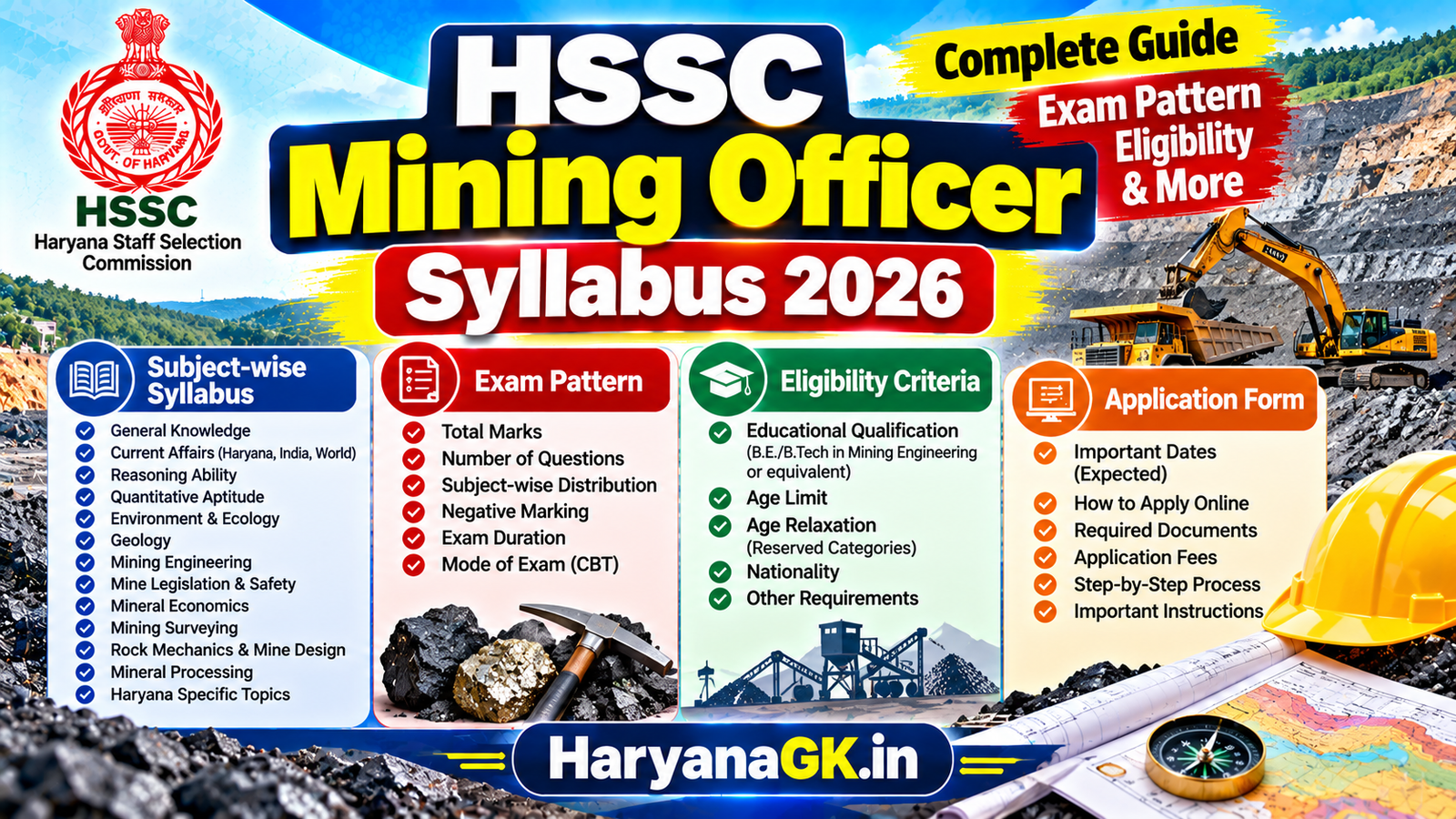
HSSC Mining Officer Syllabus 2026 covers Group 37 recruitment for Mining Officer posts under the Haryana Staff Selection Commission. This HSSC Mining Officer Syllabus guide breaks down the exam pattern and the full subject-wise topic list, straight from the official syllabus published at hssc.gov.in, so you know exactly what to study before you open a single PDF.
HSSC Group D – Previous Year Solved Papers
Practice HSSC Group D previous year solved question papers, shift-wise, with instant answers and explanations after every question.
| Exam Date | Shift | Solved Paper |
|---|---|---|
| 10 November 2018 | Shift 1 | Attempt Quiz |
| 10 November 2018 | Shift 2 | Attempt Quiz |
| 11 November 2018 | Shift 1 | Attempt Quiz |
| 11 November 2018 | Shift 2 | Attempt Quiz |
| 17 November 2018 | Shift 1 | Attempt Quiz |
| 17 November 2018 | Shift 2 | Attempt Quiz |
| 18 November 2018 | Shift 1 | Attempt Quiz |
| 21 October 2023 | Shift 1 / Morning | Attempt Quiz |
| 21 October 2023 | Shift 2 / Evening | Attempt Quiz |
| 22 October 2023 | Shift 1 / Morning | Attempt Quiz |
| 22 October 2023 | Shift 2 / Evening | Attempt Quiz |
HSSC Mining Officer Syllabus Exam Pattern
Group 37 recruitment follows the standard two-stage HSSC process. Stage one is the Common Eligibility Test (CET) — 100 questions, 100 marks, roughly 90–105 minutes, covering general awareness, reasoning, Hindi, English and quantitative aptitude. Clearing CET plus the socio-economic criteria stage qualifies you for the group-specific written exam, which is where the HSSC Mining Officer Syllabus below actually applies.
The HSSC Mining Officer Syllabus for the written exam splits into weighted parts:
- General awareness, Reasoning, Mathematics, Science, History including Haryana related history, current affairs, literature, Geography, Civics, Environment, Culture etc — 20% weightage
- Computer terminology, Fundamentals, word software, excel software, Power point, internet, web browsing, Communication, emails, downloading and uploading data on websites etc — 10% weightage
- Subject related syllabus — 70% weightage
HSSC notes on the official document that this weightage is tentative and may vary, so treat it as a study-time guide rather than a locked question count.
HSSC Mining Officer Syllabus 2026 (Subject-Wise)
The subject-specific block of the HSSC Mining Officer Syllabus spans the following areas. Here is the complete breakdown.
Earth as a planet, Earth’s magnetic field,Plate Tectonics,Hydrosphere and Atmosphere,Soil, Understanding the past from stratigraphic records, Cosmic abundance of elements. Crystallography, Crystal symmetry and projections, Rock forming minerals,Properties of light and optical microscopy. Concepts of geochemistry, Introduction to properties of elements,Layered structure of Earth and geochemistry, Element transport, Geochemistry of solid Earth, Geochemical behaviour of selected elements like Si, Al, K, Na etc. Structure and Topography,
Stress and strain in rocks: Concept of rock deformation, Folds, Introduction to the mechanics of folding, Foliation and lineation, Fractures and faults. Concepts of Igneous petrology, Introduction to petrology, Forms, Phase diagrams and petrogenesis, Magmatism in different tectonic settings, Petrogenesis of Igneous rocks. Origin of sediments, Sediment granulometry, Primary Sedimentary structures and environments of sedimentation, Modes of sedimentary transport, heavy minerals, Paleocurrent analysis, Varieties of sedimentary rocks, Carbonate rocks, Lithification & Diagenesis. Fossilization and fossil record, Taxonomy and Species concept, Invertebrates, Vertebrates, Introduction to Palaeobotany, Gondwana Flora, Application of fossils in Stratigraphy.
Metamorphism: controls and types, Metamorphic facies and grades, Metamorphism and Tectonism, Migmatites and their origin, Metamorphic rock associations. Introduction and basic concepts, Groundwater flow, well hydraulics and Groundwater exploration, Groundwater chemistry, Groundwater management, Rainwater harvesting and artificial recharge of groundwater. Ores and gangues, Mineral deposits and Classical concepts of Ore formation, Mineral exploration, Structure and texture of ore deposits, Ore grade and Reserve, assessment of grade, reserve estimation, Metallic and Non-metallic ore deposits of India.
Introduction to Geomorphology, Endogenic and Exogenic processes, Geoid, Topography, Hypsometry, Major Morphological features, Overview of Indian Geomorphology, Landforms produced by wind, glaciers and rivers. Role of Engineering geologists in planning, design and construction of major man-made structural features,Site investigation and characterization, Foundation treatment, Intact Rock and Rock Mass properties, Concept, Mechanism and Significance of Rock Quality Designation (RQD) Concept,
Mechanism and Significance of: a. Rock Structure Rating (RSR) b. Rock Mass Rating (RMR) c. Tunnelling Quality Index (Q) Geological, Geotechnical and Environmental considerations for Dams and Reservoirs, Tunnels and Tunnelling Methods, Landslides, Earthquakes. Photogeology, Remote Sensing, Concepts in Remote Sensing, IRS series imagery, GIS, Datum, Coordinate systems and Projection systems Spatial data models, Introduction to DEM analysis, GPS, Concepts of GPS Integrating GPS data with GIS Applications in earth system sciences.
Mineral Resources, Prospecting and Exploration, Evaluation of data, Drilling and Logging, Reserve estimations and Errors. Climate system, Heat budget of Earth, Atmosphere – Hydrosphere, Response of biosphere to Earth’s climate, Orbital cyclicity and climate, Monsoon. Coal, Coal as a fuel, Petroleum, Petroleum Reservoirs and Traps, Other fuels, Gas Hydrate, Nuclear Fuel. Stream hydrology, River basin, Drainage, Rivers in time and space, Paleochannels of the Sarasvati River in Haryana, Channels and Landscapes, Fluvial hazards.
Geology and Geophysics, General and Exploration geophysics, Geophysical field operations, Application of Geophysical methods, Geophysical anomalies, Integrated geophysical methods. Introduction to geology, scope, sub-disciplines and relationship with other branches of sciences, Earth in the solar system, origin Earth’s size, shape, mass, density, rotational and evolutional parameters, Solar System- Introduction to Various planets – Terrestrial Planets Solar System- Introduction to Various planets – Jovian Planets Internal constitution of the earth – core, mantle and crust, Convections in the earth’s core and production of magnetic field Composition of earth in comparison to other bodies in the solar system, Origin and composition of hydrosphere and atmosphere Origin of biosphere Origin of oceans, continents and mountains, Age of the earth;
Radioactivity and its application in determining the age of the Earth, rocks, minerals and fossils. Minerals-Definitions, Physical properties of minerals Mineralogical structure of earth, planetary minerals and native elements,Mineral structures Mineralogy of the Earth’s crust, mantle and core, Nature of light and principles of optical mineralogy Optical classification of minerals. Rocks- Definitions and types, Basics of rock formation. Earth, Earth’s interior, Elements of earth’s magnetism, Elements: Origin of elements/nucleosynthesis. Abundance of the elements in the solar system / planet earth Geochemical classification of elements. Earth accretion and early differentiation Isotopes and their applications in understanding Earth processes.
Earth Resources Resource reserve definitions; mineral, energy and water resources in industries Historical perspective and present A brief overview of classification of mineral deposits with respect to processes of formation in relation to exploration strategies, Definition of Energy: Primary and Secondary Energy Difference between Energy, Power and Electricity Renewable and Non-Renewable Sources of Energy, Potential of Hydroelectric Power, Solar Energy, Wind, Wave and Biomass Based power and Energy, Ground water resources and its role in economic development of a country, Ground water resources of Haryana, Current Scenario and Future Prospects of Solar Power, Hydrogen Power and Fuel Cells, Mineral resources of Haryana.
The Lithosphere and Related Hazards Atmospheric Hazards, Hydrosphere and Related Hazards, Concepts of disaster, Types of disaster: natural and manmade – cyclone, flood, land slide, land subsidence, fire and earthquake, tsunami and volcanic eruption, Meteorite Impacts Issues and concern for various causes of disasters Disaster management, mitigation, and preparedness Techniques of monitoring and design against the disasters Management issues related to disaster, Disaster Management in India Risk,
Vulnerability and Hazard Mitigation through capacity building Legislative responsibilities of disaster management; disaster mapping, assessment Pre-disaster risk & vulnerability reduction Post disaster recovery & rehabilitation Disaster related infrastructure development, Hazard Zonation Mapping, Remote-sensing and GIS applications in real time disaster monitoring Prevention and rehabilitation, Earthquake Zones of India, Rainfall distribution; fresh and saline groundwater zones; water logged areas; flood and drought prone areas in Haryana
How to Prepare for the HSSC Mining Officer Syllabus Exam
Start with the subject-specific block of the HSSC Mining Officer Syllabus first — it carries the heaviest weightage and is where real differentiation between candidates happens, since general awareness and computer knowledge sections overlap with every other HSSC group. Work through each topic area systematically, and revisit the subject list above every week so nothing slips through before exam day.
Don’t skip the common portion either. Haryana-specific general awareness and basic computer knowledge are easy marks that candidates often under-prepare because they’re focused on the technical syllabus.
Frequently Asked Questions: HSSC Mining Officer Syllabus
What is the HSSC Mining Officer Syllabus for Group 37?
The HSSC Mining Officer Syllabus covers the weighted sections listed above, compiled directly from the official document published by the Haryana Staff Selection Commission.
Is the HSSC Mining Officer Syllabus the same every year?
HSSC updates its syllabus documents periodically, and the weightage listed against each section is explicitly marked tentative by HSSC. Always check hssc.gov.in/examsyllabus for the latest version before you finalize your preparation.
Do I need to clear CET before attempting this exam?
Yes. HSSC recruitment follows the standard two-stage process: you first clear the Common Eligibility Test (CET), then sit for the group-specific written exam that follows the HSSC Mining Officer Syllabus covered in this guide.
Official Notification and Source
This HSSC Mining Officer Syllabus is compiled directly from the official Group 37 – Mining Officer Syllabus published by the Haryana Staff Selection Commission. Always cross-check the latest version and any amendments against the official document before you finalize your preparation.
Download the official syllabus PDF and check current recruitment notices at hssc.gov.in/examsyllabus.
| HTET PRT Syllabus 2026 | |
| Subject | Syllabus Link |
| PRT Syllabus (All Subjects) | View Syllabus  |
| HTET TGT Syllabus 2026 (Subject-Wise) | |
| Subject | Syllabus Link |
| Art | View Syllabus |
| English | View Syllabus |
| Hindi | View Syllabus |
| Home Science | View Syllabus |
| Mathematics | View Syllabus |
| Music | View Syllabus |
| Physical Education | View Syllabus |
| Punjabi | View Syllabus |
| Sanskrit | View Syllabus |
| Science | View Syllabus |
| Social Studies | View Syllabus |
| Urdu | View Syllabus |
| HTET PGT Syllabus 2026 (Subject-Wise) | |
| Subject | Syllabus Link |
| Biology | View Syllabus |
| Chemistry | View Syllabus |
| Commerce | View Syllabus |
| Economics | View Syllabus |
| English | View Syllabus |
| Fine Arts | View Syllabus |
| Geography | View Syllabus |
| Hindi | View Syllabus |
| History | View Syllabus |
| Home Science | View Syllabus |
| Mathematics | View Syllabus |
| Music | View Syllabus |
| Physical Education | View Syllabus |
| Political Science | View Syllabus |
| Psychology | View Syllabus |
| Punjabi | View Syllabus |
| Sanskrit | View Syllabus |
| Sociology | View Syllabus |
| Urdu | View Syllabus |
Explore Other HSSC Group Syllabus Guides
This HSSC Mining Officer Syllabus guide is part of a growing set of subject-wise syllabus posts for every HSSC group. Browse the full set on the HSSC Syllabus tag page or the Syllabus category. For the full HSSC recruitment process, CET details and exam pattern, see the Haryana HSSC guide.