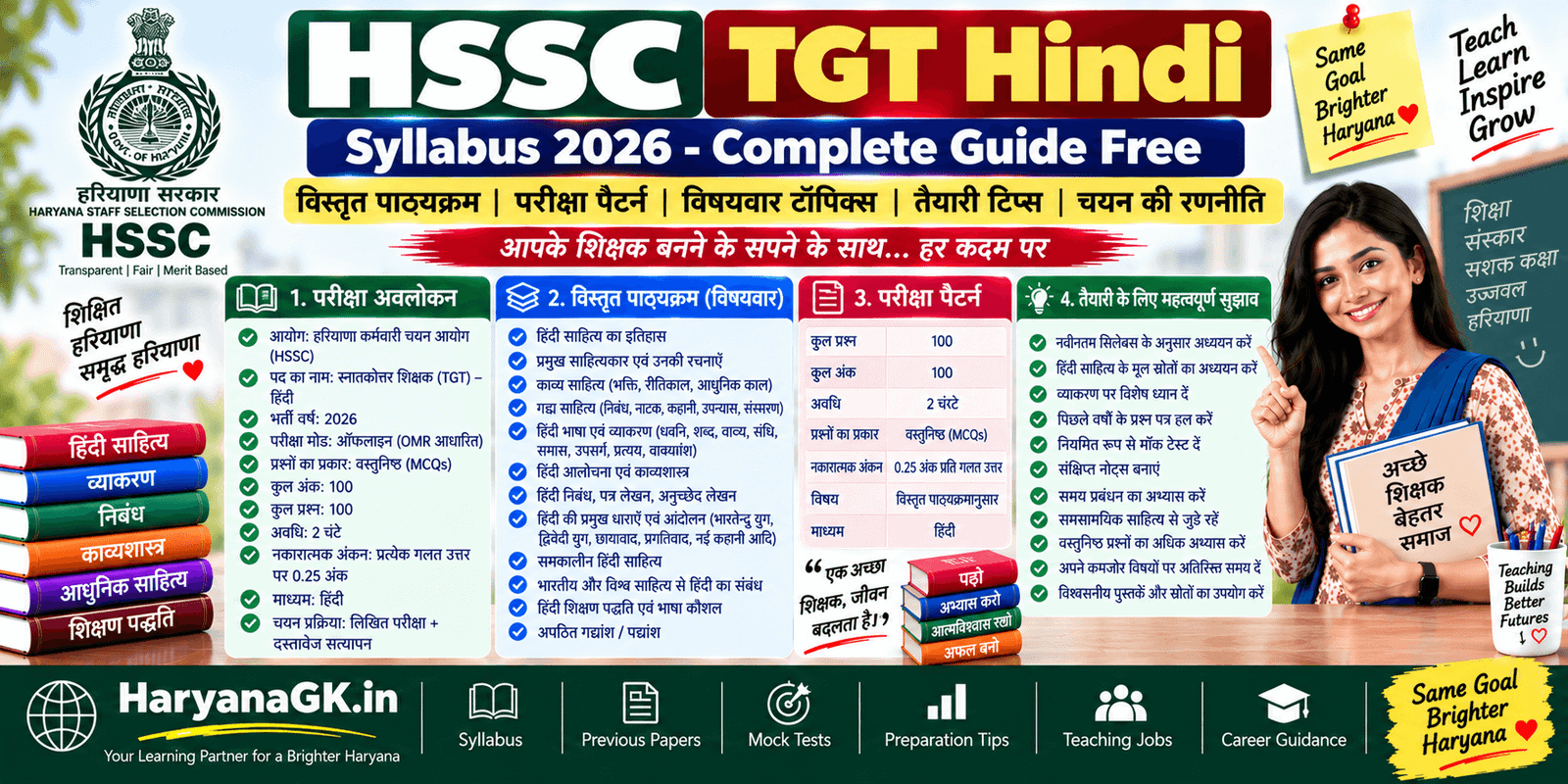
HSSC TGT Hindi Syllabus 2026 – Complete Guide Free
HSSC TGT Hindi Syllabus 2026 covers recruitment for TGT Hindi posts under the Haryana Staff Selection Commission. This HSSC TGT Hindi Syllabus guide breaks down the exam pattern and the full subject-wise topic list, straight from the official syllabus published at hssc.gov.in, so you know exactly what to study before you open a single PDF.
HSSC TGT Hindi Syllabus Exam Pattern
यह भर्ती HSSC की दो-चरण प्रक्रिया से होती है: पहले साझा पात्रता परीक्षा (CET), फिर इस पद की लिखित परीक्षा, जिसका सिलेबस नीचे दिया है। CET का पूरा पैटर्न हमारे HSSC गाइड में है।
The HSSC TGT Hindi Syllabus for the written exam splits into weighted parts:
- ENVIRONMENTAL AWARENESS — 10% weightage
- Haryana General Knowledge and Welfare schemes of Haryana Government — 20% weightage
- Road Safety Awareness — 5% weightage
- Perspectives on Education and Leadership — 15% weightage
- पाɫ यĐम — 50% weightage
HSSC notes on the official document that this weightage is tentative and may vary, so treat it as a study-time guide rather than a locked question count.
HSSC TGT Hindi Syllabus 2026 (Subject-Wise)
The subject-specific block of the HSSC TGT Hindi Syllabus spans the following areas. Here is the complete breakdown.
(a) Understanding the Learner
Concept of growth, maturation and development, principles and debates of development, development tasks and challenges, Domains of Development: Physical, Cognitive, Socio-emotional, Moral etc., deviations in development and its implications, Understanding Adolescence: Needs, challenges and implications for designing institutional support, Role of Primary and Secondary Socialization agencies. Ensuring Home school continuity.
(b) Understanding Teaching Learning
Theoretical perspectives on Learning -Behaviorism, Cognitivism and Constructivism with special reference to their implications for:
(i) The role of teacher
(ii) The role of learner
(iii) Nature of teacher- student relationship
(iv) Choice of teaching methods
(v) Classroom environment
(vi) Understanding of discipline, power etc.
Factors affecting learning and their implications for:
(i) Designing classroom instructions,
(ii) Planning student activities and,
(iii) Creating learning spaces in school.
Planning and Organization of Teaching-Learning;
- e-Perspectives in Education,
- NEP-2020: Early Childhood Care and Education:
- The Foundation of Learning; Foundational Literacy and Numeracy;
Curriculum and Pedagogy in Schools:
- Holistic & Integrated Learning; Equitable and Inclusive Education:
- Learning for All; Competency based learning and Education.
- Guiding Principles for Child Rights,
- Protecting and provisioning for rights of children to safe and secure school environment,
- Right of Children to free and Compulsory Education Act, 2009,
- Historically studying the National Policies in education with special reference to school education;
- School Curriculum Principles:
- Perspective, Learning and Knowledge, Curricular Areas, School Stages — Pedagogy & Assessment,
- (i) Concept of Syllabus and Curriculum, Overt and Hidden Curriculum
- (ii) Foundational Literacy and Numeracy, Early Childhood Care and Education
- (iii) Competency based Education, Experiential learning, etc.
- (iv) Instructional Plans: -Year Plan, Unit Plan, Lesson Plan
- (v) Instructional material and resources
- (vi) Information and Communication Technology (ICT) for teaching- learning
- (vii) Assessment of learning, for learning and as learning: Meaning, purpose and considerations in planning each.
- Enhancing Teaching Learning processes: Classroom Observation and Feedback, Reflections and Dialogues as a means of constructivist teaching
c) Creating Conducive Learning Environment
- The concepts of Diversity, disability and Inclusion,
- implications of disability as social construct,
- types of disabilities-their identification and interventions,
- Concept of School Mental Health,
- addressing the curative, preventive and promotive dimensions of mental health for all students and staff.
- Provisioning for guidance and counselling,
- Developing School, and community as a learning resource.
(d) School Organization and Leadership
Leader as reflective practitioner, team builder, initiator, coach, and mentor, Perspectives on School Leadership: instructional, distributed, and transformative, Vision building, goal setting and creating a School development Plan, Using School Processes and forums for strengthening teaching learning- Annual Calendar, time-tabling, parent teacher forums, school assembly, teacher development forums, using achievement data for improving teaching —learning, School Self-Assessment, and Improvement, Creating partnerships with community, industry and other neighboring schools and Higher Education Institutes — forming learning communities.
(e) Perspectives in Education NEP-2020: Early Childhood Care and Education: The Foundation of Learning; Foundational Literacy and Numeracy; Curriculum and Pedagogy in Schools: Holistic & Integrated Learning; Equitable and Inclusive Education: Learning for All; Competency based learning and Education, Guiding Principles for Child Rights, Protecting and provisioning for rights of children to safe and secure school environment, Right of Children to free and Compulsory Education Act, 2009, Historically studying the National Policies in education with special reference to school education; School Curriculum Principles: Perspective, Learning and Knowledge, Curricular Areas, School Stages — Pedagogy & Assessment
Common Sections for HSSC TGT English Syllabus 2026
Environmental Awareness: Introduction: Basics of ecology, eco system- concept, and sustainable development, Sources, advantages, disadvantages of renewable and non-renewable energy, Rain water harvesting, Deforestation – its effects & control measures.
Air and Noise Pollution: Air Pollution: Source of air pollution. Effect of air pollution on human health, economy, Air pollution control methods, Noise Pollution: Source of noise pollution, Unit of noise, Effect of noise pollution, Acceptable noise level, Different method of minimizing noise pollution.
Water and Soil Pollution: Water Pollution: Impurities in water, Cause of water pollution, Source of water pollution. Effect of water pollution on human health, Concept of DO, BOD, COD. Prevention of water pollution- Water treatment processes, Sewage treatment. Water quality standard, Soil Pollution: Sources of soil pollution, Effects and Control of soil pollution, Types of Solid waste- House hold, Industrial, Agricultural, Biomedical, Disposal of solid waste, Solid waste management E-waste, E – waste management. Impact of Energy Usage on Environment: Global Warming, Green House Effect, Depletion of Ozone Layer, Acid Rain. Eco-friendly Material, Recycling of Material, Concept of Green Buildings, Concept of Carbon Credit & Carbon footprint
Haryana General Knowledge and Welfare schemes of Haryana Government: Haryana history, current affairs, literature, Geography, Civics, Environment, Culture etc. and Welfare schemes run by state Government of Haryana and provisions there-in
Road Safety Awareness: Traffic Rules, importance of traffic rules, authority to implement traffic rules, punishment for violating traffic rules, authority to issue driving license, procedure to get driving license, classification of vehicles, traffic signs, knowledge of safety measures in vehicles
पाठ्यक्रम:
- हिंदी साहित्य का इतिहास – आदिकाल, रीतिकाल, भक्तिकाल, आधुनिक काल |
- उत्पत्ति, समस्याएं, विशेषताएं, प्रमुख कवि, लेखक, रचनाएँ आदि |
- कहानी, नाटक, उपन्यास |
- संज्ञा, सर्वनाम, विशेषण, क्रिया, क्रिया विशेषण, कारक, काल, विकारी, अविकारी, उपसर्ग, प्रत्यय
- वर्ण विचार, शब्द विचार, वाक्य विचार, समास, संधि, अलंकार, विलोम, पर्यायवाची, अनेकार्थी |
- हिंदी गद्य, पदम् |
Important Note: The Weightage as mentioned against the syllabus is tentative & may vary.
आधिकारिक स्रोत
इस पेज का सिलेबस हरियाणा कर्मचारी चयन आयोग (HSSC) के आधिकारिक दस्तावेज़ से लिया गया है। ताज़ा संस्करण और भर्ती सूचनाएँ hssc.gov.in/examsyllabus पर देखें।
दूसरे सभी HSSC पदों के सिलेबस और भर्ती प्रक्रिया हमारे HSSC गाइड पेज पर एक जगह दिए गए हैं।