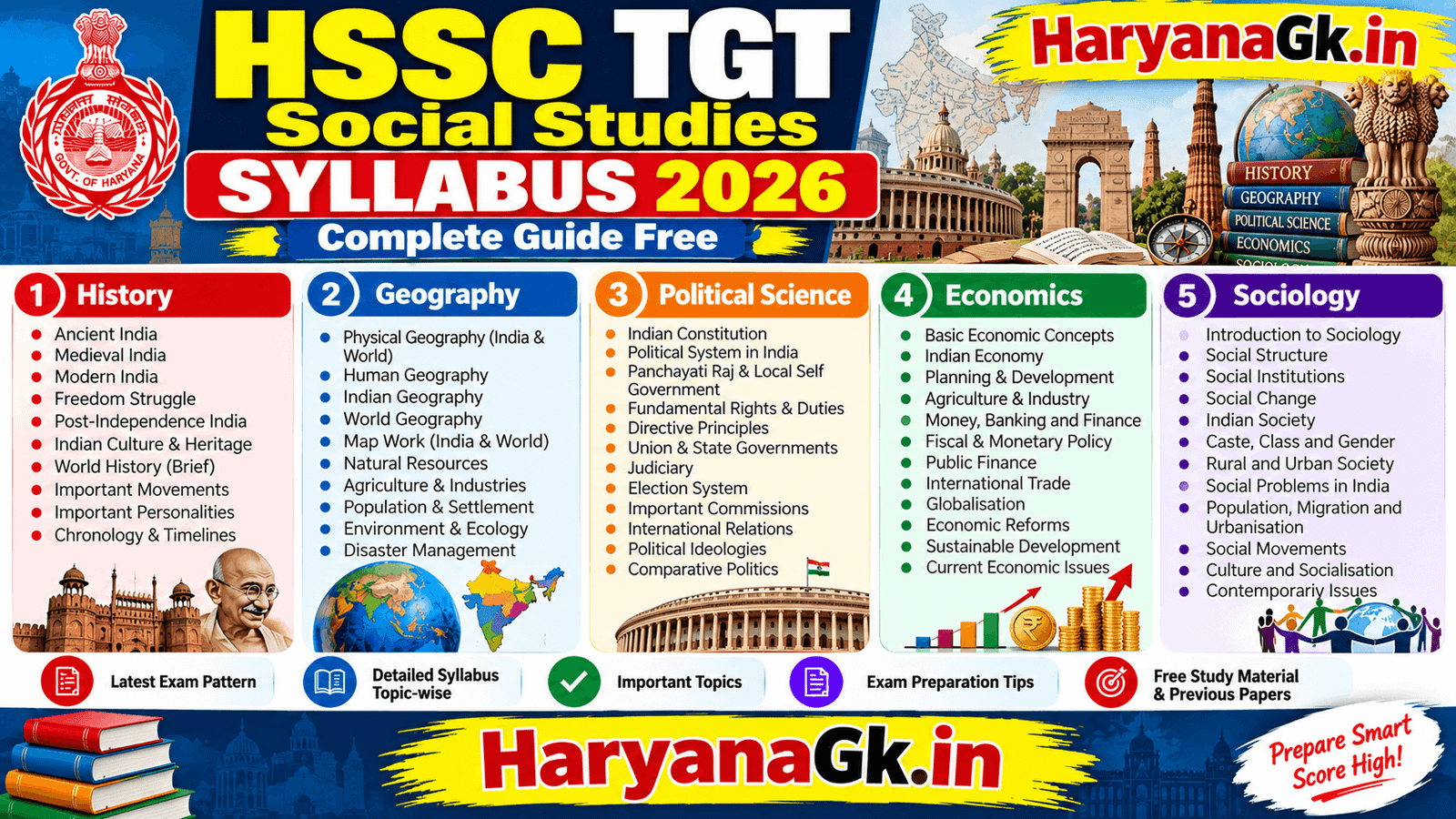
The HSSC TGT Social Studies Syllabus 2026 covers recruitment for TGT Social Studies posts under the Haryana Staff Selection Commission. This HSSC TGT Social Studies Syllabus guide breaks down the exam pattern and the full subject-wise topic list, straight from the official syllabus published at hssc.gov.in, so you know exactly what to study before you open a single PDF.
HSSC TGT Social Studies Syllabus Exam Pattern
यह भर्ती HSSC की दो-चरण प्रक्रिया से होती है: पहले साझा पात्रता परीक्षा (CET), फिर इस पद की लिखित परीक्षा, जिसका सिलेबस नीचे दिया है। CET का पूरा पैटर्न हमारे HSSC गाइड में है।
The HSSC TGT Social Studies Syllabus for the written exam splits into weighted parts:
- ENVIRONMENTAL AWARENESS — 10% weightage
- Haryana General Knowledge and Welfare schemes of the Haryana Government — 20% weightage
- Road Safety Awareness — 5% weightage
- Perspectives on Education and Leadership — 15% weightage
- Social Studies — 50% weightage
HSSC notes on the official document that this weightage is tentative and may vary, so treat it as a study-time guide rather than a locked question count.
HSSC TGT Social Studies Syllabus 2026 (Subject-Wise)
The subject-specific block of the HSSC TGT Social Studies Syllabus spans the following areas. Here is the complete breakdown.
1. ENVIRONMENTAL AWARENESS (Weightage 10%)
Introduction: Basics of ecology, ecosystem concept, and sustainable development; sources; advantages and disadvantages of renewable and non-renewable energy; Rainwater harvesting, deforestation – its effects & control measures.
Air and Noise Pollution:
Air Pollution: Source of air pollution. Effect of air pollution on human health, economy, Air pollution control methods, Noise Pollution: Source of noise pollution, Unit of noise, Effect of noise pollution, Acceptable noise level, Different methods of minimising noise pollution.
Water and Soil Pollution: Water Pollution: Impurities in water, Cause of water pollution, Source of water pollution. Effect of water pollution on human health, Concept of DO, BOD, and COD. Prevention of water pollution – Water treatment processes, sewage treatment. Water quality standard, Soil Pollution: Sources of soil pollution, Effects and Control of soil pollution, Types of Solid Waste – Household, Industrial, Agricultural, Biomedical, Disposal of solid waste, solid waste management, e-waste, and e-management. Impact of Energy Usage on the Environment: Global Warming, Greenhouse Effect, Depletion of Ozone Layer, Acid Rain. Eco-friendly material, recycling of material, concept of green buildings, concept of carbon credit & carbon footprint.
- Haryana General Knowledge and Welfare schemes of the Haryana Government. (Weightage 20%) Haryana history, current affairs, literature, geography, civics, environment, culture, etc., and welfare schemes run by the state government of Haryana and provisions there-in.
- Road Safety Awareness (Weightage 5%) Traffic rules, the importance of traffic rules, the authority to implement traffic rules, punishment for violating traffic rules, the authority to issue driving licences, the procedure to get a driving licence, the classification of vehicles, traffic signs, and knowledge of safety measures in vehicles.
- Perspectives on Education and Leadership (a) Understanding the Learner (Weightage 15%) Concept of growth, maturation and development; principles and debates of development; development tasks and challenges; domains of development: physical, cognitive, socio-emotional, moral, etc.; deviations in development and its implications; understanding adolescence: needs, challenges and implications for designing institutional support; role of primary and secondary socialisation agencies. Ensuring homeschool continuity.
(b) Understanding Teaching Learning Theoretical perspectives on Learning-Behaviourism, Cognitivism and Constructivism with special reference to their implications for: (i) The role of teacher (ii) The role of learner (iii) Nature of teacher-student relationship (iv) Choice of teaching methods (v) Classroom environment (vi) Understanding of discipline, power, etc.
Factors affecting learning and their implications for: (i) Designing classroom instructions, (ii) planning student activities and (iii) creating learning spaces in school. Planning and Organisation of Teaching-Learning: e-Perspectives in Education,
NEP-2020: Early Childhood Care and Education: The Foundation of Learning; Foundational Literacy and Numeracy; Curriculum and Pedagogy in Schools: Holistic & Integrated Learning;
Equitable and Inclusive Education: Learning for All; Competency-based Learning and Education. Guiding Principles for Child Rights, Protecting and Provisioning for Rights of Children to Safe and Secure School Environment, Right of Children to Free and Compulsory Education Act, 2009, Historically studying the National Policies in Education with special reference to school education;
School Curriculum Principles: Perspective, Learning and Knowledge, Curricular Areas, School Stages Pedagogy & Assessment, (i) Concept of Syllabus and Curriculum, Overt and Hidden Curriculum (ii), Foundational Literacy and Numeracy, Early Childhood Care and Education (iii) Competency-based education, experiential learning, etc. (iv) Instructional Plans: Year Plan, Unit Plan, Lesson Plan (v) Instructional material and resources (vi) Information and Communication Technology (ICT) for teaching-learning (vii) Assessment of learning, for learning and as learning: Meaning, purpose and considerations in planning each. Enhancing Teaching and Learning Processes: Classroom Observation and Feedback, Reflections and Dialogues as a Means of Constructivist Teaching.
c) Creating a Conducive Learning Environment The concepts of diversity, disability and inclusion; the implications of disability as a social construct; types of disabilities – their identification and interventions; the concept of school mental health; and addressing the curative, preventive and promotive dimensions of mental health for all students and staff. Provisioning for guidance and counselling, developing school and community as learning resources.
(d) School Organisation and Leaders – The leader is a reflective practitioner, team builder, initiator, coach, and mentor. Perspectives on School Leadership: instructional, distributed, and transformative. Vision building, goal setting and creating a School Development Plan, Using School Processes and Forums for Strengthening Teaching and Learning – Annual Calendar, time-tabling, parent-teacher forums, school assembly, teacher development forums, using achievement data for improving teaching and learning, School Self-Assessment, and Improvement. Creating partnerships with community, industry and other neighbouring schools and Higher Education Institutes – forming learning communities.
(e) Perspectives in Education NEP-2020: Early Childhood Care and Education: The Foundation of Learning; Foundational Literacy and Numeracy; Curriculum and Pedagogy in Schools: Holistic & Integrated Learning; Equitable and Inclusive Education: Learning for All; Competency-based Learning and Education, Guiding Principles for Child Rights, Protecting and Provisioning for Rights of Children to Safe and Secure School Environment, Right of Children to Free and Compulsory Education Act, 2009, Historically studying the National Policies in Education with special reference to School Education; School Curriculum Principles: Perspective, Learning and Knowledge, Curricular Areas, School Stages – Pedagogy & Assessment.
Weightage: 50% Social Studies
इतिहास सरस्वती सिंधु सभ्यता, वैदिक काल, रामायण व महाभारत काल, मौर्यवंश, इस्लाम का उदय, जैन धर्म, बौद्ध धर्म, शंकराचार्य का जीवन, विदेशीयों के आक्रमण एवं उनका भारतीय संस्कृति में समावेश, गुप्तकाल, हर्शवर्धन और तात्कालीन समाज, दक्षिण के राज्य चालुक्य, पल्लव एवं चोलपाल, प्रतिहार एवं राष्ट्रकूट, विश्व में भारतीय संस्कृति का प्रकार,
प्राचीन भारत में शिक्षा, साहित्य एवं कला, राजा दाहिर एवं राजा आनन्दपाल, सुहेलदेव एवं पृथ्वीराज चौहान, मोहम्मद गौरी, कुतुबद्दीन ऐबक, इल्तुतमिश, रजिया, बलबन, अलाउद्दीन खिलजी, तुगलकवंश, तैमूर, दिलावर खां, विजय नगर साम्राज्य, बाबर, राणा संग्राम सिंह, मोहन सिंह मंढार, हुमायूँ, शेर शाहसूरी, अकबर, हेम चन्द्र विक्रमादित्य, रानी दुर्गावती, महाराणा प्रताप, जहांगीर, शाहजहाँ, औरंगजेब, सिक्ख गुरु, भक्ति आंदोलन, भक्तिगुरु शंकराचार्य, गुरुनानक, कबीर, मीरा, रस खान, दारा शिकोह आदि,
छत्रपति शिवाजी एवं पेशवा, 17वीं शताब्दी में मुगलों का क्षेत्रीय प्रतिरोध, 18वीं शताब्दी का भारत: स्वतंत्र राज्यों का उदय, मराठा शक्ति, पानीपत का तीसरा युद्ध, बंगाल, अवध, राजपुताना, सिक्ख, हैदराबाद, कर्नाटक, जात, सहेलखण्ड, बुन्देलखण्ड, राज्य, यूरोपीय शक्तियाँ, संस्कृतियों का टकराव, यूरोपीय घुस पैठ तथा विस्तारवादी नीतियों, 1857 की क्रान्ति, कांग्रेस की स्थापना, मुस्लिम लीग, महात्मा गांधी और राष्ट्रीय आन्दोलन, क्रांतिकारी आंदोलन, विभाजन को समझना, संविधान का निर्माण, औध्योगिक क्रांति, भारतीय राष्ट्रीय आंदोलन में हरियाणा की भूमिका।
भूगोल सौर मंडल में पृथ्वी, ग्लोब अक्षांश रेखा एवं देशांतर रेखा, पृथ्वी की गतियाँ, पृथ्वी के प्रमुख परिमण्डल, पृथ्वी के प्रमुख स्थलरुप, पृथ्वी के अन्दर, भारत, जलवायु, वनस्पति, वन्य प्राणी, वायु, जल, भूमि, मृदा, कृषि, पर्यावरण, बस्तियाँ, परिवहन एवं संचार, रेगिस्तान में जीवन, संसाधन, उद्योग, मानव संसाधन, खनिज, उर्जा संसाधन, विनिमार्ण उद्योग।
राजनीति शास्त्र राजनीतिक सिद्धांत स्वतंत्रता, समानता, सामाजिक न्याय, अधिकार, कर्तव्य, नागरिकता, राष्ट्रवाद, धर्म निरपेक्षता, शांति, विकास, संविधान, मौलिक अधिकार, चुनाव, कार्यपालिका, विधानपालिका, न्यायपालिका, संघवाद, स्थानीय शासन, संविधान एक जीवन, दस्तावेज, राष्ट्र निर्माण मे चुनौतियाँ, नियोजित विकास, भारत के विदेशी सम्बन्ध, कांग्रेस प्रणाली- चुनौतियाँ और पुनस्थापना, लोकतांत्रिक व्यवस्था का संकट, जन आन्दोलन, भारतीय राजनीति के नए बदलाव, शीत युद्ध का दौर, दो ध्रुवीयता का अंत, समकालीन विश्व में अमेरिका, वर्च स्वसत्ता के वैकल्पिक केन्द्र, समकालीन दक्षिण एशिया, समकालीन विश्व की सुरक्षा, अन्र्तराष्ट्रीय संगठन, गुट निरपेक्ष आंदोलन, अर्थशास्त्र, उदारीकरण, वैश्वीकरण, विकास, भारतीय अर्थव्यवस्था के क्षेत्रक, मुद्रा और साख, उपभोक्ता अधिकार।
Important Note: The weightage as mentioned against the syllabus is tentative & may vary.
HSSC TGT सामाजिक अध्ययन की तैयारी: हरियाणा GK से दोहरा फ़ायदा
HSSC TGT की लिखित परीक्षा में आपका विषय 50% वेटेज रखता है, पर बाकी 50% — पर्यावरण जागरूकता (10%), हरियाणा GK व सरकारी कल्याण योजनाएँ (20%), सड़क सुरक्षा (5%) और शिक्षा व नेतृत्व के परिप्रेक्ष्य (15%) — सभी TGT विषयों में समान है। कई उम्मीदवार विषय पर पूरा ज़ोर देकर यही 50% हल्के में ले लेते हैं, जबकि यहाँ के प्रश्न अपेक्षाकृत सीधे होते हैं।
सामाजिक अध्ययन के उम्मीदवारों को एक अतिरिक्त लाभ है: हरियाणा GK (20%) का इतिहास और भूगोल वाला हिस्सा आपके अपने विषय से जुड़ा है। इसलिए हरियाणा के इतिहास, भूगोल और प्रशासन को विषय की तैयारी के साथ ही पढ़ें।
- इतिहास, भूगोल, राजनीति विज्ञान और अर्थशास्त्र — चारों के लिए NCERT कक्षा 6 से 10 की पुस्तकें मुख्य स्रोत रखें।
- हरियाणा के ऐतिहासिक स्थल (कुरुक्षेत्र, पानीपत, राखीगढ़ी, अग्रोहा) और उनसे जुड़ी घटनाओं की सूची बनाएँ।
- पर्यावरण खंड में सतत विकास, वर्षा जल संचयन और वनों की कटाई जैसे विषय आपके भूगोल से मेल खाते हैं।
- शिक्षा के परिप्रेक्ष्य (15%) में NEP-2020 की मुख्य बातें और बाल अधिकार ज़रूर पढ़ें।
आधिकारिक स्रोत
इस पेज का सिलेबस हरियाणा कर्मचारी चयन आयोग (HSSC) के आधिकारिक दस्तावेज़ से लिया गया है। ताज़ा संस्करण और भर्ती सूचनाएँ hssc.gov.in/examsyllabus पर देखें।
दूसरे सभी HSSC पदों के सिलेबस और भर्ती प्रक्रिया हमारे HSSC गाइड पेज पर एक जगह दिए गए हैं।