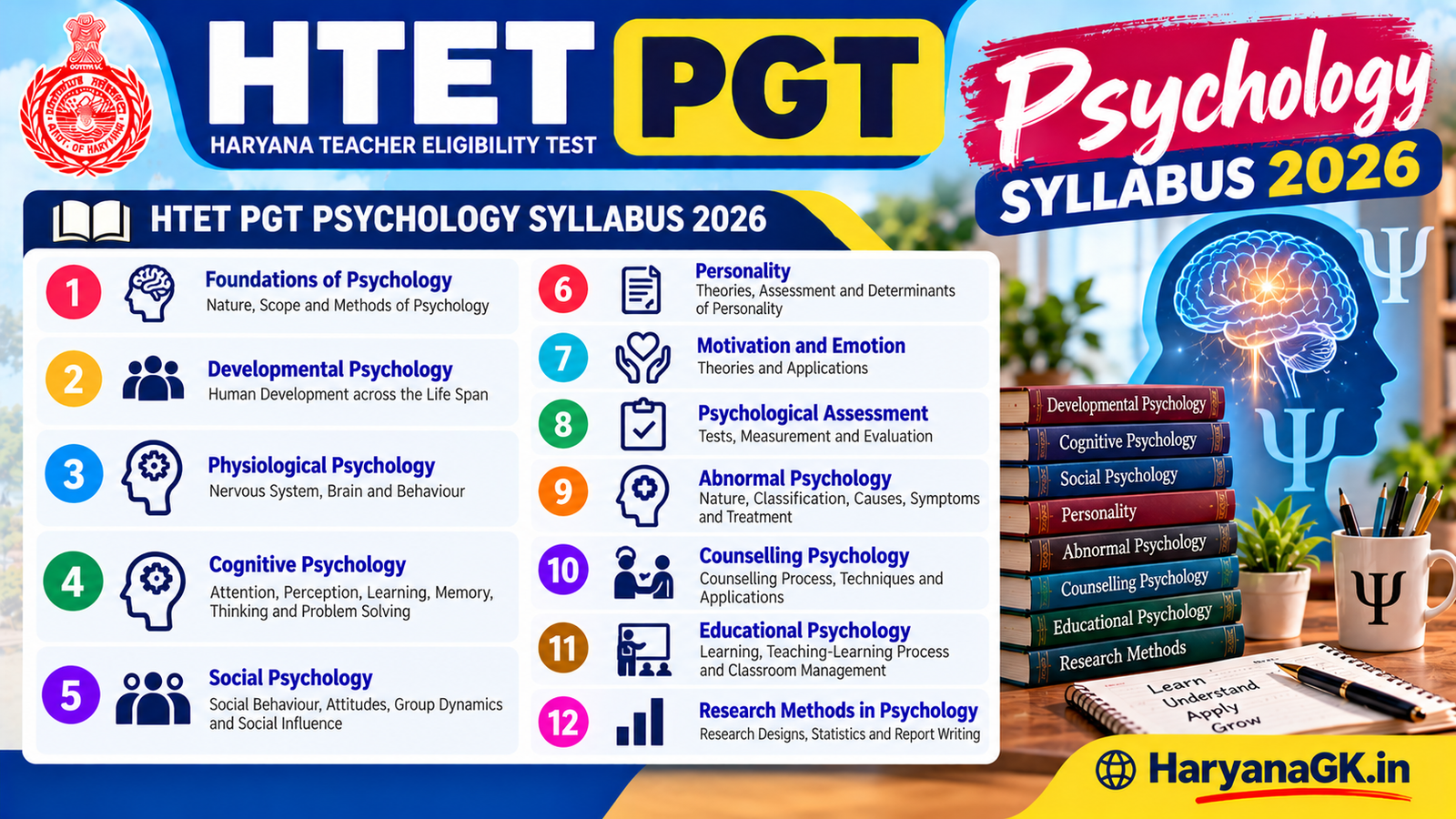
HTET PGT Psychology Syllabus 2026 Subject-wise Syllabus, Exam Pattern and Eligibility
PGT Psychology packs an almost complete postgraduate psychology curriculum into one 60-mark section — cognitive processes, human development, personality theory, abnormal psychology, therapeutic approaches and social psychology all appear as distinct, substantial topics. Candidates who specialised in clinical or counselling psychology during their M.A. sometimes under-prepare the cognitive and social psychology portions, which carry equal testable weight.
This guide covers the HTET PGT Psychology syllabus exactly as BSEH has structured it, along with the exam weightage and the eligibility conditions for this paper.
| HTET Previous Year Exam Papers with Answer Keys | ||
| Sr. No. | Year of Exam | Download Link |
| 1 | 2024 | Download PDFs  |
| 2 | 2023 | Download PDFs |
| 3 | 2022 | Download PDFs |
| 4 | 2021 | Download PDFs |
| 5 | 2020 | Download PDFs |
| 6 | 2019 | Download PDFs |
HTET PGT Psychology Exam Pattern and Weightage 2026
The paper has 150 multiple-choice questions for 150 marks, completed in two and a half hours, with one mark per question and no negative marking.
| Section | Number of MCQs | Marks |
|---|---|---|
| Child Development and Pedagogy | 30 | 30 |
| Languages (Hindi 15 + English 15) | 30 | 30 |
| General Studies (Quantitative Aptitude 10, Reasoning 10, Haryana GK 10) | 30 | 30 |
| Psychology (Subject Specific) | 60 | 60 |
| Total | 150 | 150 |
Qualifying marks:
- General category candidates: 60% (90 marks)
- SC and differently-abled candidates of Haryana domicile: 55% (82 marks)
- SC and differently-abled candidates from other states: 60% (90 marks)
Topics come from the Class 9-12 syllabus prescribed by the Haryana Education Department, with the difficulty standard reaching postgraduate level.
Common Syllabus for HTET PGT (Child Development, Languages, General Studies)
These three sections are identical across every PGT subject and make up 90 of the 150 marks. For Psychology candidates specifically, it’s worth noting that the Child Development and Pedagogy section (Piaget, Kohlberg, Vygotsky, Freud, Erikson, Bandura) overlaps conceptually with parts of the subject-specific Human Development content below — but they’re tested from different angles and shouldn’t be treated as redundant revision.
Child Development and Pedagogy
Covers the psychology of teaching and learning for the 14-17 age group, including Freud’s Psychosexual Development Theory, Erikson’s Theory of Psychosocial Development, Bandura’s Social Learning Theory, and the standard Piaget/Kohlberg/Vygotsky foundations, alongside inclusive education and assessment practices.
Languages — Hindi and English
Each carries 15 marks: one unseen passage tested for comprehension, inference, grammar and verbal ability, combined with the pedagogy of language development.
General Studies — Haryana GK, Reasoning and Quantitative Aptitude
Haryana GK (10 marks) covers state history, current affairs, geography and welfare schemes. Reasoning (10 marks) spans verbal and non-verbal types. Quantitative Aptitude (10 marks) covers number systems, percentages, interest, mensuration and data representation.
HTET PGT Psychology: Subject-Specific Syllabus
The 60-mark section spans the full breadth of psychology as a discipline.
Foundations and Research Methods
Understanding mind and behaviour, popular notions about psychology as a discipline, the evolution of psychology and its development in India, the branches of psychology, and its relationship with other disciplines and everyday life.
Methods of enquiry — the goals of psychological research, the steps in conducting scientific research, alternative research paradigms, and the nature of psychological data. Specific methods covered include the observational method, experimental method, correlational research, survey research, psychological testing and the case study method, along with quantitative and qualitative data analysis, the limitations of psychological enquiry, and ethical issues.
Cognitive Processes
Sensory, attentional and perceptual processes — the nature and varieties of stimuli, sense modalities, selective and sustained attention, perceptual organisation, the perception of space, depth and distance (monocular and binocular cues), perceptual constancies, illusions, and socio-cultural influences on perception.
Learning — classical and operant/instrumental conditioning and their determinants, observational, cognitive, verbal and skill learning, factors facilitating learning, and learning disabilities. Human memory — the information processing (stage) model, sensory/short-term/long-term memory systems, levels of processing, declarative versus procedural and episodic versus semantic memory, the causes of forgetting, and memory-enhancement techniques.
Thinking — the building blocks and processes of thought, problem solving, reasoning, decision making, creative thinking, and the relationship between thought and language.
Human Development, Motivation, Emotion, Personality and Stress
Human development — its meaning, the life-span perspective, the factors and context influencing development, and an overview of developmental stages from the prenatal period through infancy, childhood, adolescence, adulthood and old age.
Motivation and emotion — biological and psychosocial motives, Maslow’s Hierarchy of Needs, the nature and expression of emotions, cultural influences on emotional expression and labelling, and managing negative and enhancing positive emotions.
Self and personality — the cognitive and behavioural aspects of self, self-esteem, self-efficacy and self-regulation, and the major approaches to personality: type, trait, psychodynamic, behavioural, cultural and humanistic — along with personality assessment through self-report, projective techniques and behavioural analysis.
Stress — its effects on psychological functioning and health, the general adaptation syndrome, the relationship between stress and the immune system, coping techniques, and promoting positive health and wellbeing through life skills.
Individual Differences, Abnormal Psychology and Therapy
Intelligence — the major theories (one-factor, two-factor, primary mental abilities, structure of intellect, multiple intelligences, triarchic theory, and the planning-attention-arousal-simultaneous-successive model), individual and cultural variations in intelligence, emotional intelligence, and special abilities including aptitude and creativity.
Abnormal psychology — the historical background and classification of psychological disorders, and the factors underlying abnormal behaviour. Major disorders covered include anxiety disorders (generalised anxiety, panic disorder, phobia, OCD, PTSD), somatoform disorders, dissociative disorders, mood disorders, schizophrenic disorders, behavioural and developmental disorders, and substance use disorders.
Therapeutic approaches — the nature and process of psychotherapy, the therapeutic relationship, and types of therapy including behavioural, cognitive, cognitive-behavioural, humanistic-existential and alternative therapies, along with the rehabilitation of the mentally ill.
Social Psychology
Attitude and social cognition — the nature and components of attitudes, attitude formation and change, the attitude-behaviour relationship, and prejudice and discrimination along with strategies for handling it. Social influence and group processes — the nature and formation of groups, types of groups, and the influence of groups on individual behaviour, including social learning and group polarisation — plus subject-related pedagogy.
Given how much ground this syllabus covers — essentially cognitive, developmental, clinical and social psychology all in one paper — it’s worth building separate revision blocks for each rather than assuming depth in your M.A. specialisation (often clinical or counselling psychology) covers the cognitive and social psychology portions equally well.
Visit bseh.org.in or htet.eapplynow.com for official Notification & Syllabus 2026
Who Is Eligible for HTET PGT Psychology? Qualification Details
You need to satisfy all of the following:
- A Post Graduate degree in Psychology with at least 50% marks from a recognised university, along with a B.Ed. from a recognised university.
- Matric with Hindi or Sanskrit as a subject, or Senior Secondary/Graduation/Post Graduation with Hindi as one of the subjects.
- A consistent good academic record.
What counts as “Good Academic Record”
For direct recruitment, “Good Academic Record” means averaging at least 50% marks across any three of your 10th, 12th, Graduation and Post-Graduation results — but you must separately have at least 50% marks in your Post-Graduation itself.
Relaxation for SC, BC and differently-abled candidates
Where the minimum qualifying mark is 50%, SC, BC and differently-abled candidates get a 5% relaxation, bringing it to 47.5%. Where the minimum is 45%, the relaxed figure is 42.75%, per the Supreme Court’s 2011 ruling in P.V. Indiresan vs Union of India.
A qualification detail worth checking twice
Only a B.Ed. recognised by the National Council for Teacher Education (NCTE) counts. For the B.Ed. (Special Education) route specifically, the course needs recognition from the Rehabilitation Council of India (RCI) instead.
HSSC Group D – Previous Year Solved Papers
Practice HSSC Group D previous year solved question papers, shift-wise, with instant answers and explanations after every question.
| Exam Date | Shift | Solved Paper |
|---|---|---|
| 10 November 2018 | Shift 1 | Attempt Quiz  |
| 10 November 2018 | Shift 2 | Attempt Quiz |
| 11 November 2018 | Shift 1 | Attempt Quiz |
| 11 November 2018 | Shift 2 | Attempt Quiz |
| 17 November 2018 | Shift 1 | Attempt Quiz |
| 17 November 2018 | Shift 2 | Attempt Quiz |
| 18 November 2018 | Shift 1 | Attempt Quiz |
| 21 October 2023 | Shift 1 / Morning | Attempt Quiz |
| 21 October 2023 | Shift 2 / Evening | Attempt Quiz |
| 22 October 2023 | Shift 1 / Morning | Attempt Quiz |
| 22 October 2023 | Shift 2 / Evening | Attempt Quiz |
Frequently Asked Questions
Does PGT Psychology overlap with the Child Development and Pedagogy common section?
There’s conceptual overlap — both touch Piaget, Freud and Erikson, for example — but the common section applies pedagogy to teaching 14-17 year olds, while the subject-specific Human Development content covers the full life-span from a psychology-discipline perspective. Preparing one doesn’t fully cover the other.
How many psychological disorders should I prepare in detail?
The syllabus names specific disorders within five major categories — anxiety, somatoform, dissociative, mood/schizophrenic, and behavioural/developmental/substance-use disorders — each with named sub-types (like GAD, panic disorder, phobia, OCD and PTSD under anxiety disorders), so detailed preparation across all five categories is expected.
Is research methodology tested as theory only, or does it include statistical analysis?
The syllabus wording covers methods and approaches (observational, experimental, correlational, survey, case study) and the distinction between quantitative and qualitative analysis, but doesn’t list detailed statistical procedures — the emphasis is on method selection and research design rather than calculation.
Does this syllabus match a typical M.A. Psychology curriculum closely?
Very closely — the breadth (cognitive, developmental, personality, abnormal, social psychology) mirrors a general M.A. Psychology core curriculum rather than any single specialisation, so candidates should revise broadly rather than relying only on their area of specialisation.
Given the sheer range here, prioritise building a disorder-by-disorder reference table for Abnormal Psychology and a theory-by-theory table for Personality and Intelligence — these three areas pack the most named sub-concepts per syllabus line and are the easiest to lose marks on through incomplete coverage.