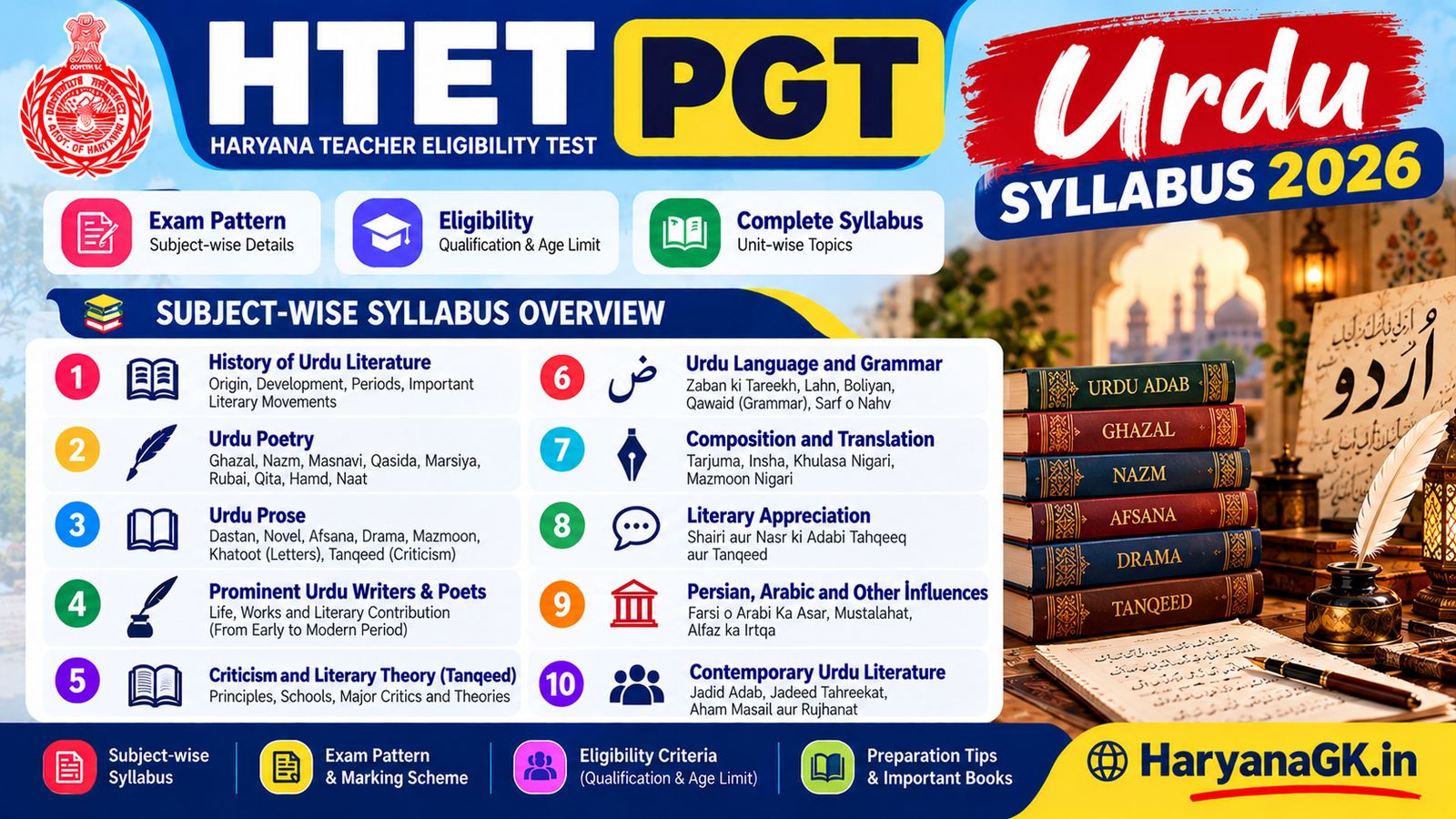
HTET PGT Urdu Syllabus 2026 Subject-wise Syllabus, Exam Pattern and Eligibility
PGT Urdu expands well beyond TGT Urdu’s single textbook series — four prescribed books feed into this 60-mark paper (Jaan Pehchaan Parts 4 and 5, plus Gulistan-e-Adab and Khiyaban-e-Urdu), and the Poetry section adds entire literary forms that TGT Urdu doesn’t cover at all, including Masnavi, Qasida, Marsiya and Rubai.
This guide covers the HTET PGT Urdu syllabus exactly as BSEH has structured it, along with the exam weightage and the eligibility conditions for this paper.
| HTET Previous Year Exam Papers with Answer Keys | ||
| Sr. No. | Year of Exam | Download Link |
| 1 | 2024 | Download PDFs  |
| 2 | 2023 | Download PDFs |
| 3 | 2022 | Download PDFs |
| 4 | 2021 | Download PDFs |
| 5 | 2020 | Download PDFs |
| 6 | 2019 | Download PDFs |
HTET PGT Urdu Exam Pattern and Weightage 2026
The paper has 150 multiple-choice questions for 150 marks, completed in two and a half hours, with one mark per question and no negative marking.
| Section | Number of MCQs | Marks |
|---|---|---|
| Child Development and Pedagogy | 30 | 30 |
| Languages (Hindi 15 + English 15) | 30 | 30 |
| General Studies (Quantitative Aptitude 10, Reasoning 10, Haryana GK 10) | 30 | 30 |
| Urdu (Subject Specific) | 60 | 60 |
| Total | 150 | 150 |
Qualifying marks:
- General category candidates: 60% (90 marks)
- SC and differently-abled candidates of Haryana domicile: 55% (82 marks)
- SC and differently-abled candidates from other states: 60% (90 marks)
Topics come from the Class 9-12 syllabus prescribed by the Haryana Education Department, with the difficulty standard reaching postgraduate level.
Common Syllabus for HTET PGT (Child Development, Languages, General Studies)
These three sections are identical across every PGT subject and make up 90 of the 150 marks.
Child Development and Pedagogy
Covers the psychology of teaching and learning for the 14-17 age group, including Freud’s Psychosexual Development Theory, Erikson’s Theory of Psychosocial Development, Bandura’s Social Learning Theory, and the standard Piaget/Kohlberg/Vygotsky foundations.
Languages — Hindi and English
Each carries 15 marks: one unseen passage tested for comprehension, inference, grammar and verbal ability, combined with the pedagogy of language development.
General Studies — Haryana GK, Reasoning and Quantitative Aptitude
Haryana GK (10 marks) covers state history, current affairs, geography and welfare schemes. Reasoning (10 marks) spans verbal and non-verbal types. Quantitative Aptitude (10 marks) covers number systems, percentages, interest, mensuration and data representation.
HSSC Group D – Previous Year Solved Papers
Practice HSSC Group D previous year solved question papers, shift-wise, with instant answers and explanations after every question.
| Exam Date | Shift | Solved Paper |
|---|---|---|
| 10 November 2018 | Shift 1 | Attempt Quiz  |
| 10 November 2018 | Shift 2 | Attempt Quiz |
| 11 November 2018 | Shift 1 | Attempt Quiz |
| 11 November 2018 | Shift 2 | Attempt Quiz |
| 17 November 2018 | Shift 1 | Attempt Quiz |
| 17 November 2018 | Shift 2 | Attempt Quiz |
| 18 November 2018 | Shift 1 | Attempt Quiz |
| 21 October 2023 | Shift 1 / Morning | Attempt Quiz |
| 21 October 2023 | Shift 2 / Evening | Attempt Quiz |
| 22 October 2023 | Shift 1 / Morning | Attempt Quiz |
| 22 October 2023 | Shift 2 / Evening | Attempt Quiz |
HTET PGT Urdu: Subject-Specific Syllabus
BSEH sources this 60-mark section from four prescribed books — NCERT’s “Jaan Pehchaan” (Parts 4 and 5, Classes 11-12) and “Gulistan-e-Adab” and “Khiyaban-e-Urdu” (Classes 9-10) — and organises it into three parts.
شاعری — Poetry
Around 47 prescribed poems make up this part, spanning a wider range of classical forms than TGT Urdu covers. Beyond the nazm, geet and ghazal, PGT-level Poetry explicitly adds Masnavi (narrative verse) and its art form, Qasida (panegyric/ode) and its elements, Marsiya (elegy) and its elements, and Rubai (quatrain) and its art form — each tested on definition and technique, alongside the lives, works and literary contributions of the poets included.
The prescribed list spans major Urdu poets across eras — pieces like “Hindustan Musalman” by Chakbast, “Bachche Ki Dua” by Allama Iqbal, “Shahadat-e-Hazrat Abbas” (a marsiya) by Mir Babar Ali Anees, and ghazals of Mirza Ghalib alongside the rubaiyat of Mohsin Naqvi. Because this list runs to roughly 47 titles across six distinct poetic forms, working from the actual prescribed books is more reliable than a general Urdu poetry overview once you reach detailed revision.
نثر — Prose
This part draws on roughly 44 prescribed prose pieces — kahani (short stories), mazmoon (essays), inshaiya, mukalma (dialogue), drama extracts and unseen passages — from writers including Munshi Premchand, Ismat Chughtai, Khwaja Ahmad Abbas, Krishan Chandar, Rajinder Singh Bedi, Intizar Hussain, Dr. Rasheed Jahan, Ghulam Abbas, Syed Ehtisham Hussain, Mir Baqar Ali and Iqbal Majeed — and even includes Mirza Ghalib represented as a prose letter-writer.
Questions cover the definitions and key elements of Urdu literary history and its theories, the essay, the short story, drama, the novel, character sketches, biography, letter-writing, autobiography, editorial writing and report writing — alongside the lives and literary contributions of the writers represented. This is a noticeably broader set of prose forms than TGT Urdu tests, which stays closer to story, essay and letter-writing alone.
قواعد — Grammar
Nouns, pronouns, adjectives, verbs and related parts of speech, idioms and proverbs, gender, singular and plural forms, and synonyms and antonyms. This part also covers ilm-e-bayan (the science of rhetoric) and ilm-e-badi (figures of speech) — including simile, metaphor, personification, hyperbole, antithesis, alliteration, pun/paronomasia and allusion, a longer list of rhetorical devices than appears at TGT level.
Visit bseh.org.in or htet.eapplynow.com for official Notification & Syllabus 2026
Given that Poetry alone spans six distinct literary forms and Prose draws from four separate prescribed books, candidates moving up from TGT-level Urdu preparation should treat both sections as needing fresh, dedicated study rather than an extension of what they already covered.
Who Is Eligible for HTET PGT Urdu? Qualification Details
You need to satisfy all of the following:
- A Post Graduate degree in Urdu with at least 50% marks from a recognised university, along with a B.Ed. from a recognised university.
- Matric with Hindi or Sanskrit as a subject, or Senior Secondary/Graduation/Post Graduation with Hindi as one of the subjects.
- A consistent good academic record.
What counts as “Good Academic Record”
For direct recruitment, “Good Academic Record” means averaging at least 50% marks across any three of your 10th, 12th, Graduation and Post-Graduation results — but you must separately have at least 50% marks in your Post-Graduation itself.
Relaxation for SC, BC and differently-abled candidates
Where the minimum qualifying mark is 50%, SC, BC and differently-abled candidates get a 5% relaxation, bringing it to 47.5%. Where the minimum is 45%, the relaxed figure is 42.75%, per the Supreme Court’s 2011 ruling in P.V. Indiresan vs Union of India.
A qualification detail worth checking twice
Only a B.Ed. recognised by the National Council for Teacher Education (NCTE) counts. For the B.Ed. (Special Education) route specifically, the course needs recognition from the Rehabilitation Council of India (RCI) instead.
Frequently Asked Questions
What poetic forms does PGT Urdu test that TGT Urdu doesn’t?
Masnavi, Qasida, Marsiya and Rubai are all explicitly named at PGT level alongside the nazm, geet and ghazal that TGT Urdu already covers — each with its own definition and art form expected to be known.
Which textbooks feed into PGT Urdu’s Poetry and Prose sections?
Four books: NCERT’s “Jaan Pehchaan” Parts 4 and 5 (Classes 11-12), and “Gulistan-e-Adab” and “Khiyaban-e-Urdu” (Classes 9-10) — a wider set than the single “Jaan Pehchaan” series used for TGT Urdu.
Is Mirza Ghalib tested only as a poet, or also as a prose writer?
Both. Ghalib’s ghazals appear in the Poetry part, while the Prose part separately includes his work as a letter-writer — a distinction worth noting since both are drawn from different syllabus sections.
Does the Grammar section cover more figures of speech than TGT Urdu?
Yes. PGT Urdu’s ilm-e-badi list adds pun/paronomasia and allusion to the simile, metaphor, personification, hyperbole, antithesis and alliteration already covered at TGT level.
Because Poetry alone covers six distinct classical forms and Prose spans four prescribed books, build your revision schedule form-by-form (nazm, geet, ghazal, masnavi, qasida, marsiya, rubai) rather than treating “Poetry” as a single undifferentiated block.