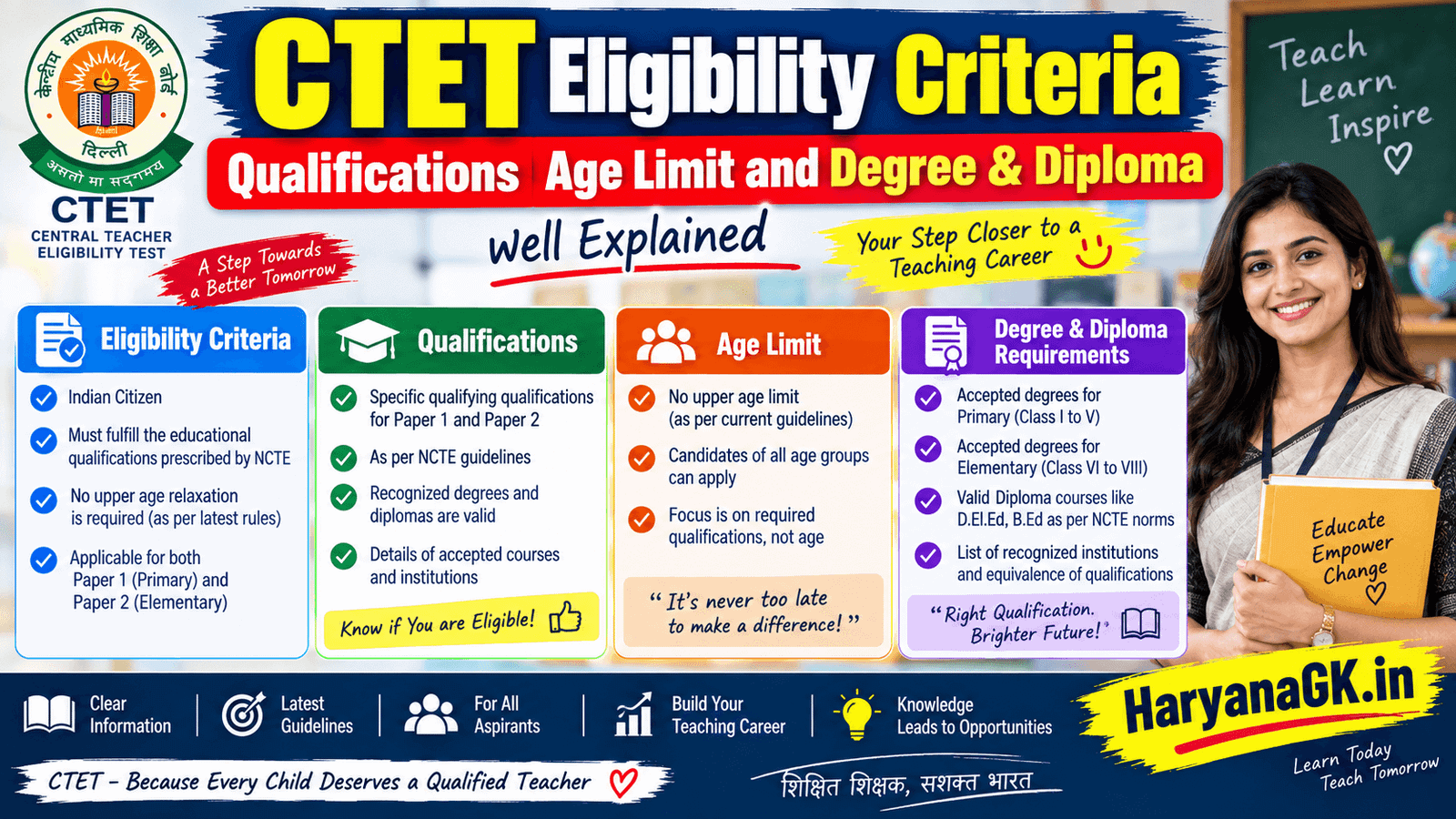
CTET Eligibility Criteria, CTET Qualifications, CTET Age Limit, CTET Nationality & Other Details:
The CTET eligibility criteria rules aren’t complicated once you separate them by paper, but almost every confused comment on CTET forums comes from someone mixing up Paper 1 and Paper 2 requirements, or applying based on a friend’s qualification instead of checking their own. This post lays out exactly who qualifies for each paper, what the age and nationality rules actually say, and the specific situations (B.Tech graduates, final-year students, NCTE relaxation cases) that generate the most questions.
One thing to flag before anything else: NCTE (the National Council for Teacher Education) revises the exact list of qualifying degrees and diplomas from time to time, and CBSE’s notification for each cycle reflects the current version. What’s below covers the routes that have stayed stable for years and account for the vast majority of candidates. If your qualification is an unusual combination, cross-check it against the current notification on ctet.nic.in before you assume either way. And once you’ve confirmed you’re eligible, it’s worth glancing at what CTET actually tests before you commit to a paper, since Paper 1 and Paper 2 pull from noticeably different sections; our CTET syllabus breakdown covers exactly what each paper covers.
CTET Age limit
The minimum age to apply for CTET is 18 years. There is no upper age limit. This is different from most government recruitment exams that cap the age at 30 or 35, and it’s one of the reasons CTET stays relevant for candidates who switch to teaching later in their career, or who already have a B.Ed but are applying at 40 because they’re only now pursuing a teaching post that requires it.
Nationality – (Nationality Required for CTET Exams)
You need to be an Indian citizen. There are a few specific exceptions written into the eligibility rules, carried over from how most central government exams handle nationality: a subject of Nepal, a subject of Bhutan, a Tibetan refugee who came to India before 1 January 1962 with the intention of permanently settling here, or a person of Indian origin who migrated from Pakistan, Myanmar, Sri Lanka, or certain East African countries with the intention of permanently settling in India. These exceptions are narrow and specific, so if you don’t fall clearly into the “Indian citizen” category, check the current notification’s exact wording rather than assuming based on a general reading.
CTET Paper 1 eligibility (Classes I to V)
Paper 1 qualifies you to teach primary classes. The routes that qualify you:
Senior secondary (12th) with at least 50% marks, plus a 2-year Diploma in Elementary Education (D.El.Ed), or appearing in the final year of the diploma. This is the most common route for candidates who went through a teacher-training diploma straight after school.
Senior secondary with at least 45% marks, plus a 2-year D.El.Ed, under the relaxation NCTE allows for candidates who fall just short of 50%. This relaxation exists specifically because a flat 50% cutoff excluded a meaningful number of otherwise qualified diploma-holders, and NCTE addressed it years ago.
Senior secondary with at least 50% marks, plus a 4-year Bachelor of Elementary Education (B.El.Ed), or appearing in the final year.
Senior secondary with at least 50% marks, plus a 2-year Diploma in Education (Special Education), or appearing in the final year. This route matters for candidates trained specifically to teach children with disabilities.
Graduation with at least 50% marks, plus a 1-year Bachelor of Education (B.Ed), or appearing in the final year. This is the route most graduates who did a standard B.Ed take, even though B.Ed is more commonly associated with Paper 2.
Notice that a B.Ed graduate can sit for Paper 1 too. This surprises people who assume B.Ed only maps to upper-primary teaching. It doesn’t. If you have a B.Ed and want to teach younger children, Paper 1 is open to you through this route.
CTET Paper 2 eligibility (Classes VI to VIII)
Paper 2 qualifies you to teach upper-primary classes. The routes:
Graduation with at least 50% marks, plus a 1-year B.Ed, or appearing in the final year. This is the standard route and covers most Paper 2 candidates.
Senior secondary with at least 50% marks, plus a 4-year Bachelor of Elementary Education (B.El.Ed), or appearing in the final year.
Senior secondary with at least 50% marks, plus a 4-year BA/B.Ed or BSc/B.Ed (integrated degree), or appearing in the final year.
Graduation with at least 45% marks, plus a 1-year B.Ed, under NCTE’s relaxation provision, similar in spirit to the 45% relaxation on the Paper 1 diploma route.
Graduation with at least 50% marks, plus a 1-year B.Ed (Special Education), or appearing in the final year, for candidates trained to teach children with disabilities at the upper-primary level.
Three worked examples
Reading a list of qualifying routes is one thing; matching your own transcript to it is another. Here are three situations that come up constantly in comment sections.
“I have 12th with 48% and a D.El.Ed, am I eligible for Paper 1?” Yes, under the 45% relaxation route. You don’t meet the standard 50% threshold, but the NCTE relaxation specifically covers candidates in the 45 to 50% band who hold a D.El.Ed, so you’re eligible.
“I’m a graduate with 52% and currently in my final year of B.Ed, can I apply for Paper 2 now or do I wait?” You can apply now, as an appearing candidate. You’ll need to submit proof of having passed the B.Ed by the time an actual recruiting body asks for your documents, but CTET itself doesn’t block final-year candidates from attempting the exam.
“I did a 3-year B.El.Ed after 12th with 55%, which paper am I eligible for?” B.El.Ed is a 4-year integrated program in its standard form, so first confirm your specific program is the recognised 4-year B.El.Ed and not a shorter variant with a similar name. Assuming it is, it makes you eligible for Paper 1 on its own, and it’s also listed as a qualifying route for Paper 2, so a genuine 4-year B.El.Ed graduate can typically apply for both.
CTET Distance and open-learning qualifications: what to check
A meaningful share of D.El.Ed and B.Ed holders completed their training through distance mode, typically via IGNOU or a state open university, rather than sitting in a regular classroom program. NCTE does recognise distance-mode teacher training, but with a narrower set of approved providers than for regular-mode programs, and the recognition has occasionally been tied to specific cohort years or specific state open universities rather than blanket approval for all distance D.El.Ed and B.Ed providers everywhere.
IGNOU’s own D.El.Ed program, run in partnership with NIOS for in-service, untrained teachers already employed in a school, is a recognised route, but it was specifically designed for that in-service population, so if you took it without already being an employed, untrained teacher at the time, that’s exactly the kind of detail worth confirming before you assume it counts the same way.
The practical check is simple even if the underlying rules aren’t: look up whether your specific university’s distance program, for your specific admission year, appears on NCTE’s list of recognised institutions. Don’t rely on the university’s own marketing material claiming NCTE recognition; go to NCTE’s own published list or ask the university directly for the recognition order number and verify that separately. This is a one-time check worth doing well before you apply for CTET, and certainly before you’d need it at document verification for an actual teaching post, since a distance-mode qualification with a recognition gap is far harder to fix retroactively than it is to catch early.
Diploma-holder routes in more detail
The D.El.Ed route gets treated as a single line item in most summaries, but the actual diploma landscape is broader than “one standard 2-year program.” Several states run their own version under a different name (some still use the older “Junior Basic Training” or “Elementary Teacher Education” naming from before D.El.Ed became the common term nationally), and NCTE’s recognition applies to the specific program and institution, not to the general idea of a 2-year elementary teaching diploma. If your diploma certificate uses an older naming convention, that alone doesn’t disqualify you, but it does mean a quick cross-check against your state’s teacher education department listing is worth doing rather than assuming the name mismatch is purely cosmetic.
There’s also a genuine difference between a diploma completed through regular, in-person study at a college affiliated with a State Council of Educational Research and Training, and one completed through a private institution that may or may not have valid, current affiliation for the specific years you studied there. Affiliation lapses do happen, sometimes mid-program, and a diploma from an institution whose affiliation lapsed during your enrollment years can create exactly the kind of document-verification problem described earlier in this post, well after you’ve already cleared CTET itself. If you’re unsure whether your specific institution’s affiliation was continuously valid across your study period, your state’s SCERT office can usually confirm this directly.
Foreign degrees and equivalency
Candidates who completed part or all of their qualifying education abroad, whether a foreign bachelor’s degree, a teacher-training diploma from another country, or schooling completed outside India, need an equivalency certificate before that qualification can be matched against NCTE’s recognised list. The Association of Indian Universities (AIU) handles equivalency for foreign degrees, issuing a certificate that states which Indian degree your foreign qualification is treated as equivalent to. NCTE itself doesn’t issue equivalency certificates for foreign teacher-training programs; it works from the AIU equivalency (or an equivalent state-level authority’s certification, depending on the qualification type) to decide whether the underlying program matches something on its recognised list.
This process takes real time, often several weeks to a few months depending on how much documentation AIU needs from the awarding institution, so if any part of your qualifying education happened outside India, start the equivalency process well before an application window opens rather than during it. Applying for CTET with a foreign qualification that hasn’t yet been through equivalency is not something CTET’s own online form is built to catch at the application stage, which means the problem, if there is one, tends to surface later, at document verification for an actual teaching post, exactly the stage where you have the least flexibility to fix it.
“I have a B.A. with 58% and a 2-year D.El.Ed, but I actually want to teach classes 6 to 8, not primary. Am I stuck with Paper 1?” A D.El.Ed on its own qualifies you for Paper 1, not Paper 2. Since your B.A. is a genuine graduation degree, though, if you also complete a 1-year B.Ed at some point, that separately opens Paper 2 for you. The D.El.Ed and B.A. by themselves, without a B.Ed, don’t get you into Paper 2, no matter how strong your graduation percentage is.
“I have a B.Sc with 61% and a B.Ed, and I want to teach Science at the upper-primary level. Does my B.Sc subject matter for eligibility?” For CTET eligibility itself, no. The B.Ed is what qualifies you for Paper 2 regardless of your undergraduate subject. Your B.Sc background becomes relevant at the recruitment stage, since a school hiring specifically for a Science teaching post will usually want your B.Sc, not just any degree, in your background, and it also matters if you’re choosing the Mathematics and Science elective section on Paper 2 itself, since that section assumes exactly this kind of subject familiarity.
“My graduation percentage is 47%, and I’m OBC non-creamy layer. Am I eligible for the B.Ed route to Paper 2?” This is where two different relaxations can get confused. The 45% relaxation NCTE allows on the B.Ed route already covers you at 47%, independent of your category, so you don’t need to invoke a category relaxation for CTET eligibility itself here at all.
Category relaxation matters more at the stage of getting admission into the B.Ed program in the first place, where many institutions apply their own reduced percentage requirement for reserved categories, and again later at the CTET qualifying-marks stage (55% instead of 60% of the exam itself), which is a separate number from your graduation percentage entirely. Don’t apply a category relaxation to your graduation percentage when the NCTE relaxation on that specific criterion already covers you.
Borderline percentages and how relaxations actually stack
Candidates sitting right around 44 to 49% on their qualifying degree or diploma tend to either give up too early, assuming they’re simply not eligible, or apply on a hopeful guess without actually confirming which relaxation applies. Neither is the right approach. The 45% relaxation on both the Paper 1 diploma route and the Paper 2 B.Ed route is a general NCTE provision, meaning it applies to any candidate in that percentage band regardless of category; it isn’t a reserved-category-only relaxation.
If your percentage is below 45%, the general relaxation doesn’t help you, and you’d need to check whether your specific state or category has a further reduced threshold, which does happen in some state-level teacher-training admission rules but isn’t something CTET’s own national eligibility framework guarantees.
The cleanest way to check where you actually stand: first identify your exact percentage on the specific qualifying criterion (not a rounded or approximate figure, since 44.6% and 45.4% land in genuinely different categories), then check whether that falls at or above the general 45% relaxation threshold. If it does, you’re eligible under that relaxation regardless of category. If it doesn’t, look specifically at your state’s teacher-training regulations or your category’s admission relaxation at the point you entered the diploma or degree program, since that’s a different rule from anything CTET itself administers. Mixing up which relaxation applies at which stage is the single most common eligibility confusion after the diploma-recognition issue covered above.
Can I apply for both papers?
Yes, and a lot of candidates do, especially those with a B.Ed who also hold a D.El.Ed or meet the Paper 1 criteria through some other route. You need to separately meet the eligibility for each paper you’re applying to. There’s no combined qualification that automatically clears you for both; each paper’s criteria are checked independently, and you pay a separate (or combined, depending on how the fee structure is worded that cycle) fee for each. Both papers also share the same exam-day structure and timing quirks worth knowing in advance, which our CTET exam pattern and dates guide covers in full.
Is B.Ed compulsory for CTET?
No, not for Paper 1. As shown above, a D.El.Ed or B.El.Ed qualifies you for Paper 1 without needing a B.Ed at all. B.Ed becomes the primary (though not the only) route for Paper 2, since the diploma-based routes for Paper 2 are narrower.
This question comes up constantly because a lot of CTET advertising assumes a B.Ed audience, and candidates who only have a D.El.Ed sometimes think they’re not eligible for anything. They are, just for Paper 1.
Can B.Tech graduates apply for CTET?
A plain B.Tech degree on its own does not meet either paper’s eligibility. What qualifies you is the teacher-training qualification (B.Ed, D.El.Ed, B.El.Ed, etc.), not your undergraduate degree subject. A B.Tech graduate who then completes a B.Ed becomes eligible for Paper 2 the same way any other graduate with a B.Ed would, since CBSE doesn’t require your original degree to be in Education or a particular subject. The B.Tech background is actually useful preparation for the Mathematics and Science section if you go on to teach that combination at the upper-primary level, but it doesn’t substitute for the B.Ed itself.
What about “appearing” candidates?
If you’re in the final year of your qualifying diploma or degree, you can apply and appear for CTET, but you’ll typically need to produce proof of having passed by the time you’re required to submit documents for an actual teaching post. CTET itself doesn’t force you to already hold the final certificate in hand on exam day; it’s your eventual employer who will ask for it when you’re being appointed. Don’t let “I’m still finishing my B.Ed” stop you from attempting CTET in the meantime.
Number of attempts
There is no cap on how many times you can attempt CTET. Unlike exams that limit you to a fixed number of tries based on category, CTET allows unlimited attempts as long as you meet the eligibility criteria and the exam is being conducted. This matters because the CTET certificate itself is valid for a lifetime (more on that below), so candidates often reattempt purely to improve their score for a specific job application that has its own merit-list weightage tied to CTET marks, not just qualifying status.
Experience requirement
None. CTET has no minimum teaching experience requirement. Freshers straight out of their B.Ed or D.El.Ed program and experienced teachers who’ve been in classrooms for a decade sit the same exam under the same eligibility rules.
Reservation and category relaxation
SC, ST, OBC (non-creamy layer), and PwD candidates get the standard relaxations that apply to most centrally conducted exams: a lower qualifying percentage requirement (55% instead of 60% of the 150 marks) to clear CTET itself, and, separately, whatever category-based relaxation their state or the admitting institution applies to entry into the D.El.Ed or B.Ed program in the first place. These are two different relaxations at two different stages: getting into the teacher-training course, and then qualifying CTET after you’ve completed it. Don’t confuse one for the other when checking whether you meet a specific cutoff.
What proof your category certificate actually needs to show
Claiming SC, ST, or OBC-NCL relaxation on the qualifying percentage isn’t just a checkbox on the application form; it needs to be backed by an actual certificate issued in the prescribed format by a competent authority, typically a Tehsildar, District Magistrate, or equivalent revenue official, not a certificate issued by a college, employer, or a community organisation. SC and ST certificates don’t expire once issued, so an older certificate is generally still valid as long as the issuing details match your current name and address.
OBC non-creamy-layer certificates work differently: they’re only valid for a limited period from the date of issue, commonly around one year in central government recruitment processes, which means a certificate you obtained two or three years ago for a different exam or admission may already be too old to use for CTET without getting a fresh one.
This distinction catches candidates off guard specifically because SC and ST certificates behave one way and OBC-NCL certificates behave another, and it’s easy to assume category proof works the same regardless of which category you fall under.
If you’re claiming OBC-NCL relaxation, check the issue date on your certificate against the current cycle’s application window before you rely on it, and if it’s aged out, budget time for reissuance, since that process runs through your local revenue office and isn’t something CBSE or NCTE can expedite. PwD candidates similarly need a disability certificate issued by a competent medical authority under the applicable disability framework, and depending on the nature of the disability, some certificates carry a review date after which they need to be reassessed and reissued rather than being a one-time permanent document.
When your qualifying institution’s recognition came later than your graduation
A specific edge case worth flagging carefully because it genuinely confuses candidates: what happens if your qualifying university or teacher-training institution wasn’t on NCTE’s recognised list at the exact time you graduated, but received recognition afterward, sometimes years later, following its own appeal or a policy review. This does happen, particularly with newer private institutions and universities that were in a provisional or pending-recognition status when a specific batch of students passed through.
Whether a later recognition covers you retroactively depends entirely on how that specific recognition order was worded when NCTE or the relevant regulatory body issued it. Some recognition orders explicitly state they apply retroactively to a named range of prior academic sessions or student batches; others apply only from the date of the order going forward, leaving earlier graduates in an unresolved position that typically only gets settled through a specific representation to NCTE or through legal action taken by affected students as a group. There’s no single answer that covers every case, which is exactly why this is worth treating as a genuine verification task rather than an assumption in either direction.
If you’re in this situation, the recognition order itself, not the institution’s own claims about it, is the document to actually read. Institutions caught in this gap sometimes describe their eventual recognition in marketing terms that don’t accurately reflect whether it was made retroactive for your specific batch. Request the exact order number and effective-date language from the institution, or look it up directly through NCTE’s own records, before relying on it for a CTET application or, more importantly, before relying on it years later at an actual recruitment document-verification stage where there’s far less room to sort out an ambiguous case under time pressure.
After you’ve confirmed eligibility, what’s next
Once you’re confident you meet the criteria for the paper (or papers) you’re targeting, the practical next steps are the application window itself, followed eventually by an exam city intimation slip and then your actual admit card. The admit card in particular carries details candidates often aren’t expecting the first time around, including a reporting time well ahead of the actual exam start and specific document requirements at the gate; our CTET admit card guide walks through the download process and what to carry.
Documents you’ll actually need when applying
Meeting the eligibility criteria on paper is separate from having the right documents ready when the application window opens. Keep these scanned and ready before you sit down to fill the form: a recent passport-size photograph and signature in the specified file format and size, your senior secondary and graduation mark sheets, your qualifying diploma or degree certificate (or a bonafide/provisional certificate if you’re still appearing), category certificate if you’re claiming SC/ST/OBC-NCL/PwD reservation, and a valid ID for Aadhaar-based or other identity verification during registration. Applications get stuck far more often over a missing category certificate or an oversized photo file than over an actual eligibility dispute, so treat this as part of the eligibility check, not an afterthought.
The certificate lasts your whole career now
This isn’t strictly an eligibility rule, but it changes how you should think about attempts and timing: since June 2021, CTET qualifying certificates are valid for a lifetime, applied retroactively to certificates issued as far back as 2011. Before that change, certificates expired after seven years and candidates had to requalify. If you cleared CTET years ago and assumed your certificate had lapsed, it almost certainly hasn’t.
CTET versus your state’s own TET
A question that comes up almost as often as the eligibility routes themselves: is CTET the same as HTET, UPTET, or whichever state-level Teacher Eligibility Test applies where you live? No. CTET is conducted by CBSE and is mandatory for teaching positions in central government schools, Kendriya Vidyalayas, Navodaya Vidyalayas, and central Tibetan schools. Most states also run their own TET for recruitment into state government school posts, and several states have chosen to accept a valid CTET score in place of their own TET, but this isn’t universal and depends on that state’s current recruitment rules.
If your goal is specifically a state government teaching post, check whether your state accepts CTET before assuming you need to write a separate state TET on top of it. If your goal is a central government school post, CTET is the one that actually applies, and a state TET won’t substitute for it. The eligibility criteria for entry (age, qualification routes) are broadly similar across most of these exams because they all trace back to the same NCTE framework, but each conducting body sets its own exact cutoffs and category relaxations, so don’t assume your CTET eligibility automatically tells you your state TET eligibility, or vice versa.
What happens at the actual recruitment stage
Clearing CTET makes you eligible to apply for teaching posts that require it; it doesn’t appoint you to a job by itself. When you apply for an actual vacancy, whether through KVS, NVS, or a state recruitment board, you’ll go through document verification where your original mark sheets, diploma or degree certificates, and CTET scorecard are checked against what you declared.
This is the point where an unrecognised diploma or a qualification that technically doesn’t meet NCTE’s list gets caught, even if it slipped through at the CTET application stage since CTET’s own application process doesn’t verify every document upfront. It’s worth getting genuine clarity on your qualification’s recognised status well before you’re standing in a verification queue with a job on the line.
Re-verifying eligibility if you took a long break
Candidates who cleared their qualifying diploma or degree years ago and are only now getting around to applying for CTET sometimes assume nothing about their eligibility could have changed in the meantime. Mostly true, but not entirely. NCTE’s recognised-institution list is a living document, and in rare cases an institution’s recognition status has been reviewed or revised well after a batch of students already graduated from it, particularly for smaller private colleges rather than established state institutions.
This doesn’t retroactively harm most graduates, since recognition changes are typically forward-looking rather than applied backward against people who already completed the program in good faith, but it’s still worth a quick recheck against the current list rather than relying on what you were told about your institution’s status a decade ago, especially if you’re about to invest time and a fee into an application cycle.
A common mistake worth calling out
Candidates sometimes check only the percentage requirement and skip verifying whether their specific diploma or degree is actually on the recognised list. A 2-year diploma that isn’t NCTE-recognised, for instance, won’t make you eligible even if you cleared it with 70%. If your qualifying course was from an institution or state board you’re not fully sure is NCTE-recognised, verify that specifically. It’s a different question from the percentage cutoff, and it’s the one that causes rejected applications after the fact, not before.
FAQs
Is there a maximum age limit for CTET? No. The only age requirement is a minimum of 18 years, with no upper cap.
Is B.Ed compulsory for CTET Paper 1? No. A 2-year D.El.Ed or 4-year B.El.Ed qualifies you for Paper 1 on its own, without needing a B.Ed.
Can I apply for both Paper 1 and Paper 2? Yes, provided you separately meet the eligibility criteria for each paper.
Can B.Tech graduates apply for CTET? A B.Tech degree alone doesn’t meet the eligibility criteria. You need a recognised teacher-training qualification such as B.Ed, D.El.Ed, or B.El.Ed in addition to your degree.
How many attempts are allowed for CTET? There’s no limit. You can reattempt as many times as you want, in as many cycles as the exam is conducted, as long as you continue to meet the eligibility criteria.
Do I need any teaching experience to apply? No. CTET has no minimum experience requirement. Fresh graduates and experienced teachers apply under the same rules.
If I hold both a D.El.Ed and a B.Ed, which paper should I choose? Either, or both. A D.El.Ed makes you eligible for Paper 1, and a B.Ed makes you eligible for Paper 2. If you hold both and aren’t sure which age group you want to teach, apply for both papers and keep your options open.
Does clearing CTET guarantee me a teaching job? No. CTET only establishes that you’re eligible to be considered for teaching posts that require it. Actual recruitment happens through separate processes, KVS, NVS, or state education department hiring drives, that have their own vacancies, selection criteria, and sometimes an additional merit weightage based on your CTET score.
Is my old CTET certificate still valid if I cleared it years ago? Almost certainly yes. The lifetime-validity rule applies retroactively to certificates issued from 2011 onward, so unless you cleared it before that cutoff, your old certificate hasn’t expired even though it may once have carried a printed seven-year validity date.