Most CTET syllabus pages online are just the CBSE notification copy-pasted with a new date at the top. That’s fine if you already know how to read a syllabus PDF and turn it into a study plan.
If you don’t, you end up memorising section names, “Child Development and Pedagogy,” “Environmental Studies,” without knowing what’s actually asked inside them. This post goes section by section, tells you what CBSE actually tests under each heading, and points out where students usually lose easy marks.
The syllabus itself hasn’t changed in any major way for several cycles now. CBSE publishes it as part of the official notification on ctet.nic.in, and it’s worth downloading that PDF once even if you read this whole post. The exact wording of a topic sometimes matters when you’re deciding how deep to go.
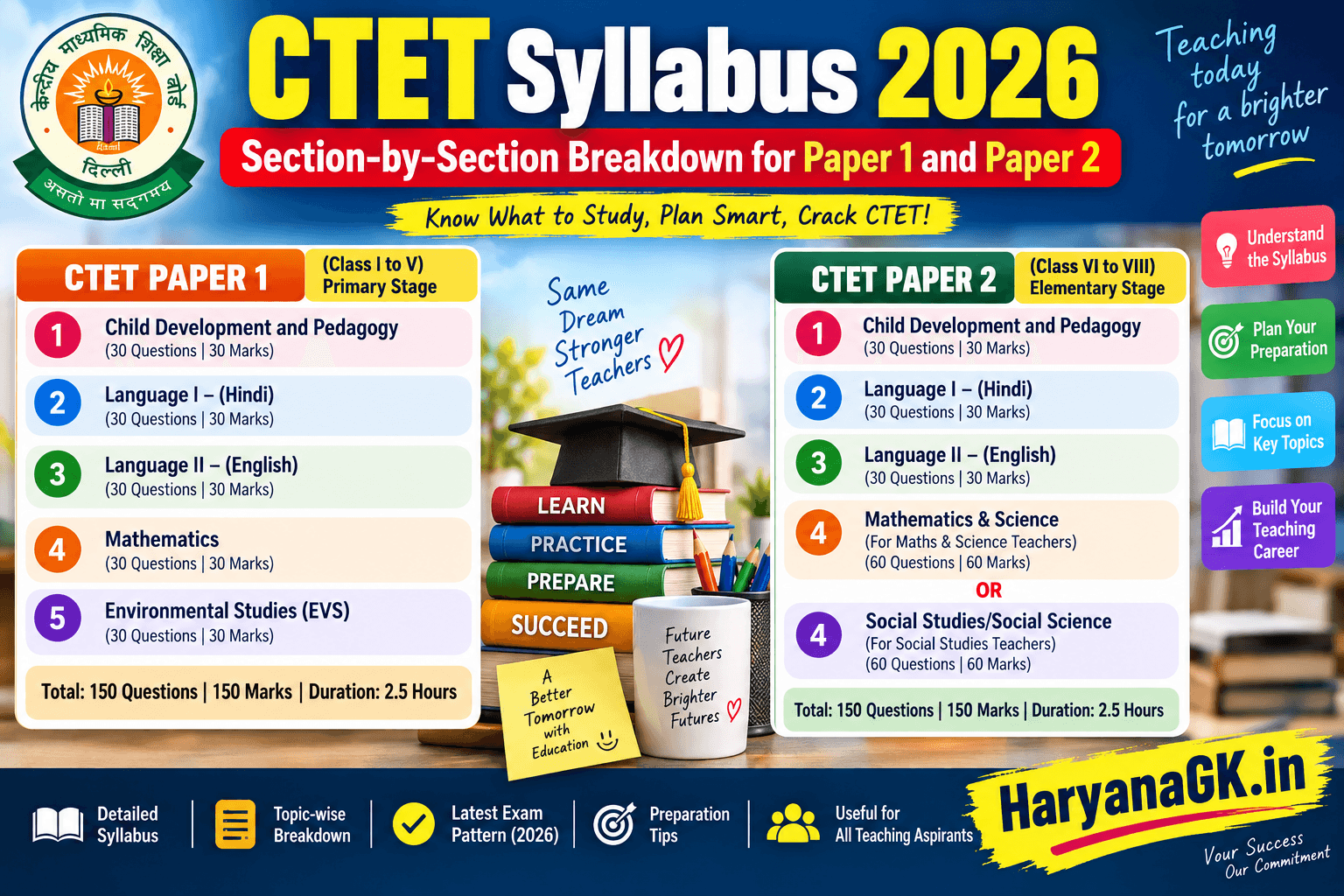
Quick reference: how the marks break down for CTET Syllabus 2026
Paper 1 (150 marks, 150 questions, 2.5 hours):
- Child Development and Pedagogy: 30 marks
- Language I: 30 marks
- Language II: 30 marks
- Mathematics: 30 marks
- Environmental Studies: 30 marks
Paper 2 (150 marks, 150 questions, 2.5 hours):
- Child Development and Pedagogy: 30 marks
- Language I: 30 marks
- Language II: 30 marks
- Mathematics and Science, OR Social Studies/Social Science: 60 marks (choose one)
There’s no negative marking on either paper. So the syllabus question isn’t really “what should I skip,” it’s “what should I prioritise studying first,” since every section is worth attempting even if you’re not fully confident in it. For the full breakdown of timing, shifts, and how marks are actually scored, see our CTET exam pattern and dates guide; this post sticks to what’s inside each section rather than how the exam itself is administered.
Syllabus and exam pattern are not the same document – Understand for CTET Exam
Candidates use these two words interchangeably, and it causes real confusion when they go looking for information. The syllabus is the list of topics you’re expected to know, arranged section by section, the thing this post is actually about. The exam pattern is a separate layer:
how many questions per section, how long you get, whether there’s negative marking, how the OMR sheet works, and how CBSE spreads a single cycle’s testing across multiple dates and shifts. You can memorise the entire syllabus and still walk into the exam unprepared if you don’t also know the pattern, and vice versa: knowing the pattern cold doesn’t help if you haven’t actually studied the content it’s testing. Treat them as two separate checklists, not one.
Paper 1 or Paper 2, which one do you need?
Paper 1 is for candidates who want to teach classes 1 to 5 (primary stage). Paper 2 is for classes 6 to 8 (elementary/upper primary stage). If you want to be eligible for both age groups, you sit for both papers, usually on the same day in two shifts. Which paper you’re even allowed to sit for depends on the qualification route you meet; our CTET eligibility criteria guide covers the exact degree and training combinations CBSE accepts for each paper, since that’s a separate question from what’s covered inside the syllabus itself.
The two papers share three sections (Child Development and Pedagogy, Language I, and Language II), but the actual questions in those shared sections are pitched differently for each paper, because the pedagogy of teaching a 7-year-old and a 13-year-old isn’t the same thing. More on that below.
Child Development and Pedagogy: how Paper 1 and Paper 2 actually diverge
Because this section carries the same name and the same 30 marks on both papers, a lot of candidates assume they can prepare it once and reuse the same notes for both. That’s mostly true for the core theory: Piaget, Vygotsky, and Kohlberg apply to both, and the underlying framework of constructivism, inclusive education, and assessment doesn’t change between the two papers. What changes is which age band the question stems describe and which concerns get more weight.
Paper 1’s CDP section leans on early-childhood and primary-stage material: attachment, play-based learning, the transition from home language to school language for a six-or seven-year-old, and how young children build number sense and early literacy.
Paper 2’s CDP section shifts the same theoretical toolkit onto adolescence: identity formation, peer group influence, the emotional volatility Erikson and others associate with early adolescence, and classroom management for a group of 12 and 13 year-olds who are far more socially self-aware than a Paper 1 candidate’s students. A question describing a student “refusing to participate because friends are watching” is a Paper 2-style scenario; a question describing a child “using blocks to understand quantity” is a Paper 1-style scenario, even though both could technically test the same underlying constructivist principle.
If you’re attempting both papers, the efficient way to prepare is to learn the theory once, thoroughly, and then deliberately practice applying it to both an early-childhood scenario and an adolescent scenario, rather than assuming the Paper 1 version of your notes will automatically transfer.
How much of Child Development and Pedagogy is actually theory?
Candidates consistently misjudge this ratio, usually in one of two opposite directions. Some assume the section is almost entirely theory names and dates, so they spend their limited prep time drilling flashcards on which psychologist proposed which stage. Others swing the other way and assume it’s mostly “common sense classroom management,” so they barely open a book for it at all. Neither assumption matches how the section is actually built.
A more accurate way to think about it: the theory itself, Piaget’s stages, Vygotsky’s zone of proximal development, Kohlberg’s moral reasoning, is maybe a third of what you need to know cold, in the sense that you should be able to name it and describe it without hesitation. The remaining two-thirds is knowing how to recognise that theory when it’s dressed up as a classroom scenario, which is a different skill from recall.
A question won’t ask “what is Vygotsky’s zone of proximal development”; it’ll describe a teacher giving a student just enough help to complete a task independently next time, and ask which concept that illustrates. If your studying stopped at memorising definitions, that question is genuinely hard. If you’ve worked through enough scenario-based practice questions to recognise the pattern, it’s close to automatic.
This is why simply re-reading theory notes a second or third time before the exam has a lower return than it feels like it should. The theory doesn’t get any harder to recall the fifth time you read it, but recognising it inside an unfamiliar scenario is a separate skill that only builds through practicing actual questions, not through more reading.
Paper 1 syllabus (Classes I–V)
Paper 1 has five sections. Each carries 30 questions worth one mark each, so every section is exactly 30 marks. There’s no weighting where one section matters more than another on paper, though in practice some sections are far easier to score full marks in than others.
1. Child Development and Pedagogy (30 marks)
This is the section that decides whether you clear CTET or not, more than any other. Roughly two-thirds of it is child development theory (Piaget, Vygotsky, Kohlberg, the usual names), and the remaining third covers inclusive education, learning and pedagogy, and children with special needs: giftedness, learning difficulties, disability categories under the RPWD Act.
What trips people up: this section doesn’t test whether you can recite Piaget’s four stages. It tests whether you can apply the theory to a classroom scenario CBSE describes in the question stem. A question will describe a child’s behaviour and ask which stage or which concept it reflects. If you’ve only memorised the stage names and their age ranges, you’ll get maybe half these questions right by elimination. You need to actually understand what each stage looks like in practice.
Topics that show up every cycle: concept of development and its relationship with learning, principles of development, influence of heredity and environment, socialisation processes, Piaget/Kohlberg/Vygotsky, concepts of child-centred and progressive education, critical perspective on the construct of intelligence, multi-dimensional intelligence, language and thought, social constructivism, and the distinction between assessment for learning and assessment of learning.
2. Language I (30 marks)
Language I is whichever language you’re most comfortable teaching in. For most candidates in Haryana and the wider Hindi belt, that’s Hindi or English. The section splits into two halves: a comprehension passage (prose or poetry, roughly 15 marks) and pedagogy of language development (15 marks).
The comprehension passage is genuinely easy marks if you read carefully. There’s no trick to it beyond actually reading the passage instead of skimming for keywords. The pedagogy half is where marks get lost. It covers things like learning and acquisition, principles of language teaching, the role of listening and speaking, challenges of teaching a second-language learner, and error analysis. This is theory, and it needs the same “apply it, don’t just memorise it” treatment as Child Development.
3. Language II (30 marks)
Same structure as Language I, comprehension plus pedagogy, but in a different language than the one you chose for Language I. Most candidates pick English if Language I was Hindi, or vice versa. You cannot choose the same language for both.
How the Language I and Language II pedagogy content actually breaks down
Since both language sections carry the same “comprehension plus pedagogy” split, it’s worth going one level deeper into what the pedagogy half actually contains, since “pedagogy of language teaching” as a phrase tells you almost nothing on its own. It generally covers four connected areas.
Learning and acquisition theory comes first: how a child picks up their first language differently from how they learn a second one, including ideas like Chomsky’s notion of an innate language faculty and the more classroom-grounded question of when and how a second language should be introduced without disrupting a child’s first-language development. Second, there’s the mechanics of the four skills, listening, speaking, reading, and writing, and specifically how these are meant to develop in an integrated way rather than as isolated drills; a pedagogy question might ask which classroom activity best develops listening and speaking together, rather than treating them as separate subjects to teach one after another.
Third, phonology and orthography basics show up more than candidates expect, particularly for younger learners:
how sound-letter relationships are introduced, common difficulties children face moving from spoken language to reading and writing it, and error patterns that are developmentally normal versus ones that need targeted support. Fourth, error analysis and remedial teaching close out the section: what a specific type of language error (a grammar slip, a spelling pattern, a comprehension gap) actually reveals about where a learner is in their language development, and what a teacher should do about it rather than simply marking it wrong.
None of this requires you to be a linguist. It requires recognising that “pedagogy of language teaching” is really four smaller, learnable ideas stacked under one heading, and studying them as four distinct areas is far more effective than treating the whole thing as one vague blob of “language teaching theory.”
4. Mathematics (30 marks)
This section has two halves too: content (roughly 15 marks of actual arithmetic, geometry, and number-sense questions pitched at a primary-school level) and pedagogical issues (15 marks covering how children develop mathematical thinking, common errors children make, the place of maths in the primary curriculum, and problem-solving approaches).
The content half is where CTET candidates who’ve been out of school for a few years underestimate themselves. The maths is genuinely primary-level: geometry of shapes, basic fractions, patterns, place value, data handling. It is not hard once you’ve looked at it again. The pedagogy half asks things like what a child’s mistake in a specific arithmetic error reveals about their understanding. Again, application over recall.
5. Environmental Studies (30 marks)
EVS at the primary level isn’t split cleanly into “science” and “social studies” the way it will be for Paper 2. It’s an integrated subject covering family, food, shelter, water, travel, and “things we make and do,” plus a pedagogy component on EVS teaching approaches, integrated EVS, and CCE in environmental studies.
If you did well in school-level EVS or general science, this section rewards general knowledge more than deep theory. The pedagogy half again tests classroom application: how would you teach a concept, what activities work, how to handle a diverse classroom.
Why EVS refuses to separate science from social studies
This is worth understanding rather than just accepting, because it explains why some “obvious” answers on EVS pedagogy questions turn out wrong. The National Curriculum Framework treats environmental studies at the primary stage as one deliberately integrated subject, not science and social studies taught side by side under a shared name.
A topic like “water” isn’t approached only as a science theme (states of matter, the water cycle) or only as a social theme (how a community accesses water, who fetches it and why); a properly designed EVS lesson moves between both within the same activity, because a six-year-old doesn’t experience “water” as two separate academic disciplines.
CTET’s pedagogy questions on EVS are built around this integrated philosophy, so an answer option that isolates the science angle while ignoring the social or environmental angle, even if it sounds like solid science teaching, is often the wrong choice on this exam specifically. Once you notice this pattern, EVS pedagogy questions get noticeably easier to predict.
Paper 2 syllabus (Classes VI–VIII)
Paper 2 has four sections instead of five. Child Development and Pedagogy, Language I, and Language II are structured the same way as in Paper 1 but pitched toward adolescents rather than young children. Expect more on adolescent psychology, peer influence, and subject-specific pedagogy rather than early-childhood concepts.
The fourth section is where Paper 2 branches:
- If you want to teach Mathematics and Science at the upper-primary level, you attempt the Mathematics and Science section (60 marks, roughly 20 pedagogy, 20 maths content, 20 science content).
- If you want to teach Social Studies/Social Science, you attempt that section instead (60 marks, covering history, geography, social and political life, plus pedagogical issues).
You pick one, not both, when you register for Paper 2. If you’re not sure which subject you’ll end up teaching, pick based on your own graduation subjects. CBSE doesn’t require you to have studied that exact subject at graduation level for Paper 2 eligibility, but it makes the content half of this section far less painful.
Mathematics and Science: content breakdown
Maths content at this level moves into number systems, algebra, geometry, mensuration, data handling, and pedagogical issues specific to teaching mathematics to 11 to 14 year-olds.
Science content covers food, materials, the world of the living, moving things, natural phenomena, and natural resources, essentially the NCERT class 6 to 8 science syllabus, plus pedagogical issues in science teaching.
Social Studies/Social Science: content breakdown
History covers the syllabus roughly from early societies through the modern Indian state: when and where, the earliest societies, agrarian settlements, kingdoms and empires, the colonial period, and the making of the modern Indian state. Geography covers geographical diversity, the earth as our habitat, resources (natural and human), agriculture, and India’s physical features.
Social and Political Life covers the Constitution, the state government and its functions, local self-government (panchayati raj and urban local bodies), and topics like social justice, marginalisation, and the media’s role in a democracy.
Candidates who studied Arts or Humanities at graduation level usually find the History and Civics content lighter going than those from a Science background, but the pedagogy questions in this section don’t require a Humanities degree.
They’re about how to teach these topics, not deep specialist knowledge. Pedagogical issues cover concepts of social science/social studies, sources of history and geography (including maps, timelines, and primary sources), and how to handle sensitive topics, communal violence, gender, caste, in a classroom without shutting down discussion.
Which languages can you actually choose?
CBSE conducts CTET in more than twenty languages, so Language I and Language II don’t have to be Hindi and English if that’s not your background. The list includes Assamese, Bengali, English, Garo, Gujarati, Hindi, Kannada, Khasi, Malayalam, Manipuri, Marathi, Mizo, Nepali, Odia, Punjabi, Sanskrit, Tamil, Telugu, Tibetan, and Urdu, among others. The exact list is printed in every cycle’s notification because CBSE occasionally adds regional languages depending on demand from a state.
Two rules that catch people out: you can’t pick the same language for both Language I and Language II, and the language you choose for the overall question paper (the medium in which Child Development, Maths, EVS etc. are printed) is separate from your Language I/II choice. You select that separately when you fill the application form.
Which NCERT textbooks actually match each section
The syllabus PDF tells you a topic name; it doesn’t hand you a textbook chapter. Since CTET question-setters draw heavily on the NCERT framework for content questions, mapping each syllabus section to the right class-level textbook saves you from studying material that’s either too basic or too advanced for what’s actually asked.
For Paper 1’s Mathematics content half, the NCERT Maths textbooks for classes 1 through 5 (commonly known by their “Math-Magic” branding in earlier editions) cover exactly the level of geometry, fractions, and number-sense CTET tests. You don’t need a class 8 or class 10 maths textbook for Paper 1; going that far above the actual tested level wastes time on content that won’t appear.
For Paper 1’s Environmental Studies, the NCERT EVS textbooks for classes 3 through 5 are the direct source, since EVS as a distinct subject doesn’t formally begin until class 3 in most state curricula, with classes 1 and 2 folding similar themes into general language and activity-based learning instead.
For Paper 2, the mapping shifts up a level. Mathematics content draws from NCERT’s class 6 to 8 textbooks, covering number systems, basic algebra, and mensuration at the level those books actually teach it, not at a competitive-exam difficulty level. Science content maps directly onto the NCERT class 6 to 8 science textbooks, and candidates who still have their own school copies of these (or a younger sibling’s) often find revising from the original textbook faster than a coaching institute’s condensed notes, precisely because the textbook’s own examples and diagrams are frequently the basis for how a question is framed.
Social Studies content spans NCERT’s class 6 to 8 History, Geography, and Civics (Social and Political Life) textbooks, and candidates from a non-Humanities graduation background specifically benefit from working through these directly rather than relying only on a summarized bullet-point version, since several pedagogy questions reference how a specific NCERT chapter approaches a topic, not just the topic in the abstract.
Child Development and Pedagogy and the Language sections don’t map onto a single NCERT textbook the same way, since they’re built from teacher-education theory and language-pedagogy material rather than a school-level subject textbook. For these, NCERT’s own teacher-training and curriculum-framework documents are a more direct source than any single class-wise textbook.
Has the syllabus weightage changed across recent cycles?
Not in any way that should change how you plan your preparation. The five-section structure for Paper 1 and the four-section structure for Paper 2, along with each section’s 30-mark (or 60-mark, for Paper 2’s elective) weightage, has held steady across recent cycles.
What does shift, occasionally and in minor ways, is the specific wording or emphasis within a sub-topic, and the exact list of languages offered for Language I and Language II, which CBSE adjusts slightly based on demand from different states. Neither of these changes affects how you should divide your study time across sections, which is exactly why the priority order later in this post is safe to follow regardless of which specific cycle you’re preparing for.
If a coaching source claims the weightage itself has shifted for an upcoming cycle, verify it against the actual notification on ctet.nic.in before trusting it, since this is one of the more common inaccuracies that circulates in exam-prep forums.
Downloading the official syllabus PDF
Don’t rely on a screenshot someone forwarded on WhatsApp. Go to ctet.nic.in, open the current cycle’s notification (it’s usually linked from the homepage under “Notifications” or “Important Links”), and download the syllabus annexure directly.
It’s a government PDF, so it won’t win any design awards, but it’s the only version guaranteed to reflect the current cycle’s exact wording, useful if you ever need to settle an argument about whether a specific sub-topic is in or out.
What CBSE means by “pedagogy” in every section
If there’s one idea worth pulling out of this whole syllabus, it’s this: every single section, without exception, has a pedagogy component alongside its content component. CBSE is not testing whether you know Hindi grammar or class 8 geography for its own sake.
It’s testing whether you can teach it. That’s the entire premise of CTET. Candidates who prepare only the content half of each section and skip the pedagogy half consistently underperform, because pedagogy questions make up close to half of every section on the paper.
Where to actually spend your prep time
If you’re starting from zero with limited time, here’s the honest priority order based on where most candidates lose marks, not where the syllabus “feels” biggest.
- Child Development and Pedagogy. Highest marks-per-hour-studied ratio because it’s the same 30 marks across both papers if you’re attempting both, and it rewards understanding over memorisation once you get past the theory names.
- Whichever Language II you’re weaker in. The comprehension half is free marks you’re currently leaving on the table if you’re not practising unseen passages.
- The content half of Maths, EVS, and Science. This is where a quick refresher of material you technically already know (because you studied it in school) closes gaps fast.
- Pedagogy sub-sections of every subject. Often skipped, always tested, and genuinely learnable from a handful of core concepts repeated across subjects: constructivism, formative vs summative assessment, inclusive classrooms.
A mistake worth naming directly
A lot of aspirants treat the Language I/II comprehension passages as “free marks, don’t need to prepare” and then lose two or three marks per attempt because the passage is denser than expected or the questions ask about tone and inference rather than direct lookup. Read a few unseen passages under time pressure before the exam. Fifteen minutes a day for two weeks is enough to fix this.
Does the NCTE syllabus differ from what CBSE actually asks?
People ask this a lot, usually after finding two slightly different-looking documents online. NCTE (National Council for Teacher Education) lays down the broad framework for what CTET should test.
CBSE, as the conducting body, publishes the detailed syllabus based on that framework in its official notification. They’re not two competing versions. The CBSE notification is the operative document for exam preparation, and it’s the one you should be studying from. If a coaching PDF ever contradicts the CBSE notification on a section’s weightage, trust the notification.
Turning this syllabus into practice
Reading a syllabus breakdown tells you what to study. It doesn’t tell you whether you’ve actually learned it.
The only way to check that is to attempt real questions from each section and see where you go wrong. Once you’ve gone through a section here, pull up a few recent CTET papers and attempt just that section in isolation before moving to the next one; our CTET previous year question papers guide covers where these papers actually come from and how to use them properly, including the difference between attempting a paper cold versus checking it against a solved key too early. It’s a slower way to prepare than reading straight through the syllabus, but it’s the difference between recognising a topic name and being able to answer a question on it under exam pressure.
A few syllabus misconceptions worth clearing up early
Some confusion around the syllabus repeats often enough across candidates that it’s worth addressing directly rather than letting it surface later as a study mistake.
The first is assuming Child Development and Pedagogy is a general “common sense” section that doesn’t need dedicated study time because it’s not a hard academic subject like Maths. It has specific theoretical content, Piaget’s stages, Vygotsky’s zone of proximal development, Kohlberg’s moral reasoning stages, that gets tested precisely, and candidates who skip formal study of it because it “feels intuitive” consistently underperform relative to how confident they felt walking in.
The second is assuming the Language I and Language II pedagogy content is identical regardless of which language you’ve chosen, since the theory is language-agnostic. The underlying pedagogical principles are shared, true, but the comprehension passages themselves are language-specific, and second-language-acquisition concepts are sometimes framed differently depending on whether the language in question is your Language I (closer to a first-language teaching context) or Language II (closer to a second-language learner’s context). Read both sections’ theory with that distinction in mind rather than assuming a single pass covers both.
The third is treating the Mathematics and Science elective in Paper 2 as automatically easier than Social Studies because it feels more “objective.” Both options carry the same 60 marks and the same proportion of pedagogy questions; the right choice depends on which content you already know well from your own education, not on an assumption that one subject area is inherently less work than the other.
FAQs
Is the CTET syllabus the same for every cycle, or does it change? The core structure, five sections for Paper 1, four for Paper 2, same section-wise weightage, has stayed consistent for years. CBSE occasionally tweaks emphasis within a topic, so it’s worth checking the current notification on ctet.nic.in rather than assuming last cycle’s PDF is word-for-word identical.
Can I appear for both Paper 1 and Paper 2 in the same session? Yes. Both papers are usually held on the same day, Paper 1 in one shift and Paper 2 in another, so you can sit both if you’ve applied and paid for both.
Do I need to know both Language I and Language II equally well? You need working knowledge of both, but the comprehension half of each is testable with careful reading rather than deep literary knowledge. The pedagogy half is language-agnostic theory, so once you’ve learned it for Language I, most of it carries over to Language II.
Is negative marking applied if I answer a pedagogy question wrong? No. There’s no negative marking anywhere in CTET, in either paper, in any section. Attempt every question.
Which is harder, Paper 1 or Paper 2? Neither is objectively harder. Paper 2’s optional Maths/Science or Social Studies section adds more subject-specific content, but Paper 1’s Child Development section is pitched at younger-child theory that some candidates find less intuitive than adolescent psychology. It comes down to which subjects and age group you’re already comfortable with.
How many questions come from Child Development and Pedagogy across both papers? 30 marks in Paper 1 and 30 marks in Paper 2. That’s 60 total if you’re attempting both papers, making it the single largest content area you’ll prepare across the full exam.
Do I need to study NCERT textbooks separately, or is the syllabus PDF enough? The syllabus PDF tells you what topics to cover, not how to actually learn the content. For the Maths, EVS, Science, and Social Studies content halves, NCERT textbooks for the relevant classes are still the most reliable source. CTET question-setters draw heavily on that framework even though the exam itself isn’t a direct NCERT reproduction.
If I choose Social Studies for Paper 2, can I switch to Maths and Science later? Not within the same application. Your choice of optional section is locked in when you fill the form for that cycle. If you want to attempt the other option, you’d need to apply again in a future cycle and select it then.
2 thoughts on “CTET Syllabus 2026: Section-by-Section Breakdown for Paper 1 and Paper 2”