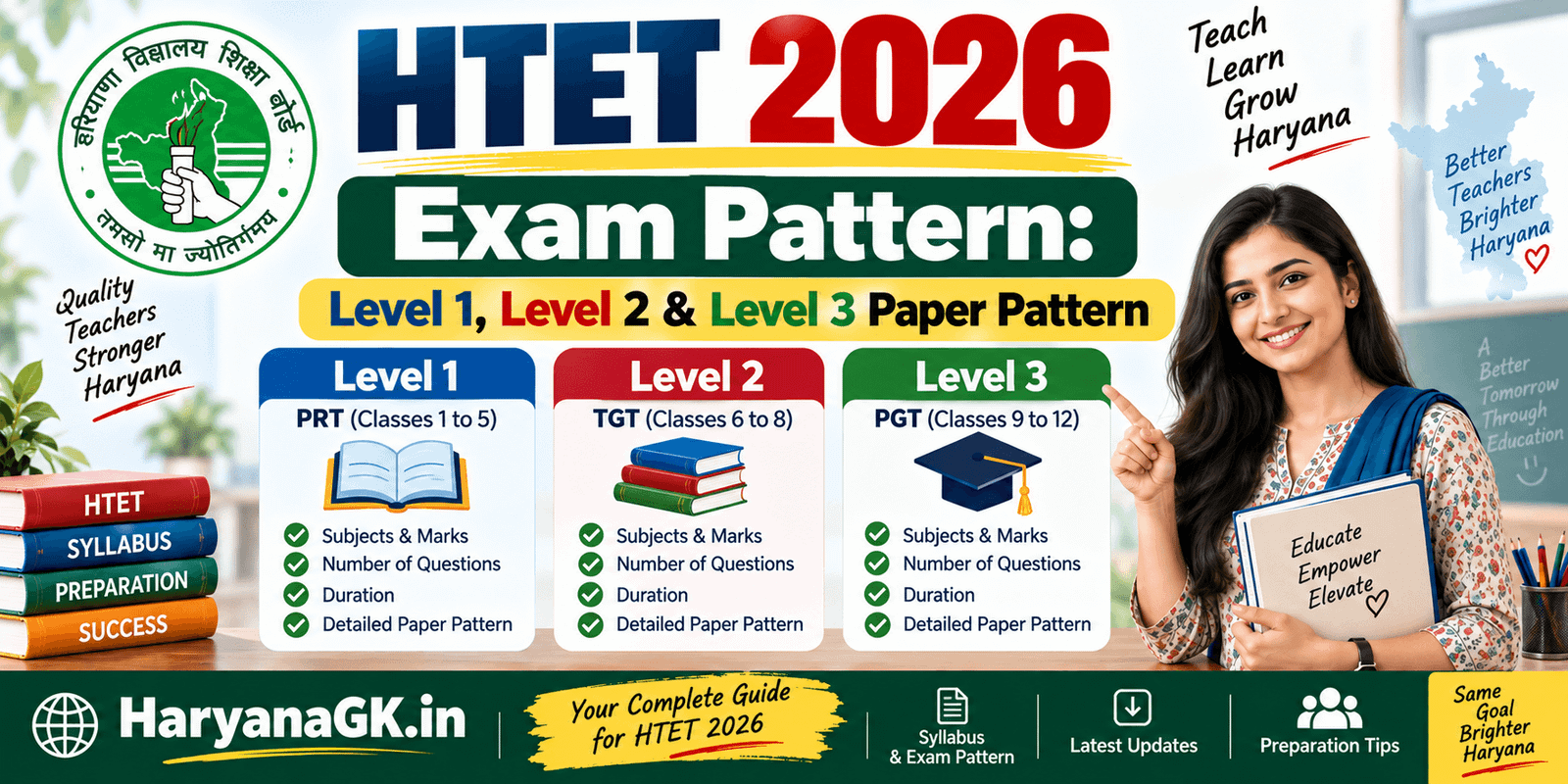
HTET 2026 Exam Pattern: Level 1, Level 2 & Level 3 Paper Pattern
The exam pattern tells you exactly how your 150 marks are going to be tested, and that detail changes how you should split your revision time. All three HTET levels share the same overall structure, but the subject-wise weight inside that structure is different for each level.
Common Structure Across All Levels
| Detail | Value |
|---|---|
| Total Questions | 150 |
| Total Marks | 150 (1 mark per question) |
| Duration | 150 minutes (2 hours 30 minutes) |
| Question Type | Multiple Choice (MCQ) |
| Mode | Offline, OMR-based, pen and paper |
| Negative Marking | None |
| Medium | Hindi and English (except language-specific papers) |
Because there is no negative marking, attempting every question is generally the safer approach, since a wrong guess costs nothing while a skipped question guarantees zero marks.
Level 1 (PRT) Paper Pattern
| Section | Questions |
|---|---|
| Child Development and Pedagogy | 30 |
| Language I (compulsory) | 30 |
| Language II (compulsory) | 30 |
| Mathematics | 30 |
| Environmental Studies | 30 |
Level 1 is aimed at candidates who want to teach Classes 1 to 5, so the questions stay close to primary-level concepts rather than advanced subject depth.
Level 2 (TGT) Paper Pattern
| Section | Questions |
|---|---|
| Child Development and Pedagogy | 30 |
| Language I (compulsory) | 30 |
| Language II (compulsory) | 30 |
| Mathematics and Science, or Social Studies | 60 |
The fourth section depends on which subject combination the candidate is applying under, aligned to Classes 6 to 8.
Level 3 (PGT) Paper Pattern
Level 3 shifts weight toward the candidate’s chosen subject at a postgraduate depth, combined with teaching methodology relevant to Classes 9 to 12. Because the subject-specific share is large and varies by subject (Political Science, Chemistry, Physics, History, Commerce, Biology, and others), we cover each one separately. Start from our HTET 2026 Syllabus guide, which links out to every subject-wise PGT syllabus page on this site.
HTET 2026 Eligibility at a Glance
| Level | Minimum Qualification | Professional Qualification |
|---|---|---|
| Level 1 (PRT) | Senior Secondary (12th) with at least 50% marks | Two-year Diploma in Elementary Education (D.El.Ed.) |
| Level 2 (TGT) | Bachelor’s degree with at least 50% marks | B.Ed. or D.El.Ed. |
| Level 3 (PGT) | Master’s degree in the relevant subject with at least 50% marks | B.Ed. |
A 5% relaxation in the minimum qualifying percentage applies to SC, BC, and physically handicapped candidates who hold Haryana domicile. Passing Hindi or Sanskrit as a subject up to Matric level is also a common condition across levels, so check this even if your degree otherwise matches. Visit official website for confirmation bseh.org.in.
How to Use the Exam Pattern While Preparing
- Attempt easier, familiar sections first (commonly Language and Child Development and Pedagogy) to secure quick marks before spending time on harder subject-specific questions.
- Since there is no negative marking, leave a question blank only as a last resort, after eliminating options through logic.
- Practice against the real 150-minute clock at least a few times before the exam, since pacing across 150 questions is a different skill from solving the same questions untimed.
Frequently Asked Questions
Is the exam pattern the same for every HTET cycle, or does it change every year?
The broad structure (150 questions, 150 marks, 150 minutes, no negative marking) has stayed consistent across recent cycles. Always confirm against the current notification, since BSEH can revise the pattern, as some sources have reported possible changes such as an additional answer option under consideration for future cycles.
Are all questions compulsory?
Yes, there is no optional or choice-based section; every candidate attempts all sections assigned to their chosen level.
How is Language I and Language II decided?
Candidates typically choose from the languages listed in the notification, commonly Hindi, English, Sanskrit, and Punjabi, depending on availability for that level. Check the notification for the exact list before assuming your preferred language is offered.
Does the PGT pattern change based on the subject I choose?
The number of questions and marks stays the same across PGT subjects; what changes is the actual content being tested inside the subject-specific section, which is why we maintain separate syllabus pages by subject rather than one generic PGT page.
2 thoughts on “HTET 2026 Exam Pattern: Level 1, Level 2 & Level 3 Paper Pattern”