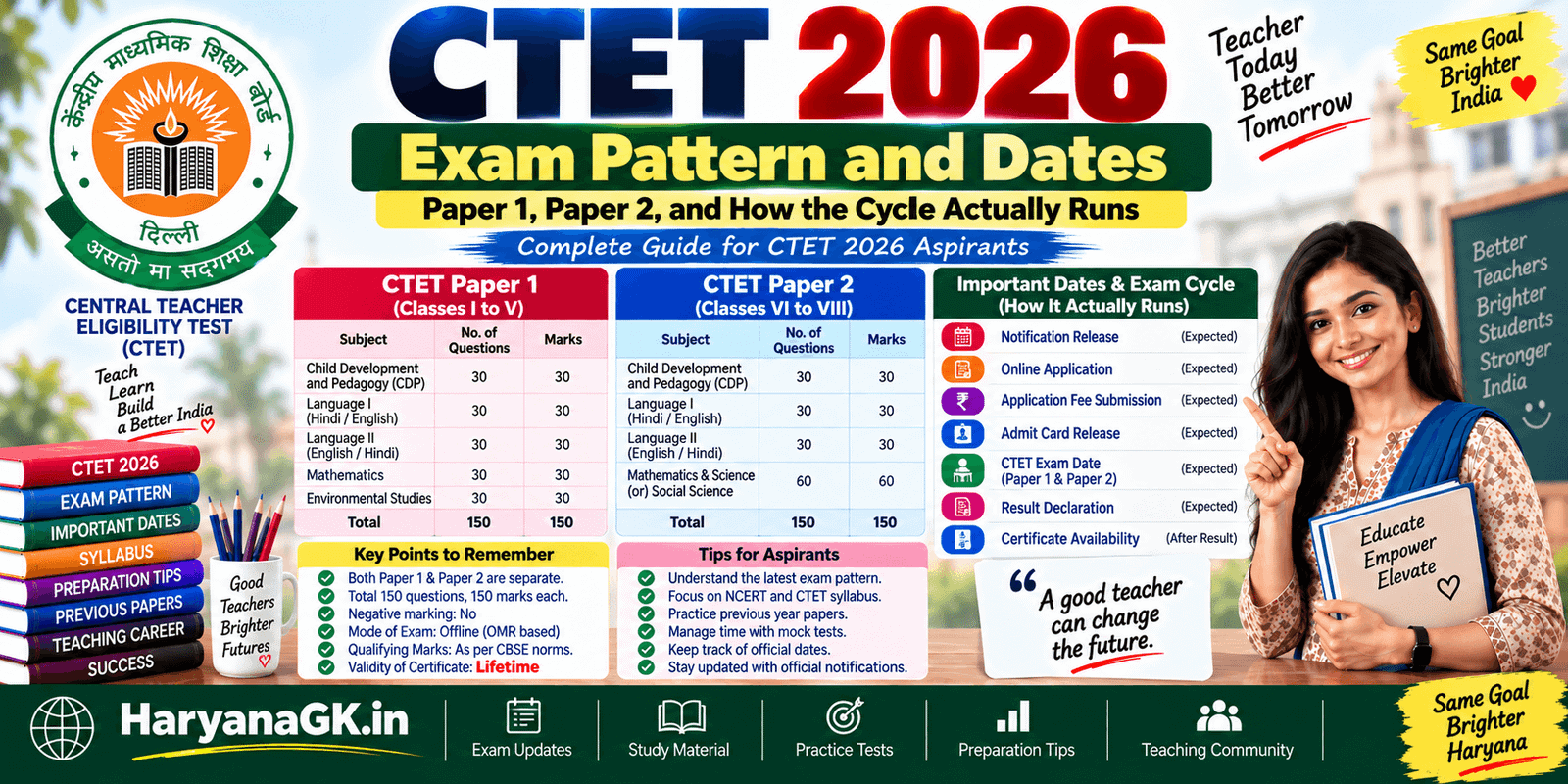
CTET Previous Year Question Papers for Paper 1 and Paper 2
Search for “CTET previous year question paper” and you’ll land on a dozen sites all claiming to have the complete archive. Almost none of them are working from an official CBSE-published repository, because one doesn’t really exist in the form most candidates imagine. What’s actually circulating is a mix of candidate recall, RTI-obtained copies, and coaching-institute reconstructions. That distinction matters for how much you should trust any given PDF, and this post walks through it year by year, plus a more useful question: what to actually do with old papers once you have them.
The thing nobody tells you: there’s no permanent official archive
CBSE publishes the provisional and final answer keys for a cycle on ctet.nic.in during that cycle’s objection window, but it doesn’t maintain a standing, publicly browsable archive of every past question booklet going back years. Once a cycle’s objection window closes and results are out, the official portal’s focus moves to the next cycle, not to preserving old papers as a study resource. Question papers from a specific past cycle sometimes get pulled offline from the official site entirely.
What fills that gap is coaching institutes, who compile “previous year papers” from a combination of sources: candidates who reconstruct the paper from memory right after their shift, invigilators’ and centre staff’s informal notes in some cases, and occasionally an RTI request that produces an actual scanned copy. None of this is dishonest, exactly, but it does mean two different sites’ “2023 CTET Paper 1 previous year paper” PDFs can have small differences in exact wording or option order, since neither is a verified CBSE-issued original. Treat any previous year paper you download as a strong practice approximation of that cycle’s real paper, not a guaranteed byte-for-byte copy.
Why this still matters for your preparation CTET Previous Year Question Papers
None of this makes previous year papers less useful. The actual value isn’t in memorizing that one specific paper; it’s in seeing, repeatedly, how CBSE phrases Child Development and Pedagogy questions, how EVS and Social Studies questions tend to test application rather than pure recall, and how consistently the marks distribution across sections has held cycle after cycle. That pattern-recognition is what transfers to your own exam, even if a handful of individual questions in a specific PDF aren’t word-for-word what CBSE originally printed.
CTET February 2026 cycle
The most recent completed cycle at the time of writing. Paper 1 and Paper 2 followed the same five-section and four-section structures covered in our CTET exam pattern and dates guide, with no structural surprises compared to previous cycles. As with most recent cycles, testing was spread across multiple dates within the announced window rather than a single day, so candidates who sat this cycle didn’t all take an identical paper: different dates typically use different (though equivalent-difficulty) question sets. If you’re using February 2026 papers for practice, treat them as one data point on typical difficulty and phrasing rather than “the” definitive paper for that cycle.
CTET 2024 cycles
CBSE ran CTET cycles in 2024 following the now-familiar pattern: Paper 1 and Paper 2 offered on the same day in separate shifts for candidates who applied for both, OMR-based, no negative marking. Papers from this year are a reasonably close reflection of the exam’s current form, since the core structure hasn’t shifted meaningfully since. If you can only get your hands on a limited number of previous year papers, recent ones like this are generally worth prioritizing over much older cycles.
CTET 2023 cycles
Similar structure again. One thing candidates preparing from 2023 papers specifically flag: the EVS section in Paper 1 that year leaned noticeably toward application-based scenario questions (a short passage or situation followed by a question) rather than pure one-line factual recall, a trend that’s continued rather than reversed in later cycles. If your preparation so far has been mostly definition-and-fact based for EVS, working through a 2023 paper is a useful gut check on whether you can handle the scenario-style framing.
CTET 2022 cycles
2022 papers are still broadly representative of the current pattern and worth including in a practice rotation. This is also roughly when multi-date, multi-shift administration for a single cycle became the clear norm rather than the exception, driven by candidate volume, so papers from this point forward are more directly comparable to what you’ll actually sit than papers from years when CTET ran as a single-day exam.
CTET 2021 cycles
2021 sits in an unusual window: exam administration that year had to account for pandemic-related protocols in several cycles, including staggered shifts and additional health-related instructions on the admit card that don’t apply today. The actual subject-matter content and marking scheme weren’t affected, so 2021 papers are still fine for content practice, but don’t take that cycle’s administrative details (shift timing, seating protocols) as representative of current procedure.
CTET 2019 cycle
2019 predates the multi-date administration pattern discussed above; this was closer to the traditional single-day format. Content-wise, the sections and marks distribution are the same structure as today, making 2019 papers still reasonably useful, though the exact difficulty calibration of that cycle isn’t something you should read too much into given how many cycles have run since.
CTET 2018 cycles, including Paper 2
2018 is often searched specifically because of “CTET 2018 question paper 2,” and it’s a reasonable one to include in a broader practice set precisely because it’s old enough that you’re less likely to have already seen it circulated heavily in recent coaching material, giving you a slightly more honest gauge of where you stand. Paper 2 that year followed the same Child Development and Pedagogy, Language I, Language II, and Mathematics-and-Science-or-Social-Studies structure that’s held since. If your target level is upper primary (classes 6 to 8), specifically seek out Paper 2 papers rather than defaulting to whatever’s most heavily promoted online, since Paper 1 and Paper 2 practice isn’t interchangeable.
CTET 2020 cycle
2020 is worth calling out on its own because that year’s cycle was directly disrupted by the pandemic, with the actual exam pushed later than its original schedule and run under health protocols that added extra instructions around masks, sanitization, and spacing at the centre. None of that changed the paper’s content or structure, so 2020 papers remain fine for subject practice, but if you’re reading old admit card or reporting-time details from that cycle expecting them to carry over, they won’t; current cycles have dropped those pandemic-specific protocols.
Papers older than 2018
Papers from further back exist and circulate, but their usefulness drops off for two reasons: the syllabus emphasis within sections has drifted somewhat over a decade (particularly around how pedagogy questions are framed), and there’s a much higher chance an older PDF circulating online has transcription errors that have been copied from site to site without anyone re-checking against a genuine source. Use very old papers, if at all, for volume of practice on question types and timing, not for treating every option as a verified correct answer.
Hindi medium versus English medium papers
CTET question papers are typically printed bilingually, with the Hindi and English versions of each question appearing together on the same page rather than as entirely separate booklets, except for the Language sections themselves, which are obviously language-specific.
When you’re downloading a previous year paper, check whether the PDF you’ve found preserves both versions or has stripped one out, since a paper missing the Hindi version isn’t usable the same way for candidates who rely on it to clarify a question’s exact intent, and CDP and pedagogy questions in particular can shift subtly in meaning depending on which language version you’re reading. If you genuinely study in Hindi medium, don’t settle for an English-only reconstruction just because it was easier to find; look specifically for a bilingual copy.
Watch for missing diagrams and images
Mathematics questions involving shapes, and occasionally EVS or Social Studies questions built around a map, chart, or picture, depend entirely on an image that has to be reproduced correctly in the PDF. Reconstructed previous year papers assembled from candidate recall sometimes drop these images entirely, replacing them with a vague text description or, worse, nothing at all, which makes the question unanswerable and wastes your practice time figuring out that the PDF itself is broken rather than that you don’t understand the material. Before committing to a source for a full timed practice attempt, skim through it first specifically to check that any image-dependent questions actually have their images intact.
How CBSE’s answer key philosophy shows up across years
Working through several years of previous year papers alongside their answer keys teaches you something that a single mock test can’t: how CBSE actually resolves the genuinely tricky, arguable questions that show up in most cycles. Across recent years, questions with more than one defensible answer have generally been handled by awarding marks to every option accepted after the objection process, rather than being deliberately designed to have one hidden “trick” answer.
This is a useful thing to internalize before your own exam: in the Child Development and Pedagogy section especially, where reasonable-sounding options can conflict with each other, the exam tends to reward the option most closely aligned with mainstream constructivist pedagogy (the kind covered in NCERT’s own teacher-training material) over one that sounds intuitively appealing but reflects an older, more rote-learning-oriented view of teaching.
Previous year papers versus model or mock papers
These get used interchangeably in casual conversation, but they’re different things. A previous year paper is meant to reflect an actual past CTET exam, however imperfectly reconstructed, as covered above. A model paper or mock test is written fresh by a coaching institute or content team to match the CTET pattern and difficulty level, without being tied to any specific real past cycle. Model papers are useful for extra volume once you’ve worked through the genuine previous year papers you can find, but they shouldn’t be your first or only source, since they don’t tell you anything about CBSE’s actual historical phrasing habits the way a real past paper does.
Solved papers with, and without, answers
Most previous year paper PDFs come in one of two forms: a “with answers” or “solved” version that has the correct option marked (and sometimes a brief explanation) directly alongside each question, and a plain version with no answers included at all, meant to be attempted like a real exam first. Both have a place, but not at the same time.
Use the unsolved version first, ideally under actual timed conditions: two and a half hours, phone away, one sitting, no pausing to look anything up. Only after you’ve completed it and marked your own responses should you move to the solved version to check your answers and understand where you went wrong. Going straight to a solved paper skips the part that actually builds exam readiness, which is retrieving the answer under time pressure rather than recognizing it when it’s shown to you.
How to actually use previous year papers in your preparation
Working through fifteen previous year papers passively, one after another, without reviewing your mistakes, teaches you far less than working through five papers properly. After each attempt, go back through every question you got wrong and, separately, every question you got right by guessing rather than genuine knowledge; both categories need more study, even though only the first one shows up as a wrong answer.
Track section-wise performance rather than just your overall score. A candidate scoring 100 out of 150 with EVS and Maths both weak is in a very different position from one scoring 100 out of 150 with Child Development and Pedagogy weak, even though the raw number looks the same, because the fix for each is different. Previous year papers are one of the few tools that let you see this section-wise pattern clearly across multiple attempts, since a single mock test in isolation doesn’t tell you whether a weak section was a one-off bad day or an actual gap.
Space your practice papers out rather than clustering them all in the final week. Working through one every few days over a longer stretch, with real review time in between, builds more durable improvement than cramming ten papers into the last five days before your exam, when you have no time left to act on what the review reveals.
Topics that show up again and again
Work through even four or five previous year papers and certain topics start repeating with enough regularity that they’re worth specifically prioritizing rather than treating every topic in the syllabus as equally likely to appear.
In Child Development and Pedagogy, the theories of Piaget, Vygotsky, and Kohlberg come up almost every cycle, usually as application-based questions describing a classroom scenario rather than a direct “define this stage” question. Inclusive education and how to accommodate children with learning disabilities like dyslexia also appear consistently, as does the Right to Education Act, 2009, particularly its provisions around age-appropriate admission and the no-detention policy in earlier versions of the Act.
In Mathematics, place value, basic geometry (properties of shapes rather than complex construction), and questions about the pedagogy of teaching mathematics specifically, not just solving a maths problem yourself, show up repeatedly. A meaningful share of Maths questions in Paper 1 and Paper 2 alike aren’t testing whether you can solve the sum; they’re testing whether you understand common misconceptions children have and how a teacher should address them.
In Environmental Studies, questions drawing on the National Curriculum Framework’s approach to integrated EVS teaching (treating EVS as combining science, geography, and social themes rather than as pure science) recur often, alongside straightforward environmental awareness content like conservation and natural resources.
In the Language sections, expect comprehension passages paired with pedagogy questions about listening, speaking, reading, and writing skills, plus recurring references to language acquisition theory, including Chomsky’s ideas about innate language ability. These pedagogy-of-language questions are exactly the ones candidates who focus only on grammar tend to underprepare for, which ties back to the earlier point about not treating the language sections as lower priority.
None of this means other topics won’t appear; the full chapter-by-chapter breakdown in our CTET syllabus guide is broader than this list. But if your revision time is limited, previous year papers are the most reliable way to see which topics CBSE actually returns to most often, rather than guessing from the syllabus document alone.
Language section practice: don’t skip it
Candidates preparing heavily for Child Development and Pedagogy, Maths, and EVS or Social Studies sometimes treat the Language I and Language II sections as lower priority, on the assumption that language ability doesn’t need dedicated practice the way subject content does. Previous year papers are useful specifically for correcting this assumption: the language sections test comprehension passages and pedagogy-of-language-teaching questions, not just grammar recall, and the pedagogy angle in particular is easy to underestimate until you’ve actually attempted a real paper’s language section under time pressure.
A practical schedule for working through previous year papers
If you’re starting roughly two months out from your exam, a workable rhythm is one full timed previous year paper every week for the first month, moving to one every four to five days in the final month as your speed improves and you have more capacity to handle the extra volume.
After each paper, block out a review session at least as long as the exam itself; a two-and-a-half-hour paper deserves a genuine two-and-a-half-hour (or longer) review, not a rushed fifteen-minute check of your score. In the final week before your exam, taper down rather than up: one last full paper roughly three to four days out, followed by lighter, targeted review of your weak sections rather than another full timed attempt the day before, when fatigue does more damage than a last paper does good.
Keep a simple running log across papers rather than treating each attempt in isolation: your score per section, and one or two specific mistakes worth remembering. Reviewing that log before your actual exam, rather than trying to recall six weeks of scattered practice from memory, is a far more efficient use of your final prep days than attempting yet another paper you haven’t got time left to properly review anyway.
Keeping a practice-paper tracking log
A running log turns scattered practice into something you can actually act on, and it doesn’t need to be complicated. A simple spreadsheet with one row per paper attempted works fine, with columns for the date you attempted it, which year and paper it was, your raw score, your score broken down section by section (CDP, Language I, Language II, Maths, EVS or Social Studies), the top two or three specific mistakes you want to remember, and a revisit date, roughly a week or two later, when you’ll re-attempt just those specific weak questions or a similar set on the same topic.
The revisit-date column is the part most candidates skip, and it’s the one that actually closes the loop. Reviewing a mistake once tells you what you got wrong; revisiting it a week later tells you whether you actually fixed the underlying gap or just recognized the answer because you’d seen it recently. If you get the same type of question wrong again on the revisit, that’s a much stronger signal that you need to go back to the source material, rather than just attempting another paper and hoping repetition alone closes the gap.
If you’re attempting CTET again after a previous unsuccessful cycle
Previous year papers do a different job the second time around than they did the first. On your first attempt at CTET, working through old papers broadly, across every section, makes sense because you don’t yet know where your weak points actually are. If you’ve already sat CTET once and fallen short, you have something more valuable than a fresh candidate does: an actual CTET result with a sense of where you stood relative to the qualifying mark, plus whatever mistakes you noted from your own preparation the first time around.
Use that. Rather than restarting with a broad rotation of full papers across every section, pull previous year papers apart by section and drill specifically the one or two sections that were actually weak last time, using several years’ worth of just that section rather than spreading the same practice time thin across a full paper you’re already reasonably strong on.
A candidate who qualified comfortably on Language I and Maths but fell short specifically because of Child Development and Pedagogy gains far more from ten years of CDP sections in isolation than from ten full mixed papers repeating sections they’ve already proven they can handle. Save full timed papers for closer to your actual exam date, purely to confirm your pacing and stamina haven’t slipped, rather than as your main diagnostic tool this time around.
Using previous year papers to decide between Maths and Science, or Social Studies
If you’re still undecided on Paper 2’s Section 4 elective, working through a few previous year papers for each option is a more honest test than trying to judge from the syllabus document alone. Attempt a genuine, timed Mathematics and Science section from one previous year paper, then a Social Studies section from another, on separate days so you’re not comparing a fresh attempt against a tired one. Look past your raw score on each; pay attention to which one you finished with time to spare versus which one you were still rushing through in the last ten minutes, and which one’s wrong answers felt like genuine knowledge gaps versus careless misreading under time pressure.
This matters because the two options draw on genuinely different skills day to day as a teacher, not just different exam content: Mathematics and Science rewards comfort with numerical reasoning and basic scientific concepts, while Social Studies rewards comfort with historical and civic reasoning and longer reading passages. A previous year paper attempt won’t make the decision for you, but it’s a far more concrete data point than guessing based on which subject you personally enjoyed more in school a decade or two ago, which is the far less reliable way most candidates end up making this call.
Where to actually practice, beyond hunting for PDFs
If your main goal is genuine practice rather than specifically studying CBSE’s original historical phrasing, a well-organized digitized question bank, like the one on this site covering CTET topics section by section, often serves you better day to day than repeatedly downloading and re-downloading previous year PDFs from different sources. It lets you drill a specific weak section (say, just EVS, or just Paper 2’s Social Studies option) directly, rather than working through an entire mixed paper every time you want to target one weak area. Use previous year papers for full-length, timed simulation closer to your exam date, and a topic-organized question bank for the day-to-day section-by-section grinding in between.
Background reading that makes previous year papers more useful
A previous year paper tests you on material; it doesn’t teach that material to you. If a paper repeatedly exposes gaps in a specific area, the fix is usually to go back to the actual source material rather than just attempting more papers on the same weak topic. For Child Development and Pedagogy, that means the NCERT-aligned teacher-education material covering developmental theory and inclusive education, plus the actual text of the Right to Education Act, 2009, rather than a coaching institute’s summarized bullet points of it.
For Mathematics and EVS pedagogy questions, the NCERT textbooks for classes 1 through 8 are the direct source most CTET questions are built around, since the exam is fundamentally testing whether you can teach at that level, not testing advanced subject knowledge beyond it. Reading the National Curriculum Framework’s stated philosophy on integrated EVS teaching also clarifies why certain “obvious” answers on EVS pedagogy questions are actually wrong: the exam consistently rewards the integrated, activity-based approach the NCF describes over a more traditional, subject-siloed way of teaching the same content.
How to tell if a specific PDF source is actually trustworthy
Not every site offering a “CTET previous year paper” put the same care into compiling it, and a few quick checks before you commit real study time to a source can save you from practicing off a badly reconstructed paper.
Start with the watermark and formatting. A source that’s actually done the work tends to have clean, consistent formatting throughout, options aligned the same way question after question, and if there’s a watermark, it’s usually a single small logo rather than something stamped diagonally across every page in a way that suggests the file was hastily lifted from somewhere else and rebranded. A PDF where the font size or spacing changes partway through, or where later questions look visibly different in layout from earlier ones, is a sign the file was stitched together from more than one source without much editorial care.
Check whether the source says anything about how it built the paper. A site that states plainly that its previous year papers are reconstructed from candidate recall and faculty review, the same honest explanation covered earlier in this post, is telling you something true and useful. A site that implies its PDF is a direct official CBSE release without any such disclosure is either mistaken about its own sourcing or being deliberately vague, and either way it hasn’t earned extra trust just for making the claim.
Look at the question numbering. A genuine, carefully compiled paper runs its numbering straight through without gaps or duplicate numbers, and the count matches what the actual exam structure calls for, 150 for a full paper split correctly across the relevant sections. If you spot a skipped number, a repeated number, or a section that has clearly too few or too many questions for its stated marks, that’s a concrete, checkable sign of a sloppy compilation rather than a matter of opinion.
Finally, before working through an entire paper from a new source, spot-check three or four answers yourself using your own subject knowledge, particularly on questions you’re confident about. If your own reasoning disagrees with the source’s listed answer on more than one of these spot checks, treat the rest of that paper’s answer key with real caution rather than assuming the disagreement is your own error. This five-minute habit, done once per new source rather than once per paper, is the single most efficient way to filter out weaker compilations before you’ve sunk hours into them.
A note on official sources and verification
For anything procedural, exam dates, city allotment, eligibility, or the current cycle’s notification, ctet.nic.in remains the only source worth trusting fully. Previous year question papers themselves are a different category; since CBSE doesn’t maintain the kind of permanent public archive discussed earlier, no single third-party source can claim to be “the official” one, and healthy skepticism toward any specific PDF’s exact wording is reasonable rather than paranoid.
FAQs
Are CTET previous year question papers officially released by CBSE? Not as a permanent, ongoing archive. CBSE publishes answer keys during each cycle’s objection window on ctet.nic.in, but most “previous year paper” PDFs circulating online are compiled by coaching institutes from candidate recall or other indirect sources rather than downloaded directly from an official repository.
How many previous year papers should I practice before my exam? There’s no fixed number that works for everyone, but working through a smaller set of papers thoroughly, with real review of every mistake, generally helps more than rushing through a large stack without reviewing them properly.
Should I attempt previous year papers with a timer? Yes, ideally under conditions close to the real exam: two and a half hours, one sitting, no interruptions. This is what actually builds the retrieval speed and stamina you need on exam day, which a leisurely untimed read-through doesn’t train.
Is there a difference between Paper 1 and Paper 2 previous year papers? Yes, they test different content since Paper 1 targets classes 1 to 5 and Paper 2 targets classes 6 to 8, with Paper 2 also including the Mathematics-and-Science-or-Social-Studies elective section that Paper 1 doesn’t have. Make sure you’re downloading and practicing the paper that matches the level you’re actually preparing for.
Are older CTET papers, from 2018 or earlier, still worth practicing? To some extent, mainly for volume of practice and exposure to question types, since the core pattern has stayed fairly consistent. Treat them as slightly less reliable on exact wording than more recent papers, and don’t assume every answer key attached to an older PDF has been double-checked.
What’s the difference between a previous year paper and a mock test? A previous year paper is meant to reconstruct an actual past CTET exam. A mock test is written fresh by a coaching provider to match the pattern and difficulty without being tied to a specific real cycle. Both are useful, but they serve slightly different purposes in your preparation.
Should I use a solved paper or an unsolved one first? Attempt the unsolved version first, under timed conditions, exactly as you would the real exam. Only switch to the solved version afterward to check your answers and understand your mistakes; going straight to a solved paper skips the retrieval practice that actually builds exam readiness.
Do previous year papers come with the Hindi version as well as English? Most genuine CTET papers are bilingual, with Hindi and English versions of each question printed together, aside from the language-specific sections. Check that any PDF you download has preserved both versions rather than stripping one out, especially if you study in Hindi medium.
Can I trust the answer key attached to a previous year paper PDF I found online? Treat it as a strong starting point rather than an unquestionable source, particularly for older papers. Cross-check a handful of answers you’re unsure about against more than one source, or against your own reasoning, before assuming the attached key is fully correct.
2 thoughts on “CTET Previous Year Question Papers: What’s Actually Available and How to Use Them”