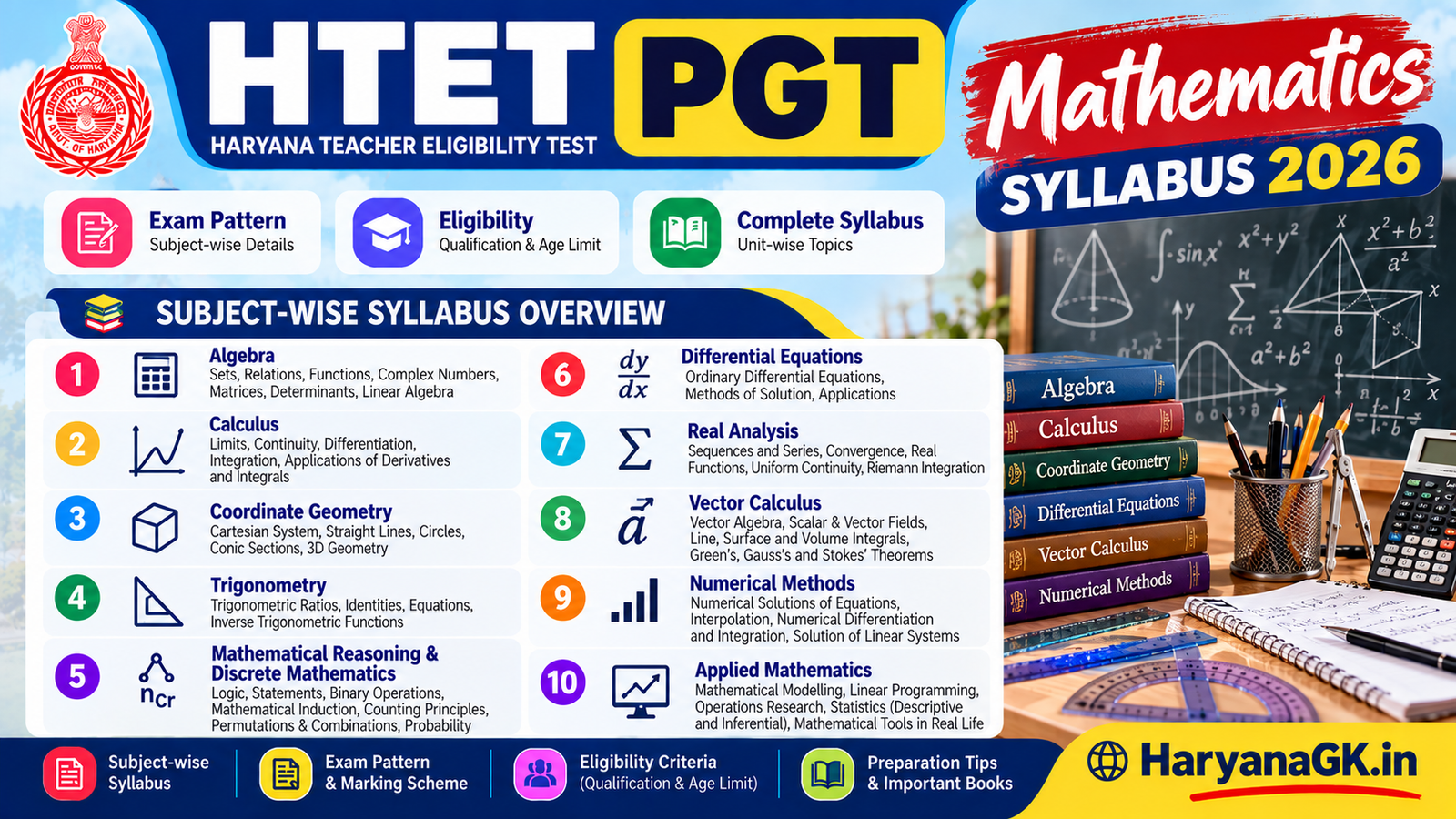
HTET PGT Mathematics Syllabus 2026 Subject-wise Syllabus, Exam Pattern and Eligibility
PGT Mathematics spans Class 9-10 arithmetic and geometry all the way through Class 12 calculus and vectors in a single 60-mark section, which makes it one of the most content-heavy PGT papers purely in terms of named topics. Candidates who focus revision on calculus and coordinate geometry (the parts that feel most “advanced”) sometimes under-revise the foundational Arithmetic, Algebra and Trigonometry block, which carries exactly the same weight.
This guide covers the HTET PGT Mathematics syllabus exactly as BSEH has structured it, along with the exam weightage and the eligibility conditions for this paper.
HSSC Group D – Previous Year Solved Papers
Practice HSSC Group D previous year solved question papers, shift-wise, with instant answers and explanations after every question.
| Exam Date | Shift | Solved Paper |
|---|---|---|
| 10 November 2018 | Shift 1 | Attempt Quiz  |
| 10 November 2018 | Shift 2 | Attempt Quiz |
| 11 November 2018 | Shift 1 | Attempt Quiz |
| 11 November 2018 | Shift 2 | Attempt Quiz |
| 17 November 2018 | Shift 1 | Attempt Quiz |
| 17 November 2018 | Shift 2 | Attempt Quiz |
| 18 November 2018 | Shift 1 | Attempt Quiz |
| 21 October 2023 | Shift 1 / Morning | Attempt Quiz |
| 21 October 2023 | Shift 2 / Evening | Attempt Quiz |
| 22 October 2023 | Shift 1 / Morning | Attempt Quiz |
| 22 October 2023 | Shift 2 / Evening | Attempt Quiz |
HTET PGT Mathematics Exam Pattern and Weightage 2026
The paper has 150 multiple-choice questions for 150 marks, completed in two and a half hours, with one mark per question and no negative marking.
| Section | Number of MCQs | Marks |
|---|---|---|
| Child Development and Pedagogy | 30 | 30 |
| Languages (Hindi 15 + English 15) | 30 | 30 |
| General Studies (Quantitative Aptitude 10, Reasoning 10, Haryana GK 10) | 30 | 30 |
| Mathematics (Subject Specific) | 60 | 60 |
| Total | 150 | 150 |
Qualifying marks:
- General category candidates: 60% (90 marks)
- SC and differently-abled candidates of Haryana domicile: 55% (82 marks)
- SC and differently-abled candidates from other states: 60% (90 marks)
Topics come from the Class 9-12 syllabus prescribed by the Haryana Education Department, with the difficulty standard reaching postgraduate level.
Common Syllabus for HTET PGT (Child Development, Languages, General Studies)
These three sections are identical across every PGT subject and make up 90 of the 150 marks.
Child Development and Pedagogy
Covers the psychology of teaching and learning for the 14-17 age group, including Freud’s Psychosexual Development Theory, Erikson’s Theory of Psychosocial Development, Bandura’s Social Learning Theory, and the standard Piaget/Kohlberg/Vygotsky foundations.
Languages — Hindi and English
Each carries 15 marks: one unseen passage tested for comprehension, inference, grammar and verbal ability, combined with the pedagogy of language development.
General Studies — Haryana GK, Reasoning and Quantitative Aptitude
Haryana GK (10 marks) covers state history, current affairs, geography and welfare schemes. Reasoning (10 marks) spans verbal and non-verbal types. Quantitative Aptitude (10 marks) covers number systems, percentages, interest, mensuration and data representation — note this overlaps conceptually with parts of the subject-specific Mathematics section but is scored separately.
| HTET Previous Year Exam Papers with Answer Keys | ||
| Sr. No. | Year of Exam | Download Link |
| 1 | 2024 | Download PDFs  |
| 2 | 2023 | Download PDFs |
| 3 | 2022 | Download PDFs |
| 4 | 2021 | Download PDFs |
| 5 | 2020 | Download PDFs |
| 6 | 2019 | Download PDFs |
HTET PGT Mathematics: Subject-Specific Syllabus
The 60-mark section spans five broad areas, running from Class 9-10 foundations through Class 12 calculus and vectors.
Arithmetic, Algebra, Trigonometry, Geometry and Statistics (Class 9-10 level)
The real number system, arithmetic progressions, polynomials, linear equations in two variables, quadratic equations, and an introduction to trigonometry and its application to heights and distances. Euclid’s geometry, lines and angles, congruence and similarity of triangles, quadrilaterals, circles, Heron’s formula, the area related to circles, and the surface area and volume of combinations of solids.
Statistics covers bar graphs, histograms and frequency polygons, measures of central tendency (mean, median, mode) and dispersion (range, mean deviation, variance, standard deviation) for both grouped and ungrouped data. Probability covers the theoretical and axiomatic approaches, conditional probability, the multiplication theorem, independent events, Bayes’ Theorem, and the theorem of total probability.
Sets, Relations and Functions
Sets and their representation, types of sets, Venn diagrams, set operations (union, intersection, difference) and the complement of a set. Ordered pairs, the Cartesian product of sets, relations and their types, functions and their types, the algebra and composition of functions, and invertible functions. Radian and degree measure, trigonometric functions and their graphs, and the principal value and properties of inverse trigonometric functions.
Algebra (Class 11-12 level)
Complex numbers and quadratic equations, the Argand plane, linear inequalities, and linear programming problems and their mathematical formulation. Permutations and combinations, the binomial theorem, Pascal’s triangle, and sequences and series (geometric progressions), including the relationship between arithmetic and geometric means.
Matrices — their types, operations, transpose, symmetric and skew-symmetric forms, and invertibility. Determinants of matrices of order one, two and three, the area of a triangle using determinants, minors and cofactors, the adjoint and inverse of a matrix, and solving systems of linear equations using the inverse of a matrix.
Calculus
The intuitive idea of limits, and limits of polynomial, rational, trigonometric, exponential and logarithmic functions. The definitions of continuity and differentiability, and the algebra of continuous and differentiable functions. Derivatives — their definition, algebra, and the derivatives of polynomial, trigonometric, composite (via the chain rule), implicit, inverse trigonometric, exponential and logarithmic functions, plus logarithmic differentiation, derivatives in parametric form, and second-order derivatives.
Rate of change of quantities, and the application of derivatives to increasing and decreasing functions and maxima and minima. The process and methods of integration, the Fundamental Theorem of Calculus, evaluating definite integrals by substitution, the properties of definite integrals, and the application of integrals to the area under simple curves.
Vectors and Coordinate Geometry
Two- and three-dimensional coordinate geometry, straight lines, and conic sections (circles, ellipses, parabolas, hyperbolas, and degenerate cases). Coordinate axes and planes in three dimensions, and the distance between two points.
Vectors — their definition, position vectors, direction cosines, types of vectors, vector addition and scalar multiplication, components of a vector, the vector joining two points, and the section formula. The scalar (dot) product and vector (cross) product of two vectors, projection of a vector on a line, direction cosines and ratios of a line, the equation of a line in space, the angle between two lines, and the shortest distance between two lines — plus subject-related pedagogy.
Visit bseh.org.in or htet.eapplynow.com for official Notification & Syllabus 2026
Given how evenly this syllabus distributes across five major areas — foundational maths, sets/functions, algebra, calculus, and vectors/coordinate geometry — it’s worth building a checklist by area rather than assuming the most recently studied topics (usually calculus, if you’re coming straight from an M.Sc.) will carry the whole paper.
Who Is Eligible for HTET PGT Mathematics? Qualification Details
You need to satisfy all of the following:
- M.A./M.Sc. in Mathematics or Applied Mathematics, with Mathematics as one of the subjects at Graduation level, with at least 50% marks from a recognised university, along with a B.Ed. from a recognised university.
- Matric with Hindi or Sanskrit as a subject, or Senior Secondary/Graduation/Post Graduation with Hindi as one of the subjects.
- A consistent good academic record.
Note the specific condition that Mathematics must have been one of your subjects at the Graduation level as well — an M.Sc. Mathematics obtained without Mathematics at graduation (for example, through a lateral entry route) would not automatically satisfy this condition.
What counts as “Good Academic Record”
For direct recruitment, “Good Academic Record” means averaging at least 50% marks across any three of your 10th, 12th, Graduation and Post-Graduation results — but you must separately have at least 50% marks in your Post-Graduation itself.
Relaxation for SC, BC and differently-abled candidates
Where the minimum qualifying mark is 50%, SC, BC and differently-abled candidates get a 5% relaxation, bringing it to 47.5%. Where the minimum is 45%, the relaxed figure is 42.75%, per the Supreme Court’s 2011 ruling in P.V. Indiresan vs Union of India.
A qualification detail worth checking twice
Only a B.Ed. recognised by the National Council for Teacher Education (NCTE) counts. For the B.Ed. (Special Education) route specifically, the course needs recognition from the Rehabilitation Council of India (RCI) instead.
Frequently Asked Questions
Does PGT Mathematics require Mathematics at both graduation and post-graduation level?
Yes. The eligibility condition specifically requires Mathematics as one of your subjects at Graduation, in addition to the M.A./M.Sc. in Mathematics or Applied Mathematics itself.
Is Class 9-10 level content actually tested, or is PGT Mathematics purely Class 11-12?
Both are explicitly included — arithmetic progressions, Euclid’s geometry and basic trigonometry (Class 9-10 level) sit in the same subject-specific syllabus as calculus and vectors (Class 11-12 level).
How much of this syllabus is calculus specifically?
Calculus is one of five major areas and covers limits, continuity, differentiation and integration in detail, but it’s not weighted more heavily than Algebra or Vectors and Coordinate Geometry in the official syllabus structure.
Does the subject-specific Mathematics section overlap with the common Quantitative Aptitude section?
There’s conceptual overlap in basic arithmetic and mensuration, but Quantitative Aptitude (10 marks) stays at a general-aptitude level, while the subject-specific section (60 marks) goes into full Class 9-12 curriculum depth, including calculus and vectors that Quantitative Aptitude doesn’t touch.
With five roughly equal-sized areas in this syllabus, a realistic revision plan should allocate comparable time to each — don’t let calculus, which tends to feel the most “serious,” crowd out foundational geometry and statistics review.