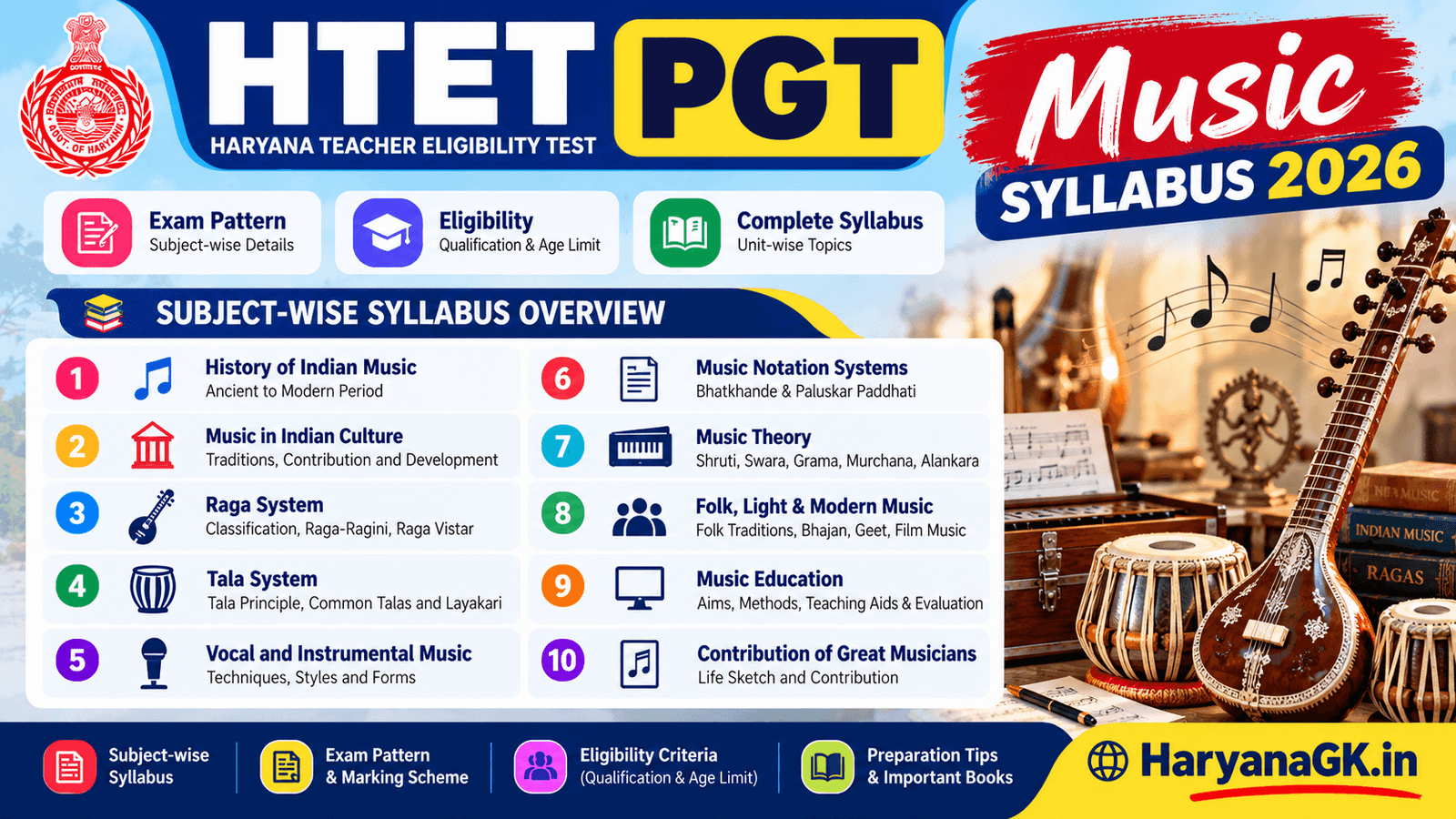
HTET PGT Music Syllabus 2026: Subject-wise Syllabus, Exam Pattern and Eligibility
PGT Music goes considerably deeper into music theory than TGT Music — alongside raga and tala fundamentals, it adds graam and moorchhana theory (the ancient seven-note scale systems from which ragas are derived), the time-theory governing when specific ragas are traditionally performed, and classical treatises like the Natyashastra, Sangeet Ratnakar and Sangeet Parijat. Candidates moving up from TGT-level preparation need to treat this as a genuinely more advanced paper, not an extension of the same material.
This guide covers the HTET PGT Music syllabus exactly as BSEH has structured it, along with the exam weightage and the eligibility conditions for this paper.
HSSC Group D – Previous Year Solved Papers
Practice HSSC Group D previous year solved question papers, shift-wise, with instant answers and explanations after every question.
| Exam Date | Shift | Solved Paper |
|---|---|---|
| 10 November 2018 | Shift 1 | Attempt Quiz  |
| 10 November 2018 | Shift 2 | Attempt Quiz |
| 11 November 2018 | Shift 1 | Attempt Quiz |
| 11 November 2018 | Shift 2 | Attempt Quiz |
| 17 November 2018 | Shift 1 | Attempt Quiz |
| 17 November 2018 | Shift 2 | Attempt Quiz |
| 18 November 2018 | Shift 1 | Attempt Quiz |
| 21 October 2023 | Shift 1 / Morning | Attempt Quiz |
| 21 October 2023 | Shift 2 / Evening | Attempt Quiz |
| 22 October 2023 | Shift 1 / Morning | Attempt Quiz |
| 22 October 2023 | Shift 2 / Evening | Attempt Quiz |
HTET PGT Music Exam Pattern and Weightage 2026
The paper has 150 multiple-choice questions for 150 marks, completed in two and a half hours, with one mark per question and no negative marking.
| Section | Number of MCQs | Marks |
|---|---|---|
| Child Development and Pedagogy | 30 | 30 |
| Languages (Hindi 15 + English 15) | 30 | 30 |
| General Studies (Quantitative Aptitude 10, Reasoning 10, Haryana GK 10) | 30 | 30 |
| Music (Subject Specific) | 60 | 60 |
| Total | 150 | 150 |
Qualifying marks:
- General category candidates: 60% (90 marks)
- SC and differently-abled candidates of Haryana domicile: 55% (82 marks)
- SC and differently-abled candidates from other states: 60% (90 marks)
Topics come from the Class 9-12 syllabus prescribed by the Haryana Education Department, with the difficulty standard reaching postgraduate level.
Common Syllabus for HTET PGT (Child Development, Languages, General Studies)
These three sections are identical across every PGT subject and make up 90 of the 150 marks.
Child Development and Pedagogy
Covers the psychology of teaching and learning for the 14-17 age group, including Freud’s Psychosexual Development Theory, Erikson’s Theory of Psychosocial Development, Bandura’s Social Learning Theory, and the standard Piaget/Kohlberg/Vygotsky foundations.
Languages — Hindi and English
Each carries 15 marks: one unseen passage tested for comprehension, inference, grammar and verbal ability, combined with the pedagogy of language development.
General Studies — Haryana GK, Reasoning and Quantitative Aptitude
Haryana GK (10 marks) covers state history, current affairs, geography and welfare schemes. Reasoning (10 marks) spans verbal and non-verbal types. Quantitative Aptitude (10 marks) covers number systems, percentages, interest, mensuration and data representation.
HTET PGT Music: Subject-Specific Syllabus
BSEH organises this 60-mark section into three parts, each combining theory with musician biographies — a pattern carried over from TGT Music but expanded with more advanced theoretical content.
Part A — Sound, Notes, Graam-Moorchhana Theory and Raga Time-Theory
Core definitions covering dhwani (sound) and its characteristics, and naad (tone) — including its *aahat* (struck) and *anaahat* (unstruck) forms. Ornamentation concepts — meend, kan, murki and khatka — alongside aalap and taan. The note hierarchy within a raga — vadi, samvadi, anuvadi, vivadi and varjit swar — and structural elements including aarohan-avarohan (ascent-descent), pakad, sthayi, antara, sam, taali, khaali, vibhag, matra and aavartan.
This part also covers graam (ग्राम) — the ancient scale system from which ragas are derived, including the Shadja, Madhyam and Gandhar graams — and moorchhana (मूर्च्छना), the sequential rearrangement of notes within a graam, along with the distinction between moorchhana and aarohan. A dedicated raga time-theory section explains how a raga’s traditional performance time is determined — through its komal or shuddha rishabh/dhaivat notes, its komal gandhar, the use of madhyam, its vadi-samvadi notes, whether it’s poorvang- or uttarang-pradhan, and according to season.
This part also covers thaat theory (थाट) — its definition, the ten named thaats, the notes used in each, and the distinction between a raga and a thaat — along with the qualities expected of a vocalist and the definition of a vaggeyakar (a composer-cum-performer). Specific ragas are studied in full classical detail, including Bhoopali, Bhairav, Bhairavi, Yaman, Bhimpalasi, Vrindavani Sarang, Khamaj, Asavari, Jaunpuri, Desh and Bihag — each covering its thaat, jaati, vadi-samvadi notes, and aarohan-avarohan-pakad.
This part also introduces the tanpura’s construction and parts, and classical music treatises — the Natyashastra, Sangeet Ratnakar and Sangeet Parijat — covering how many chapters of each relate to music, their subject matter, and the periods in which they were composed. It closes with the classification of ragas as shuddha (pure), chhayalag (shaded) or sankirna (mixed), with their defining characteristics.
Musician biographies here include vocalists and theorists such as Pandit Jasraj, Kishori Amonkar, Pandit Vishnu Digambar Paluskar, Sharangdev, Omkarnath Thakur, Bade Ghulam Ali Khan, Lata Mangeshkar, Tansen, Sadarang-Adarang and Baiju Bawra.
Part B — Gat, Jhala, Taan, Lakshangeet and Instrumental Styles
Core definitions covering gat (its types and characteristics), jhala (its characteristics and tempo), taan (its types), and lakshangeet (its definition, characteristics and components). This part also covers the qualities and shortcomings expected of an instrumentalist, future prospects in the music field, and why the medieval period is referred to as the golden age of Indian music.
Instrumentalist biographies here include Nikhil Banerjee, Debu Chaudhuri and Vilayat Khan, alongside the construction of the sitar and tuning its strings. This part also revisits sound (its intensity and quality) and the broader classification of music into classical and semi-classical streams, their respective vocal styles, and the contributions of Ravi Shankar and Annapurna Devi — plus questions on the national song (when and by whom it was written), the North Indian music notation system, and the authorship of well-known devotional songs like “Vaishnav Jan To.”
Part C — Tala, Laya and Percussion Instruments
Core definitions: *uthan*, *peshkar*, *chakkardar jarb*, *kaal*, *kriya*, *ang*, *rela*, *aamad*, *mohra*, *tihai*, *tukda*, *kayda*, *parun* and *jaati*. The Delhi gharana of tabla — its founder, representation, disciple lineage and distinctive playing characteristics.
The classification of instruments — tat (string), dhan (idiophone), sushir (wind) and avanaddha (percussion) vadya — and the specific characteristics and named examples of each. Laya (tempo) — its types, and which tempo forms (tarana, dhrupad, vilambit khyal, drut khyal) are performed in which laya. Tala — its ten defining pranas (elements) studied in detail.
Musician biographies here cover tabla and pakhawaj players: Zakir Hussain, Alla Rakha Khan, Kishan Maharaj and Ustad Ahmedjan Thirakwa, alongside pakhawaj construction and tuning. This part also covers a comparative study of tala pairs (Chartaal-Ektaal, Jhaptaal-Sooltaal, Teentaal-Tilwada), the origin and tuning of the tabla, layakari (rhythmic variation — dugun, tigun, chaugun, aad, biyaad, kuwaad) and how many matras each uses, and tala recognition from given bol sequences across Teentaal, Jhaptaal, Chartaal, Dhamar, Ektaal and Roopak Taal.
It closes with melodic instrument knowledge — sarod, violin, dilruba/israj, bansuri, mandolin, guitar and sarangi — the distinction between chakkardar tukda and chakkardar parun, instruments described in the Natyashastra, a detailed study of South Indian tala systems, the biography and contribution of Kudau Singh (of the pakhawaj gharana), and a comparative understanding of taali-khaali, dugun-do aavartan, tigun-tihai and laya-layakari, alongside brief histories of the various tabla and pakhawaj gharanas and their disciple lineages.
Given how much Part A alone expands beyond TGT Music — graam-moorchhana theory, raga time-theory and classical treatises are entirely new at this level — candidates should treat Part A as the section needing the most dedicated fresh study, even with strong TGT-level preparation already in place.
Visit bseh.org.in or htet.eapplynow.com for official Notification & Syllabus 2026
Quizzes (Subject Wise)
Practice free HTET-pattern MCQ quizzes, subject by subject. Pick a subject below to start.
| Subject | Quiz |
|---|---|
| Haryana GK | Haryana GK HTET Online Quiz  |
| Math | Math Quiz – TGT/PGT HTET |
| Reasoning | Reasoning Quiz – HTET |
| English Grammar | English Grammar Quiz –1 |
| Hindi Grammar | Hindi Grammar Quiz – 15 Difficult Questions |
| Psychology | Psychology HTET PGT Quiz |
| Computer Science | Computer Science Practice Set |
| Child Development & Pedagogy | CDP Practice Set |
Who Is Eligible for HTET PGT Music? Qualification Details
You need to satisfy all of the following:
- M.A. Music with at least 50% marks, along with a B.Ed. from a recognised university.
- Matric with Hindi or Sanskrit as a subject, or Senior Secondary/Graduation/Post Graduation with Hindi as one of the subjects.
- A consistent good academic record.
What counts as “Good Academic Record”
For direct recruitment, “Good Academic Record” means averaging at least 50% marks across any three of your 10th, 12th, Graduation and Post-Graduation results — but you must separately have at least 50% marks in your Post-Graduation itself.
Relaxation for SC, BC and differently-abled candidates
Where the minimum qualifying mark is 50%, SC, BC and differently-abled candidates get a 5% relaxation, bringing it to 47.5%. Where the minimum is 45%, the relaxed figure is 42.75%, per the Supreme Court’s 2011 ruling in P.V. Indiresan vs Union of India.
A qualification detail worth checking twice
Only a B.Ed. recognised by the National Council for Teacher Education (NCTE) counts. For the B.Ed. (Special Education) route specifically, the course needs recognition from the Rehabilitation Council of India (RCI) instead.
Frequently Asked Questions
What does PGT Music cover that TGT Music doesn’t?
Graam and moorchhana theory, the detailed time-theory governing when ragas are traditionally performed, and the study of classical treatises like the Natyashastra, Sangeet Ratnakar and Sangeet Parijat are all explicitly PGT-level additions not found in the TGT Music syllabus.
How many ragas are studied in full classical detail at PGT level?
Eleven named ragas — Bhoopali, Bhairav, Bhairavi, Yaman, Bhimpalasi, Vrindavani Sarang, Khamaj, Asavari, Jaunpuri, Desh and Bihag — each expected to be known for its thaat, jaati, vadi-samvadi notes, and aarohan-avarohan-pakad.
Is South Indian (Carnatic) music theory tested, or only Hindustani?
Both systems appear — Part A touches the differences between Hindustani and Carnatic practice, and Part C includes a dedicated detailed study of South Indian tala systems.
Are musician biographies tested as thoroughly as theory?
Yes — each of the three parts pairs its theory with named musician biographies, and BSEH’s own syllabus structure suggests questions connect a raga, tala or instrument directly to the musician associated with it, so biographical knowledge carries real weight.
Given how much new theoretical ground Part A covers compared to TGT Music, build a dedicated study block for graam-moorchhana and raga time-theory before moving on to the instrument and tala-focused content in Parts B and C — treating this as a fresh syllabus rather than a TGT-level refresher will serve your score better.