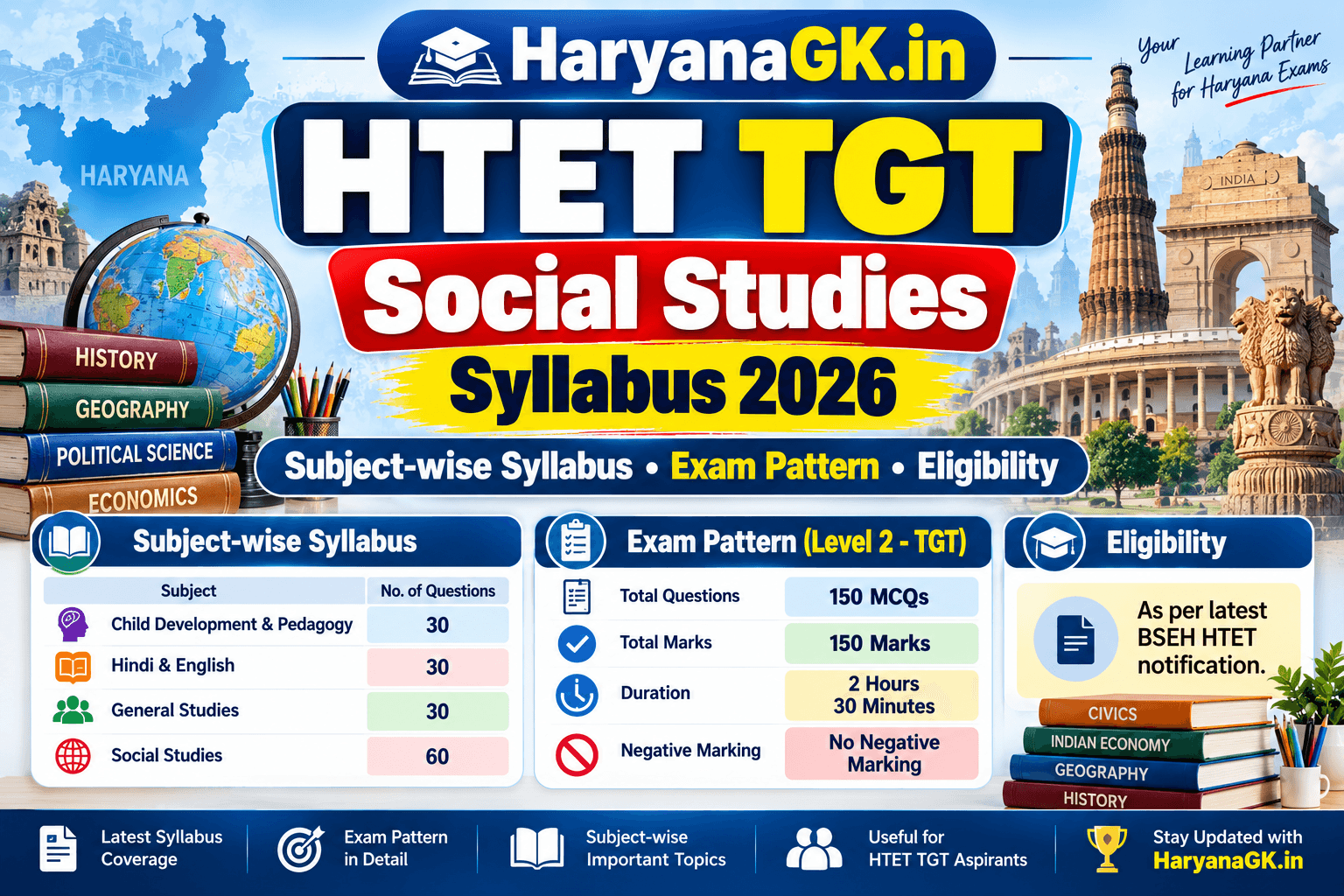
HTET TGT Social Studies Syllabus 2026 Subject-wise Syllabus, Exam Pattern and Eligibility
TGT Social Studies is one of the broadest papers in the whole HTET structure, because it isn’t really one subject. The 60-mark subject-specific section pulls from Geography, Political Science, History and Economics at once, and candidates who prepare only the part they studied at graduation level routinely get caught out by the other three.
This guide breaks the paper down exactly as the Board of School Education Haryana (BSEH) has defined it — the marks distribution, the eligibility rules for this specific paper, and the full topic list across all four component subjects.
HTET TGT Social Studies Exam Pattern and Weightage 2026
The TGT paper has 150 multiple-choice questions for 150 marks, completed in two and a half hours. Every question carries one mark, with no negative marking.
| Section | Number of MCQs | Marks |
|---|---|---|
| Child Development and Pedagogy | 30 | 30 |
| Languages (Hindi 15 + English 15) | 30 | 30 |
| General Studies (Quantitative Aptitude 10, Reasoning 10, Haryana GK 10) | 30 | 30 |
| Social Studies (Subject Specific) | 60 | 60 |
| Total | 150 | 150 |
Qualifying marks:
- General category candidates: 60% (90 marks)
- SC and differently-abled candidates of Haryana domicile: 55% (82 marks)
- SC and differently-abled candidates from other states: 60% (90 marks)
Questions are based on the topics prescribed for Classes VI to X by the Board of School Education Haryana, but the difficulty level and conceptual linkages can go up to senior secondary standard. That gap matters more in this paper than most, since Political Theory and Economics topics especially tend to get tested at a level closer to graduation coursework than a Class 9 textbook.
HSSC Group D – Previous Year Solved Papers
Practice HSSC Group D previous year solved question papers, shift-wise, with instant answers and explanations after every question.
| Exam Date | Shift | Solved Paper |
|---|---|---|
| 10 November 2018 | Shift 1 | Attempt Quiz  |
| 10 November 2018 | Shift 2 | Attempt Quiz |
| 11 November 2018 | Shift 1 | Attempt Quiz |
| 11 November 2018 | Shift 2 | Attempt Quiz |
| 17 November 2018 | Shift 1 | Attempt Quiz |
| 17 November 2018 | Shift 2 | Attempt Quiz |
| 18 November 2018 | Shift 1 | Attempt Quiz |
| 21 October 2023 | Shift 1 / Morning | Attempt Quiz |
| 21 October 2023 | Shift 2 / Evening | Attempt Quiz |
| 22 October 2023 | Shift 1 / Morning | Attempt Quiz |
| 22 October 2023 | Shift 2 / Evening | Attempt Quiz |
Common Syllabus for HTET TGT (Child Development, Languages, General Studies)
These three sections are identical across every TGT subject paper and account for 90 of the 150 marks.
Child Development and Pedagogy
Focused on the psychology of teaching and learning for the 11-16 age group:
- Concept of development and its relationship with learning; principles of child development; influence of heredity and environment
- Socialisation processes — the child’s social world involving teachers, parents and peers
- Piaget, Kohlberg and Vygotsky — their constructs and the critical perspectives around them
- Concepts of child-centred and progressive education; the critical perspective on intelligence and multi-dimensional intelligence
- Language and thought; gender as a social construct, and its effect on educational practice
- Individual differences among learners based on language, caste, gender, community and religion
- Assessment for learning versus assessment of learning; school-based assessment; Continuous and Comprehensive Evaluation (CCE)
- Inclusive education and children with special needs, including talented and specially-abled learners
- How children think and learn, and why they sometimes fail in school performance
- The child as a problem-solver and “scientific investigator”; understanding children’s errors as a step in learning
- Cognition and emotions; motivation and learning; personal and environmental factors affecting learning
Languages — Hindi and English
Both carry 15 marks each, with an identical structure: one unseen passage tested for comprehension, inference, grammar and verbal ability, paired with the pedagogy of language development — learning and acquisition, principles of language teaching, the role of listening and speaking, teaching language in a diverse classroom, and the use of textbooks and multilingual classroom resources. For Hindi, the passage can be prose, drama or poetry; for English, it’s a single unseen prose passage (literary, narrative, discursive or scientific).
Quizzes (Subject Wise)
Practice free HTET-pattern MCQ quizzes, subject by subject. Pick a subject below to start.
| Subject | Quiz |
|---|---|
| Haryana GK | Haryana GK HTET Online Quiz  |
| Math | Math Quiz – TGT/PGT HTET |
| Reasoning | Reasoning Quiz – HTET |
| English Grammar | English Grammar Quiz –1 |
| Hindi Grammar | Hindi Grammar Quiz – 15 Difficult Questions |
| Psychology | Psychology HTET PGT Quiz |
| Computer Science | Computer Science Practice Set |
| Child Development & Pedagogy | CDP Practice Set |
General Studies — Haryana GK, Reasoning and Quantitative Aptitude
Haryana GK (10 marks) covers the state’s history, current affairs, literature, geography, civics, environment, culture, art, traditions and welfare schemes — the section most likely to change between exam cycles.
Reasoning (10 marks) covers both verbal and non-verbal types: analogies, classification, series, coding-decoding, Venn diagrams, figure folding, embedded figures, and emotional and social intelligence, across semantic, symbolic and figural formats.
Quantitative Aptitude (10 marks) covers number systems, percentage, ratio and proportion, interest, profit and loss, time-distance and time-work, algebraic identities, properties of triangles and circles, mensuration, trigonometric ratios, and data representation through histograms and charts.
HTET TGT Social Studies: Subject-Specific Syllabus
This is the 60-mark section, and it’s split across four distinct subject areas — Geography, Political Science, History, and Economics. Each is tested independently, so there’s no shortcut around preparing all four.
Geography
General Geography: geography as a social study, the solar system, the earth’s motions, latitudes and longitudes, the earth’s major spheres, layers and rocks, landforms — mountains, plateaus, plains, volcanoes and earthquakes — and the agents and processes that shape them. The atmosphere’s composition and structure, air pressure, winds, precipitation and climatic regions. The hydrosphere, tides and ocean currents. Environmental concepts — ecosystems, pollution, hazards and disasters, and human-environment interaction. Resources — land, soil, water, natural vegetation and wildlife. Agriculture types and methods, major crops, industrial classification and distribution, human resources, and types of maps.
Geography of India: size and location, physiography and physical structure, drainage, climate and monsoon, natural vegetation and wildlife, water resources, major crops and agricultural problems, minerals and energy resources, manufacturing industries, and the lifelines of the national economy — plus subject-related pedagogy.
Political Science
Political Theory: the nature, scope and significance of political theory; the state’s elements and theories of its origin; sovereignty, liberty, equality, justice, rights, citizenship, nationalism, secularism, consumer protection rights and feminism. Forms of government — democratic and dictatorial, parliamentary and presidential, unitary and federal. Democracy — its concept, types, and the challenges it faces: inequality, poverty, illiteracy, communalism, casteism, separatism and political violence.
Indian Constitution: its development and making, sources, features and preamble; fundamental rights and duties; directive principles; the Union executive and legislature; state legislature; the judiciary, judicial review and public interest litigation; the Right to Information Act; federalism; Panchayati Raj and the 73rd Amendment; the Election Commission and electoral reforms; the party system, coalition governments, and reservation politics.
UNO: its origin, organs, specialised agencies, and the roles of the Security Council and Secretary-General.
Foreign Policy of India: basic principles, relations with neighbouring countries, the US and Russia, the Cold War and post-Cold War era, NAM, the end of bipolarity, the new world order, regional bodies like SAARC and ASEAN, and global institutions like the WTO and World Bank — plus subject-related pedagogy.
History
Ancient India: sources of ancient Indian history, prehistoric civilisation, the Harappan civilisation, Vedic religion, Buddhism and Jainism, the Mahajanapada period, the Mauryan Empire, post-Mauryan political developments, southern dynasties (Chalukyas, Pallavas, Cholas), trade and urbanisation, the Gupta and Vardhana empires, and the expansion of Indian culture and art through the post-Gupta period.
Medieval India: sources for the period 700-1750 AD, early medieval dynasties and rulers, the Delhi Sultanate and Mughal administration, the Vijayanagar Empire, Shivaji and the Marathas, medieval art, architecture, language and literature, socio-religious movements (Bhakti, Sufi, Sikh Gurus), trade, and agrarian society.
Modern India: sources of modern Indian history, 18th-century India, European trading companies, changes to the land revenue system, the Revolt of 1857, the Indian Renaissance, British education policy, the effects of colonisation on indigenous industry, the rise of nationalism, the Indian National Movement (1885-1947), the roles of Gandhi and Netaji, Independence and Partition, the framing of the Constitution, and Haryana’s role in the freedom movement.
World History: human evolution, prehistoric man, the rise of Islam, Genghis Khan and the Mongol Empire, European feudalism, the role of the Church, and the European Renaissance — plus subject-related pedagogy.
Economics
Agriculture’s role in the Indian economy and its development through the Five Year Plans. Factors of production — land, labour, capital and entrepreneurship — and the theories of rent, wages, interest and profit, along with unemployment trends.
Poverty — its measurement, causes, inter-state disparities and anti-poverty schemes. Food security, the Green Revolution, the Public Distribution System and buffer stocks. Economic development — growth versus development, and measurement through HDI, HPI, PQLI and the Hunger Index.
The sectors of the Indian economy — primary, secondary and tertiary; organised and unorganised; public and private. Money and credit — the functions of money, the role of commercial banks and the RBI, and credit creation. Globalisation — liberalisation, privatisation, the WTO, and its effects on the Indian economy. Consumer rights under the Consumer Protection Act, 1986. Utility analysis and demand analysis — including the law of demand and elasticity — plus subject-related pedagogy.
Visit bseh.org.in or htet.eapplynow.com for official Notification & Syllabus 2026
Who Is Eligible for HTET TGT Social Studies? Qualification Details
The eligibility rule for this specific paper is more layered than most TGT subjects, because it checks both your degree stream and your subject combination within that degree. You need to satisfy all of the following:
- A Bachelor’s degree with at least 50% marks in Social Science as an elective or Honours subject, combined with Social Science as a teaching subject in one of: BTC/JBT/D.Ed./D.El.Ed, or B.Ed./B.Ed. (Special Education) recognised under NCTE norms, or a 4-year B.El.Ed with at least 50% marks in Social Science, or a 4-year integrated BA-B.Ed with at least 50% marks in Social Science.
- Within your Bachelor’s degree, any two subjects from this list, each with at least 50% marks in aggregate across all three years: History, Political Science, Economics, Geography, Sociology, Psychology. If you hold an Honours degree in one of these, you still need to have studied the other two in your first and second year.
- Hindi or Sanskrit as a subject in Matric, or Hindi as a subject at a higher education level.
The second condition is where most eligibility confusion happens. Having a Social Science elective alone isn’t enough — BSEH specifically wants two named subjects from that list studied with a 50% aggregate, so a candidate who studied, say, History and Geography at graduation level but didn’t cross 50% aggregate across all three years in both would not meet this condition even with an otherwise strong overall degree.
Relaxation for SC, BC and differently-abled candidates
Where the minimum qualifying mark is 50%, SC, BC and differently-abled candidates get a 5% relaxation, bringing it to 47.5%. Where the minimum is 45%, the relaxed figure is 42.75%. This follows the Supreme Court’s 2011 ruling in P.V. Indiresan vs Union of India, which clarified that the relaxation is calculated as a percentage of the qualifying mark itself, not a flat subtraction.
A qualification detail worth checking twice
Only a diploma or degree in teacher education recognised by the National Council for Teacher Education (NCTE) counts. For the Diploma in Education (Special Education) or B.Ed. (Special Education) route specifically, the course must instead be recognised by the Rehabilitation Council of India (RCI), New Delhi — NCTE recognition alone does not cover that route.
Frequently Asked Questions
Does TGT Social Studies cover Geography, History, Political Science and Economics equally?
Yes. All four form the 60-mark subject-specific section, and BSEH doesn’t publish a fixed split between them, so none of the four can be safely skipped during preparation.
Can I apply with a History Honours degree alone?
Only if your Honours coursework also included the other two subjects from the approved list (History, Political Science, Economics, Geography, Sociology, Psychology) in the first and second year, since the eligibility rule requires two named subjects with 50% aggregate marks, not just your Honours subject.
Is the difficulty level for TGT Social Studies higher than the Class 6-10 syllabus it’s based on?
Yes. The topics come from the Classes VI-X syllabus prescribed by BSEH, but the difficulty standard and conceptual linkages can extend up to senior secondary level.
Is Hindi compulsory for this paper even if my graduation was entirely in English medium?
Yes. You separately need Hindi or Sanskrit as a subject in Matric, or Hindi as a subject at a higher education level — this is independent of your Social Science qualification route.
Given how much ground this paper covers, it helps to build a subject-by-subject revision table early — Geography, Political Science, History and Economics each deserve their own study block rather than being treated as one combined “Social Studies” revision pass.