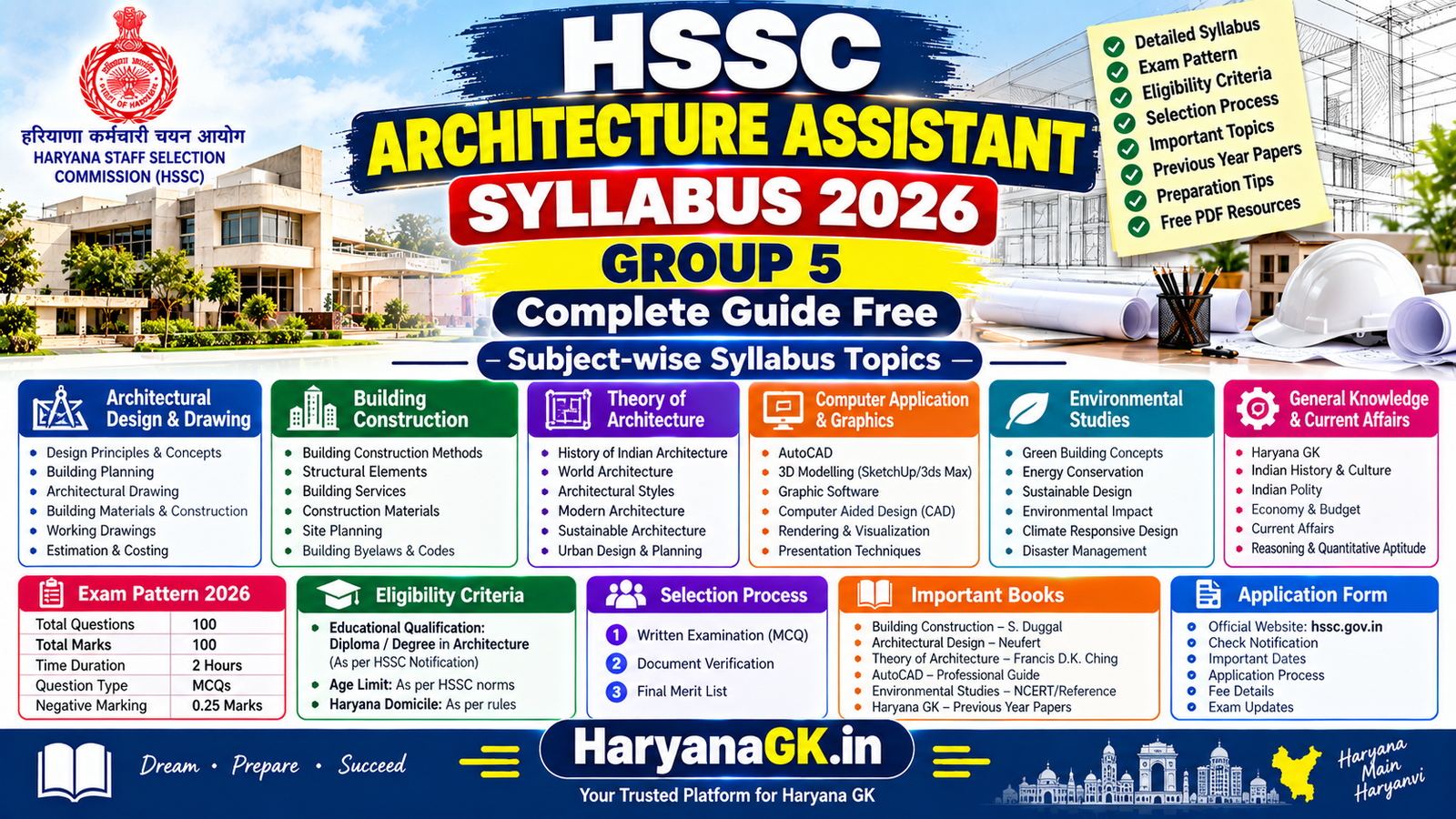
HSSC Architecture Assistant Syllabus 2026 covers Group 5 recruitment for Architecture Assistant posts under the Haryana Staff Selection Commission. This HSSC Architecture Assistant Syllabus guide breaks down the exam pattern and the full subject-wise topic list, straight from the official syllabus published at hssc.gov.in, so you know exactly what to study before you open a single PDF.
HSSC Architecture Assistant Syllabus Exam Pattern
Group 5 recruitment follows the standard two-stage HSSC process. Stage one is the Common Eligibility Test (CET) — 100 questions, 100 marks, roughly 90–105 minutes, covering general awareness, reasoning, Hindi, English and quantitative aptitude. Clearing CET plus the socio-economic criteria stage qualifies you for the group-specific written exam, which is where the HSSC Architecture Assistant Syllabus below actually applies.
The HSSC Architecture Assistant Syllabus for the written exam splits into weighted parts:
- General awareness, Reasoning, Mathematics, Science, History including Haryana related history, current affairs, literature, Geography, Civics, Environment, Culture etc — 20% weightage
- Computer terminology, Fundamentals, word software, excel software, Power point, internet, web browsing, Communication, emails, downloading and uploading data on websites etc — 10% weightage
- Subject related syllabus — 70% weightage
HSSC notes on the official document that this weightage is tentative and may vary, so treat it as a study-time guide rather than a locked question count.
HSSC Architecture Assistant Syllabus 2026 (Subject-Wise)
The subject-specific block of the HSSC Architecture Assistant Syllabus spans the following areas. Here is the complete breakdown.
Introduction and relevance (need and importance) of the architectural drawing, Introduction to the Studio Environment, Line Work, Lettering using different pencils & pens, stencils, Introduction to Scale, Geometric Shapes, Orthographic Projections, Section of Solids, Development of surface, Isometric Views, Axonometric View, Perspective, Simple Perceptive, Introduction to Scio-graphics (in plans and Elevations), Introduction to Rendering. Primary Elements of Design, Design Elements, Principles of Design, Relationship of form and functions, Relationship of Aesthetics and utility, Colours.
Building Stones, Bricks, Lime, Cement, Aggregates, Mortar, Concrete, Timber, Plastics, Alloys and Metals, Glass, building hardware (sizes, applications), Paints and Varnishes, Drying Oil, Pigment, Drier, Thinner, Floor Finishes (Laying sizes, availability, popular brand names, quality of polish, uses), Wall Finishes (along with application method), Ceiling Materials (Size, quality, their availability, types of finishes, uses, trade names and application methods, Roofing Materials, Additives and Admixtures, Adhesives, Kitchen and Toilet Fixtures.
Introduction and Demonstration of model making materials and techniques, Block models of basic geometrical shapes like prisms, pyramids, cubes, cylinders etc., using, Handmade and ivory sheet, Thermo-coal, Mount Board/Sun Board/Balsa Wood strips. Composition of various geometrical shapes in different materials, Sculpture Making, Introduction to carpentry, Brick Masonry, Painting and Polishing.
1. Information Technology – its concept and scope, applications of IT, ethics and future with information technology 2. Impact of computer and IT in society. — Computer application in office, book publishing, data analysis, accounting, investment, inventory control, graphics, air and railway ticket reservation, robotics, military, banks, Insurance financial transactions and many more,3. Generations of computer, block diagram of a computer, CPU, memory, data – numeric data, alpha numeric data, processing of data. 4. Computers for information storage, information seeking, information processing and information transmission, computer organization, computer hardware and software; primary and secondary memory: RAM, ROM, PROM etc. Input devices; keyboard, mouse, scanner, etc ; output devices ; VDU and Printer(Impact and non-Impact printers), Plotter etc.
Primary and Secondary Storage (Auxiliary Storage), Secondary storage; magnetic disks – tracks and sectors, optical disk (CD, CD-RW and DVD Memory) 5. Introduction to Operating Systems such as MS-DOS and Windows, difference between DOS and Windows 6. Basics of Networking – LAN, MAN, WAN. Masonry Construction, Brick work, Brick work in Foundation, Stone work, DPC, Brick work in super structure, Openings in Walls, Classification of Arches and Lintels, Joinery, Flooring, Roof and roof coverings, Staircases and ramps, Expansion joints, Form work and steel work, Finishes, Interiors of Buildings, Doors and Windows, Earthquake resistant building configuration, Riveted Connections and Welded Joints, Steel Sections, Steel Roofs, Frame and Sealed Connections Built Up Steel Columns and Beams.
Pre-Historical Architecture and Introduction to History of Architecture, Western Civilization, Greek Civilization, Roman Civilization, Indian Civilization, Buddhist Architecture in India, Temple Architecture in India, Early Christian Architecture, Byzantine Architecture, Romanesque Architecture, Gothic Architecture, Renaissance Architecture, Islamic Architecture in India, Industrial revolution, Modern Architecture in Europe and America, Contemporary/post-Independence Architecture in India.
Proportion of Components of Human Body, Human Activities, Furniture Standards, Vehicles, Street furniture, Graphic Representation of plant material (ground cover, foliage, shrubs, trees) human figures and vehicles, Introduction of Structure Systems, Study of spaces and layout of furniture. Introduction, Chain surveying, Compass surveying, Levelling, Plane Table Surveying, Contouring, Instruments, Use of Modern Surveying equipment. General Introduction, Relation of Climate and comfort, Sun Control and shading devices, Wind control, Use of building materials with respect to climate, Criteria for site selection, Environment and Ecology.
Water Supply, Drainage, Sound Insulation, Lighting and Electrical Fittings, Heat, Ventilation and Air Conditioning (HVAC), Vertical Transportation Systems, Fire Fighting Services, Integration of lighting, air-conditioning, acoustics and other services/systems in buildings. Force system and Equilibrium, Centroid and Moment of Inertia, Stress and Strain, Shear Force and Bending Moment, Bending stresses in Beams, Analysis of Perfect Frames.
Need of building byelaws for urban development, Basic Terminology, Factors affecting planning of byelaws, Bye laws, Zoning, Residential and commercial building with respect to implementation of local Bye laws, various Performa’s to be used, BIS and CPWD By-laws/standards for removing Architectural barriers for persons with disabilities (PWDs), Introduction to earthquake resistant regulations, Code provisions (IS-1893), seismic zoning, Preparation of one set of municipal drawing of a residential building already designed in A.D. showing all services along with Performa’s.
Site Plan, foundation layout plan with benchmark, section details of foundations for brick external wall, brick internal wall, brick partition wall, brick toe wall, brick boundary wall and R.C.C Column, Ground Floor Plan, Terrace Plan, Section, Elevations, Details of Toilet, Kitchen etc.,Built-in furniture, Entrance gate, boundary wall and railing details. Introduction to AutoCAD, Creating and Saving a new Drawing, Drawing Commands, Viewing an Existing Drawing, Modifying an Existing Drawing, Making and Inserting Blocks, Dimensioning and Text, Plotting Drawings, Project (Rendering of CAD drawing), Fundamentals of 3-D Drafting, converting an existing 2-D plan drawing compatible to 3-D drafting, 3-D Modelling, Demonstration of 3D max, Corel Draw, Adobe Photoshop as rendering tool for 3D blocks/ walk through etc.
Definition, Scope and Importance of Environmental Education, Basics of ecology, biodiversity, eco system and sustainable development, Basics of ecology, biodiversity, eco system and sustainable development, Sources of pollution, Solid waste management, Mining and deforestation, Environmental Legislation – Water (prevention and control of pollution) Act 1974, Air (Prevention and Control of Pollution) Act 1981 and Environmental Protection Act 1986, Role and Function of State Pollution Control Board, Environmental Impact Assessment (EIA), Role of Non-conventional Energy Resources, Current Issues in Environmental Pollution.
Introduction, Introduction to following methods of RCC design, Shear and Development Length, Singly Reinforced Beam (working stress method), Concept of Limit State Method (as per IS 456: 2000), Singly Reinforced beam, Doubly Reinforced Beams, Behaviour of T beam, inverted T beam, isolated T beam and ‘L’ beams, One Way Slab, Two Way Slab, Axially Loaded Column, Prestressed Concrete. Introduction to quantity surveying and its importance.
Duties of quantity surveyor, Types of estimates, Measurement, Preparation of Detailed and Abstract Estimates from Drawings, Calculation of quantities of materials from working drawings, Analysis of Rates, Measurement Book and Billing, Valuation, Contractor-ship, Preparation of Tender Document based on Common Schedule Rates.
Overview of town planning: Principal elements and the location of public functions, Growth of the Industrial Town, Planning Process: Site Selection, Land uses in a town, their hierarchy and location. Types of town shapes with reference to circulation (Linear, Star, grid, Satellite), Introduction to Urban land uses & their management, Legislation and Urban Controls. File management, Customization, Layer management, Creating and Editing objects and parameters, Edit tools, Modifiers and application, Utilities and application, Materials and mapping, Rendering, Animation and walkthrough
How to Prepare for the HSSC Architecture Assistant Syllabus Exam
Start with the subject-specific block of the HSSC Architecture Assistant Syllabus first — it carries the heaviest weightage and is where real differentiation between candidates happens, since general awareness and computer knowledge sections overlap with every other HSSC group. Work through each topic area systematically, and revisit the subject list above every week so nothing slips through before exam day.
Don’t skip the common portion either. Haryana-specific general awareness and basic computer knowledge are easy marks that candidates often under-prepare because they’re focused on the technical syllabus.
Frequently Asked Questions: HSSC Architecture Assistant Syllabus
What is the HSSC Architecture Assistant Syllabus for Group 5?
The HSSC Architecture Assistant Syllabus covers the weighted sections listed above, compiled directly from the official document published by the Haryana Staff Selection Commission.
Is the HSSC Architecture Assistant Syllabus the same every year?
HSSC updates its syllabus documents periodically, and the weightage listed against each section is explicitly marked tentative by HSSC. Always check hssc.gov.in/examsyllabus for the latest version before you finalize your preparation.
Do I need to clear CET before attempting this exam?
Yes. HSSC recruitment follows the standard two-stage process: you first clear the Common Eligibility Test (CET), then sit for the group-specific written exam that follows the HSSC Architecture Assistant Syllabus covered in this guide.
Official Notification and Source
This HSSC Architecture Assistant Syllabus is compiled directly from the official Group 5 – Architecture Assistant Syllabus published by the Haryana Staff Selection Commission. Always cross-check the latest version and any amendments against the official document before you finalize your preparation.
Download the official syllabus PDF and check current recruitment notices at hssc.gov.in/examsyllabus.
HSSC Group D – Previous Year Solved Papers
Practice HSSC Group D previous year solved question papers, shift-wise, with instant answers and explanations after every question.
| Exam Date | Shift | Solved Paper |
|---|---|---|
| 10 November 2018 | Shift 1 | Attempt Quiz  |
| 10 November 2018 | Shift 2 | Attempt Quiz |
| 11 November 2018 | Shift 1 | Attempt Quiz |
| 11 November 2018 | Shift 2 | Attempt Quiz |
| 17 November 2018 | Shift 1 | Attempt Quiz |
| 17 November 2018 | Shift 2 | Attempt Quiz |
| 18 November 2018 | Shift 1 | Attempt Quiz |
| 21 October 2023 | Shift 1 / Morning | Attempt Quiz |
| 21 October 2023 | Shift 2 / Evening | Attempt Quiz |
| 22 October 2023 | Shift 1 / Morning | Attempt Quiz |
| 22 October 2023 | Shift 2 / Evening | Attempt Quiz |
| HTET PRT Syllabus 2026 | |
| Subject | Syllabus Link |
| PRT Syllabus (All Subjects) | View Syllabus  |
| HTET TGT Syllabus 2026 (Subject-Wise) | |
| Subject | Syllabus Link |
| Art | View Syllabus |
| English | View Syllabus |
| Hindi | View Syllabus |
| Home Science | View Syllabus |
| Mathematics | View Syllabus |
| Music | View Syllabus |
| Physical Education | View Syllabus |
| Punjabi | View Syllabus |
| Sanskrit | View Syllabus |
| Science | View Syllabus |
| Social Studies | View Syllabus |
| Urdu | View Syllabus |
| HTET PGT Syllabus 2026 (Subject-Wise) | |
| Subject | Syllabus Link |
| Biology | View Syllabus |
| Chemistry | View Syllabus |
| Commerce | View Syllabus |
| Economics | View Syllabus |
| English | View Syllabus |
| Fine Arts | View Syllabus |
| Geography | View Syllabus |
| Hindi | View Syllabus |
| History | View Syllabus |
| Home Science | View Syllabus |
| Mathematics | View Syllabus |
| Music | View Syllabus |
| Physical Education | View Syllabus |
| Political Science | View Syllabus |
| Psychology | View Syllabus |
| Punjabi | View Syllabus |
| Sanskrit | View Syllabus |
| Sociology | View Syllabus |
| Urdu | View Syllabus |
Explore Other HSSC Group Syllabus Guides
This HSSC Architecture Assistant Syllabus guide is part of a growing set of subject-wise syllabus posts for every HSSC group. Browse the full set on the HSSC Syllabus tag page or the Syllabus category. For the full HSSC recruitment process, CET details and exam pattern, see the Haryana HSSC guide.