CTET Exam Pattern and Dates – Paper 1, Paper 2, and How the Cycle Actually Runs
CTET 2026 isn’t a single exam date the way a college entrance test often is. It runs as a cycle spread across CBSE’s own schedule, with candidates allotted specific cities, dates within that cycle, and shifts through a computerized process rather than everyone sitting the same paper on the same morning. This post covers the actual exam pattern for both papers and clears up the parts of the scheduling that trip candidates up most, along with the pacing, OMR, and logistical details that matter once you’re actually sitting for it.
CTET exam pattern: the basics – CTET 2026
Understanding the pattern properly, rather than skimming a summary table, is what lets you build a preparation and exam-day plan around the exam as it actually runs, not around a rough impression of it.
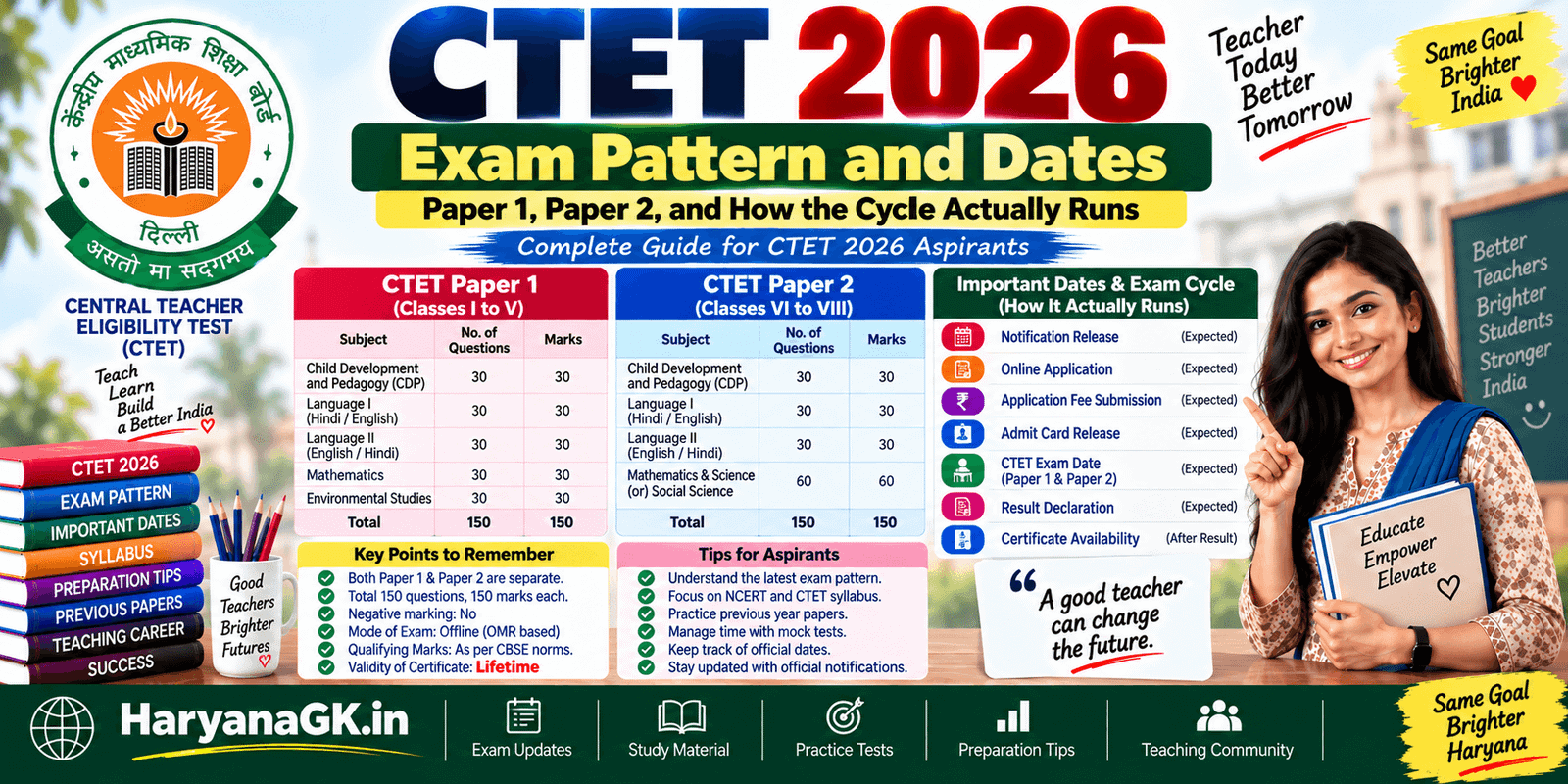
CTET 2026 is conducted by CBSE in offline, pen-and-paper mode using OMR answer sheets, not as a computer-based test. Every question is multiple choice with four options, one mark each, and there’s no negative marking anywhere on either paper. That last point matters for how you approach the exam itself: an educated guess costs you nothing, so leaving a question fully blank because you’re unsure is rarely the right call.
Both papers run for two and a half hours, and both carry 150 questions worth 150 marks total. Where they differ is in what those questions cover and how the sections are weighted.
Paper 1 pattern (for candidates targeting classes 1 to 5) – CTET 2026
Paper 1 is built from five sections of 30 questions each, and every section carries 30 marks:
- Child Development and Pedagogy
- Language I (the medium of instruction you choose)
- Language II (a different language from Language I)
- Mathematics
- Environmental Studies
All five sections are compulsory. There’s no elective structure at this stage; every Paper 1 candidate answers the same five sections regardless of which subject they eventually want to teach. If you want the actual topic list inside each of these five sections rather than just the section names, our CTET syllabus guide breaks each one down chapter by chapter.
Paper 2 pattern (for candidates targeting classes 6 to 8) – CTET 2026
Paper 2 uses four sections instead of five, and the last one works differently from anything in Paper 1:
- Child Development and Pedagogy, 30 questions, 30 marks
- Language I, 30 questions, 30 marks
- Language II, 30 questions, 30 marks
- Either Mathematics and Science, or Social Studies/Social Science, 60 questions, 60 marks
Section 4 is the one genuine choice in the entire exam. Candidates who want to teach Maths or Science at the upper primary level attempt the Mathematics and Science section; candidates aiming for Social Studies attempt that section instead. You commit to this choice at the application stage, and it determines which subject-specific eligibility you’re claiming, so it isn’t something you can casually swap on exam day. Our CTET syllabus guide covers exactly which chapters fall under each of these two Section 4 tracks if you’re still deciding which one matches your background.
Why Section 4 carries double the marks – CTET 2026
It’s worth pausing on why CBSE built Paper 2 this way instead of just adding a fifth 30-mark section the way Paper 1 does. Section 4 isn’t double-weighted by accident; it’s the section that actually certifies your subject-teaching competence for classes 6 to 8, whereas the other three sections (Child Development and Pedagogy, Language I, Language II) are common ground every upper-primary teacher needs regardless of subject specialization. Putting 60 of the paper’s 150 marks into that one section is CBSE’s way of making sure a candidate’s score reflects real depth in the subject they intend to teach, not just competence in the shared pedagogical basics.
The practical consequence for your preparation is straightforward, even if it’s easy to overlook while you’re juggling five or six subjects: proportionally, Section 4 alone is worth as much as any two of the other three sections combined. A revision plan that spends equal time on all four Paper 2 sections is quietly under-preparing for the section that decides the largest single chunk of your score. This doesn’t mean neglect Child Development and Pedagogy or the languages; it means Section 4 deserves a genuinely larger share of your study hours than a simple four-way split would give it, closer to 40 percent of your total Paper 2 prep time than 25 percent.
Marking scheme for CTET 2026, in full
One mark per correct answer, across both papers, with no deduction for a wrong answer and no deduction for leaving a question unattempted. The only way to score zero on a question is to leave it blank or to shade more than one option on the OMR sheet, which counts as an invalid response the same as an unattempted one.
Budgeting your 150 minutes across the paper for CTET 2026
Two and a half hours for 150 questions works out to an average of exactly one minute per question, but treating every question as an equal one-minute slot is a poor strategy in practice, because the sections aren’t equally time-hungry. Child Development and Pedagogy and the two Language sections are largely reading-and-reasoning questions that most prepared candidates can move through faster than a full minute each, often 30 to 40 seconds once you’re familiar with the format, since they don’t involve calculation. Mathematics, by contrast, genuinely needs closer to a minute and a half on a meaningful share of its questions, particularly anything involving multi-step arithmetic or a geometry calculation you can’t shortcut.
A workable approach on Paper 1 is to move through Child Development and Pedagogy, Language I, and Language II first, banking the time you save there, then spend the surplus on Mathematics and Environmental Studies, which tend to have more questions that reward a slower, careful read. On Paper 2, the same logic applies to the first three sections, but Section 4 (Mathematics and Science, or Social Studies) deserves the largest single time allocation of the paper simply because it’s twice the size of every other section: roughly 55 to 60 minutes of your 150, rather than the flat 36 minutes a naive even split across four sections would suggest.
Whatever allocation you settle on, decide it before exam day using previous year papers attempted under a real timer, not on exam morning itself. Your own actual pace on each section type is something you can only learn by practicing under the same time pressure you’ll face for real, and it’s usually a little different from whatever a generic pacing guide (including this one) suggests.
Common OMR mistakes beyond the basics in CTET 2026
Beyond darkening bubbles fully and not attempting to erase, a few less obvious OMR errors show up often enough each cycle to be worth flagging specifically. Skipping a question but forgetting to skip its row on the OMR sheet is the classic one: if you leave question 47 blank in your question booklet but don’t leave the corresponding row blank on the OMR sheet, every answer from 48 onward can end up shifted one row off, turning a handful of blank answers into dozens of wrong ones.
The fix is simple but easy to forget under time pressure: every time you skip a question, glance at the OMR sheet and confirm the row you’re about to mark next actually matches the question number you’re now answering.
Marking two options for the same question, even faintly, is treated as an invalid response rather than a wrong answer, which matters because it means you lose the chance at that mark even if one of your two markings happens to be correct. If you change your mind about an answer, the safer move (where the rules for that cycle allow a fresh sheet or correction) is to ask an invigilator rather than trying to overwrite or scratch out the original mark yourself.
Filling in personal details, roll number, booklet series, or set code incorrectly on the OMR sheet itself is a separate category of error from the answer bubbles, but it’s just as consequential, since a mismatched roll number or set code can create genuine complications when your sheet is processed. Treat the top of the OMR sheet with the same care as the questions themselves rather than rushing through it to get to the actual exam.
How CTET’s pattern compares to state-level TET exams – CTET 2026
If you’re weighing whether to prepare for CTET, a state TET, or both, it helps to know the pattern differences aren’t cosmetic. Most state TET exams borrow CTET’s broad two-paper structure (a Paper 1 for primary and a Paper 2 for upper primary) and its no-negative-marking approach, since CTET set the template most states have followed. Where they typically diverge is in the state-specific content woven into the syllabus, most commonly a dedicated section or sub-section on that state’s own history, geography, and current affairs, which CTET doesn’t test at all since it’s a national-level certificate. Some states also run their TET as fewer, larger sections rather than CTET’s five-and-four split, or weight sections slightly differently.
The practical upshot is that CTET preparation transfers substantially to most state TETs, but not completely; you generally still need dedicated additional study for whatever state-specific content that state’s exam adds on top of the shared core. Since state TET patterns vary from state to state and get revised on their own separate schedules, check that specific state board’s own current notification for its exact pattern rather than assuming it mirrors CTET exactly, and treat this section as a general orientation rather than a state-by-state reference.
Language codes: how Language I and II actually work
CTET offers a genuine list of languages for the Language I and Language II sections, not just Hindi and English. Each language is assigned a numeric code on the application form, and you select your Language I and Language II from that list, with the constraint that the two must be different languages. Language I is generally expected to be your medium of instruction, so most candidates pick the language they intend to actually teach in, and Language II is typically a second language you’re proficient in.
The exact list of available languages and their codes is published in each cycle’s official notification and has included regional languages such as Bengali, Gujarati, Marathi, Tamil, Telugu, Urdu, Punjabi, and several others in past cycles, alongside Hindi and English as the two most commonly chosen. Since availability can vary slightly by cycle and by exam city (not every language is necessarily offered at every centre), check the current notification on ctet.nic.in for the definitive list rather than assuming a language you sat for previously is guaranteed to be available again.
Exam mode and centre-level instructions
CTET is offline. You’ll be given a question paper booklet and a separate OMR answer sheet, and you fill in your responses by darkening the correct bubble with a ballpoint pen, not a pencil. A few centre-level instructions catch first-time candidates out:
- Darken the OMR bubble fully and clearly; a light or partial mark is sometimes not read correctly by the scanning machine, which can register as no answer at all.
- You generally cannot go back and change an OMR response cleanly once marked, since these sheets aren’t designed for erasing. Decide before you mark, not after.
- Rough work is usually meant to stay confined to the space provided in the question booklet itself, not on the OMR sheet or on separate paper you bring in.
- You’ll typically be asked to fill in and sign a declaration on the OMR sheet itself, confirming your roll number and other identifying details match what’s pre-printed. Skipping this is a completely avoidable way to create a problem for yourself after the exam.
How CTET exam dates actually work
Because CTET draws an enormous number of candidates nationwide, a single “exam date” announced for a cycle often isn’t a single calendar day for every candidate. In recent cycles, CBSE has spread the actual test-taking across several dates within the announced window, allotting each candidate a specific date and shift through a randomized, computerized process tied to your application and exam city. Two people who registered on the same day, for the same exam city, can still end up sitting the paper on different dates within that window.
This is exactly why the admit card, not the original notification date, is the document that tells you your actual exam day. Don’t make travel or leave-of-absence plans around the announced cycle window; wait for your specific date and shift to appear on your admit card. Candidates who’ve booked non-refundable travel based on the notification’s headline dates, rather than their own admit card, have occasionally found themselves needing to rebook once their actual allotted date came out, which is an entirely avoidable expense.
Exam city intimation: what it is and why it comes first
Before the admit card, CBSE releases an exam city intimation slip, which tells you which city you’ve been allotted for the exam, without yet giving you the exact centre address, date, or shift. This is released purely so candidates who need to travel or arrange accommodation have enough lead time to plan and book before the more detailed admit card comes out closer to the exam.
Your exam city is generally based on the preferences you filled in during the application form, but allotment depends on seat availability at centres in that city, so getting your first-preference city isn’t guaranteed, particularly for high-demand cities where capacity fills up early relative to demand. If your allotted city is meaningfully different from what you expected, there’s typically no straightforward way to request a change after the fact, which is one more reason to fill in city preferences carefully and realistically at the application stage rather than only listing the most popular options.
Shifts within a single exam day
On any given exam date, CTET commonly runs Paper 1 and Paper 2 in separate shifts, since a large share of candidates apply for both papers on the same day. If your city has a high volume of candidates, CBSE may also run multiple shifts of the same paper across a single day to manage centre capacity. Your specific shift, along with its reporting time, is confirmed only on your admit card, not on the earlier city intimation slip. Our admit card guide covers exactly what to check on that document once it’s out, including the download steps and the gate-verification process.
How city, date, and shift allotment actually interact for dual-paper candidates
Candidates appearing for both papers sometimes assume the two are allotted independently, which occasionally causes unnecessary worry when the reality is closer to a single combined allotment. In practice, CBSE allots you a city first, generally the same city for both papers since you register for both under one application. Your specific date within the cycle window and your shift for each paper are then generated together, with the two papers usually scheduled as different shifts on the same date precisely so you don’t need to travel to your exam city on two separate days.
This isn’t universal every cycle, and a small number of candidates each cycle do end up with their two papers on different dates, typically due to centre capacity constraints in high-demand cities. If that happens to you, it isn’t an error to dispute; it’s simply how the allotment worked out given seat availability, and the only real response is to plan for two separate exam days instead of one. Confirm this by looking at your actual admit card rather than assuming based on what’s typical, since your own allotment is what governs your travel planning, not the general pattern described here.
One detail worth double-checking specifically: reporting time is set independently for each shift, so if you do have both papers on the same day, back-to-back shifts can leave a tighter gap between when your morning paper ends and when you need to report for the afternoon one than you might expect. Read both reporting times off your admit card and plan your midday break, including where you’ll wait and whether you’ll need to re-clear security, before exam day rather than figuring it out on the spot.
The final ten minutes: a submission checklist
Most candidates spend their last ten minutes either still working through the hardest remaining questions or sitting idle once they’ve finished, and both are missed opportunities. Before you hand in your OMR sheet, run through a short, deliberate check rather than just stopping when time is called.
Count your marked bubbles against the number of questions you intended to attempt; a mismatch usually means a skipped question wasn’t left blank on the OMR sheet the way you thought, which is exactly the row-shift error covered earlier and is far easier to catch with two minutes left than to discover after the exam. Confirm your name, roll number, booklet series, and set code fields are all filled in and match your admit card, since these are easy to leave for “later” early in the exam and then genuinely forget under time pressure at the end. Sign the declaration if the sheet requires one; an unsigned OMR sheet has caused real problems for candidates in past cycles.
If you finish with meaningful time left over, resist the urge to hand in early just because you’re done with a first pass. Go back through questions you marked with low confidence, particularly any Child Development and Pedagogy or language pedagogy questions where two options both sounded plausible, and re-read the question stem itself once more with fresh eyes. It’s common to catch a misread word or a missed “not” in the question on a second pass that changes which option is actually correct.
When your admit card shows something different from what you expected
Occasionally a candidate’s admit card reflects a different city, date, or shift than what they assumed based on the general scheduling patterns described in this post, and it’s worth being clear about what that does and doesn’t mean. It doesn’t mean an error has necessarily occurred; general patterns like same-city dual-paper scheduling or a typical release timeline are just that, general, and your individual allotment depends on the specific capacity and demand situation for your registered city and preferences that cycle.
What it does mean is that your admit card, not this guide or any other general resource, is the authoritative source for your actual exam logistics. If something on it looks like a genuine data error, a wrong name, wrong category, or a centre in a city you never selected, that’s a correction-request situation rather than something to resolve by comparing notes with other candidates whose allotments went differently.
Time-remaining announcements during the exam
Invigilators typically call out time-remaining warnings at set points during the exam rather than only at the very end, commonly somewhere around the halfway mark and again with roughly 30 minutes left, though the exact timing and whether it’s a verbal announcement or a board update at the front of the room varies by centre.
Treat these announcements as scheduled checkpoints for a quick pacing review rather than background noise. When you hear the halfway call, glance at how many questions you’ve actually completed against how many you budgeted for that point; if you’re meaningfully behind, that’s the moment to consciously speed up on the sections you know well rather than discovering the shortfall only when the final warning comes and there’s no room left to recover.
The 30-minutes-remaining call is a different kind of checkpoint. By then, your priority should shift from working through remaining questions in order to making sure every question has some answer marked, since an unattempted question and a wrong one score identically at zero. If you reach that point with, say, twelve questions left, it’s usually better to quickly mark your best guess on all twelve within the remaining time than to spend that same time carefully solving the first four and leaving the other eight blank. A guessed answer has real odds of being correct; a blank one has none.
Finishing early: can you leave before time is up?
Most centres do allow candidates to submit their OMR sheet and leave before the full two and a half hours is over, but almost always only after a minimum duration has passed, commonly somewhere in the range of an hour to ninety minutes into the exam, specifically so that early finishers can’t create a security or malpractice concern by leaving during the exam’s most sensitive early window. Check your specific admit card or the instructions read out at the start of your shift for the exact minimum duration that cycle, since this detail isn’t universal and centre staff enforce whatever that cycle’s actual rule is rather than a general assumption.
If you do finish well within that window and are confident in your answers, there’s rarely any strategic benefit to sitting for the remaining time out of obligation once your own review pass is genuinely done, particularly compared to the earlier advice about using leftover time to re-check low-confidence answers. But rushing to be among the first to leave, at the cost of skipping that review pass, is a bad trade for the sake of finishing early; a few unforced errors caught on a second read are worth far more than the extra twenty minutes saved by leaving the moment you reach the last question.
Why the pattern rarely changes but dates do, every cycle
The five-section Paper 1 structure and four-section Paper 2 structure have stayed consistent across recent cycles, so once you understand the pattern for one cycle, it’s a reasonably safe reference for planning your preparation going forward. Exam dates, city lists, and language code numbering, by contrast, are set fresh in each cycle’s official notification and are genuinely worth re-checking even if you’ve appeared for CTET before, rather than assuming last cycle’s schedule structure repeats exactly.
FAQs
How many questions are there in each CTET paper? 150 objective-type questions in both Paper 1 and Paper 2, each worth one mark, for a total of 150 marks per paper.
Is CTET conducted online or offline? Offline. It’s a pen-and-paper exam using OMR answer sheets, not a computer-based test.
Is there negative marking in CTET? No. There’s no deduction for a wrong answer on either paper, so attempting every question is generally the safer approach than leaving uncertain ones blank.
How long is the CTET exam? Two and a half hours for each paper, whether you’re appearing for Paper 1, Paper 2, or both on the same day.
Can I choose which languages appear in the Language I and Language II sections? Yes, from a list published in the official notification, with the requirement that Language I and Language II must be two different languages. Availability can vary slightly by exam city.
What’s the difference between the exam city intimation slip and the admit card? The city intimation slip only confirms your allotted city, released early so you can plan travel. The admit card, released later, has your specific exam date, shift, and centre address.
Do all CTET candidates sit the exam on the same date? Not necessarily. Because of the scale of the exam, recent cycles have spread testing across multiple dates within an announced window, with each candidate’s specific date and shift confirmed only on their admit card.
What is Section 4 of Paper 2, and do I have to choose one option? Yes, Section 4 requires choosing either Mathematics and Science or Social Studies/Social Science, based on the subject area you selected during application. It carries 60 marks, twice the weight of the other three sections.
Is Child Development and Pedagogy compulsory in both papers? Yes, it’s a compulsory 30-mark section in both Paper 1 and Paper 2, regardless of which other sections or elective you choose.
Can I request a different exam city after submitting my application? Generally no, once city allotment is finalized based on the preferences submitted and seat availability at the time. Fill in realistic preferences during the application window itself.
What kind of pen should I bring for the OMR sheet? A black or blue ballpoint pen, since OMR sheets are typically read by a scanning machine and pencil marks or gel pens can sometimes affect how clearly the mark is registered.
If I’m appearing for both papers, will I get separate admit cards for each? It varies by cycle; some cycles issue a single admit card covering both papers and shifts on the same day, others issue two. Either way, verify that both sets of exam details are present and correct on whatever you’re issued.
Does the exam pattern change frequently between cycles? Rarely for the core structure of sections and marks, which has stayed stable across recent cycles. Scheduling details like exact dates, city lists, and language availability are set fresh each cycle, so those are worth reconfirming even if you’ve appeared before.
How much time should I spend on Section 4 of Paper 2? Proportionally more than an even four-way split across the paper’s sections would suggest, since Section 4 carries 60 of the paper’s 150 marks. Budgeting somewhere close to 55 to 60 minutes of your two and a half hours for that section, rather than a flat 36 minutes, better reflects its actual weight.
What happens if I mark two options for the same question by mistake? It’s treated as an invalid response, the same as leaving the question blank, regardless of whether one of the two markings was correct. Mark carefully the first time, and ask an invigilator about correction options if you do need to change an answer.
Do CTET and state TET exams follow the same pattern? Broadly similar in structure, since most state TETs adopted CTET’s two-paper, no-negative-marking approach. States typically add their own state-specific content and can weight or organize sections differently, so check that state’s own current notification rather than assuming an exact match with CTET.
Will both my papers definitely be on the same date if I apply for Paper 1 and Paper 2 together? Usually, but not guaranteed. Most dual-paper candidates get both papers as different shifts on the same date, but centre capacity constraints occasionally place a candidate’s two papers on separate dates. Your admit card, not the general pattern, tells you which applies to you.
Should I attempt every question even if I’m unsure of the answer? Yes. Since there’s no negative marking, an unattempted question and a wrong answer both score zero, so there’s no downside to marking your best guess rather than leaving a bubble blank on either paper.
2 thoughts on “CTET Exam Pattern and Dates: Paper 1, Paper 2, and How the Cycle Actually Runs”