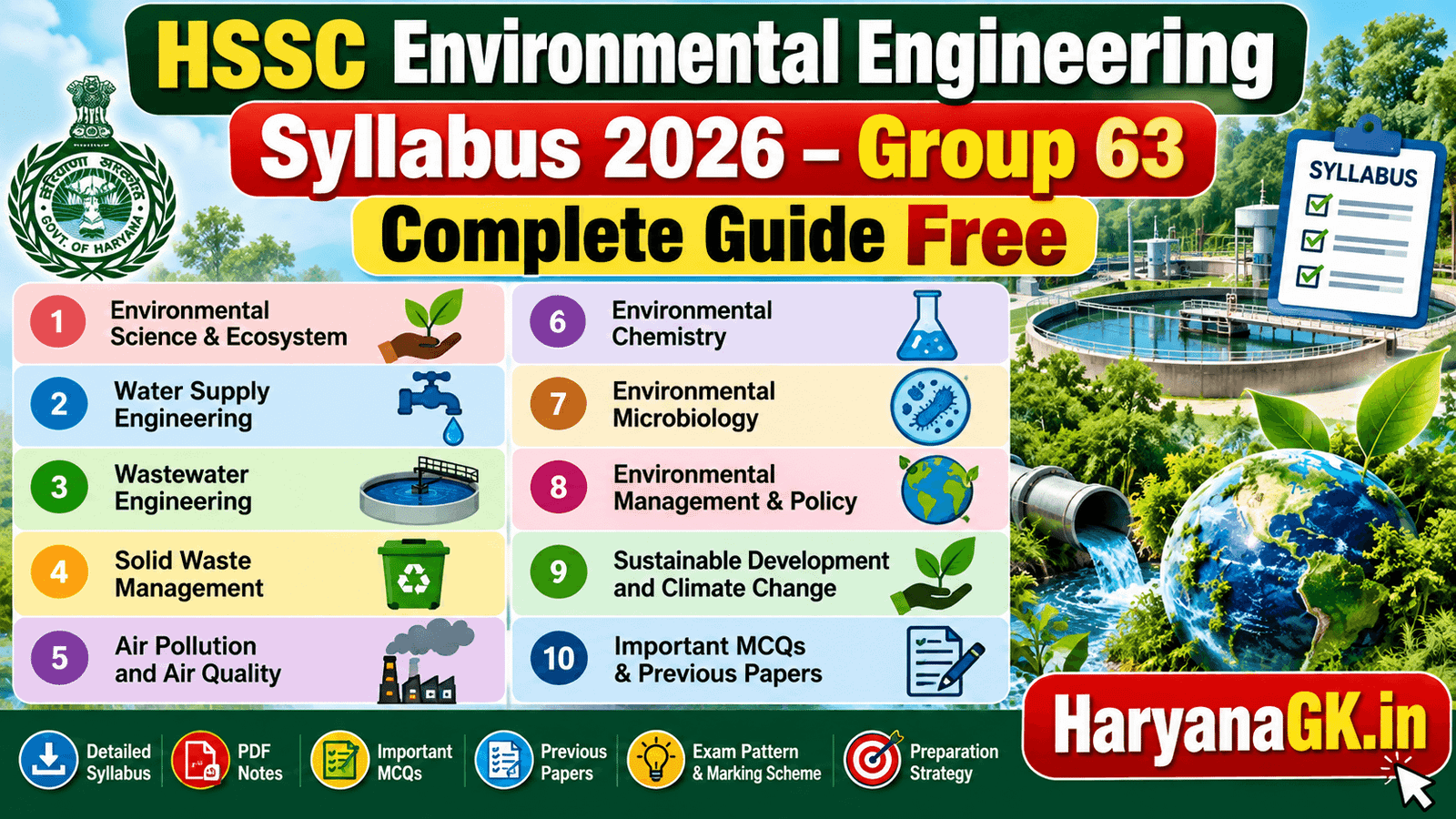
The HSSC Environmental Engineering Syllabus 2026 covers Group 63 recruitment for environmental engineering posts under the Haryana Staff Selection Commission. This HSSC Environmental Engineering Syllabus guide breaks down the exam pattern and the full subject-wise topic list, straight from the official syllabus published at hssc.gov.in, so you know exactly what to study before you open a single PDF.
HSSC Environmental Engineering Syllabus Exam Pattern
Group 63 recruitment follows the standard two-stage HSSC process. Stage one is the Common Eligibility Test (CET) — 100 questions, 100 marks, roughly 90–105 minutes, covering general awareness, reasoning, Hindi, English and quantitative aptitude. Clearing CET plus the socio-economic criteria stage qualifies you for the group-specific written exam, which is where the HSSC Environmental Engineering Syllabus below actually applies.
The HSSC Environmental Engineering Syllabus for the written exam splits into weighted parts:
- General awareness, reasoning, mathematics, science, history (including Haryana-related history), current affairs, literature, geography, civics, environment, culture, etc.—20% weightage
- Computer terminology, fundamentals, word software, Excel software, PowerPoint, internet, web browsing, communication, emails, downloading and uploading data on websites, etc.—10% weightage
- Subject-related syllabus — 70% weightage
HSSC notes on the official document that this weightage is tentative and may vary, so treat it as a study-time guide rather than a locked question count.
HSSC Environmental Engineering Syllabus 2026 (Subject-Wise)
The subject-specific block of the HSSC Environmental Engineering Syllabus spans the following areas. Here is the complete breakdown.
Environmental Ecology and Ecosystem
Concepts in Ecology: The terms ‘ecology’, ‘environment’, ‘multidisciplinary approach’ and ‘place’ are in other branches of learning. Taxonomy and ecology. Levels of organisations in the environment, the ecosystem concept. Structure and functions in an ecosystem. Organisms-environment relationships and principles. Relationships between organisms. Atmosphere – origin, composition, altitudinal expanse.
Hydrosphere – geographical distribution, estimated quantities of water in different places, natural composition of fresh and marine water, important physiochemical properties of water. Lithosphere – weathering and sedimentation cycles in time and space, physical and chemical properties of soils, major plant nutrients and other minerals in soil and their mineralisation. Biosphere- origin and distribution on land, in water and in air. Broad nature of chemical composition of plants and animals. Nature of the interface between different spheres. Nature cycles – the general path of materials in biogeochemical cycles.
Ecological Factors: Ecological factors affecting ecosystems. Temperature – temperature regimes & survival of organisation, temperature belts, cardinal points – maxima, minima, optima. Solar radiation – intensity, duration-related effects, photoperiodism, effect on photosynthesis, compensation point, impact on vegetative and reproductive growth. Water – Water is a limiting factor, excess and deficient water, rain quantity and duration (i.e., distribution of rainfall in a year), now, dew, the role of water in the metabolism of plants and animals’ growth medium, and types of habitats according to water availability. Land topography, mineral status, and physical and chemical nature. Land use capability and determinants.
Lithosphere and its Characteristics: Rocks and their classification. Minerals and their classification. Weathering and soil formation. Soil profiles, their characteristics and classification. Classification of soils in India.
Hydrological Cycles: Natural water cycle. Water cycle in human habitat. Ground water. Waterlogging and soil sodality. Exploitation of groundwater and its effects.
Natural Disasters: Floods. Droughts. Desertification. Earthquakes. Volcanoes. Landslides. Cyclones and Tsunamis. Forest fires. Lightning: Why these occur and their effect on environmental degradation and preventive measures to avoid or to minimise damage.
Environmental Pollution
Air Pollution: The atmosphere, composition of atmospheric air. Air Pollution – concepts, sources of air pollution – natural and anthropogenic. Air quality standards, emission standards. Primary and secondary air pollutants. Atmospheric reactions, the mechanism of transformations and their relationship. Particulate matter- Sources, classification and composition, particulate dynamics, viable and nonviable particles. Effects of air pollution on human health, animals and vegetation. Pollution-related phenomena and their consequences – greenhouse effect, global warming, temperature inversion, CFCs and ozone depletion, photochemical smog. Meteorological aspects: Lapse rates and atmospheric stability, temperature inversions. Plume behaviour, Meteorological parameters: wind roses, dispersion models. Global climatic changes and future trends. International protocols.
Water Pollution: Characteristics of natural water and aquatic environments. Sources of potable water. Water quality standards- WHO, EPA and BIS. Industrial water quality standards. Types of water pollution- physical, chemical, biological and physiological. Sources of water pollution. Waste waters- domestic, industrial waste waters, their compositions, discharge standards and effects on receiving bodies. Fate of pollutants in water – metals, non-metals and their specifications. Pesticides, oils, greases, organic matters, biodegradation, bioaccumulation and their effects on water bodies. Marine, thermal and radioactive pollution in water and their consequences. Transport of pollutants, pollutant cycle in environment (land, air and water).
Soil Pollution: Soil formation, inorganic and organic components of soil, soil profile. Sources of soil pollution- agricultural, industrial, mining and dumping. Absorption of chemicals and toxic metals by soil and effects. Detrimental effects of soil pollution toxicity, diseases caused, and impact on air and water bodies.
Noise Pollution and Control: Sources of noise pollution, measurement of noise and indices. Effects of meteorological parameters on noise propagation. Noise exposure levels and standards. Impact of noise on human health. Control of Noise Pollution: Control of industrial and transport noise at the source. Noise control in the transmission path, Noise barriers, enclosures and silencers. Protection of the receiver. Noise Pollution Standards and Legal Framework.
Analytical and Instrumental Techniques of Monitoring
Concepts of Environmental Monitoring and its relevance: concepts, descriptions & applications. Ambient air monitoring Workplace monitoring VOC/HC process vents. Stacks/chimney. Fugitive emission. Sampling: Protocol and methods of sampling, sampling devices, preservation, storage and processing of air, water and soil samples.
Methods of determining physical characteristics of samples: Water: Potable water, industrial effluents, domestic effluent Solid: Municipal Solid Waste Hazardous Solid Waste Study of Physical Appearance Colour, odour, viscosity, density / specific gravity.
Basic Methods of Chemical Analysis: Titrimetric: Theory and applications of acid-base, complex metric, redox and precipitation titrations. Gravimetry: Principle of gravimetric analysis. Precipitation methods. Drying and ignition of precipitates. Organic precipitants. Applications. Instrumental Methods of Environmental Analysis: Theory, instrumentation and applications of conductometry, potentiometry and voltammetry. Colorimetry and Spectrophotometry: Electromagnetic radiation interaction of radiation with matter. Beer-Lambert’s law. Types of errors and their sources. Colourimeters and Spectrophotometers. Applications. Principles, instrumentation and applications of nephelometry and turbidimetry, Flame photometry. Infrared spectroscopy. Conventional microscopy and electron microscopy. Chromatographic Methods in Environmental Analysis Calibration of instruments. Quality assurance. Statistical interpretation and data validation. Advancement in instrumental monitoring and analysis.
Pollution Control and Waste Management
Water and Wastewater Treatment: Quality requirements of water for human and habitat and different industrial uses. Treatment with UV, H202, Ozonisation. Examples of industries with specific water quality requirements: pharmaceutical industries, General scheme for the treatment of water for drinking purposes. Characteristics of municipal sewage and various industrial wastewaters. Planning for wastewater treatment and disposal. Preliminary, primary, secondary (biological and chemical) and tertiary treatments. Unit processes in the treatment of water and wastewater, Physio-chemical treatment processes: screening, grit removal, aeration/stripping, oil removal, coagulation and flocculation, sedimentation, filtration, floatation, equalisation, neutralisation, oxidation-reduction, chemical precipitation, disinfection, adsorption, softening, desalination/demineralisation, and membrane processes.
Biological treatment processes – aerobic processes: Suspended floc type – the activated sludge process. Extended aeration. Aerated lagoons. Waste stabilisation ponds. Attached is the film type and the rotating disc biological contact system, the trickling filter process. Biological treatment processes – anaerobic processes: Flow through systems and contact systems. UASB reactors and modifications. Expanded-bed and fluidised-bed reactors. Nature, type and characteristics of sludge of different origins: Sludge treatment and disposal. Processing of sludges – conditioning, thickening, de-watering, drying, incineration, disposal. Land application. Sludge stabilisation. Radiation sterilisation. Digestate gas utilisation. Concept of Common Effluent Treatment Plant (CETP), their importance and advantages, role in wastewater treatment, and unit processes involved. Designing aspects of CETPs.
The nitrification and denitrification processes for nitrogenous effluents, removal of phosphates, cyanide and heavy metals from wastewaters. Wastewater treatment for the effluents from major industries such as fertilisers, pharmaceuticals, petroleum refining and petrochemicals, pesticides, pulp and paper, sugar, textiles and power generation. A comparison of end-of-the-pipe treatment and in-plant treatment. Waste minimisation and resource recovery as part of process control. Effluent discharge standards, concepts of dilution in receiving waters, industry-specific, minimum and national standards.
Control Measures for Air Emissions: Various types of air emissions. Characteristics and composition of gaseous emissions at the point of origin from major industries: fertilisers, oil refining, chemical-petrochemicals, coal/oil/gas-fired power plants/boilers and smelters. Gravitational settling chambers; cyclone separators; fabric filters; electrostatic precipitators; wet collectors and scrubbers. Absorption in liquids, adsorption on solids. Combustion: flaring, thermal incineration, catalytic oxidation. Control of other gaseous pollutants, odours, VOCs, oxides of sulphur and nitrogen emissions. Indoor air quality management, principles and control measures, and steps for improving indoor air quality. Auto-exhausts, its components. Control of auto-exhaust emissions, emission-specific control options; use of afterburners, catalytic converters, and engine modifications/tuning; importance of good maintenance and driving habits. Alternative fuels.
Waste Management: Management of municipal solid waste (MSW): Sources of generation, physical composition and characteristics. Methods of sampling, proximate and ultimate analysis. Collection, storage, transport and disposal methods; open dumping and sanitary landfills. Reduction, reuse and recycling of materials. Optional technologies for processing of MSW: Incineration, palletisation, gasification, pyrolysis.
Hazardous Waste: Sources and characteristics, classification. Health and environmental effects. Safe storage, transport and storage of hazardous waste. Stabilisation and disposal of hazardous waste. Criteria for selection of secured and unsecured landfill disposal sites. Introduction to biomedical waste. Radioactive Waste: Sources, Classification, and Health and Safety Aspects. Management of radioactive waste.
Environmental Chemistry and Microbiology
Environmental Chemistry: Introduction to Environment Chemistry; Contamination and Pollutants, Medium and Organisms as a receptor and sink as a chemical medium; Environmental Indicators; Applications; Methods Environmental Indicators: Freshwater environmental quality parameters: Chemical measures of water quality include dissolved oxygen (DO), chemical oxygen demand (COD), biochemical oxygen demand (BOD), total dissolved solids (TDS), pH, nutrients (nitrates and phosphorus), heavy metals (including copper, zinc, cadmium, lead and mercury), and pesticides. Heavy metal contamination of land by industry. Nutrients leaching from agricultural land into watercourses. Urban runoff of pollutants washing off impervious surfaces (roads, parking lots and rooftops) during rain storms. Typical pollutants include gasoline, motor oil and other hydrocarbon compounds, metals, nutrients and sediment (soil). Organic metallic compounds.
Environmental Microbiology: Microbial Ecology & Environmental Microbiology: Concepts, principles, and definitions. Microbial Habitats: Effect of Extreme Environments, Environmental, Human and Animal Biota Microbial Processes: Definitions and effects of Microbial Ecology-Interactions, Biogeochemical Cycles and Global Warming, Plant Microbe Interaction-Symbiotic Nitrogen Fixation, Microbial Ecology Techniques, Water Microbiology-habitat, processes & techniques.
Environmental Biotechnology and Health: Biomedical waste: definition, types, sources and categories, and generation in different clinical areas in hospitals. Classification, segregation and colour-coding for storage containers. Code of practice for proper handling and management of biomedical waste. Treatment of biomedical wastes: Disinfection/sterilisation, autoclaving, microwave treatment and incineration. Disposal methods. Preventive and control measures for biomedical wastes. Environmental and Human Health: Environmental change and health: Changing environment and changing pattern of disease, ailment of the respiratory tract, waterborne diseases, and heavy metal-induced diseases. Vector-borne diseases. Epidemiological approach, dose-response curves, cost externalities, and impact externalities.
Environmental and Industrial Hygiene and Occupational Health & Safety
Industrial Hygiene: a) Definition, scope, significance and applications. b) Occupational environmental stresses. (i) Physical stresses – noise, vibration, illumination, ventilation, heat stress. (ii) Chemical stresses – toxic chemicals, hazardous chemicals, flammable chemicals, explosive chemicals, etc. Inhalation and ingestion risks.
Airborne Chemicals: Dust or aerosols (respirable, non-respirable, inhalable and total dust), gases, fumes, vapours, mist or smoke. Concept of threshold limiting values (concentration) TLVS, Time Weighted Average (TWAs); Short term exposure limits (STELS); International and National regulatory agencies like ACGIH, OSI (A, Factory Act 1948 & 1987 amendment). Concepts of Minimum National Standards (MINAS), suggested by organisations like CPCB.
Occupational Health: Toxicology: Basic principles of toxicology assessment, including LD50 and LC50; In vitro and in vivo studies. Natural detoxification, biochemical mechanism. Basic hazards of airborne chemicals, route of entry into the human body, mode of action, metabolism, and dose-response relationship. Biochemical action of toxic substances and TLVs. Exposure to toxic chemicals, acute and chronic effects, occupational disorder, allergens, mutagenicity, teratogenicity and carcinogenicity. Occupational diseases: Pneumoconiosis, silicosis, asbestosis, byssinosis, metal poisoning (lead, mercury, manganese, copper, etc.) Notifiable diseases, possible symptoms and target organs. Synergistic effects: enhancement in toxic effects to extraneous factors, reversible and irreversible effects, and synergism.
Safety and Personal Protective Equipment
a. Safety in the Chemical Industry: Definition and concepts; Criteria for siting and layout of chemical plants, precautions in the processes and operations involving explosives, flammables, toxic substances, dust, vapours, cloud formation and combating. Chemical compatibility considerations. Safety precautions for the transportation of hazardous chemicals. Handling and storage of hazardous chemicals. Safety in pipelines and colour coding. Risk assessment and on-site and off-site emergency planning. Safety audit in the chemical industry. Accidents and unusual occurrences reporting. b. Personal Protective Equipment: Respiratory Personal Protective Equipment (RPPE) & Non-Respiratory Personal Protective Equipment (NRPPE): Selection, use, care, and maintenance of non-respiratory protective equipment.
Environmental Management
Principles of Environmental Management: Environmental management perspectives: Development and environmental linkages. Environmental concern in India. The need for sustainable development. Actions for environmental protection: National and international initiatives, ISO framework, ecosystem approach, emerging environmental management strategies, and Indian initiatives. Environmental management tools and the role of professionals in environmental management. Emerging basis of environmental management in the 21st century, e.g., fresh water availability and global crisis. Case studies: International Conventions and Treaties: Stockholm Conference 1972, Rio Earth Summit 1992, Montreal Protocols, Agenda 21 Prominent NGOs and their contributions. International organisations; World Environment Day- Concept and themes.
Policies and Legal Aspects of Environmental Management and Legislation: Environmental Protection Acts. Rules and amendments thereof. Philosophy and major provisions of the Act. Indian Forest Policy 1987. Policy Statement on Environment and Development and on Abatement of Pollution. The National Tribunal Bill 1992; the Forest Act, 1948. The Wildlife (Protection) Act, 1972.
Ministry of Environment and Forest – notifications related to hazardous microorganisms and genetically modified organisms or cells. Biomedical Waste (Management and Handling) Rules, 1998. Environmental Clearances and Prevention & Control of Pollution Acts. Projects requiring clearances. Guidelines for industries. Statutory obligations of industries. Public Liability Insurance Act, 1991. Coastal Zone Regulations 1991 and modifications thereafter. Pollution Control Boards and their functions. Legislation for control of noise pollution. Judicial interventions in environmental management.
Environmental Hazards and Disaster Management: Introduction, definitions, natural hazards, nature, causes, impacts and occurrences. Earthquakes, volcanic activity, landslides, cyclones, floods, droughts, and forest fires; their mitigation. Industrial and technological hazards: types and causes of industrial accidents, physical, chemical, biological, and electrical. Nature of accidents: fire, explosion, toxic release and dispersion. Disaster Management: Components of disaster management plans on-site and off-site emergency plans. Technical hazards control system incident reduction, incident management. Techniques of hazard assessment: PHA, HAZOP, HAZAN, MМСАА.
Environmental Impact Assessment (EIA): Concept of EIA. Its scope, EIA study procedures, and requirements for the same. Resources needed for EIA. Report preparation. Legal aspects.
Important Note: The weightage as mentioned against the syllabus is tentative & may vary.
How to Prepare for the HSSC Environmental Engineering Syllabus Exam
Start with the subject-specific block of the HSSC Environmental Engineering Syllabus first — it carries the heaviest weightage and is where real differentiation between candidates happens, since general awareness and computer knowledge sections overlap with every other HSSC group. Work through each topic area systematically, and revisit the subject list above every week so nothing slips through before exam day.
Don’t skip the common portion either. Haryana-specific general awareness and basic computer knowledge are easy marks that candidates often under-prepare because they’re focused on the technical syllabus.
Frequently Asked Questions: HSSC Environmental Engineering Syllabus
What is the HSSC Environmental Engineering Syllabus for Group 63?
The HSSC Environmental Engineering Syllabus covers the weighted sections listed above, compiled directly from the official document published by the Haryana Staff Selection Commission.
Is the HSSC Environmental Engineering Syllabus the same every year?
HSSC updates its syllabus documents periodically, and the weightage listed against each section is explicitly marked tentative by HSSC. Always check hssc.gov.in/examsyllabus for the latest version before you finalise your preparation.
Do I need to clear CET before attempting this exam?
Yes. HSSC recruitment follows the standard two-stage process: you first clear the Common Eligibility Test (CET), then sit for the group-specific written exam that follows the HSSC Environmental Engineering Syllabus covered in this guide.
Official Notification and Source
This HSSC Environmental Engineering Syllabus is compiled directly from the official Group 63 – Environmental Engineering Syllabus published by the Haryana Staff Selection Commission. Always cross-check the latest version and any amendments against the official document before you finalise your preparation.
Download the official syllabus PDF and check current recruitment notices at hssc.gov.in/examsyllabus.
Explore Other HSSC Group Syllabus Guides
This HSSC Environmental Engineering Syllabus guide is part of a growing set of subject-wise syllabus posts for every HSSC group. Browse the full set on the HSSC Syllabus tag page or the Syllabus category. For the full HSSC recruitment process, CET details and exam pattern, see the Haryana HSSC guide.