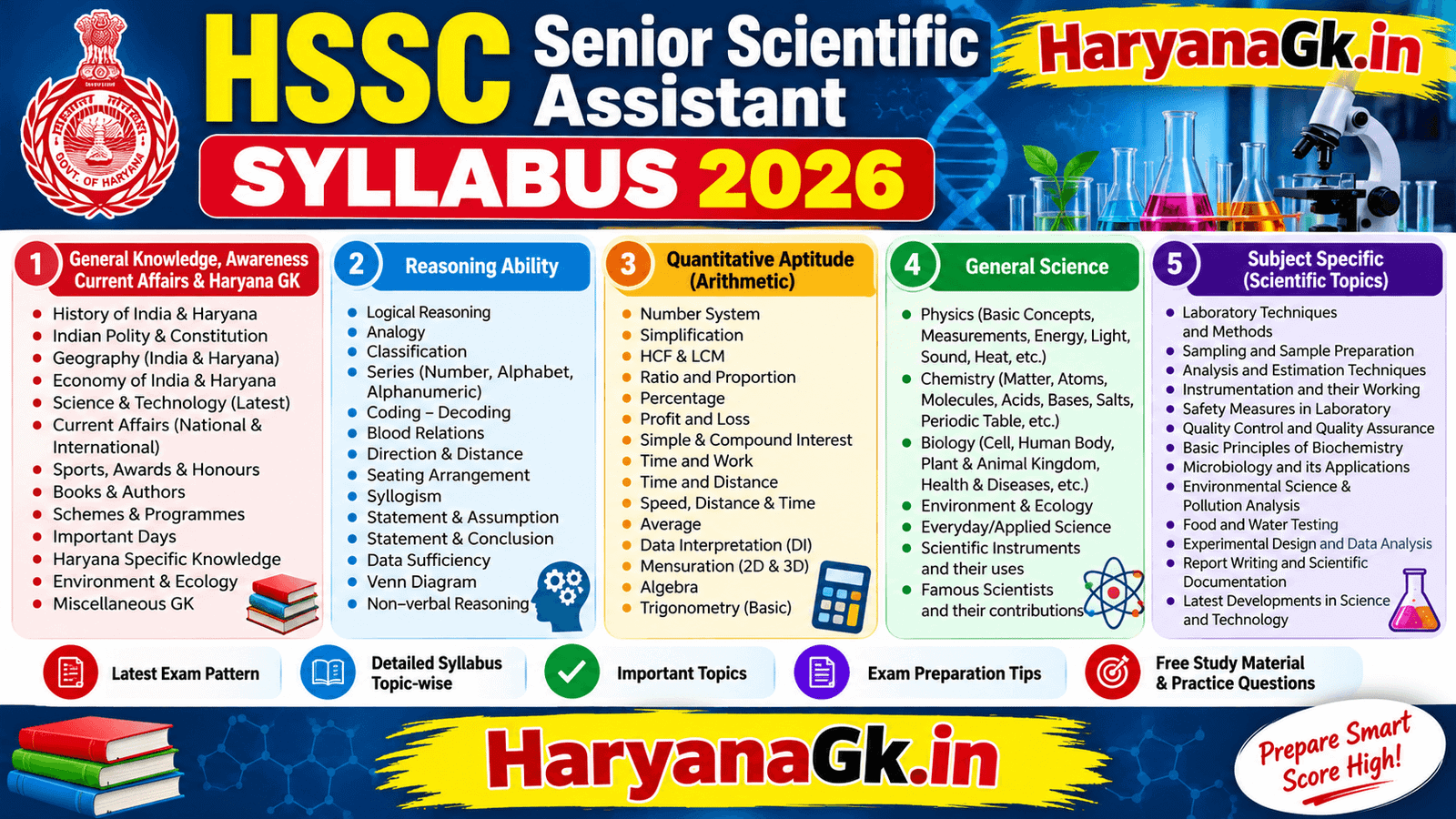
The HSSC Senior Scientific Assistant Syllabus 2026 covers recruitment for Senior Scientific Assistant and Scientific Assistant posts under the Haryana Staff Selection Commission (Advt. No. 5/2023). This HSSC Senior Scientific Assistant Syllabus guide breaks down the exam pattern and the full subject-wise topic list for every specialisation category, straight from the official syllabus published at hssc.gov.in, so you know exactly what to study before opening a single PDF.
HSSC Senior Scientific Assistant Syllabus Exam Pattern
This recruitment follows the standard two-stage HSSC process. Stage one is the Common Eligibility Test (CET) — 100 questions, 100 marks, roughly 90–105 minutes, covering general awareness, reasoning, Hindi, English and quantitative aptitude. Clearing CET plus the socio-economic criteria stage qualifies you for the group-specific written exam, which is where the HSSC Senior Scientific Assistant Syllabus below actually applies.
Advt. No. 5/2023 covers several different technical categories under one umbrella recruitment — Forensic Serology & DNA Examination, Questioned Documents Examination, Lab Assistant (General Science), and Dark Room Attendant (Radiography). Each category has its own subject-specific technical syllabus carrying 40% weightage, on top of shared common sections:
- Technical / Subject-Specific Syllabus (varies by category) — 40% weightage
- General Awareness & G.K.—10% weightage
- Reasoning & Mental Ability — 10% weightage
- English Language — 5% weightage
- Hindi Language — common section
- General Knowledge of Haryana State — 25% weightage
- Computer Knowledge — 5% weightage
The total paper consists of 100 questions, each worth 0.95 marks, with 105 minutes allowed, including 5 extra minutes to mark at least one option per question. HSSC notes on the official document that this weightage is tentative and may vary, so treat it as a study-time guide rather than a locked question count.
The written examination for the HSSC Senior Scientific Assistant and Scientific Assistant posts (Advt. No. 05/2023) consists of 100 mandatory questions carrying 0.95 marks each, with a total allotted time of 105 minutes. The syllabus is divided into a common non-technical section applicable to all candidates and a specialised technical section based on the specific category applied for.
Common Subjects (60% Weightage)
- General Knowledge of Haryana State (25% Weightage): History, literature, geography, economy, civics, polity, environment, art, culture, customs, norms, society, and current events of Haryana.
- General Awareness & G.K. (10% Weightage): Environmental awareness, current events, Indian history, polity & constitution, art & culture, geography, economics, national/international organisations, globalisation, climate, and general science.
- Reasoning & Mental Ability (10% Weightage): Semantic and symbolic analogy, space orientation, Venn diagrams, drawing inferences, pattern folding, number series, coding and decoding, simplification, fractions, L.C.M., H.C.F., ratio & proportion, average, profit & loss, simple & compound interest, time & work, basic algebra, geometry, and trigonometry.
- English Language (5% Weightage): Spotting errors, fill in the blanks, synonyms/antonyms, spellings, idioms & phrases, one-word substitution, active/passive voice, direct/indirect narration, and comprehension passages.
- Hindi Language (5% Weightage): शब्द, अलंकार, विकारी/अविकारी शब्द, मुहावरें, लोकोक्तियां, संधि, उपसर्ग, प्रत्यय, समास, पर्यायवाची, विलोम, वर्तनी, संज्ञा, सर्वनाम, विशेषण, काल, and तदभव-तत्सम शब्द.
- Computer Knowledge (5% Weightage): Basic computer terminology, hardware and software, peripheral devices, and MS Office suite (Word, Excel).
Technical Syllabus: Group A (40% Weightage)
Applicable to Categories 01, 02, 05, 06, 07, 08 & 10 (Biology, Serology, DNA)
- Introduction to Forensic Science & Statistics: History and development, crime scene management, evidence collection and preservation, legal procedures, mean, median, mode, correlation, regression analysis, t-test, chi-square test, and probability.
- Biomolecules & Microscopy: Structure and functions of carbohydrates, lipids, proteins, nucleic acids, protein purification, DNA sequencing, and principles of bright field, phase-contrast, fluorescence, confocal, and electron microscopy.
- Human Physiology, Metabolism & Enzymology: Digestive, nervous, respiratory, circulatory, and reproductive systems, glycolysis, citric acid cycle, oxidative phosphorylation, lipid and amino acid metabolism, and enzyme kinetics/inhibition.
- Human Genetics & DNA Profiling: Genetic code, gene expression, Mendelian principles, genetic disorders, DNA typing, organic extraction of DNA, PCR, SNP, STRs, and mitochondrial DNA polymorphism.
- Forensic Immunology & Serology: Innate and adaptive immunity, antigen-antibody interactions, ABO/MN/Rh blood groups for disputed paternity, electrophoresis methods, presumptive/confirmatory tests for blood, and species determination via precipitin test.
Technical Syllabus: Group B (40% Weightage)
Applicable to Categories 03, 04 & 09 (Ballistics, Documents, SOC)
- Crime Scene Management & Statistics: Evaluation and processing of the crime scene, maintaining the chain of custody, measurement of uncertainty, random sampling, unit of measurement, and significant figures.
- Mechanics & Laser Physics: Velocity, acceleration, projectile motion, Newtonian mechanics, Bernoulli’s theorem, Poiseuille’s law, and the properties and propagation of laser beams.
- Spectroscopy & Chromatography: UV/Visible, Infrared, Raman, and Mass Spectroscopy, Atomic Absorption, X-ray diffraction, NMR, Thin Layer Chromatography, and Gas Chromatography.
- Forensic Ballistics: Classification of standard and improvised firearms, internal ballistics (recoil, pressure, barrel fouling), external ballistics (trajectories, air resistance), terminal/wound ballistics (threshold velocity, entry/exit wounds), and gunshot residue (GSR) analysis.
- Forensic Document Examination: Handwriting comparison, natural variations, forgery detection, document alterations (deletion, overwriting), ink examination (destructive/non-destructive), paper examination, indented writings, and examination of security documents (passports, currency, plastic cards).
How to Prepare for the HSSC Senior Scientific Assistant Syllabus Exam
First, identify exactly which category and technical track your post falls under — Forensic Serology, Questioned Documents, Lab Assistant or Dark Room Attendant — since the 40% technical block is the single biggest differentiator between candidates, and each track’s content is completely different. Once you know your track, work through it systematically since it decides nearly half your score.
Don’t skip the common portion either. At 25% weightage, general knowledge of Haryana is the second-biggest scoring block on this paper and applies to every category regardless of technical specialisation, so it deserves dedicated preparation time alongside your subject-specific study.
Frequently Asked Questions: HSSC Senior Scientific Assistant Syllabus
What is the HSSC Senior Scientific Assistant Syllabus for Advt. No. 5/2023?
The HSSC Senior Scientific Assistant Syllabus covers four technical tracks — Forensic Serology & DNA Examination, Questioned Documents Examination, Lab Assistant/General Science, and Dark Room Attendant/Radiography — each carrying 40% weightage, plus common sections in General Awareness, Reasoning, English, Hindi, Haryana GK and Computer Knowledge, compiled directly from the official document published by the Haryana Staff Selection Commission.
Which technical syllabus applies to my category number?
Categories 01, 02, 05, 06, 07, 08 and 10 follow the Forensic Serology & DNA Examination syllabus. Categories 03, 04 and 09 follow the Questioned Documents Examination syllabus. Categories 11 to 15 follow the Lab Assistant/General Science syllabus. Category 16 (Dark Room Attendant) follows the Radiography syllabus. Always confirm your exact category against the official notification.
Is the HSSC Senior Scientific Assistant Syllabus the same every year?
HSSC updates its syllabus documents periodically, and the weightage listed against each section is explicitly marked tentative by HSSC. Always check hssc.gov.in/examsyllabus for the latest version before you finalize your preparation.
Do I need to clear CET before attempting this exam?
Yes. HSSC recruitment follows the standard two-stage process: you first clear the Common Eligibility Test (CET), then sit for the group-specific written exam that follows the HSSC Senior Scientific Assistant Syllabus covered in this guide.
Official Notification and Source
This HSSC Senior Scientific Assistant Syllabus is compiled directly from the official Senior Scientific Assistant & Scientific Assistant Syllabus (Advt. No. 5/2023) published by the Haryana Staff Selection Commission. Always cross-check the latest version and any amendments against the official document before you finalise your preparation.
Download the official syllabus PDF and check current recruitment notices at hssc.gov.in/examsyllabus.
Explore Other HSSC Group Syllabus Guides
This HSSC Senior Scientific Assistant Syllabus guide is part of a growing set of subject-wise syllabus posts for every HSSC group. Browse the full set on the HSSC Syllabus tag page or the Syllabus category. For the full HSSC recruitment process, CET details and exam pattern, see the Haryana HSSC guide.