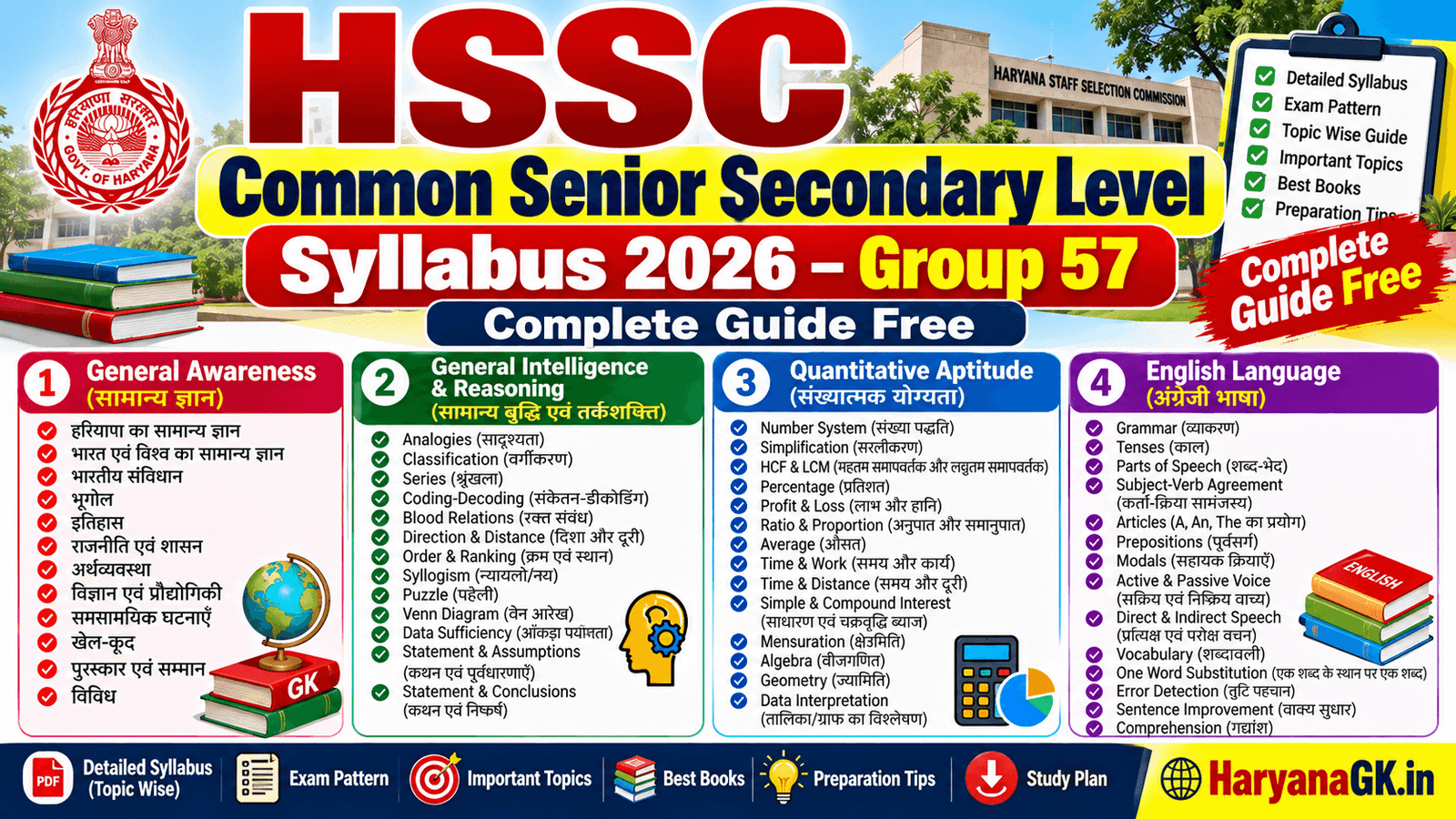
Group 57 is the sister category of Group 56, but pitched one level lower. Group 56 requires a Bachelor’s degree, while for Group 57 only a 10+2 (Senior Secondary) pass is required. This is probably where you end up if you’ve finished Class 12 and nothing else, and you don’t have a diploma or trade certificate pointing you to a particular technical group. There’s no single subject paper here, as with Group 56 — instead of testing one technical field in depth, HSSC distributes the 70% subject weightage across general awareness, reasoning, English, quantitative aptitude, Hindi, Haryana economy, rural marketing and environmental studies. This page covers the complete subject list, the exam pattern, and the exact eligibility criteria, including the age and educational cut-offs HSSC has applied for Group 57 in recent CET-linked cycles.
HSSC Common Senior Secondary Level Syllabus Exam Pattern
Group 57 recruitment follows the standard two-stage HSSC process. Stage one is the Common Eligibility Test (CET) — 100 questions, 100 marks, roughly 90–105 minutes, covering general awareness, reasoning, Hindi, English and quantitative aptitude. Clearing CET plus the socio-economic criteria stage qualifies you for the group-specific written exam, which is where the HSSC Common Senior Secondary Level Syllabus below actually applies.
The HSSC Common Senior Secondary Level Syllabus for the written exam splits into weighted parts:
- Haryana related history, current affairs, literature, Geography, Civics, Environment, Culture, art, traditions, and welfare schemes of Haryana Government etc — 20% weightage
- Subject related syllabus — 70% weightage
HSSC notes on the official document that this weightage is tentative and may vary, so treat it as a study-time guide rather than a locked question count.
HSSC Common Senior Secondary Level Syllabus 2026 (Subject-Wise)
The subject-specific block of the HSSC Common Senior Secondary Level Syllabus spans the following areas. Here is the complete breakdown.
Questions from the General Awareness section are designed to test the candidate’s general knowledge of the environment around him and its applications to society. Questions are also designed to test knowledge of current events and of such matters of everyday observation and experience in their scientific aspect as may be expected of an educated person. The test will also include questions relating to India and its neighbouring countries especially pertaining to History, Culture, Geography, Economic Scene, General policy, Static Awareness, and scientific research.
Introduction to Indian Constitution: Preamble, Fundamental duties and fundamentals rights only, Traffic Rules, Traffic signs, Penalties for violating traffic rules, first aid, safety precautions and occupational health, Welfare Schemes run by Government of Haryana and provisions. FUNDAMENTALS OF INSURANCE: Introduction to insurance, Contract of life insurance, Fire insurance, Marine insurance, Accident and motor insurance, Farm Crop Insurance, Insurance intermediaries – role of agents and procedure for becoming an agent; cancellation of license; revocation/suspension/termination of agent appointment; code of conduct; unfair practices.
This section includes questions of both verbal and non-verbal reasoning. The questions will be asked from: Semantic Analogy, Symbolic operations, Symbolic/ Number Analogy, Trends, Figural Analogy, Space Orientation, Semantic Classification, Venn Diagrams, Number Series, Embedded figures, Figural Series, Critical Thinking, Problem Solving, Symbolic/ Number Classification, Drawing inferences, Figural Classification, Punched hole/ pattern folding & unfolding, Semantic Series, Figural Pattern-folding and completion, Emotional Intelligence, Word Building, Social Intelligence, Coding and de-coding, Other sub- topics if any Numerical operations,
The English Language questions will be asked from the following topics: Spot the Error, fill in the Blanks, Synonyms/ Homonyms, Antonyms, Spellings/ Detecting misspelt words, Idioms & Phrases, One-word substitution, Improvement of Sentences, Active/ Passive Voice of Verbs, Conversion into Direct/Indirect narration, Shuffling of Sentence parts, Shuffling of Sentences in a passage, Cloze Passage, Comprehension Passage, English/Hindi words & terminology used in offices and their inter-translation. Number Systems: Computation of Whole Number, Decimal and Fractions, Relationship between numbers.
Fundamental arithmetical operations: Percentages, Ratio and Proportion, Square roots, Averages, Interest (Simple and Compound), Profit and Loss, Discount, Partnership Business, Mixture and Allegation, Time and distance, Time and work. Mensuration: Triangle, Quadrilaterals, Regular Polygons, Circle, Right Prism, Right Circular Cone, Right Circular Cylinder, Sphere, Hemispheres, Rectangular Parallelepiped, Regular Right Pyramid with triangular or square Base. Algebra: Basic algebraic identities of School Algebra and Elementary surds (simple problems) and Graphs of Linear Equations.
Geometry: Familiarity with elementary geometric figures and facts: Triangle and its various kinds of centres, Congruence and similarity of triangles, Circle and its chords, tangents, angles subtended by chords of a circle, common tangents to two or more circles. Trigonometry: Trigonometry, Trigonometric ratios, Complementary angles, Height and distances (simple problems only) Standard Identities like sin2 𝜃 + Cos2 𝜃=1 etc. Statistical Charts: Use of Tables and Graphs: Histogram, Frequency polygon, Bar-diagram, Pie-chart
E. HINDI
शब्द, अलंकार, विकारी शब्द, वाक्य, अविकारी शब्द, पद, पदबंध, मुहावरें, लोकोक्तियां, संधि, उपसर्ग, प्रत्यय, समास, पर्यायवाची, विलोम व अनेकार्थी शब्द, अयोगवाह, वाक्य शोधन, निपात (अवधारक), विरामचिन्ह, संबंधबोधक, अनेक शब्दों के लिए एक शब्द, एकार्थक शब्द, युग्म शब्द, वर्तनी (शब्द एवं वाक्य शुद्धिकरण), वर्ण, स्वर, व्यंजन, विदेशी ध्वनियाँ, संज्ञा, सर्वनाम, विशेषण, क्रिया, क्रियाविशेषण, समुच्चय बोधक, विस्मय बोधक, वचन, लिंग, कारक, काल, तद्भव–तत्सम शब्द।
F. Haryana economy
nature, characteristics and problems; concept of economic development; State of the Haryana economy since its inception: Income; Population, Health & Nutrition and declining sex ratio, Haryana agriculture: nature, cropping pattern, role of agriculture in Haryana economy, Measures for development in agriculture, crop insurance, Agriculture credit: agriculture finance, types of agriculture finance; credit needs of farmers; sources of credit: institutional and non-institutional sources; NABARD; rural indebtedness: causes, consequences and debt relief measures, Micro, small & medium enterprises (MSME) in Haryana: meaning, role, performance and challenges; SEZ, Growth of MNCs in Haryana, Role of HSIIDC, HFC, HAFED, HKVIB, Haryana budget: objectives and policies, sources of revenues and its utilization
G. Rural Marketing
Meaning, nature, characteristics; opportunities and challenges to rural markets in Haryana; Socio- cultural, economic, demographic, technological and other environmental factor affecting rural marketing; rural consumer behaviour; segmentation of rural market; strategies for rural marketing; rural marketing mix; difference in rural and urban market; problems in rural marketing; Strategies for rural marketing, Product planning, pricing, promotion and management of distribution channels for marketing of durables and non-durables in rural areas; Planning and organizing personnel selling in rural markets; Innovation in rural market; E-commerce in rural markets, e-chaupal& other similar initiatives in rural markets
H. Environmental Studies and Disaster Management
Multidisciplinary nature of environmental studies, Natural Resources, Forest resources, Water resources, Mineral resources, Food resources, Energy resources, Land resources, Ecosystems, Energy flow in the ecosystem, Introduction, types, characteristic features,
structure and function of the following ecosystem:
a. Forest ecosystem
b. Grassland ecosystem
c. Desert ecosystem
d. Aquatic ecosystems (ponds, streams, lakes, rivers, oceans, and estuaries). Biodiversity and its conservation, value of biodiversity, hot spots of biodiversity, threats to biodiversity, and endangered and endemic species of India.
Conservation of biodiversity, environmental pollution, effects and control measures of: a. Air pollution b. Water pollution c. Soil pollution. Marine pollution. Noise pollution. Thermal pollution and nuclear hazards. Solid Waste Management, Social Issues and the Environment, Environmental Ethics, Wasteland Reclamation, Consumerism and Waste Products. Environment Protection Act. Air (Prevention and Control of Pollution) Act. Water (Prevention and Control of Pollution) Act. Wildlife Protection Act. Forest Conservation Act. Issues involved in the enforcement of environmental legislation. Public awareness. Human Population and the Environment, Environment and Human Health, Role of Information Technology in Environment and Human Health.
DISASTER MANAGEMENT: Natural Disasters, Climatic Change, Man-Made Disasters, Disaster Management, International strategy for disaster reduction, national disaster management framework, financial arrangements, and the role of NGOs, community-based organisations and media. Central, state, district and local administration; Armed forces in disaster response; Disaster response: police and other organisations
Common Sections
Haryana related history, current affairs, literature, Geography, Civics, Environment, Culture, art, traditions, and welfare schemes of Haryana Government etc: 2) Computer terminology, Fundamentals, word software, excel software, Power point, internet, web browsing, Communication, emails, downloading and uploading data on websites etc
How to Prepare for the HSSC Common Senior Secondary Level Syllabus Exam
Start with the subject-specific block of the HSSC Common Senior Secondary Level Syllabus first — it carries the heaviest weightage and is where real differentiation between candidates happens, since general awareness and computer knowledge sections overlap with every other HSSC group. Work through each topic area systematically, and revisit the subject list above every week so nothing slips through before exam day.
Don’t skip the common portion either. Haryana-specific general awareness and basic computer knowledge are easy marks that candidates often under-prepare because they’re focused on the technical syllabus.
ELIGIBILITY & QUALIFICATION: WHO CAN APPLY FOR HSSC GROUP 57
Educational Qualification: Senior Secondary (10+2) pass from a recognised board. Unlike Group 56, Group 57 does not require a Bachelor’s degree — the academic requirement is both the floor and the ceiling at Class 12, which is exactly why “Senior Secondary Level” is in the group’s own name. HSSC does require working knowledge of Hindi or Sanskrit up to Matric standard in most Group C notifications, so check the official Group 57 advertisement to see if that clause applies here too.
Age limit: HSSC has kept the Group C age bracket at 18 to 42 years as on the closing date of the application, across groups 56 to 63 and beyond, and Group 57 follows the same rule. Candidates belonging to Haryana’s Scheduled Castes and Backward Classes get a five-year age relaxation, taking the ceiling to 47. The relaxation for disability is 10 years in the general category and 13 years for SC and BC, per the pattern in recent CET-linked HSSC cycles.
Domicile: Like most Group C postings, vacancies under Group 57 are mostly reserved for Haryana-domiciled candidates, with a smaller share kept open for candidates from other states. HSSC does not publish the SC, BC-A, BC-B, EWS, PwD and ex-servicemen reservation breakup in the syllabus document — that detail is available in the specific recruitment notification, so treat the figures here as a general guide and cross-check with the live advertisement.
Frequently Asked Questions: HSSC Common Senior Secondary Level Syllabus
What’s the real difference between Group 56 and Group 57?
Mostly the educational level. Group 56 requires a Bachelor’s degree, while Group 57 only requires a 10+2 pass. There’s a lot of overlap in the subject syllabus — reasoning, English, Hindi, quantitative aptitude, Haryana economy and rural marketing are all covered — but Group 57 drops Group 56’s heavier theory block on microeconomics, market structures and insurance fundamentals, keeping the syllabus pitched closer to Class 12 level.
Is Group 57’s Hindi section just comprehension, or full grammar?
Full grammar. Group 56 checks only basic Hindi and English comprehension and office terminology, whereas Group 57 has a separate Hindi Language section covering sandhi, samas, paryayvachi, vilom, alankar, karak and kaal in detail — similar to a school Hindi grammar paper.
What’s the age relaxation for Haryana’s SC and Backward Class candidates applying for Group 57?
Five years above the general 42-year ceiling, taking it to 47 — the same relaxation pattern HSSC applies across its Group C categories, including Group 56. Persons with disabilities get 10 years over the standard limit in the general category, or 13 years in the SC and BC categories.
Do I need to clear CET before attempting the Group 57 written exam?
Yes. Like every other HSSC Group C category, Group 57 candidates first clear the Common Eligibility Test, then the socio-economic criteria screening, before sitting for the group-specific written exam that this syllabus page covers.
Official Notification and Source
This HSSC Common Senior Secondary Level Syllabus is compiled directly from the official Group 57 – Common Senior Secondary Level Syllabus published by the Haryana Staff Selection Commission. Always cross-check the latest version and any amendments against the official document before you finalize your preparation.
Download the official syllabus PDF and check current recruitment notices at hssc.gov.in/examsyllabus.
Explore Other HSSC Group Syllabus Guides
This HSSC Common Senior Secondary Level Syllabus guide is part of a growing set of subject-wise syllabus posts for every HSSC group. Browse the full set on the HSSC Syllabus tag page or the Syllabus category. For the full HSSC recruitment process, CET details and exam pattern, see the Haryana HSSC guide.