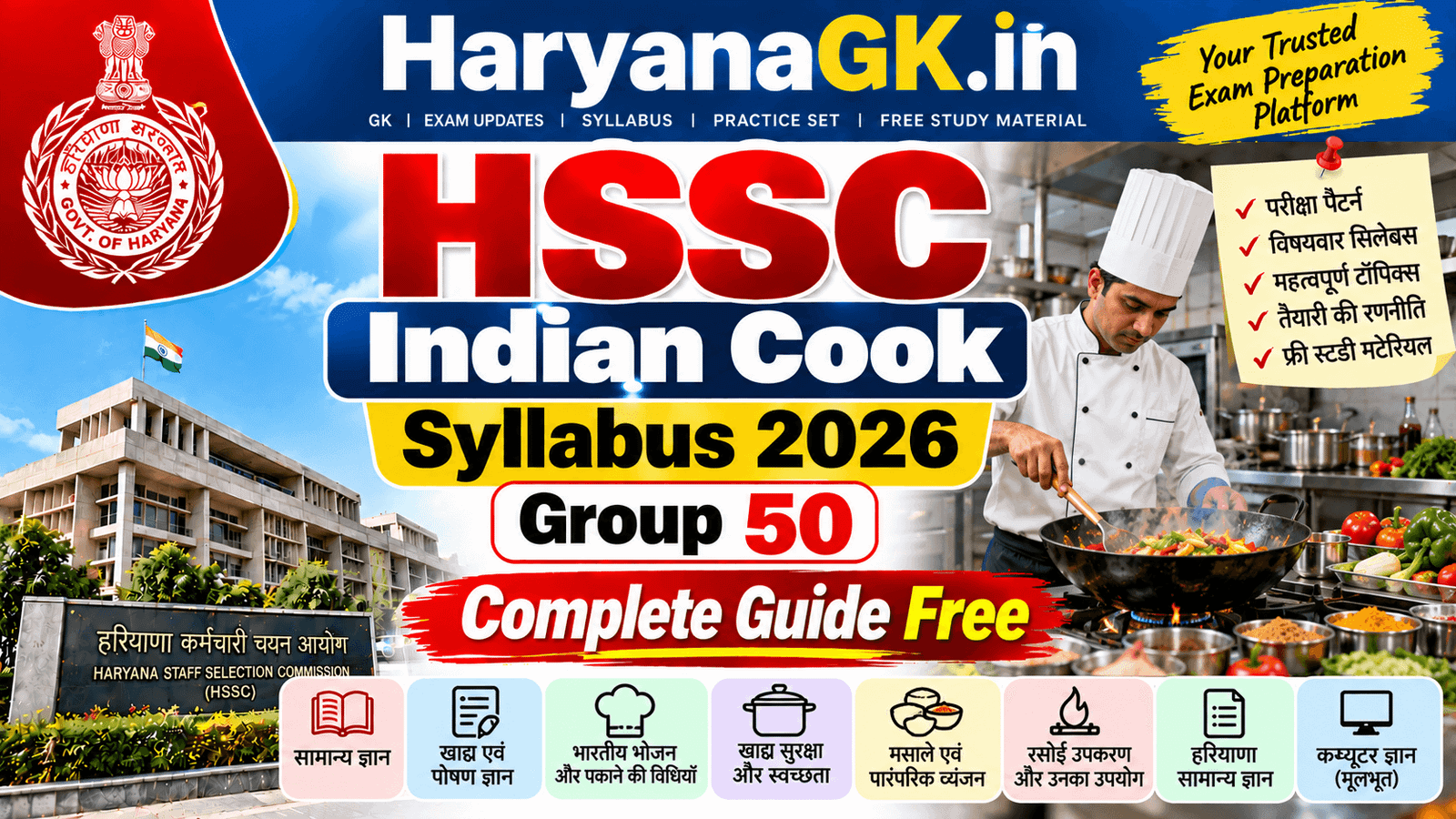
The HSSC Indian Cook Syllabus 2026 covers Group 50 recruitment for Indian Cook posts under the Haryana Staff Selection Commission. This HSSC Indian Cook Syllabus guide breaks down the exam pattern and the full subject-wise topic list, straight from the official syllabus published at hssc.gov.in, so you know exactly what to study before you open a single PDF.
HSSC Indian Cook Syllabus Exam Pattern
Group 50 recruitment follows the standard two-stage HSSC process. Stage one is the Common Eligibility Test (CET) — 100 questions, 100 marks, roughly 90–105 minutes, covering general awareness, reasoning, Hindi, English and quantitative aptitude. Clearing CET plus the socio-economic criteria stage qualifies you for the group-specific written exam, which is where the HSSC Indian Cook Syllabus below actually applies.
The HSSC Indian Cook Syllabus for the written exam splits into weighted parts:
- General awareness, reasoning, mathematics, science, history (including Haryana-related history), current affairs, literature, geography, civics, environment, culture, etc.—20% weightage
- Computer terminology, fundamentals, word software, Excel software, PowerPoint, internet, web browsing, communication, emails, downloading and uploading data on websites, etc.—10% weightage
- Subject-related syllabus — 70% weightage
HSSC notes on the official document that this weightage is tentative and may vary, so treat it as a study-time guide rather than a locked question count.
HSSC Indian Cook Syllabus 2026 (Subject-Wise)
The subject-specific block of the HSSC Indian Cook Syllabus spans the following areas. Here is the complete breakdown.
FOOD PRODUCTION (COOKERY)
Importance of kitchen in hotel & catering establishments; aims and objectives of cooking, classification of raw materials, preparation of ingredients, methods of mixing foods, effect of heat on various foods, weighing and measuring, texture of food, and culinary terms. Methods of cooking with special application to meat, fish, vegetables, cheese, pulses and egg. Conventional and non-conventional methods of cooking, solar cooking, microwave cooking, and fast food operation. Varieties of fish, meat and vegetables. Accompaniments, garnishes and réchauffé.
Balancing of recipes, standardisation of recipes, standard yield, maintaining recipe files. Menu planning, portion control, and a brief study of how portions are worked out. Invalid cookery. Purchasing specifications, quality control, indenting and costing. Description and use of the following: Basic Stocks, Aspics & Jellies. Roux Blanc, Roux Blond and Roux Brun. Recipes and quantities required to produce 10 litres of Stock – White & Brown.
Recipes are required to produce one litre of the following: Bechamel Sauce, Tomato Sauce, Velouté Sauce, Espagnole Sauce, Hollandaise and Mayonnaise Sauce with the necessary precautions to be observed while preparing these, with a minimum of five derivatives of each. Soup definition, classification of soups with examples in each group, recipe for one litre of consommé, and 10 popular consommés with their garnishes. Eggs – structure, selection of quality, various ways of cooking eggs with examples in each method and prevention of blue ring formation.
Vegetables – effect of heat on different vegetables in acid/alkaline medium and reaction with metals. Method of cooking different vegetables with emphasis on cooking asparagus, artichokes, and Brussels sprouts. Theory of Bread Making, Bread Rolls, Bread Sticks, and Indian Breads. Pastry – recipes of short-crust pastry, puff pastry, flaky pastry, choux paste, danish pastry and their derivatives. Recipes and method of preparation of plain ice cream. Kitchen stewarding and upkeep of equipment. Staff organisation of the kitchen; its coordination with other departments
LARDER
Larder – organisation & layout. Larder control – maintenance & upkeep of larder equipment and supplies. Hors ‘d’oeuvre & salads – classification. Fish – classification, sealing, cleaning, preparation, basic cuts and its uses and storage. Butchery – cuts of beef, lamb, mutton and pork, its uses and weights. Poultry & Game: Poultry – classification, preparation, dressing and cuts with its uses. Game – furred game and feathered game, preparation cuts with their uses. Assembling of cold buffets, sandwiches and canapes. Proper storage of leftovers. Different types of forcement and their uses. Decorative work including sculptures, ice carvings, and vegetable and fruit carvings. Cleaning and care of larder equipment
COMMODITIES AND FOOD COSTING
Cereals – Wheat, Rice, Maize. Breakfast Cereals – uses and storage of cornflakes, puffed rice, and pressed rice. Pulses – types & uses of pulses. Fresh fruits & vegetables – classification of fruits & vegetables and their use. Dairy products – milk and its composition & storage, classification & uses of cheese, butter & cream. Prevailing food standards in India, food adulteration as a public health hazard, simple tests in the detection of common food adulterants, and the Essential Commodities Act (ISI Agmark). Herbs, spices and condiments – classification and uses of different types of herbs and condiments.
Brief introduction of tea, coffee, cocoa and their procurement, storage and use. Food flavours, essences and colours with brand names. Methods of food preservation – long-term and short-term methods. Convenience food – sugar preserves and confectionery gums. Importance of costing and cost dynamics – variable and semi-variable and fixed costs. Elements of cost – material, labour and overhead. Cost control procedure through purchasing, receiving, storing, issuing & preparation, portion control
HYGIENE & NUTRITION
Personal hygiene, care of skin, hands and feet, food handlers’ hygiene, and protective clothing. Garbage disposal – different methods, their advantages & disadvantages. Food Poisoning – causative factors and the precautions to be taken by food handlers. Food Storage – techniques of correct storage and storage temperature of different commodities to prevent bacterial manifestation or contamination. Pest Control – rodents and insect control techniques, special stress on control of flies, rats and cockroaches. Municipal Health Laws. Golden rules of first aid and treatment for cuts, wounds, and burns
NUTRITION
Definition of nutrition, definition of a calorie, daily caloric requirements for different age groups, factors. Food groups and their role in a balanced diet. Carbohydrates and Proteins – classification, sources, functions, Recommended Daily Allowance (RDA), excess and deficiency. Fats – classification according to sources, difference between animal fat and vegetable fat, functions, Recommended Daily Allowance (RDA), excess and deficiency. Minerals – importance of minerals with special emphasis on calcium and iron (function & sources). Vitamins in diet – fat soluble – A, D, E & K; water soluble – B complex, thiamin, niacin, riboflavin & vitamin C; their sources & functions. Health foods & menus for diabetic, heart, and blood pressure patients. Specific requirement for sportsmen/women
How to Prepare for the HSSC Indian Cook Syllabus Exam
Start with the subject-specific block of the HSSC Indian Cook Syllabus first — it carries the heaviest weightage and is where real differentiation between candidates happens, since general awareness and computer knowledge sections overlap with every other HSSC group. Work through each topic area systematically, and revisit the subject list above every week so nothing slips through before exam day.
Don’t skip the common portion either. Haryana-specific general awareness and basic computer knowledge are easy marks that candidates often under-prepare because they’re focused on the technical syllabus.
Frequently Asked Questions: HSSC Indian Cook Syllabus
What is the HSSC Indian Cook Syllabus for Group 50?
The HSSC Indian Cook Syllabus covers the weighted sections listed above, compiled directly from the official document published by the Haryana Staff Selection Commission.
Is the HSSC Indian Cook Syllabus the same every year?
HSSC updates its syllabus documents periodically, and the weightage listed against each section is explicitly marked tentative by HSSC. Always check hssc.gov.in/examsyllabus for the latest version before you finalise your preparation.
Do I need to clear CET before attempting this exam?
Yes. HSSC recruitment follows the standard two-stage process: you first clear the Common Eligibility Test (CET), then sit for the group-specific written exam that follows the HSSC Indian Cook Syllabus covered in this guide.
Official Notification and Source
This HSSC Indian Cook Syllabus is compiled directly from the official Group 50 – Indian Cook Syllabus published by the Haryana Staff Selection Commission. Always cross-check the latest version and any amendments against the official document before you finalise your preparation.
Download the official syllabus PDF and check current recruitment notices at hssc.gov.in/examsyllabus.
Explore Other HSSC Group Syllabus Guides
This HSSC Indian Cook Syllabus guide is part of a growing set of subject-wise syllabus posts for every HSSC group. Browse the full set on the HSSC Syllabus tag page or the Syllabus category. For the full HSSC recruitment process, CET details and exam pattern, see the Haryana HSSC guide.