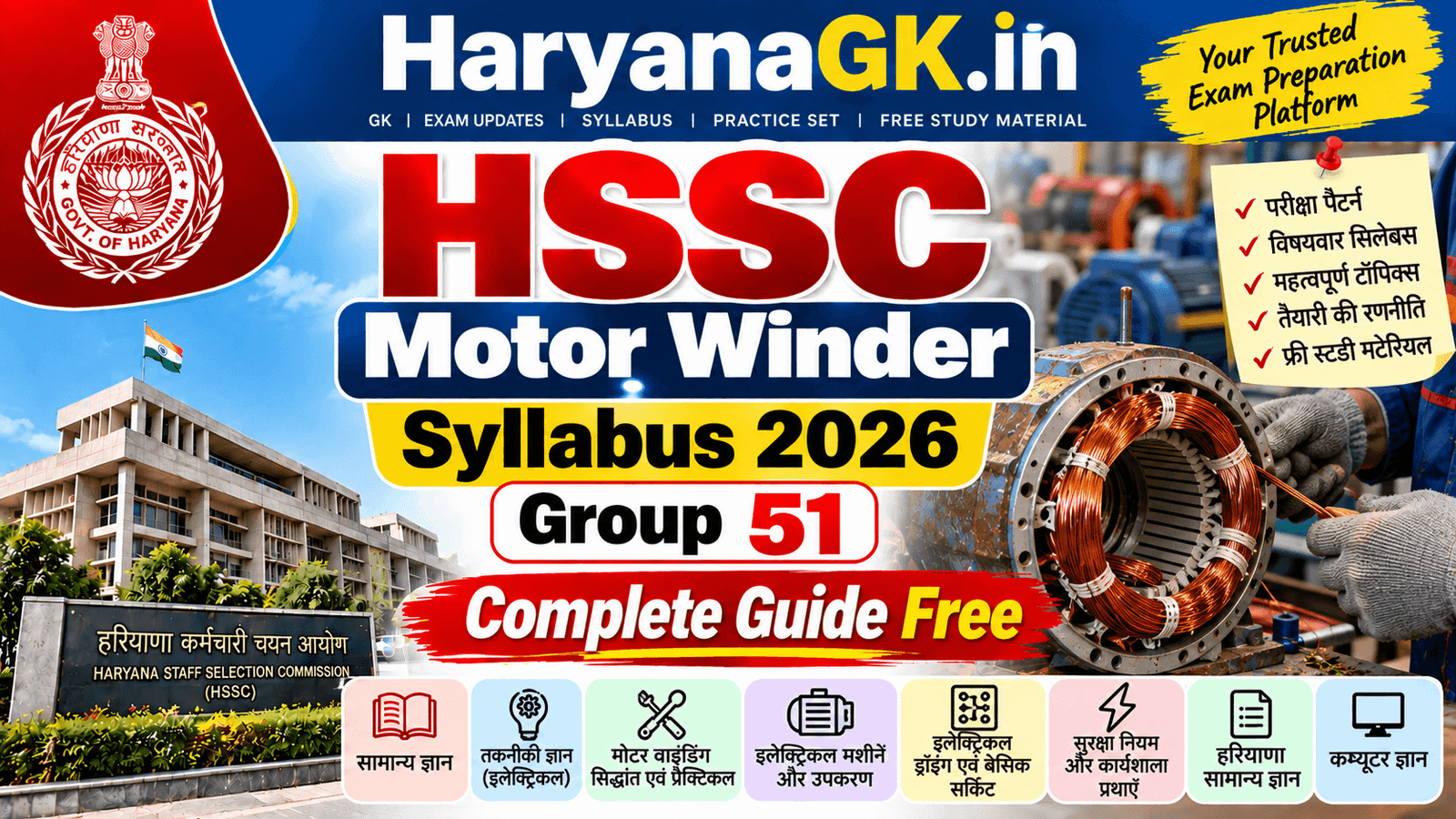
The HSSC Motor Winder Syllabus 2026 covers Group 51 recruitment for Motor Winder posts under the Haryana Staff Selection Commission. This HSSC Motor Winder Syllabus guide breaks down the exam pattern and the full subject-wise topic list, straight from the official syllabus published at hssc.gov.in, so you know exactly what to study before you open a single PDF.
HSSC Motor Winder Syllabus Exam Pattern
Group 51 recruitment follows the standard two-stage HSSC process. Stage one is the Common Eligibility Test (CET) — 100 questions, 100 marks, roughly 90–105 minutes, covering general awareness, reasoning, Hindi, English and quantitative aptitude. Clearing CET plus the socio-economic criteria stage qualifies you for the group-specific written exam, which is where the HSSC Motor Winder Syllabus below actually applies.
The HSSC Motor Winder Syllabus for the written exam splits into weighted parts:
- General awareness, reasoning, mathematics, science, history (including Haryana-related history), current affairs, literature, geography, civics, environment, culture, etc.—20% weightage
- Computer terminology, fundamentals, word software, Excel software, PowerPoint, internet, web browsing, communication, emails, downloading and uploading data on websites, etc.—10% weightage
- Subject-related syllabus — 70% weightage
HSSC notes on the official document that this weightage is tentative and may vary, so treat it as a study-time guide rather than a locked question count.
HSSC Motor Winder Syllabus 2026 (Subject-Wise)
The subject-specific block of the HSSC Motor Winder Syllabus spans the following areas. Here is the complete breakdown.
Introduction Unit: Systems of units (FPS, CGS, MKS/SI), unit of length, mass and time, conversion of units, fractions & simplification (fractions, decimal fractions, multiplication and division of fractions and decimals, conversion of fractions to decimals and vice versa). Simple problems: simplification using BODMAS. Square Root: Square and Square Root, method of finding out square roots, Simple problem using calculator, ratio & proportion: Simple calculation on related problems,
Percentage: Introduction, simple calculation. Changing percentage to decimal and fraction and vice versa, Material Science: properties – Physical & Mechanical, Types – Ferrous & Non-Ferrous, difference between Ferrous and Non-Ferrous metals, introduction of Iron, Cast Iron, Wrought Iron, Steel, difference between Iron and Steel, Alloy steel, carbon steel, stainless steel, Non-Ferrous metals, Non-Ferrous Alloys, Mass,
Weight and Density: Mass, Unit of Mass, Weight, difference between mass and weight, Density, unit of density, specific gravity of metals, Work, Power and Energy: work, unit of work, power, unit of power, horsepower of engines, mechanical efficiency, energy, use of energy, potential and kinetic energy, examples of potential energy and kinetic energy, Mensuration: Area and perimeter of square, rectangle, parallelogram, triangle, circle, and semi-circle. Volume of solids – cube, cuboid, cylinder and sphere. Surface area of solids – cube, cuboid, cylinder and sphere. Occupational Safety & Health Basic safety introduction,
Personal protection: – Basic injury prevention, basic first aid, Hazard identification and avoidance, safety signs for danger, warning, caution & personal safety messages. Use of fire extinguishers. Visit & observation of sections. Various safety measures involved in the industry. Elementary first aid. Concept of Standard. Soft Skills: its importance and job area after completion of training. Introduction of first aid. Operation of electrical mains. Introduction of PPEs. Introduction to the 5S concept & its application. Response to emergencies, e.g., power failure, fire, and system failure. Identification of Trade-Hand Tools, Specifications Earthing – Principle of different methods of earthing & selection. i.e., pipe, plate, etc. Importance of earthing.
Improving earth resistance Earth Leakage Circuit Breaker (ELCB). Common electrical accessories, their specifications in line with NEC 2011- Explanation of switches, lamp holders, plugs and sockets. Developments of domestic circuits, alarms & switches, with individual switches, MCB, ELCB, and MCCB. Series-parallel testing board & use. Solders, flux and soldering technique. Types of resistors & properties of resistors.
Introduction of the National Electrical Code. Explanation, definition and properties of conductors, insulators and semiconductors. Types of wires & cables, standard wire gauge. Specification of wires & cables – insulation & voltage grades – low, medium & high voltage. Fundamental of electricity: Fundamental terms – Current, Voltage definitions, AC, DC, Phase, Neutral, Earth. Units & effects of electric current. Ohm’s Law – Simple electrical circuits and problems. Reading of simple electrical layout. Resistors – Law of Resistance.
Series and parallel circuits & related calculations. Alternating Current – Comparison and Advantages D.C. and A.C. related terms: frequency, instantaneous value, R.M.S. value, average value, peak factor, form factor, sine wave, phase and phase difference. Inductive and capacitive reactance, impedance (Z), and power factor (p.f.). Active and reactive power. Single-phase and three-phase systems, etc. Power consumption in series and parallel, P.F., etc. Concept: three-phase star and delta connections. Line and phase voltage, current and power in a 3-phase circuit with a balanced and unbalanced load. Three-phase four-wire system.
Electrical Measuring Instruments – types, indicating types PMMC & MI meter (ammeter, voltmeter) – Range extension – Multi-meter (Digital/Analogue) – Wattmeter – P.F. meter – Energy meter (digital/analogue) – Insulation tester (megger) – Earth tester. -Frequency meter -Phase sequence meter – Multi-meter – Analogue and Digital – Tong tester – Techo-meter. Introduction to fitting trade. Descriptions, General Care & Maintenance of Hammer, Chisels, Try Square, etc. Descriptions, General Care & Maintenance of different types of files. Descriptions, general care & maintenance of hacksaws, drilling machines, etc. Description of taps and dies, types of rivets and riveted joints.
Finishing and polishing materials and their process. D.C. Machines – General concept of electrical machines. D.C. generator. Parts: Armature, Field Coil, Polarity, Yoke, Cooling Fan, Commutator, Brushes, Laminated Core. series, shunt and compound generators. Voltage build-up, loading. Types of D.C. Motor. Starters used in D.C. motors Types of speed control of DC motors in industry. Application of D.C. motors. Care, routine & preventive maintenance. AC Generator: Explanation of alternator, working principle, voltage build-up, loading, and regulation. Efficiency.
Types of prime mover, phase sequence, and specification of alternators. Transformers 1ph and 3ph: Working principle of transformer, classification of C.T., P.T. instruments and auto-transformers, construction of single-phase and poly-phase. Type of cooling for transformer. Protective devices. Components, auxiliary parts, i.e., breather, conservator, Buchholz relay, and other protective devices. Transformer oil testing and tap changer (offload and onload). Dry-type transformer. Bushings and termination. Three-phase induction motor – Working principle – Production of rotating magnetic field, squirrel cage induction motor, slip-ring induction motor.
Control & power circuits of starters: D.O.L. starter, forward/reverse starter, star/delta starter, autotransformer starter, rotor resistance starter, etc. Single phasing preventer. Application of induction motor care, routine & preventive maintenance. Single-phase induction motor, working principle, different methods of starting and running (capacitor start, permanent capacitor, capacitor start & run, shaded pole technique). FHP motors, repulsion motors, stepper motors, and application of single-phase motors.
Electro-mechanical assemblies:
(1) Complete component identification. Knowledge of various mechanical and magnetic parts such as stampings, housings, keys, shafts, commutators, slipring assemblies, cooling fans, poles, etc.
(2) Job instructions on handling and storing the assemblies.
(3) Concept of jigs and fixtures as applicable in the winding job.
(4) Details of shrink fit and welding as applicable in the winding job.
(5) Reconditioning/replacing of defective parts, testing of magnetic core loss.
Coil winding and insulation preparation:
(1) Insulating materials: Solid, liquid and gaseous insulating materials H Class, Kapton tape, Nomex paper, Tetrafluorores the lenetape, fibre glass tape, mica tape, silicon tape, thermal classification, properties, and typical schemes of insulation used in the windings. Methods of testing insulating materials. Reference to relevant Indian/international standards.
(2) Conductors: Conductors are materials such as copper, aluminium, brass, etc., and their shape, size and current-carrying capacity. Insulation used on winding wires, their types, size, voltage and temperature ratings. End connection lead cables. Specification relevant to Indian / international standards.
(3) Windings: Different types of windings used in AC/DC rotating machines and transformers. winding terminology, finding armature winding data, i.e., calculating speed, pole, pole pitch, coil pitch, parallel paths, and preparing winding diagrams as per data given (LAP & WAVE) winding, AC & DC machine winding.
(4) Calculations for making formers for different types of windings. D.C. m/c Winding—Introduction to armature winding, winding terms—pole pitch, coil pitch, back pitch, front pitch, Types of winding – lap & wave winding, progressive and retrogressive winding. Winding materials, winding hand tools, coil winding machines, winding calculations and tables. Conditions to be fulfilled for lap & wave winding.
Growler – construction details & testing of armature rewinding by growler. Impregnation/varnish & baking, high-voltage test & insulation resistance test. REWINDING OF AC MOTOR – A.C. M/C WINDING – Introduction to stator winding, terminology used in single-phase and three-phase winding like pole pitch, coil pitch, etc., and rules for end connection of 3Ø & single-phase motors.
Winding materials, winding tools, coil winding machines, winding calculations and tables, Testing the motor before declaring for rewinding. Principle of different winding techniques/methods Impregnation methods of armature after rewinding. Varnish the armature winding. Testing the motor after rewinding. Insulation resistance & high-voltage test. Impregnation: Theoretical knowledge with reference to the process of preheating of armature, Vacuum pressure impregnating plant and baking. Types of impregnating varnishes, thinners and solvents used.
Types of air-drying varnishes and details of equipment used. Balancing: Principle of static and dynamic balancing. Description of machine used. A final assembly test is to be conducted after rewinding the armature. No load test, observe humming, commutator flashing, on-load test (Hopkins test), IR value, HV test, high-speed test, and temperature test. Procedure of repairs of common electrical machines such as 3-phase and single-phase motors, alternators, welding generators, and transformers DC machines.
1 Safety & Health Introduction to Occupational Safety and Health: Importance of Safety and Health at the Workplace.
2 Occupational Hazards: Basic Hazards, Chemical Hazards, Vibro-acoustic Hazards, Mechanical Hazards, Electrical Hazards, and Thermal Hazards. Occupational health, occupational hygiene, occupational diseases/disorders & their prevention.
3 Accident & Safety Basic principles for protective equipment. Accident prevention techniques – control of accidents and safety measures.
4 First Aid Care of injured & sick at the workplaces, First Aid & Transportation of sick persons
5 Basic Provisions: An overview of the basic provisions of legislation in India. of safety, health, and welfare under the legislation of India.
6 Ecosystem Introduction to Environment. Relationship between society and environment, ecosystem and factors causing imbalance.
7. Pollution and pollutants, including liquid, gaseous, solid and hazardous waste.
8. Energy conservation of energy, reuse and recycling.
9 Global warming Global warming, climate change and ozone layer depletion.
10. Groundwater Hydrological Cycle, Ground and Surface Water, Conservation and Harvesting of Water
11. Environment: Right attitude towards the environment, maintenance of in-house environment. Welfare Acts Benefits are guaranteed under various acts – the Factories Act, the Apprenticeship Act, the Employees State Insurance Act (ESI), the Payment of Wages Act, the Employees Provident Fund Act, and the Workmen’s Compensation Act.
1 Quality Consciousness: Meaning of Quality, Quality Characteristic 2 Quality Circles: Definition, advantage of small group activity, objectives of quality circles, roles and function of quality circles in organisations, operation of quality circles. Approaches to starting Quality Circles and steps for continuing Quality Circles. 3 Quality Management System: The idea of ISO 9000 and BIS systems and their importance in maintaining qualities. 4 Housekeeping: Purpose of Housekeeping, Practice of Good Housekeeping. 5 Quality Tools Basic quality tools
How to Prepare for the HSSC Motor Winder Syllabus Exam
Start with the subject-specific block of the HSSC Motor Winder Syllabus first — it carries the heaviest weightage and is where real differentiation between candidates happens, since general awareness and computer knowledge sections overlap with every other HSSC group. Work through each topic area systematically, and revisit the subject list above every week to ensure nothing slips through before exam day.
Don’t skip the common portion either. Haryana-specific general awareness and basic computer knowledge are easy marks that candidates often under-prepare because they’re focused on the technical syllabus.
Frequently Asked Questions: HSSC Motor Winder Syllabus
What is the HSSC Motor Winder Syllabus for Group 51?
The HSSC Motor Winder Syllabus covers the weighted sections listed above, compiled directly from the official document published by the Haryana Staff Selection Commission.
Is the HSSC Motor Winder Syllabus the same every year?
HSSC periodically updates its syllabus documents, and it explicitly marks the weightage listed against each section as tentative. Always check hssc.gov.in/examsyllabus for the latest version before you finalise your preparation.
Do I need to clear CET before attempting this exam?
Yes. HSSC recruitment follows the standard two-stage process: you first clear the Common Eligibility Test (CET), then sit for the group-specific written exam that follows the HSSC Motor Winder Syllabus covered in this guide.
Official Notification and Source
This HSSC Motor Winder Syllabus is compiled directly from the official Group 51 – Motor Winder Syllabus published by the Haryana Staff Selection Commission. Always cross-check the latest version and any amendments against the official document before you finalise your preparation.
Download the official syllabus PDF and check current recruitment notices at hssc.gov.in/examsyllabus.
Explore Other HSSC Group Syllabus Guides
This HSSC Motor Winder Syllabus guide is part of a growing set of subject-wise syllabus posts for every HSSC group. Browse the full set on the HSSC Syllabus tag page or the Syllabus category. For the full HSSC recruitment process, CET details and exam pattern, see the Haryana HSSC guide.