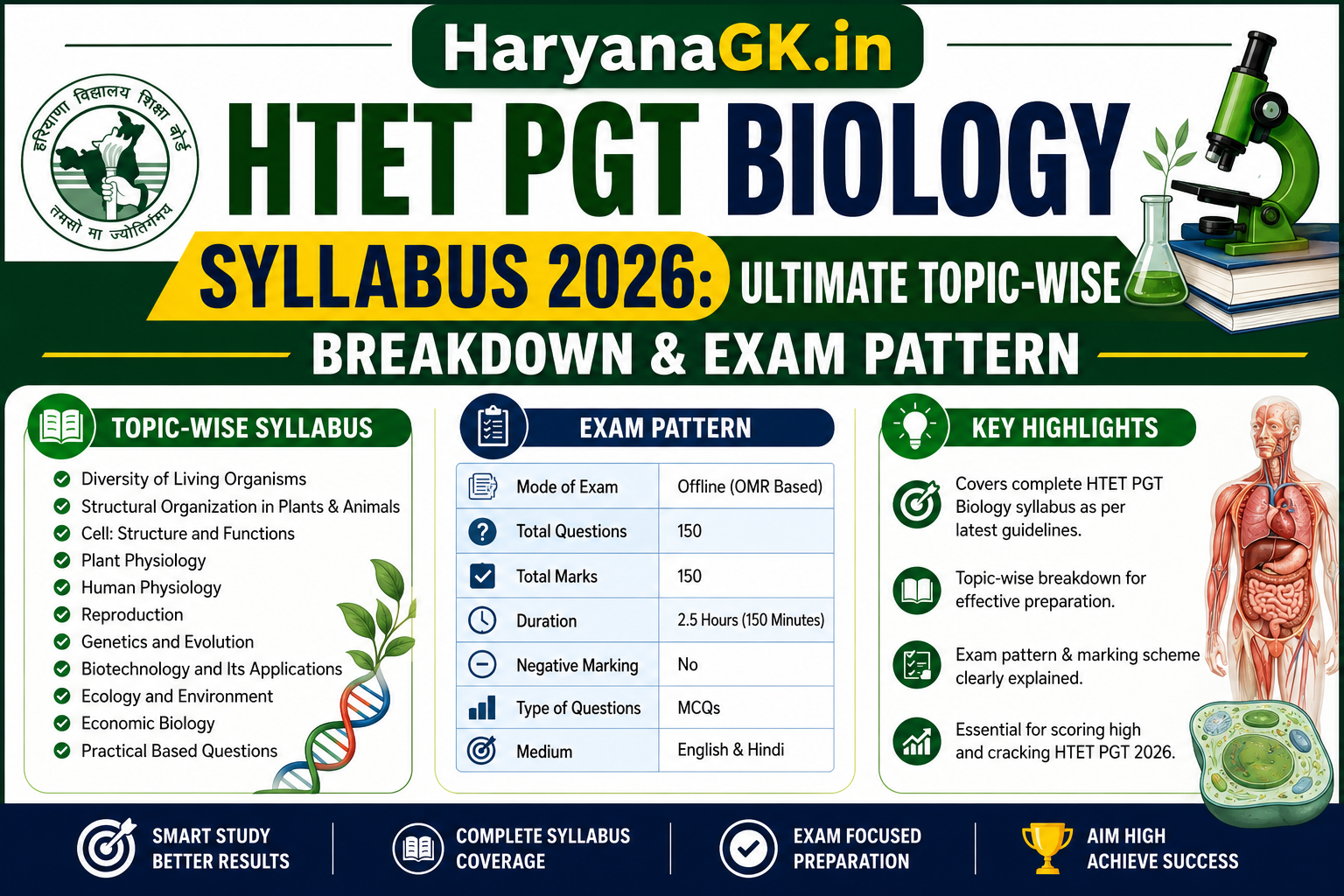
HTET PGT Biology Syllabus 2026: Full Topic-Wise Breakdown and Exam Pattern
If you’re preparing for HTET PGT Biology, you already know the subject rewards a particular kind of studying. It isn’t one you can cram the night before — cell biology, human physiology, genetics, ecology and biotechnology all lean on the same core vocabulary, and that vocabulary only sticks if you go over it in rounds rather than a single read-through. Candidates who clear this paper comfortably are almost always the ones who treat revision as a cycle, not a one-time event.
This guide walks through the exact HTET PGT Biology syllabus 2026 as notified by the Board of School Education Haryana (BSEH) — the 60 marks of core Biology, the 90 marks of common papers every Level-3 candidate sits for, and the overall exam pattern for the year. As per BSEH’s latest notification, the next HTET exam (PRT, TGT and PGT together) is scheduled for 21–22 November 2026 — always confirm the exact date on bseh.org.in closer to the exam, since boards do occasionally revise schedules. Keep it open as a reference while you plan your revision. Download complete HTET Syllabus 2026 from here for HTET 2026 exam paper.
HTET PGT Biology Exam Pattern 2026
Here’s how those 150 marks are split:
Before diving into topics, it helps to know exactly what you’re up against. The HTET PGT paper runs for 2.5 hours and consists of 150 objective-type questions worth one mark each — 150 marks total. There’s no negative marking on this paper, which changes your test-day strategy: an unanswered question and a wrong answer cost you exactly the same, so there’s no real reason to leave anything blank. So download HTET PGT Biology Syllabus 2026 for upcoming HTET 2026 Exam Paper.
- Child Development and Pedagogy — 30 questions, 30 marks
- Languages (Hindi: 15, English: 15) — 30 questions, 30 marks
- General Studies (Quantitative Aptitude, Reasoning, Haryana GK) — 30 questions, 30 marks
- Core Subject – Biology — 60 questions, 60 marks
Total — 150 questions, 150 marks, 2.5 hours, no negative marking of HTET 2026 Exam Paper.
With the format out of the way, here’s the syllabus itself, section by section.
Part I: Common Papers (90 Marks)
Every candidate appearing for HTET Level-3, regardless of subject, answers the same 90 marks worth of common papers. In a field where most candidates know their core subject reasonably well, it’s often this common section — not the specialization — where ranks are actually decided.
1. Child Development and Pedagogy (30 Marks)
This part checks how well you understand educational psychology as it plays out in a senior secondary classroom. HTET 2026 will also ask 30 questions related to Child Development and Pedagogy questions.
- Child development: the concept of development and its link to learning, principles governing how children develop, the roles heredity and environment play, and how socialization happens through teachers, parents and peers.
- Major theorists: Piaget, Kohlberg and Vygotsky and the critical lenses applied to their work; Freud’s theory of psychosexual development; Erikson’s psychosocial stages; Bandura’s social learning theory.
- Intelligence and educational thought: child-centred and progressive education, critiques of how intelligence is defined, the idea of multiple intelligences, the relationship between language and thought, and gender viewed as a social construct along with its effect on classroom practice.
- Individual differences: recognizing how language, caste, gender, community and religion shape learner diversity.
- Assessment: the difference between assessment of learning and assessment for learning, school-based assessment, Continuous and Comprehensive Evaluation (CCE), and how to frame questions that gauge readiness, build critical thinking, and measure genuine achievement.
- Inclusive education: teaching children with special needs, learners from disadvantaged or deprived backgrounds, students with learning difficulties or impairments, and gifted or specially-abled learners.
- Learning and pedagogy: how children actually think and learn (and why they sometimes don’t), the basic mechanics of teaching, learning as a social process, viewing the child as an active problem-solver, treating errors as part of learning rather than failures, and the roles emotion, motivation and environment play in how a student absorbs material.
2. Languages (30 Marks)
The language component is split evenly — 15 marks for Hindi, 15 for English. All HTET 2026 will ask 30 questions related to languages 15 questions of English Language and 15 questions of Hindi Language.
- Hindi (15 marks): an unseen passage — prose, drama or poetry — with questions testing comprehension, inference, grammar and verbal ability, plus pedagogy topics covering how language is learned and acquired, principles of teaching it, the importance of listening and speaking, a critical look at how grammar is taught, the challenges of teaching in a linguistically diverse classroom, common language difficulties and disorders, and appropriate teaching-learning materials.
- English (15 marks): one unseen prose passage (this could be discursive, literary, narrative or scientific in style) tested for comprehension, grammar and verbal ability, paired with the same pedagogy themes as above plus questions on textbooks, multimedia resources and materials suited to multilingual classrooms.
3. General Studies (30 Marks)
A three-way split covering aptitude, reasoning and awareness of the state you’ll be teaching in.
- Quantitative Aptitude (10 marks): whole numbers, fractions and decimals, percentages, profit and loss, ratio and proportion, time and work, averages, elementary algebra, geometry of triangles and circles, basic trigonometry, and reading data from pie charts and histograms.
- Reasoning Ability (10 marks): verbal and non-verbal reasoning, analogies, spatial visualization, coding-decoding, syllogisms, Venn diagrams, figure folding and unfolding, embedded figures, and questions on social and emotional intelligence.
- Haryana GK and Current Awareness (10 marks): the state’s history, geography, civics, environment, regional culture, art and traditions, current affairs, and its active welfare schemes.
Part II: Core Subject – Biology (60 Marks) – HTET PGT Biology
This section draws from the Class 9 to 12 Biology curriculum as prescribed by Haryana’s Education Department — but don’t mistake “familiar” for “easy.” The Board tests these same topics at a depth closer to post-graduate level, so plan to go beyond what a Class 12 exam would ask.
A) Cell Biology, Plant Diversity & Plant Physiology
- The cell as the fundamental unit of life; biomolecules; the cell cycle and cell division
- Plant tissues
- Diversity in the living world — classification systems, the plant kingdom, and the economic importance of plants
- Structural organization in plants — morphology and anatomy of flowering plants, sexual and asexual reproduction, life processes, movement and coordination, and seed germination/dormancy
- Plant physiology — transport mechanisms, mineral nutrition, photosynthesis, respiration, and plant growth and development
B) Animal Life, Human Physiology & Human Welfare
- Animal tissues, the animal kingdom, and structural organisation in animals
- Animal reproduction and development; human reproduction and reproductive health; economic zoology
- Human physiology — digestion and absorption, breathing and gas exchange, body fluids and circulation, excretion, locomotion and movement, and neural and chemical coordination
- Biology in human welfare — types and causes of disease, treatment and prevention, strategies to improve food production, and the role microbes play in human welfare
- Food production — improving food resources and animal husbandry
C) Ecology, Genetics, Evolution & Biotechnology
- Ecology — organisms and populations, ecosystems, pollution, biogeochemical cycles, biodiversity, conservation, resource management and environmental issues
- Genetics and evolution — principles of inheritance and variation, the molecular basis of inheritance, and evolutionary theory
- Biotechnology — its underlying principles, processes, and real-world applications
Subject-Related Pedagogy
The core paper doesn’t stop at content — it also tests how you’d actually teach Biology. Expect questions on teaching strategies and methods, instructional tools and aids, how curriculum gets translated into the classroom, practical and activity-based learning approaches, and assessment techniques suited to senior secondary students.
How to Prepare for HTET PGT Biology 2026
A few pointers, in the order they’ll pay off:
1. Lock down the common 90 marks first. These questions barely change year to year, which makes them the fastest, most predictable marks on the paper.
2. Move through the core syllabus in order — A, then B, then C. It roughly mirrors how the topics build across Class 9-10, Class 11 and Class 12, so this sequence tends to feel the most natural.
3. Start with NCERT and Haryana Board textbooks, then layer in post-graduate reference material once the basics are solid — that’s where the extra depth the exam demands comes from.
4. Work through previous years’ HTET Level-3 papers. They will get you used to how questions are phrased and how tight the time really feels.
5. Practice full-length attempts within the 2.5-hour window. Since there’s no negative marking, your goal in practice should be answering all 150 questions, not just the ones you’re sure about.
HTET PGT Computer Science Syllabus 2026
Where to Verify the Official Syllabus
Always cross-check this breakdown against the Board’s own notification before finalizing your study plan — syllabi do get revised, and the official source is the final word. The HTET PGT Biology syllabus is issued by the Board of School Education Haryana:
– Official BSEH website: [bseh.org.in](https://www.bseh.org.in)
– [HTET 2025 Information Bulletin (PDF)](https://htet.eapplynow.com/HTET25_Info_Bulletin.pdf)
If you’re preparing for a different Level-3 subject, similar syllabus guides are available for Physics, Chemistry, Mathematics, Commerce, Economics, English and Computer Science.
Frequently Asked Questions
Is there negative marking in HTET PGT Biology?
No. HTET does not deduct marks for wrong answers, so it’s worth attempting every question rather than leaving any blank.
How many questions come from Biology itself versus the common papers?
Out of 150 total questions, 60 are from core Biology and the remaining 90 are split across Child Development and Pedagogy, Languages, and General Studies — 30 each.
What level of difficulty should I expect in the Biology section?
The topics are drawn from the Class 9-12 syllabus, but questions are typically framed at a depth closer to graduate or post-graduate level, so surface-level familiarity with NCERT usually isn’t enough on its own.
How long is the HTET PGT exam?
The entire paper — all 150 questions across all sections — must be completed in 2.5 hours.
This page gets updated whenever BSEH revises the official syllabus or issues a fresh notification, so it’s worth bookmarking and checking back closer to your exam date.