The HSSC Scientific Assistants/Analysts Syllabus 2026 covers Group 25 recruitment for Scientific Assistants/Analysts posts under the Haryana Staff Selection Commission. This HSSC Scientific Assistants/Analyst Syllabus guide breaks down the exam pattern and the full subject-wise topic list, straight from the official syllabus published at hssc.gov.in, so you know exactly what to study before you open a single PDF.
HSSC Scientific Assistants / Analyst Syllabus Exam Pattern
Group 25 recruitment follows the standard two-stage HSSC process. Stage one is the Common Eligibility Test (CET) — 100 questions, 100 marks, roughly 90–105 minutes, covering general awareness, reasoning, Hindi, English and quantitative aptitude. Clearing the CET and the socio-economic criteria stage qualifies you for the group-specific written exam, where the HSSC Scientific Assistants / Analyst Syllabus below actually applies.
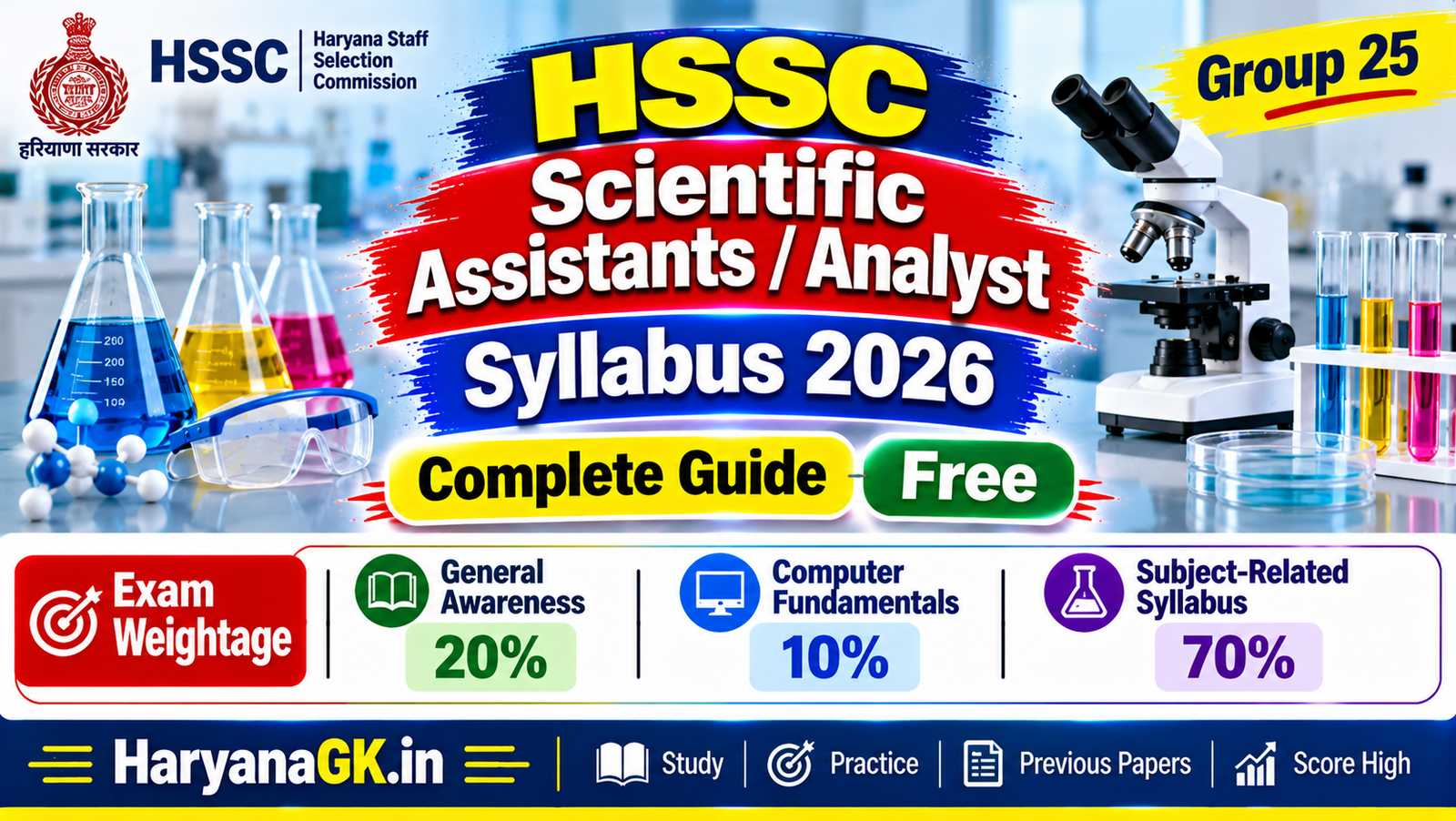
The HSSC Scientific Assistants/Analyst Syllabus for the written exam splits into weighted parts:
- General awareness, reasoning, mathematics, science, history (including Haryana-related history), current affairs, literature, geography, civics, environment, culture, etc.—20% weightage
- Computer terminology, fundamentals, word software, Excel software, PowerPoint, internet, web browsing, communication, emails, downloading and uploading data on websites, etc.—10% weightage
- Subject-related syllabus — 70% weightage
HSSC notes on the official document that this weightage is tentative and may vary, so treat it as a study-time guide rather than a locked question count.
HSSC Scientific Assistants / Analyst Syllabus 2026
Subject-Wise Complete Syllabus
The following is the detailed subject-specific syllabus for the HSSC Scientific Assistants / Analyst Examination 2026, organised subject-wise and topic-wise for easy reading and preparation.
1. Inorganic Chemistry
1.1 Atomic Structure
- de Broglie matter waves.
- Heisenberg’s uncertainty principle.
- Atomic orbitals and quantum numbers.
- Radial and angular wave functions.
- Normal and orthogonal wave functions.
- Significance of Ψ and Ψ².
- Probability distribution curves.
- Shapes of s, p, d and f orbitals.
- Aufbau principle and Pauli exclusion principle.
- Hund’s rule of maximum multiplicity.
- Electronic configuration of elements.
- Effective nuclear charge.
- Slater’s rules.
1.2 Periodic Table and Atomic Properties
- Classification of the periodic table into s, p, d and f blocks.
- Atomic and ionic radii.
- Ionisation energy.
- Electron affinity.
- Electronegativity:
- Definition.
- Methods of determination or evaluation.
- Periodic trends in s-block and p-block elements.
1.3 Covalent Bond
- Valence Bond Theory (Heitler-London and Pauling approaches).
- Limitations of Valence Bond Theory.
- Directional characteristics of covalent bonds.
- Types of hybridisation and shapes of simple inorganic molecules and ions:
- BeF₂, BF₃, CH₄, PF₅, SF₆, IF₇.
- SO₄²⁻, ClO₄⁻, NO₃⁻.
- Valence Shell Electron Pair Repulsion (VSEPR) Theory and its applications to:
- NH₃, H₃O⁺, SF₄, ClF₃, H₂O, SnCl₂.
- ClO₃⁻ and ICl₂⁻.
- Molecular Orbital Theory:
- Homonuclear diatomic molecules: N₂ and O₂.
- Heteronuclear diatomic molecules: CO and NO.
- Bond energy, bond angle and bond length.
- Dipole moments.
- Percentage ionic character from dipole moment and electronegativity difference.
1.4 Ionic Solids
- Ionic structures:
- NaCl.
- CsCl.
- ZnS (Zinc Blende).
- CaF₂.
- Size effects.
- Radius ratio rule and its limitations.
- Stoichiometric and non-stoichiometric defects in crystals.
- Born-Haber cycle.
- Solvation energy and its relationship with the solubility of ionic solids.
- Polarising power and polarisability of ions.
- Fajans’ rules.
1.5 Hydrogen Bonding and Van der Waals Forces
- Hydrogen bonding:
- Definition.
- Types.
- Effects of hydrogen bonding on the properties of substances.
- Applications.
- Brief discussion of various types of Van der Waals forces.
1.6 Metallic Bond and Semiconductors
- Metallic bond.
- Qualitative understanding of:
- Valence Bond Theory.
- Band theory of metallic bonding.
- Conductors, semiconductors and insulators.
- Semiconductors:
- Introduction.
- Types.
- Applications.
1.7 s-Block Elements
- Comparative study of s-block elements.
- Diagonal relationship.
- Salient features of:
- Hydrides.
- Oxides.
- Halides.
- Hydroxides.
- Methods of preparation excluded.
1.8 Chemistry of Noble Gases
- General physical properties.
- Low chemical reactivity.
- Chemistry of xenon.
- Structure and bonding in:
- Fluorides of xenon.
- Oxides of xenon.
- Oxyfluorides of xenon.
1.9 p-Block Elements
- Boron family (Group 13).
- Carbon family (Group 14).
- Nitrogen family (Group 15).
- Oxygen family (Group 16).
- Halogen family (Group 17).
1.10 Chemistry of d-Block Elements
1.11 Coordination Compounds
2. Physical Chemistry
2.1 Gaseous States
- Kinetic Molecular Theory of Gases.
- Maxwell’s distribution of velocities and energies (derivation excluded).
- Calculation of:
- Root mean square velocity.
- Average velocity.
- Most probable velocity.
- Collision diameter.
- Collision number.
- Collision frequency.
- Mean free path (derivations excluded).
- Deviation of real gases from ideal behaviour.
- Derivation of the Van der Waals equation of state.
- Applications of the Van der Waals equation.
- Calculation of Boyle’s temperature and compression factor.
2.2 Critical Phenomenon
- Critical temperature.
- Critical pressure.
- Critical volume and their determination.
- P-V isotherms of real gases.
- Continuity of states.
- Isotherms of the Van der Waals equation.
- Relationship between critical constants and Van der Waals constants.
- Critical compressibility factor.
- Law of corresponding states.
2.3 Liquid States
- Structure of liquids.
- Properties of liquids.
2.4 Solid State
- Classification of solids.
- Law of constancy of interfacial angles.
- Law of rational indices.
- Miller indices.
- Elementary ideas of symmetry and symmetry elements.
- Seven crystal systems.
- Fourteen Bravais lattices.
- X-ray diffraction.
- Bragg’s law.
2.5 Chemical Kinetics
- Rate of reaction.
- Rate equation and its types.
2.6 Electrochemistry
– Electrolytic conduction.
2.7 Laws of Thermodynamics
2.8 Chemical Equilibrium
2.9 Distribution Law
– Nernst distribution law.
3. Organic Chemistry
3.1 Structure and Bonding
- Localised chemical bond.
- Delocalised chemical bond.
3.2 Stereochemistry of Organic Compounds
- Concept of isomerism.
- Relative and absolute configuration.
- Sequence rules.
- R and S systems of nomenclature.
- Geometric isomerism.
3.3 Mechanism of Organic Reactions
3.4 Alkanes and Cycloalkanes
– IUPAC nomenclature of branched and unbranched alkanes.
3.5 Alkenes, Dienes and Alkynes
- Alkenes.
- Dienes.
- Alkynes.
- Chemical reactions of alkynes.
- Acidity of alkynes.
- Mechanism of electrophilic and nucleophilic addition reactions.
- Hydroboration-oxidation of alkynes.
3.6 Alkyl and Aryl Halides
3.7 Alcohols, Phenols and Epoxides
3.8 Carboxylic Acids and Acid Derivatives
3.9 Ultraviolet (UV) Absorption Spectroscopy
4. Classical Mechanics
4.1 Basic Concepts of Classical Mechanics
- Mechanics of single particles and systems of particles.
- Conservation law of:
- Linear momentum.
- Angular momentum.
- Mechanical energy.
- Conservation laws for a particle and a system of particles.
- Centre of mass and equation of motion.
- Constrained motion.
4.2 Generalised Notations
- Degrees of freedom.
- Generalised coordinates.
- Transformation equations.
- Generalised displacement.
- Generalised velocity.
- Generalised acceleration.
- Generalised momentum.
- Generalised force and potential.
4.3 Hamilton’s Variational Principle
- Hamilton’s variational principle.
- Lagrange’s equation of motion from Hamilton’s principle.
4.4 Applications of Classical Mechanics
- Linear harmonic oscillator.
- Simple pendulum.
- Atwood’s machine.
5. Electricity, Magnetism and Electromagnetic Theory
5.1 Vector Background and Electric Field
- Gradient of a scalar and its physical significance.
- Line, surface and volume integrals of a vector and their physical significance.
- Flux of a vector field.
- Divergence and curl of a vector and their physical significance.
- Gauss’s divergence theorem.
- Stoke’s theorem.
- Derivation of electric field (E) from potential as gradient.
- Derivation of Laplace and Poisson equations.
- Electric flux.
- Gauss’s law.
- Mechanical force of charged surface.
- Energy per unit volume.
5.2 Magnetism
- Magnetic induction.
- Magnetic flux.
- Solenoidal nature of the vector field of magnetic induction.
- Properties of magnetic fields.
- Electronic theory of:
- Diamagnetism.
- Paramagnetism.
- Domain theory of ferromagnetism (Langevin’s theory).
- Cycle of magnetisation.
- Hysteresis loop:
- Energy dissipation.
- Hysteresis loss.
- Importance of the hysteresis curve.
5.3 Electromagnetism
- Maxwell’s equations and their derivations.
- Displacement current.
- Vector and scalar potentials.
- Boundary conditions at the interface between two different media.
- Propagation of electromagnetic waves (basic idea, no derivation).
- Poynting vector.
- Poynting theorem.
5.4 A.C. Analysis
A.C. circuit analysis using complex variables:
- Capacitance and Resistance (CR).
- Resistance and Inductance (LR).
- Capacitance and Inductance (LC).
- Capacitance, Inductance and Resistance (LCR).
- Series and parallel resonance circuits.
- Quality factor (sharpness of resonance).
6. Semiconductor Devices
6.1 Semiconductors
- Energy bands in solids.
- Intrinsic and extrinsic semiconductors.
- Carrier mobility and electrical resistivity of semiconductors.
- Hall effect.
- p-n junction diode and its characteristics.
- Zener and avalanche breakdown.
- Zener diode.
- Zener diode as a voltage regulator.
- Light Emitting Diodes (LED).
- Photoconduction in semiconductors.
- Photodiode.
- Solar cell.
- p-n junction as a rectifier.
- Half-wave and full-wave rectifiers (with derivation).
6.2 Filters
- Series inductor filter.
- Shunt capacitance filter.
- L-section or choke filter.
- π-filter.
- R.C. filter circuits.
6.3 Transistors
- Junction transistors.
- Working of NPN and PNP transistors.
- Three configurations of transistors:
- Common Base (CB).
- Common Emitter (CE).
- Common Collector (CC).
- Characteristics of:
- Common Base configuration.
- Common Emitter configuration.
- Common Collector configuration.
- Constants of a transistor and their relationship.
- Advantages and disadvantages of CE configuration.
- D.C. load line.
- Transistor biasing.
- Various methods of transistor biasing and stabilisation.
6.4 Transistor Amplifiers
- Amplifiers.
- Classification of amplifiers.
- Common Base and Common Emitter amplifiers.
- Coupling of amplifiers.
- Various methods of coupling.
- Resistance-capacitance (RC) coupled amplifier:
- Two-stage RC coupled amplifier.
- Concept of bandwidth (no derivation).
- Feedback in amplifiers.
- Advantages of negative feedback.
- Emitter follower.
- Distortion in amplifiers.
6.5 Oscillators
- Oscillators.
- Principle of oscillation.
- Classification of oscillators.
- Condition for self-sustained oscillation.
- Barkhausen criterion for oscillation.
- Tuned collector common-emitter oscillator.
- Hartley oscillator.
6.6 Cathode Ray Oscilloscope (CRO)
– Principle and working of CRO.
7. Quantum and Laser Physics
7.1 Origin of Quantum Physics
- Overview of quantum physics.
- Scale of quantum physics.
- Boundary between classical and quantum phenomena.
- Photon.
- Photoelectric effect.
- Compton effect (theory and result).
- Franck-Hertz experiment.
- de Broglie hypothesis.
- Davisson-Germer experiment.
- G.P. Thomson experiment.
- Phase velocity and group velocity and their relationship.
7.2 Heisenberg’s Uncertainty Principle
- Time-energy uncertainty.
- Angular momentum uncertainty.
- Position uncertainty.
- Uncertainty principle from de Broglie waves (wave-particle duality).
- Gamma-ray microscope.
- Electron diffraction from a slit.
7.3 Schrödinger Wave Equation
- Derivation of one-dimensional time-dependent Schrödinger wave equation:
- Subject to force.
- Free particle.
- Time-independent Schrödinger wave equation.
- Eigenvalues and eigenfunctions.
- Wave functions and their significance.
- Orthogonality and normalisation of functions.
- Concept of observer and operator.
- Expectation values of dynamical quantities.
- Probability current density.
7.4 Applications of the Schrödinger Wave Equation
(i) Free Particle in a One-Dimensional Box
- Solution of Schrödinger wave equation.
- Eigenfunctions and eigenvalues.
- Quantisation of energy and momentum.
- Nodes and antinodes.
- Zero-point energy.
(ii) One-Dimensional Step Potential (E > V₀)
- Reflection coefficient.
- Transmission coefficient.
(iii) One-Dimensional Step Potential (E < V₀)
– Penetration depth calculation.
(iv) One-Dimensional Potential Barrier (E > V₀)
- Reflection coefficient.
- Transmission coefficient.
(v) One-Dimensional Potential Barrier (E < V₀)
- Penetration coefficient.
- Quantum tunnelling.
(vi) Harmonic Oscillator
- Solution of Schrödinger equation.
- Quantisation of energy.
- Zero-point energy.
- Wave equation for ground state and excited states.
7.5 Laser Physics
- Absorption and emission of radiation.
- Main features of a laser:
- Directionality.
- High intensity.
- High degree of coherence.
- Spatial and temporal coherence.
- Einstein’s coefficients and possibility of amplification.
- Momentum transfer.
- Lifetime of a level.
- Kinetics of optical absorption:
- Two-level rate equation.
- Three-level rate equation.
- Füchtbauer-Ladenburg formula.
- Population inversion: a necessary condition for light amplification.
- Resonance cavity.
- Laser pumping.
- Threshold condition for laser emission.
- Line broadening mechanisms:
- Homogeneous broadening.
- Inhomogeneous broadening.
- Natural broadening.
- Collision broadening.
- Doppler broadening.
7.6 Types of Lasers
- He-Ne laser:
- Principle.
- Construction.
- Working.
- Ruby laser:
- Principle.
- Construction.
- Working.
- Optical properties of semiconductors.
- Semiconductor laser:
- Principle.
- Construction.
- Working.
- Applications of lasers in medicine and industry.
8. Solid State and Nano Physics
8.1 Crystal Structure
- Crystalline and glassy forms.
- Liquid crystals.
- Crystal structure.
- Periodicity.
- Lattice and basis.
- Crystal translational vectors and axes.
- Unit cell and primitive cell.
- Wigner-Seitz primitive cell.
- Symmetry operations for a two-dimensional crystal.
- Bravais lattices in two and three dimensions.
- Crystal planes and Miller indices.
- Interplanar spacing.
- Crystal structures of:
- Zinc sulphide.
- Sodium chloride.
- Diamond.
8.2 X-Ray Diffraction
- X-ray diffraction.
- Bragg’s law.
- Experimental X-ray diffraction methods.
- K-space and reciprocal lattice.
- Physical significance of reciprocal lattice.
- Reciprocal lattice vectors.
- Reciprocal lattice corresponding to:
- Simple cubic lattice.
- Body-centred cubic (BCC) lattice.
- Face-centred cubic (FCC) lattice.
8.3 Superconductivity
- Historical introduction.
- Survey of superconductivity.
- Superconducting systems.
- High-Tc superconductors.
- Isotope effect.
- Critical magnetic field.
- Meissner effect.
- London theory.
- Pippard’s equation.
- Classification of superconductors:
- Type I superconductors.
- Type II superconductors.
- BCS theory of superconductivity.
- Flux quantisation.
- Josephson effect:
- AC Josephson effect.
- DC Josephson effect.
- Practical applications of superconductivity and their limitations.
- Power applications of superconductors.
8.4 Introduction to Nano Physics
- Definition of nanophysics.
- Length scale.
- Importance of nanoscale and nanotechnology.
- History of nanotechnology.
- Benefits and challenges in molecular manufacturing.
- Molecular assembler concept.
- Understanding advanced capabilities.
- Vision and objectives of nanotechnology.
8.5 Applications of Nanotechnology
– Nanotechnology in different fields:
- Automobile.
- Electronics.
- Nanobiotechnology.
- Materials.
- Medicine.
Note: This is a structured and formatted version of the syllabus you provided. The subject matter and topic coverage have been retained, with spelling, terminology, chemical notation and headings standardised where appropriate. It is not an independently verified HSSC notification.
| HTET PRT Syllabus 2026 | |
| Subject | Syllabus Link |
| PRT Syllabus (All Subjects) | View Syllabus  |
| HTET TGT Syllabus 2026 (Subject-Wise) | |
| Subject | Syllabus Link |
| Art | View Syllabus |
| English | View Syllabus |
| Hindi | View Syllabus |
| Home Science | View Syllabus |
| Mathematics | View Syllabus |
| Music | View Syllabus |
| Physical Education | View Syllabus |
| Punjabi | View Syllabus |
| Sanskrit | View Syllabus |
| Science | View Syllabus |
| Social Studies | View Syllabus |
| Urdu | View Syllabus |
| HTET PGT Syllabus 2026 (Subject-Wise) | |
| Subject | Syllabus Link |
| Biology | View Syllabus |
| Chemistry | View Syllabus |
| Commerce | View Syllabus |
| Economics | View Syllabus |
| English | View Syllabus |
| Fine Arts | View Syllabus |
| Geography | View Syllabus |
| Hindi | View Syllabus |
| History | View Syllabus |
| Home Science | View Syllabus |
| Mathematics | View Syllabus |
| Music | View Syllabus |
| Physical Education | View Syllabus |
| Political Science | View Syllabus |
| Psychology | View Syllabus |
| Punjabi | View Syllabus |
| Sanskrit | View Syllabus |
| Sociology | View Syllabus |
| Urdu | View Syllabus |
How to Prepare for the HSSC Scientific Assistants / Analyst Syllabus Exam
Start with the subject-specific block of the HSSC Scientific Assistants/Analyst Syllabus first — it carries the heaviest weightage and is where real differentiation between candidates happens, since general awareness and computer knowledge sections overlap with every other HSSC group. Work through each topic area systematically, and revisit the subject list above every week to ensure nothing slips through before exam day.
Don’t skip the common portion either. Haryana-specific general awareness and basic computer knowledge are easy marks that candidates often under-prepare because they’re focused on the technical syllabus.
Frequently Asked Questions: HSSC Scientific Assistants / Analyst Syllabus
What is the HSSC Scientific Assistants/Analyst Syllabus for Group 25?
The HSSC Scientific Assistants/Analyst Syllabus covers the weighted sections listed above, compiled directly from the official document published by the Haryana Staff Selection Commission.
Is the HSSC Scientific Assistants/Analyst Syllabus the same every year?
HSSC updates its syllabus documents periodically, and the weightage listed against each section is explicitly marked ‘tentative’ by HSSC. Always check hssc.gov.in/examsyllabus for the latest version before you finalise your preparation.
Do I need to clear CET before attempting this exam?
Yes. HSSC recruitment follows the standard two-stage process: you first clear the Common Eligibility Test (CET), then sit for the group-specific written exam that follows the HSSC Scientific Assistants/Analyst Syllabus covered in this guide.
Official Notification and Source
This HSSC Scientific Assistants/Analyst Syllabus is compiled directly from the official Group 25 – Scientific Assistants/Analyst Syllabus published by the Haryana Staff Selection Commission. Always cross-check the latest version and any amendments against the official document before you finalise your preparation.
Download the official syllabus PDF and check current recruitment notices at hssc.gov.in/examsyllabus.
Explore Other HSSC Group Syllabus Guides
This HSSC Scientific Assistants/Analyst Syllabus guide is part of a growing set of subject-wise syllabus posts for every HSSC group. Browse the full set on the HSSC Syllabus tag page or the Syllabus category. For the full HSSC recruitment process, CET details and exam pattern, see the Haryana HSSC guide.