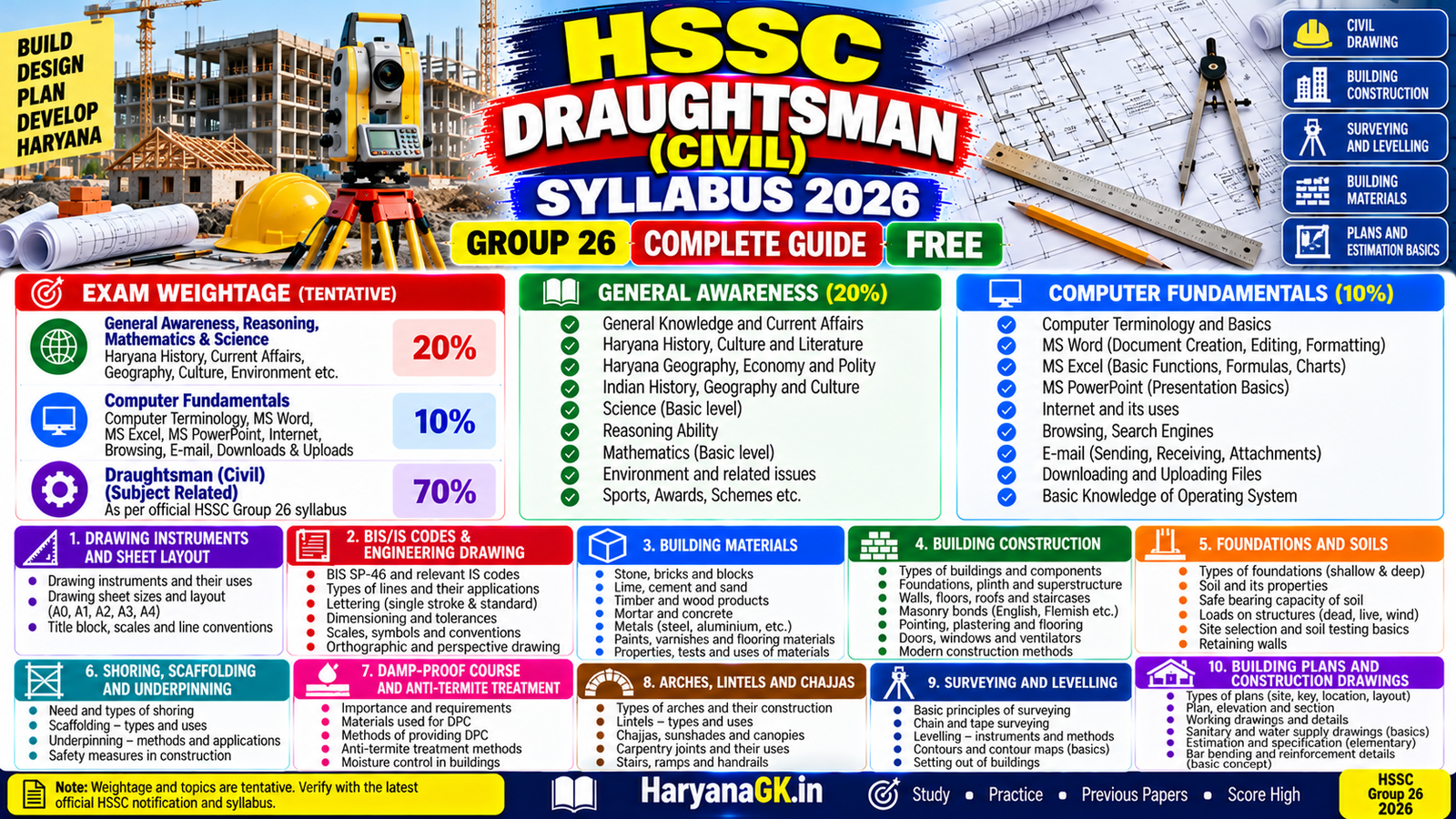
The HSSC Draughtsman (Civil) Syllabus 2026 covers Group 26 recruitment for Draughtsman (Civil) posts under the Haryana Staff Selection Commission. This HSSC Draughtsman (Civil) Syllabus guide breaks down the exam pattern and the full subject-wise topic list, straight from the official syllabus published at hssc.gov.in, so you know exactly what to study before you open a single PDF.
HSSC Draughtsman (Civil) Syllabus Exam Pattern
Group 26 recruitment follows the standard two-stage HSSC process. Stage one is the Common Eligibility Test (CET) — 100 questions, 100 marks, roughly 90–105 minutes, covering general awareness, reasoning, Hindi, English and quantitative aptitude. Clearing CET plus the socio-economic criteria stage qualifies you for the group-specific written exam, which is where the HSSC Draughtsman (Civil) Syllabus below actually applies.
| HTET Previous Year Exam Papers |
HTET Previous Year Sample Exam Papers 2024 – 2014  |
The HSSC Draughtsman (Civil) Syllabus for the written exam splits into weighted parts:
- General awareness, reasoning, mathematics, science, history (including Haryana-related history), current affairs, literature, geography, civics, environment, culture, etc.—20% weightage
- Computer terminology, fundamentals, word software, Excel software, PowerPoint, internet, web browsing, communication, emails, downloading and uploading data on websites, etc.—10% weightage
- Subject-related syllabus — 70% weightage
HSSC notes on the official document that this weightage is tentative and may vary, so treat it as a study-time guide rather than a locked question count.
हरियाणा जीके – चरखी दादरी जिला
HSSC Draughtsman (Civil) Syllabus 2026 (Subject-Wise)
The subject-specific block of the HSSC Draughtsman (Civil) Syllabus spans the following areas. Here is the complete breakdown.
Importance of safety and general precautions observed in the industry/shop floor and working of the Industrial Training Institute system, including store procedures. Soft Skills: its importance and job area after completion of training, Introduction of first aid, Introduction of PPEs, introduction to the 5S concept & its application, response to emergencies (e.g., power failure, fire alarm, etc.). Familiarisation & information about the rules and regulations of the Institute and Trade, the list of the instruments, equipment and materials to be used during training. Importance of B.I.S. Introduction of Code for Practice of Architectural and Building Drawings (IS: 962-1989, SP-46: 2003), Layout of Drawing. Lines, lettering, dimensioning, and knowledge of different types of scales.
Principle of R.F. Materials: Stones: characteristics, types & uses; bricks – manufacturing, characteristics of good bricks, types, uses and hollow bricks; lime – characteristics, types, manufacturing & its uses; pozzolanic: characteristics, types & uses, Cement: – Manufacturing, characteristics, types, uses and tests of good cement, Different types of projection views: orthographic, isometric, oblique and perspective. Building materials: – Sand: – characteristics, types & uses – Clay Products: – types, earthenware, stoneware, porcelain, terracotta, glazing,
Mortar & Concrete: Types, uses, preparation, proportion, admixtures and applications Timber: Types, structure, disease & defects, characteristics, seasoning, preservation and utility, alternative material to timber, plywood, blockboard, particleboard, fireproof reinforced plastic (FRP), medium-density fireboard (MDF), etc. Tar, bitumen, and asphalt: properties, applications, and uses, Protective materials: – Paints: – characteristics, types, uses, Varnishes: – characteristics and uses, Metal: – characteristic, types, uses, Plastics: characteristics, types, uses
Building Construction
Sequence of construction of a building, Name of different parts of the building, Stone masonry: Terms, use and classification, Principle of construction, composite masonry, Strength of walls, strength of masonry, brick masonry – principles of construction of bonds, tools and equipment used. Foundation: – Purpose of foundation, causes of failure of foundation, bearing capacity of soils, dead and live loads, Examination of ground, Types of foundation, drawing of footing, foundation setting out of building on ground excavation, Simple machine foundation Types of shoring and scaffolding in detail, Types of Underpinning and Timbering in Detail
Treatments of building structures: – DPC sources and effects of dampness, Method of prevention of dampness in building: Damp-proofing materials – properties, function and types. Anti-termite treatment – objectives, uses and applications.
Arches: – Technical terms-types, centring Lintel: -types, wooden, brick, stone, steel & RCC. Chajjahs – characteristics, centring & shuttering carpentry joints: – terms, classification of joints, uses, types of fixtures, fastenings. Doors – Parts, Location, standard sizes, types
Windows-type, ventilator-purpose-type
Electrical Wiring: -Safety precautions and elementary first aid, artificial respiration and treatment of electrical shock, elementary electricity, general ideas of supply system, wireman’s tools kit, wiring materials, electrical fittings, and system of wiring. Wiring and installation for domestic lighting. Floors – Ground floor & upper floor – Types, flooring – materials used,
Types of stairs: – Terms, requirements, planning and designing of stairs and details of construction. Basic concept of lift and escalator roofs & roof coverings: purposes, elements, types, flared, pitched, truss-king post, queen post, mansard, bel-fast, steel, composite. Roof & coverings – objectives, types & uses. Surveying: – Introduction, history and principles of chain survey, instrument employed, use, care, maintenance and common terms, classification, accuracy, types, main divisions (plane & geodetic), chaining, speed in field and office work, knowledge of Mouza map,
Compass survey: – Instrument and its setting up, bearing and each included angle of close traverse, local attraction, magnetic declination and its true bearing, and precautions in using a prismatic compass. Plane table survey: – Instrument used in plane table survey, care and maintenance of plane table Levelling: – Auto level, dumpy level, tilting level – introduction, definition, principle of levelling, levelling staff, its graduation & types, minimum equipment required, types, component/part and function, temporary and permanent, adjustment, procedure in setting up, level & horizontal surface, datum benchmark, focusing & parallax, deduction of levels/reduced level, types of levelling, application to chain and levelling instrument to building construction.
Contouring: – Definition, Characteristics, Methods, Direct and Indirect Methods, Interpolation of Contour, Contour Gradient, Uses of Contour Plan and Map, Knowledge on Road Project, Theodolite Survey: – Introduction, Types of Theodolites, Uses, Methods of Plotting, Transit Vernier Theodolite, Terms of transit theodolite, Fundamental line of theodolite, adjustment of theodolite, Checks, adjustment of errors, Open and closed traverse and their application to engineering problems, Vernier scale types, Measurement of horizontal angle, Measurement of vertical angle, adjustment of a close traverse, Problems in transit, theodolite departure, latitude, northing and easting
WORKSHOP CALCULATION & SCIENCE
Unit, Fractions, Classification of Unit System, Fundamental and Derived Units (F.P.S., C.G.S., M.K.S. and SI Units), Measurement Units and Conversion, Factors, HCF, LCM and Problems Fractions – addition, subtraction, multiplication & division; decimal fractions – addition, subtraction, multiplication & division; solving problems; square root; ratio and proportions; percentage; square and square root; simple problems using a calculator; applications of the Pythagoras theorem and related problems, Ratio and proportion, Ratio and proportion – direct and indirect proportions, percentage, percentage – changing percentage to decimal and fraction,
Centre of gravity – Centre of gravity and its practical application, Area of cut-out regular surfaces and area of irregular surfaces, Area of cut-out regular surfaces – circle, segment and sector of circle, Related problems of the area of cut-out regular surfaces – circle, segment and sector of circle Area of irregular surfaces and application related to shop problems, Algebra – Addition, subtraction, multiplication & division,
Theory of indices, algebraic formula, related problems, elasticity – elastic, plastic materials, stress, strain and their units, and Young’s modulus – elasticity – ultimate stress and working stress, Profit and loss – Simple problems on profit & loss, simple and compound interest, Estimation and costing – Simple estimation of the requirement of material, etc., as applicable to the trade, Estimation and costing – Problems on estimation and costing
Material Science
Types of metals, types of ferrous and nonferrous metals, physical and mechanical properties of metals, introduction of iron and cast iron, difference between iron & steel, alloy steel and carbon steel, Properties of timber: mass, weight, volume and density; mass, volume, density, weight and specific gravity, Heat & Temperature and Pressure, Concept of heat and temperature, effects of heat, difference between heat and temperature, boiling point & melting point of different metals and non-metals Scales of temperature, Celsius, Fahrenheit, kelvin and conversion, between scales of temperature, Heat & Temperature – Temperature measuring instruments, types of thermometer, pyrometer and transmission of heat – Conduction, convection and radiation Coefficient of linear expansion and related problems.
Mensuration Area and perimeter of square, rectangle and parallelogram, area and perimeter of triangles, area and perimeter of circle, semi-circle, circular ring, sector of circle, hexagon and ellipse, Surface area and volume of solids – cube, cuboid, cylinder, sphere, and hollow cylinder, Finding the lateral surface area, total surface area and capacity in litres of hexagonal, conical and cylindrical shaped vessels Trigonometry: Measurement of angles, Trigonometrical ratios, Trigonometrical tables, Application in calculating height and distance (Simple applications)
Building
Principle of planning, objectives & importance, function & responsibility, orientation, local building bye-laws as per ISI code, layout plan & key plan, Submitted in the composition of drawing, Provisions for safety, Requirement of green belt and land, Computer-aided drafting: -Operating system,Hardware& software, introduction of CAD, its graphical user interface, method of installation, basic commands of CAD, knowledge of tool icons and set of toolbars, Knowledge of shortcut keyboard commands,
Building Planning: -Economy & orientation, provision for lighting and ventilation, Provision for drainage and sanitation, Types of building, planning & designing of residential, public and commercial buildings, Prefabricated Structure: – Preparation, method of construction, assembling, advantages & disadvantages, 3D modelling concept in CAD, 3D coordinate systems to aid in the construction of 3D objects, Knowledge of shortcut keyboard commands, parks & playgrounds- Types of recreation, landscaping, etc.
Concepts of design of earthquake-resisting buildings: requirements for resistance, safety, flexible building elements, special requirements, base, isolation techniques, and reinforced cement concrete structure: – Introduction to RCC uses, materials – proportions, formwork, bar bending details as per IS Code, reinforced brickwork, materials used for
RCC: – Construction, Selection of materials – coarse aggregate, fine aggregate, cement water and reinforcement, Characteristics, Method of mixing concrete – machine mixing and hand mixing, Slump test, Structure – columns, beams, slabs – one-way slab & two-way slab, Innovative construction, Safety against earthquake, grade of cement, steel, behaviour and test, bar-bending schedule, Retaining wall, R.C.C.-framed structure.
Steel structures: – Concrete forms of steel sections, structural fasteners, joints, tension & compression members, classification, fabrication, construction details, House drainage of building: – Introduction, terms used in PHE, systems of sanitation, system of house drainage, plumbing, sanitary fittings, etc. Types of sewer appurtenance, systems of plumbing, manholes & septic tanks, water treatment plants, sewerage treatment plants
Roads
Introduction, History of highway development, General principles of alignment, Classification and construction of different types of roads, component parts, road curves, gradient, Curves types, designation of curves, Setting out a simple curve by successive bisection from long chords, simple curve by offsets from long chords, Road drainage system
Bridges & Culvert
Introduction to bridges, Components of the bridge, Classification of culverts, IRC loading, selection of type and location, Factors governing the ideal site, Alignment of bridge, foundation – selection, caisson, coffer dam – types, types of superstructure, substructure – piers, abutments, wing walls, Classification of bridge. Tunnels – rules used for the sizes of different members
Irrigation Engineering
Terms used in irrigation and hydrology, like duty, delta, base period, intensity of irrigation, hydrograph, peak flow, runoff, catchment area, CCA, corps like, rabi, kharif, etc. Storage, diversion headwork – characteristics and types, reservoir – types of reservoirs, i.e., single-purpose and multipurpose, area, capacity, and curves of reservoir, dams, weir & barrage types, hydroelectric projects like forebay, penstock, and turbines,
Powerhouse, etc. Canals – classification and distribution system, canal structures, types of cross drainage, works like aqueduct, super passage, syphon, level crossing, inlet and outlet, etc. Estimating and Costing: – Introduction, purpose and common techniques, drawing of construction, measurement techniques, Estimate-necessity, importance, types, approximate and detailed estimate – main and sub estimates, revised, supplementary, maintenance/repair estimate-taking off quantities – method, Rate analysis of typical items and their specifications, labour and materials, government schedule of rate, estimating of irregular boundaries by trapezoid and Simpson’s formula,
Total Station
Introduction, components, parts, accessories used, characteristics, features, advantages and disadvantages, principle of EMD, Working and need, setting and measurement, electronic, display & data reading, rectangular and polar coordinate systems, terminology of open and closed traverse
GPS (Global Positioning System)
Introduction of GPS system, coordinate and time system, satellite and conversional geodetic system, GPS. Signal, code, and biases; role of TRANSIT in GPS development; GPS segment organisation; GPS survey methods. Basic geodetic coordinates, Ground support equipment, signals, Tracking devices & system, time measurement and GPS timing
| HTET PRT Syllabus 2026 | |
| Subject | Syllabus Link |
| PRT Syllabus (All Subjects) | View Syllabus  |
| HTET TGT Syllabus 2026 (Subject-Wise) | |
| Subject | Syllabus Link |
| Art | View Syllabus |
| English | View Syllabus |
| Hindi | View Syllabus |
| Home Science | View Syllabus |
| Mathematics | View Syllabus |
| Music | View Syllabus |
| Physical Education | View Syllabus |
| Punjabi | View Syllabus |
| Sanskrit | View Syllabus |
| Science | View Syllabus |
| Social Studies | View Syllabus |
| Urdu | View Syllabus |
| HTET PGT Syllabus 2026 (Subject-Wise) | |
| Subject | Syllabus Link |
| Biology | View Syllabus |
| Chemistry | View Syllabus |
| Commerce | View Syllabus |
| Economics | View Syllabus |
| English | View Syllabus |
| Fine Arts | View Syllabus |
| Geography | View Syllabus |
| Hindi | View Syllabus |
| History | View Syllabus |
| Home Science | View Syllabus |
| Mathematics | View Syllabus |
| Music | View Syllabus |
| Physical Education | View Syllabus |
| Political Science | View Syllabus |
| Psychology | View Syllabus |
| Punjabi | View Syllabus |
| Sanskrit | View Syllabus |
| Sociology | View Syllabus |
| Urdu | View Syllabus |
आधिकारिक स्रोत
इस पेज का सिलेबस हरियाणा कर्मचारी चयन आयोग (HSSC) के आधिकारिक दस्तावेज़ से लिया गया है। ताज़ा संस्करण और भर्ती सूचनाएँ hssc.gov.in/examsyllabus पर देखें।
दूसरे सभी HSSC पदों के सिलेबस और भर्ती प्रक्रिया हमारे HSSC गाइड पेज पर एक जगह दिए गए हैं।