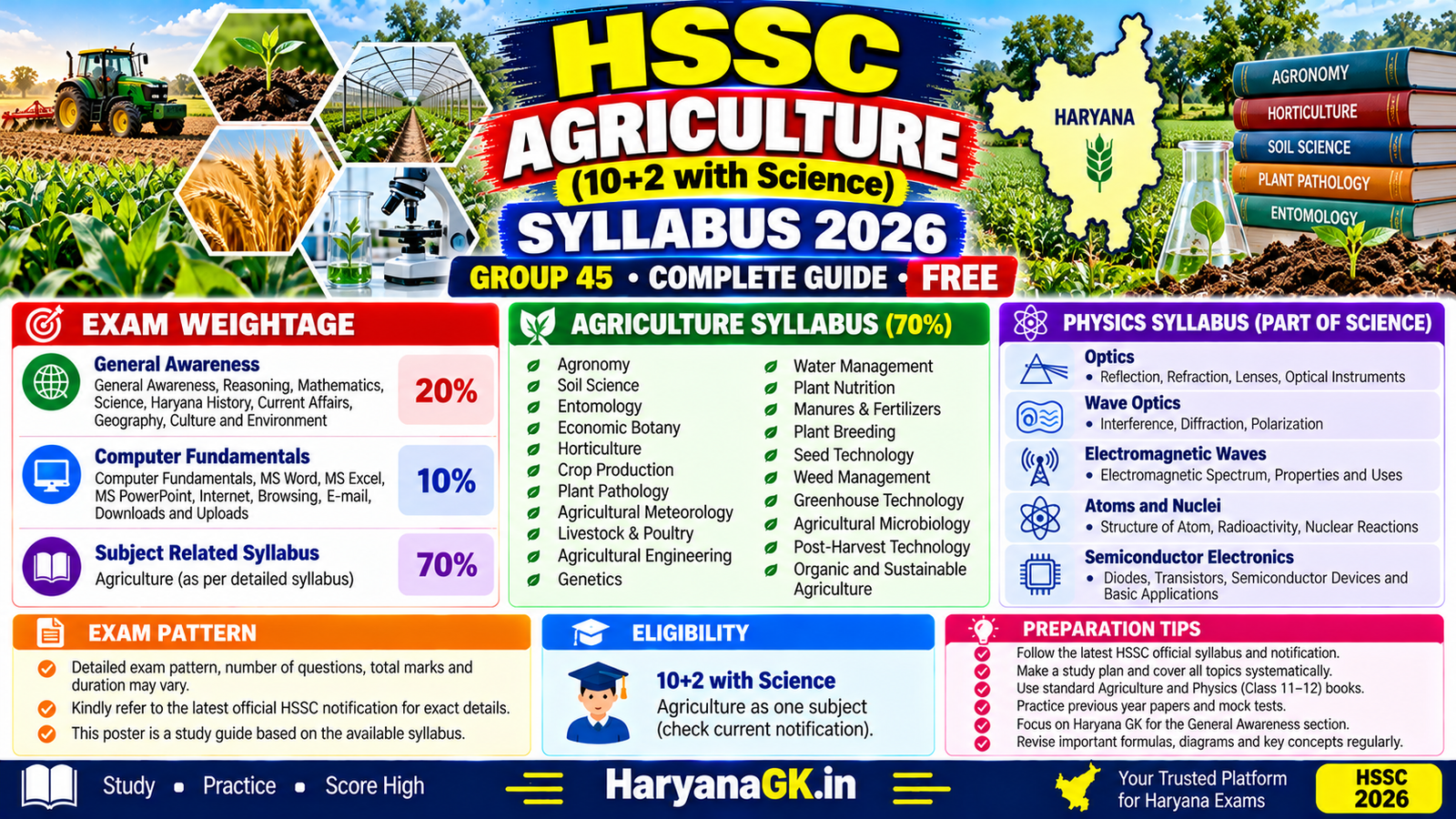
HSSC Agriculture (10+2 with Science) Syllabus 2026 covers Group 45 recruitment for Agriculture (10+2 with Science) posts under the Haryana Staff Selection Commission. This HSSC Agriculture (10+2 with Science) Syllabus guide breaks down the exam pattern and the full subject-wise topic list, straight from the official syllabus published at hssc.gov.in, so you know exactly what to study before you open a single PDF.
HSSC Agriculture (10+2 with Science) Syllabus Exam Pattern
Group 45 recruitment follows the standard two-stage HSSC process. Stage one is the Common Eligibility Test (CET) — 100 questions, 100 marks, roughly 90–105 minutes, covering general awareness, reasoning, Hindi, English and quantitative aptitude. Clearing CET plus the socio-economic criteria stage qualifies you for the group-specific written exam, which is where the HSSC Agriculture (10+2 with Science) syllabus below actually applies.
The HSSC Agriculture (10+2 with Science) Syllabus for the written exam splits into weighted parts:
- General awareness, reasoning, mathematics, science, history (including Haryana-related history), current affairs, literature, geography, civics, environment, culture, etc.—20% weightage
- Computer terminology, fundamentals, word software, Excel software, PowerPoint, internet, web browsing, communication, emails, downloading and uploading data on websites, etc.—10% weightage
- Subject-related syllabus — 70% weightage
HSSC notes on the official document that this weightage is tentative and may vary, so treat it as a study-time guide rather than a locked question count.
| HTET Previous Year Exam Papers |
HTET Previous Year Sample Exam Papers 2024 – 2014  |
HSSC Agriculture (10+2 with Science) Syllabus 2026 (Subject-Wise)
The subject-specific block of the HSSC Agriculture (10+2 with Science) syllabus spans the following areas. Here is the complete breakdown.
Agriculture: Introduction to Agriculture, Principles of Agronomy, Fundamentals of Soil Science, Fundamentals of Entomology, Economic Botany, Principles of Horticulture, and Biomathematics. Crop Production, Soil Chemistry, Principles of Insect Control, Plant Pathology, Agricultural Meteorology, Livestock and Poultry Production, Basics of Agricultural Engineering.
Principles of Genetics, Water Management, Pests and Pest Control, Diseases of Field Crops, Production of Technology of Food Crops, Dairy Cattle and Buffalo, Organic Farming and Sustainable Agriculture, Plant Nutrition, Manures, and Fertilisers. Plant Breeding, Agricultural Statistics, Weed Management, Greenhouse Technology, Agricultural Microbiology, Seed Production Technology, Post-Harvest Technology.
Electromagnetic waves: Basic idea of displacement current, electromagnetic waves, sources, and characteristics of EMW, transverse nature of EMW (qualitative ideas only) Electromagnetic Spectrum (radio waves, microwaves, infrared, visible, ultraviolet, X-rays, and gamma rays). including elementary facts about their uses.
Ray optics and optical instruments: Ray optics: Reflection of light by spherical mirrors, mirror formula, refraction of light, lateral shift of a ray refraction through a glass slab, real and apparent depth, advance sunrise and delayed sunset due to atmospheric refraction, total internal reflection and its applications, optical fibre, mirage, totally reflecting prism, brilliance of diamond, and refraction at convex spherical surfaces.
Lenses, refraction by a lens, power of a lens, combination of thin lenses and a mirror in contact, and the lens formula (lens maker’s formula). Refraction and dispersion of light through a prism: pattering of light – the blue colour of the sky and the reddish appearance of the sun at sunrise and sunset. Some natural phenomena due to sunlight – the rainbow.
Optical instruments: – Microscopes and Astronomical telescopes (reflecting and refracting) and their magnifying powers.
Wave optics: Wavefront and Huygens’s principle, refraction and reflection of plane waves at a plane surface using Huygens’s principle. Proof of law of reflection and refraction using Huygens’s principle. Interference of light waves. Young’s double slit experiment and expression for fringe width, coherent sources and sustained Interference of light. Diffraction, diffraction due to a single slit width of central maxima, and resolving power of microscopes and telescopes. Polarisation, plane polarised light. Brewster’s law, Uses of plane polarised light & Polaroid.
Atoms: Alpha particle scattering experiment. Rutherford’s Model of the Atom: Drawbacks of Rutherford’s Model. Bohr’s model of the hydrogen atom postulates the Bohr radius and the total energy of the electron in the nth orbit. Energy levels of hydrogen atom The line spectra of the hydrogen atom.
Nuclei: Atomic masses & composition of nuclei, size of nucleus, isotopes, isobars, isotones, mass-energy relation, nuclear binding energy and mass defect. Binding Energy and Mass Defect. Binding Energy Curve, Radioactivity. The law of radioactive decay, alpha, beta & gamma particles/rays and their properties, and nuclear fission and fusion.
Semiconductor Electronics, Materials, Devices & Simple Circuits: Energy bands in conductors, semiconductors & insulators (qualitative ideas only). Intrinsic & Extrinsic Semiconductor, Semiconductor diode I-V characteristics in forward and reverse bias. Diodes as full-wave & half-wave rectifiers: special-purpose p-n junction diodes – Zener diodes and their characteristics, Zener diodes as voltage regulators, LEDs, photodiodes, solar cell junction transistors, transistor action, characteristics of a transistor, transistors as amplifiers (C.E. configuration), the basic idea of analogue & digital signals, and logic gates (OR, AND, NOT, NAND, NOR).
Solution: Types of solutions, expression of concentration of solution of solid in liquids, solubility of gases in liquids (Henry’s law), solid solutions, colligative properties (relative lowering of vapour pressure), Raoults’s law, ideal and non-ideal solutions, osmotic pressure, osmosis and its applications, depression of freezing point, elevation of boiling point, determination of molecular masses using colligative properties, abnormal molecular masses, Van’t Hoff factor, and Van’t Hoff equation for colligative properties.
Electrochemistry: Redox reactions, conductance in electrolytic solutions, specific and molar conductivity, variation of conductivity with concentration, Kohlrausch’s law, electrolysis and laws of electrolysis (only elementary idea), electrochemical cell (construction, representation and working), dry cell – electrolytic cells, lead accumulator, Ni-cd cell, fuel cell, EMF of a cell, standard electrode potential, Nernst equation and its application to chemical cells, reference electrode (NHE) relation between Gibb’s free energy change and EMF of a cell, electrochemical series and its applications.
Coordination compounds: Coordination compounds- Introduction, difference between coordination compounds and double salts, ligands, coordination number, colour, magnetic properties and shapes, IUPAC nomenclature of mono-nuclear Coordination compounds, bonding in complex compounds, Werner’s theory, VBT and CFT: Structure and stereo isomerism, importance of coordination compounds (in qualitative inclusion, extraction of metals and biological systems).
Haloalkanes and Haloarenes: Haloalkanes: Nomenclature, nature of C-X bond physical and chemical properties, mechanism of substitution reaction, optical rotation. Haloarenes: Nature of C-X bond, substitution reaction (directive Influence of halogen in monosubstituted compounds only) Uses and environmental effects of dichloromethane, trichloromethane, tetrachloromethane, iodoform, freons, and DDT.
Alcohols, Phenols and Ethers: Alcohols: Nomenclature, methods of preparation, physical and chemical properties (primary alcohols only), identification of primary, secondary and tertiary alcohols, mechanism of dehydration of alcohols, and uses of alcohol with special reference to ethanol and methanol. Phenols: Nomenclature, methods of preparation, physical and chemical properties, acidic nature of phenol, electrophilic substitution reactions, and uses of phenol. Ethers: Nomenclature, methods of preparation, physical and chemical properties, and uses.
Aldehydes, Ketones and Carboxylic Acids: Aldehydes and Ketones: Nomenclature, nature of carbonyl group, methods of preparation of aldehydes & ketones, physical and chemical properties and mechanism of nucleophilic addition, reactivity of alpha hydrogen in aldehydes, and uses. Carboxylic acids: Nomenclature, acidic nature, methods of preparation, physical and chemical properties, and uses.
Organic compounds containing nitrogen: amines: nomenclature, classification, structure, methods of preparation, physical and chemical properties, and basic nature of amines. Identification of primary, secondary and tertiary amines and uses of amines. Diazonium salts: preparation, chemical reaction and importance in synthetic organic chemistry.
The Living World: Biodiversity; the need for classification; three domains of life; taxonomy and systematics; the concept of species and taxonomical hierarchy; and binomial nomenclature.
Biological Classification: Five kingdom classification; salient features and classification of Monera, Protista and Fungi into major groups; lichens, viruses and viroids.
Plant Kingdom: Classification of plants into major groups; salient and distinguishing features and a few examples of algae, Bryophyta, Pteridophytes, and Gymnospermae (topics excluded – angiosperms, plant life cycle, and alternation of generations)
Animal Kingdom: Salient features and classification of animals, non-chordates up to the phylum level and chordates up to the class level (salient features and a few examples of each category). (No live animals or specimens should be displayed.)
Cell – The Unit of Life: Cell theory and cell as the basic unit of life; structure of prokaryotic and eukaryotic cells; plant cell and animal cell; cell envelope; cell membrane; cell wall; cell organelles – structure and function; endomembrane system, endoplasmic reticulum, Golgi bodies, lysosomes, vacuoles, mitochondria, ribosomes, plastids, microbodies, cytoskeleton, cilia, flagella, centrioles (ultrastructure and function), and nucleus.
Biomolecules: Chemical constituents of living cells: biomolecules, structure and function of proteins, carbohydrates, lipids, and nucleic acids; enzyme types, properties, and enzyme action. (Topics excluded: Nature of Bond Linking Monomers in a Polymer, Dynamic State of Body Constituents – Concept of Metabolism, Metabolic Basis of Living, The Living State)
Cell Cycle and Cell Division: Cell cycle, mitosis, meiosis and their significance
Photosynthesis in Higher Plants: Photosynthesis as a means of autotrophic nutrition; site of photosynthesis; pigments involved in photosynthesis (elementary idea); photochemical and biosynthetic phases of photosynthesis; cyclic and non-cyclic photophosphorylation; chemiosmotic hypothesis; photorespiration; C3 and C4 pathways; factors affecting photosynthesis.
Respiration in Plants: Exchange of gases; cellular respiration – glycolysis, fermentation (anaerobic), TCA cycle and electron transport system (aerobic); energy relations – number of ATP molecules generated; amphibolic pathways; respiratory quotient.
Plant – Growth and Development: Seed germination; phases of plant growth and plant growth rate; conditions of growth; differentiation, dedifferentiation and redifferentiation; sequence of developmental processes in a plant cell; growth regulators – auxin, gibberellin, cytokinin, ethylene, and ABA.
Sexual Reproduction in Flowering Plants: Flower structure; development of male and female gametophytes; pollination – types, agencies and examples; out-breeding devices; pollen-pistil interaction; double fertilisation; post-fertilisation events – development of endosperm and embryo, development of seed and formation of fruit; special modes – apomixis, parthenocarpy, polyembryony; Significance of seed dispersal and fruit formation.
Heredity and variation: Mendelian inheritance; deviations from mentalism – incomplete dominance, co-dominance, multiple alleles and inheritance of blood groups; pleiotropy; elementary idea of polygenic inheritance; chromosome theory of inheritance; chromosomes and genes; sex determination – in humans, birds and honeybees; linkage and crossing over; sex-linked inheritance – haemophilia and colour blindness; Mendelian disorders in humans – thalassaemia; chromosomal disorders in humans; Down’s syndrome, Turner’s and Klinefelter’s syndromes.
Molecular Basis of Inheritance: Search for genetic material and DNA as genetic material; Structure of DNA and RNA; DNA packaging; DNA replication; Central Dogma; transcription, genetic code, translation; gene expression and regulation – lac operon; genome, human and rice genome projects; DNA fingerprinting.
Evolution: Origin of life; biological evolution and evidence for biological evolution (palaeontology, comparative anatomy, embryology and molecular evidence); Darwin’s contribution, modern synthetic theory of evolution; mechanism of evolution – variation (mutation and recombination) and natural selection with examples, types of natural selection; gene flow and genetic drift; Hardy-Weinberg’s principle; adaptive radiation; and human evolution.
Organisms and Populations: Population interactions – mutualism, competition, predation, parasitism; population attributes – growth, birth rate and death rate, age distribution. (Topics excluded: Organism and its Environment, Major Abiotic Factors, Responses to Abiotic Factors, Adaptations)
Ecosystems: Patterns, components; productivity and decomposition; energy flow; pyramids of number, biomass, and energy (Topics excluded: Ecological Succession and Nutrient Cycles)
Biodiversity and its Conservation: Biodiversity concept, patterns, importance; loss of biodiversity; biodiversity conservation; hotspots, endangered organisms, extinction, Red Data Book, Sacred Groves, biosphere reserves, national parks, wildlife, sanctuaries and Ramsar sites
| HTET PRT Syllabus 2026 | |
| Subject | Syllabus Link |
| PRT Syllabus (All Subjects) | View Syllabus  |
| HTET TGT Syllabus 2026 (Subject-Wise) | |
| Subject | Syllabus Link |
| Art | View Syllabus |
| English | View Syllabus |
| Hindi | View Syllabus |
| Home Science | View Syllabus |
| Mathematics | View Syllabus |
| Music | View Syllabus |
| Physical Education | View Syllabus |
| Punjabi | View Syllabus |
| Sanskrit | View Syllabus |
| Science | View Syllabus |
| Social Studies | View Syllabus |
| Urdu | View Syllabus |
| HTET PGT Syllabus 2026 (Subject-Wise) | |
| Subject | Syllabus Link |
| Biology | View Syllabus |
| Chemistry | View Syllabus |
| Commerce | View Syllabus |
| Economics | View Syllabus |
| English | View Syllabus |
| Fine Arts | View Syllabus |
| Geography | View Syllabus |
| Hindi | View Syllabus |
| History | View Syllabus |
| Home Science | View Syllabus |
| Mathematics | View Syllabus |
| Music | View Syllabus |
| Physical Education | View Syllabus |
| Political Science | View Syllabus |
| Psychology | View Syllabus |
| Punjabi | View Syllabus |
| Sanskrit | View Syllabus |
| Sociology | View Syllabus |
| Urdu | View Syllabus |
आधिकारिक स्रोत
इस पेज का सिलेबस हरियाणा कर्मचारी चयन आयोग (HSSC) के आधिकारिक दस्तावेज़ से लिया गया है। ताज़ा संस्करण और भर्ती सूचनाएँ hssc.gov.in/examsyllabus पर देखें।
दूसरे सभी HSSC पदों के सिलेबस और भर्ती प्रक्रिया हमारे HSSC गाइड पेज पर एक जगह दिए गए हैं।