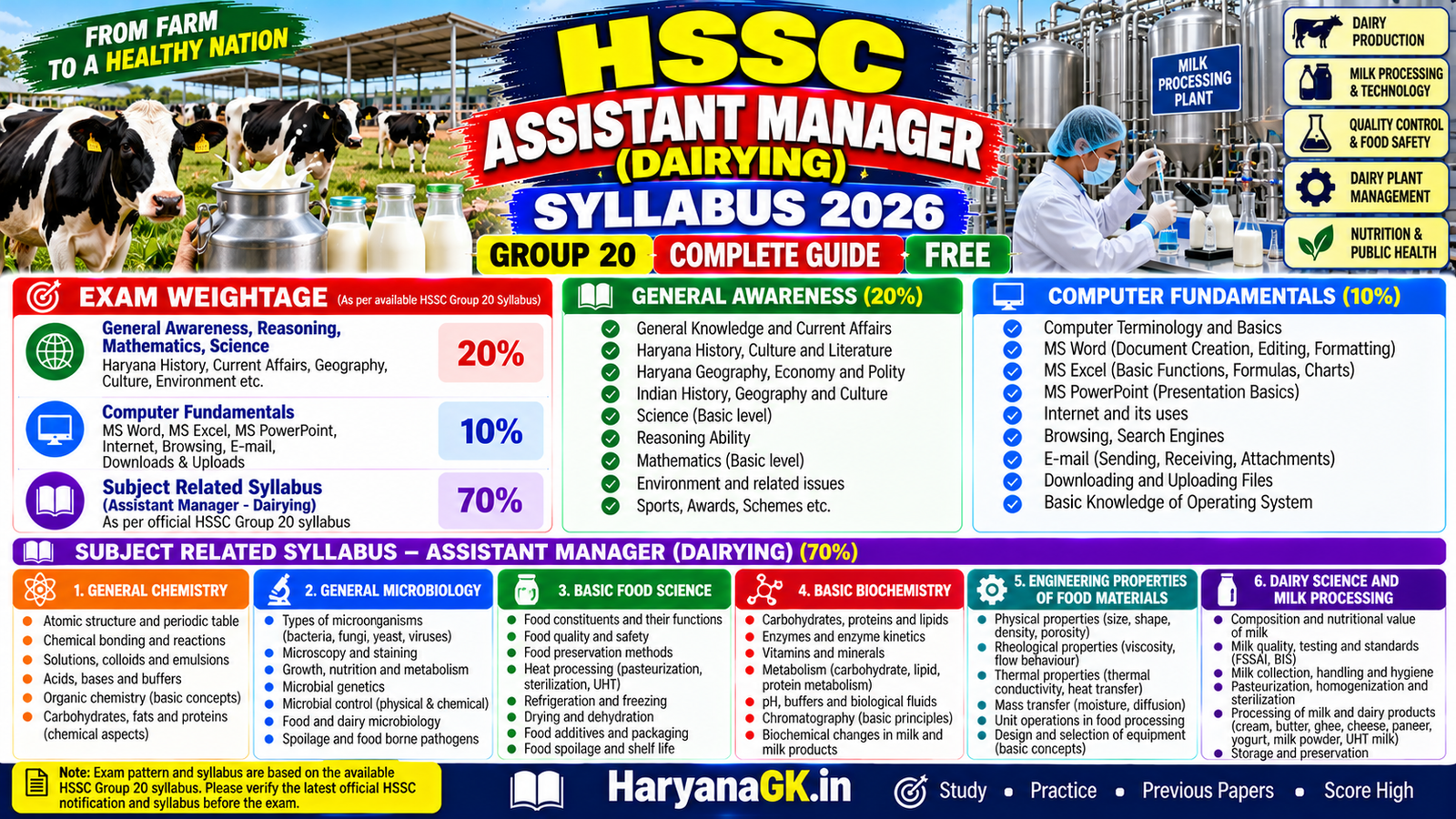
HSSC Assistant Manager (Dairying) Syllabus 2026 covers Group 20 recruitment for Assistant Manager (Dairying) posts under the Haryana Staff Selection Commission. This HSSC Assistant Manager (Dairying) Syllabus guide breaks down the exam pattern and the full subject-wise topic list, straight from the official syllabus published at hssc.gov.in, so you know exactly what to study before you open a single PDF.
| HTET Previous Year Exam Papers |
HTET Previous Year Sample Exam Papers 2024 – 2014  |
HSSC Assistant Manager (Dairying) Syllabus Exam Pattern
Group 20 recruitment follows the standard two-stage HSSC process. Stage one is the Common Eligibility Test (CET) — 100 questions, 100 marks, roughly 90–105 minutes, covering general awareness, reasoning, Hindi, English and quantitative aptitude. Clearing CET plus the socio-economic criteria stage qualifies you for the group-specific written exam, which is where the HSSC Assistant Manager (Dairying) Syllabus below actually applies.
The HSSC Assistant Manager (Dairying) Syllabus for the written exam splits into weighted parts:
- General awareness, Reasoning, Mathematics, Science, History including Haryana related history, current affairs, literature, Geography, Civics, Environment, Culture etc — 20% weightage
- Computer terminology, Fundamentals, word software, excel software, Power point, internet, web browsing, Communication, emails, downloading and uploading data on websites etc — 10% weightage
- Subject related syllabus — 70% weightage
HSSC notes on the official document that this weightage is tentative and may vary, so treat it as a study-time guide rather than a locked question count.
HSSC Assistant Manager (Dairying) Syllabus 2026 (Subject-Wise)
The subject-specific block of the HSSC Assistant Manager (Dairying) Syllabus spans the following areas. Here is the complete breakdown.
Atomic Structure, Chemical bonding, Solutions, Organic Chemistry: Structures and nomenclature of organic compounds, Types of reactions of organic compounds, Chemistry of functional groups.
History and scope of Microbiology, discovery, importance and relevance of microorganisms. Microscopy, Microbial Control, Important cultural characteristics of Bacteria, Virus, Fungus and algae, Isolation and preservation of pure cultures, Applications – Food microbiology, Agriculture microbiology, Medical microbiology, Industrial microbiology Environmental and Biotechnology microbiology.
Introduction to Food Science, Different kinds of Food Industries, Components of Food industries,Food constituents, Introduction to Food preservation techniques. Define: Pasteurization, Sterilization, Ultra High temperature, Blanching, etc.
Low temperature preservation techniques: Cooling, Evaporation, refrigeration and freezing, Definition of chemical preservatives and types. Introduction to new techniques in preservation of food like High Pressure Processing, Ohmic heating, Pulse electric field processing, Irradiation etc.
Drying and their importance in the food processing, Basic introduction to unit operation in Food Processing and define the term Cleaning, dry cleaning methods, wet cleaning methods, peeling, grading, sorting.
Units and measurement, Basic laws in physics, Laser, Crystal structure, Radioactivity and nuclear detector.
Chemical constituents of life: Cell, eukaryotic and prokaryotic cell Biomolecules: Carbohydrates- structure of monosaccharide, disaccharides, polysaccharides, homopolysaccharides (starch, dextrin & glucose), hetero poly-saccharides Proteins- Amino acids, structure of amino acids, properties of protein, denaturation, classification of protein
Lipids, fatty acids, essential fatty acid and triglycerides, Enzymes: Introduction, classification, structures and functions Co-enzymes and co-factors Active site Mechanisms of enzyme action Factors affecting enzyme activity Specificity of enzymes Enzyme inhibition Isozymes,
Metabolism: Introduction to metabolism, metabolism of carbohydrates, metabolism of lipids, metabolism of amino acids, integration of metabolism, metabolism of nucleotides, mineral metabolism.
Insulin, glucose homeostasis and diabetes mellitus, Metabolism of lipids: fatty acid oxidation, ketone bodies, biosynthesis of fatty acids, metabolism of phospholipids, glycolipids, cholesterol, lipoproteins, metabolism of HDL, obesity, Metabolism of amino acids, transamination, metabolism of ammonia, urea cycle, integration of metabolism, metabolism of nucleotides,
Preparation of buffers and determination of pH-by pH meter and pH indicators.
Separation of amino-acids and sugars by ascending paper chromatography and thin layer chromatography. Isolation of proteins and amino- acids by paper electrophoresis, gel electrophoresis and column chromatography.
Physical Properties of food and measuring methods, Rheological characteristics of Foods like stress, strain time effects, Thermal Properties of Foods Definitions & significance, Aerodynamic and hydrodynamic properties of Foods Drag coefficient, terminal velocity and their application in the handling and separation of food materials, Mechanical properties related terms and their definition, Types of mechanical damage, causes of damage, Mechanical damage in grains, fruits & vegetables, Coefficient of restitution, Damage of food materials under static, impact and vibration.
Natural Resources, Ecosystems, Environmental pollution, Biodiversity and its conservation, Human rights and its role in society.
Screening types of screens, Definition and Introduction to Separation Types of Separator, Size reduction procedures, Utilities of Drying thermal properties Equilibrium moisture content (EMC) Drying theories methods of drying – Contact drying, Convective drying, freeze drying, radiation drying, Superheated steam, Drying rate period
types of dryers-Deep bed, Flat bed, Continuous, Recirculating, LSU, Fluidised bed, Rotary, Tray, Tunnel and solar, Etc., Material handling & transportation.
Water, Carbohydrates, Proteins, Lipids, Enzymes. Food processing and preservation principles, method of preservation, Food Freezing and thawing process, Food Drying/Dehydration, Food Concentration, Membrane Processing.
Introduction: Meaning, Importance and Limitation and Distrust on Statistics
Collection, Classification, Tabulation, Graphic and Diagrammatic presentation of Data (one dimensional and two dimensional), Measures of Central Tendency: Mean, Median, Mode, Geometric Mean, Harmonic Mean, Partition Values, Measures of Dispersion: Range Method, Quartile Deviation, Mean Deviation, Standard Deviation, Coefficient of Variation.
Measures of Skewness: Karl Pearson’s Coefficient of Skewness, Bowley’s Coefficient of Skewness, Correlation: Karl Pearson’s Coefficient of Correlation, Spearman’s rank Correlation Coefficient, Index Number: Fixed-base and Chain-based Index numbers, Changing and Shifting of Base, Weighted Index number, Cost of living Index Number, Fisher’s Ideal Index Number.
Current status of production and processing of fruits and vegetables.
Scope of fruits and vegetables preservation in India: Product mix, availability of raw material, manpower, capital, lack of awareness, marketing facility, transport facility, availability of containers, publicity and role of government,
Juice extraction: juice, history of juicing, types of juices, process flow diagram for fruit juice production, juice extraction process- fruit selection, sorting, washing, juice extraction, deaeration, straining/filtration, clarification, adding of sugars, fortification, bottling, sealing and storage; methods of juice preservation, causes of juice spoilage,
Canning: Introduction, can manufacture, canning process – selection of fruits and vegetables, grading, washing, peeling, cutting, blanching, cooling, filling, exhausting, sealing, processing, cooling and storage; types of canning- pressure canning and water bath canning, common causes of spoilage in canning of foods,
Minimally processed fruits and vegetables: Modified atmosphere packaging (MAP): Introduction, gases used in MAP, role of N2, O2 & Co2, Principles of MAP, Types of MAPactive packaging & passive packaging, factors affecting MAP, graphical representation, application of MAP, effect of MAP on shelf-life, future research needed, advantages and disadvantages
and controlled atmosphere packaging (CAP): Introduction, gases used in CAP, factors affecting CAP- Temperature control, humidity control and gas control, advantages and disadvantages, Statutory Provisions for Quality Control in India.
Food as a substrate for microorganisms, Microorganisms important in food microbiology, General principles underlying food spoilage, Food Fermentations, Contamination of foods, from green plants and fruits, from animals, from sewage, from soil, from water, from air, during handling and processing, Food- borne illness: Bacterial: Food borne poisonings, infections and intoxicants: non-bacterial: Mycotoxins, Viruses, Rickettsia’s, Food borne parasites, Seafood Toxicants, Poisoning by chemicals.
Definition and functions of Food Packaging, Structure and properties of plastic polymers,Paper and Paper based packaging materials, Metal and Glass packaging materials, Package testing.
Milk- Definition, Status, Indian Standards Composition. Factor affecting composition of milk, food and nutritive value, physical chemical properties of milk and milk constituents. Microbiology of milk and public health, clean milk production, packaging, Cleaning and sanitization of dairy equipment judging and grading of milk,
Introduction- sterilized milk, homogenized milk, soft curd milk flavoured milks, Vitamin/Irradiation milk, Acidophilus milk fermented milk, standardized milk, Reconstituted/ rehydrated milk, recombined milk, toned & double toned milk,
Cream-Introduction, definition, classification, composition, nutritive value and production.
Butter- Introduction, definition, classification, composition, nutritive value and methods of manufacturing.
Butter oil- Introduction, definition, classification, composition, nutritive value and methods of manufacturing,
Ice Cream- Introduction, definition, classification, composition, nutritive value, role of constituents, properties of mixture and methods of manufacturing. packaging, hardening and storage and distribution, Defects in ice cream, their causes and prevention, use of ice cream,
Introduction, definition and composition of Cheese, Paneer, Channa, Ghee, Khoa Importance of cleaning and sanitization and In-plant cleaning system methods
AGRICULTURAL WASTE AND BY-PRODUCTS UTILIZATION
Introduction and Background Agricultural Waste, Crop Waste, Agricultural Residues (annual crops), Technical terms, rice by-products utilization-rice bran and germ, rice bran oil, economic products from agriculture waste/by-products, Biomass Gasifier, Technology used for the utilization of agricultural wastes, Biogas, Production of Alcohol from waste materials: Introduction, Production methods, Cellulolytic (biological approach), Production and testing of Paperboards and Particleboards from Agricultural Waste.
Objectives, importance and functions of quality control, Concept of food safety and standards, food safety strategies, HACCP (Hazard Analysis Critical Control Point systems), Food Adulteration- Nature of adulterants, methods of evaluation of food adulterants and toxic constituents, Introduction to food laws, need for enforcing the laws and various types of laws, Labelling – Nutritional labelling – Specification – rules and regulation- ISI certification- Principles – Role of AGMARK, FPO, BIS and PFA, Labelling – Nutritional labelling – Specification – rules and regulation- ISI certification- Principles – Role of AGMARK, FPO, BIS and PFA, Food hygiene auditing
| HTET PRT Syllabus 2026 | |
| Subject | Syllabus Link |
| PRT Syllabus (All Subjects) | View Syllabus  |
| HTET TGT Syllabus 2026 (Subject-Wise) | |
| Subject | Syllabus Link |
| Art | View Syllabus |
| English | View Syllabus |
| Hindi | View Syllabus |
| Home Science | View Syllabus |
| Mathematics | View Syllabus |
| Music | View Syllabus |
| Physical Education | View Syllabus |
| Punjabi | View Syllabus |
| Sanskrit | View Syllabus |
| Science | View Syllabus |
| Social Studies | View Syllabus |
| Urdu | View Syllabus |
| HTET PGT Syllabus 2026 (Subject-Wise) | |
| Subject | Syllabus Link |
| Biology | View Syllabus |
| Chemistry | View Syllabus |
| Commerce | View Syllabus |
| Economics | View Syllabus |
| English | View Syllabus |
| Fine Arts | View Syllabus |
| Geography | View Syllabus |
| Hindi | View Syllabus |
| History | View Syllabus |
| Home Science | View Syllabus |
| Mathematics | View Syllabus |
| Music | View Syllabus |
| Physical Education | View Syllabus |
| Political Science | View Syllabus |
| Psychology | View Syllabus |
| Punjabi | View Syllabus |
| Sanskrit | View Syllabus |
| Sociology | View Syllabus |
| Urdu | View Syllabus |
आधिकारिक स्रोत
इस पेज का सिलेबस हरियाणा कर्मचारी चयन आयोग (HSSC) के आधिकारिक दस्तावेज़ से लिया गया है। ताज़ा संस्करण और भर्ती सूचनाएँ hssc.gov.in/examsyllabus पर देखें।
दूसरे सभी HSSC पदों के सिलेबस और भर्ती प्रक्रिया हमारे HSSC गाइड पेज पर एक जगह दिए गए हैं।