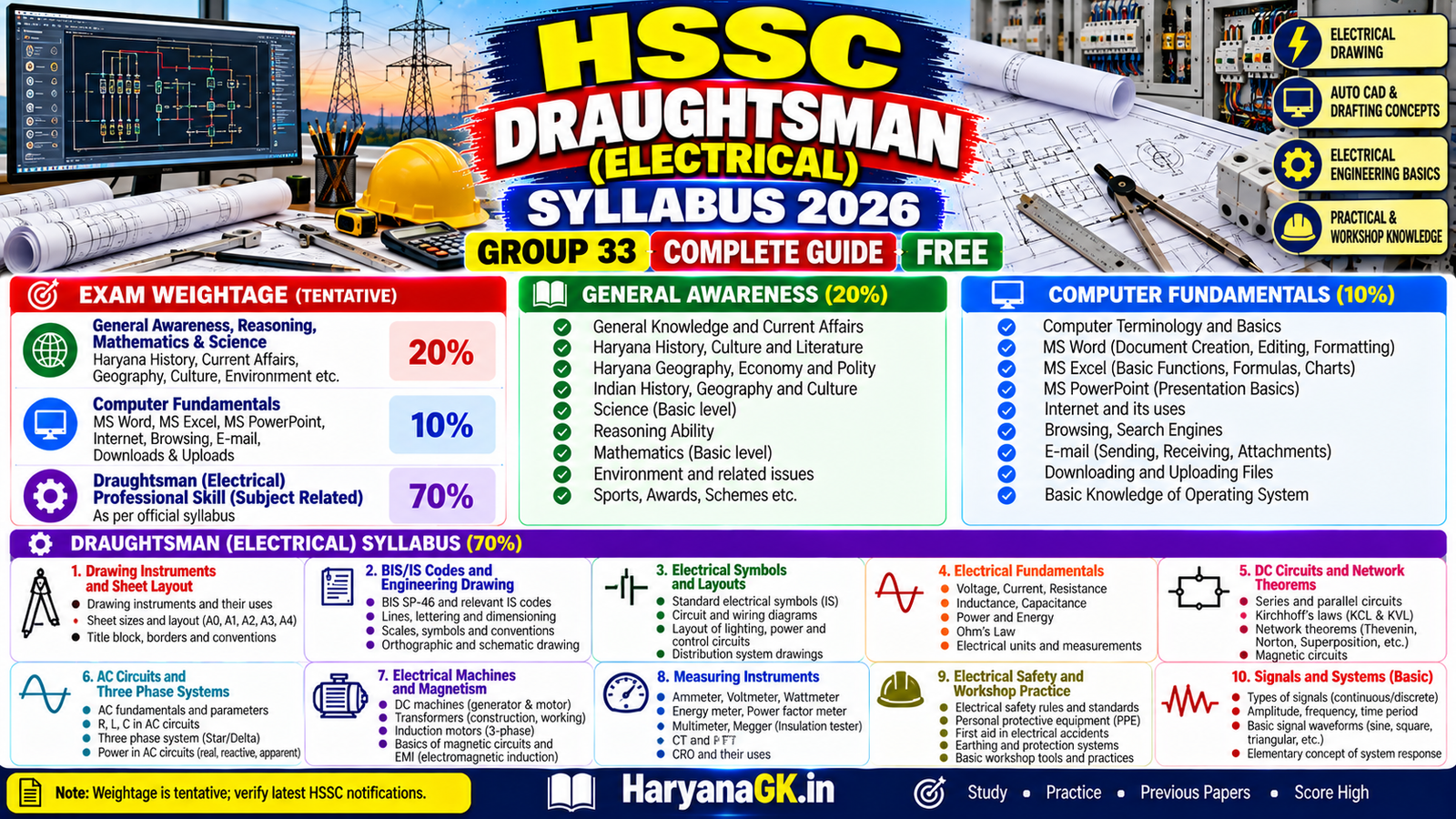
The HSSC Draughtsman (Electrical) Syllabus 2026 covers Group 33 recruitment for Draughtsman (Electrical) posts under the Haryana Staff Selection Commission. This HSSC Draughtsman (Electrical) Syllabus guide breaks down the exam pattern and the full subject-wise topic list, straight from the official syllabus published at hssc.gov.in, so you know exactly what to study before you open a single PDF.
HSSC Draughtsman (Electrical) Syllabus Exam Pattern
Group 33 recruitment follows the standard two-stage HSSC process. Stage one is the Common Eligibility Test (CET) — 100 questions, 100 marks, roughly 90–105 minutes, covering general awareness, reasoning, Hindi, English and quantitative aptitude. Clearing CET plus the socio-economic criteria stage qualifies you for the group-specific written exam, which is where the HSSC Draughtsman (Electrical) Syllabus below actually applies.
| HTET Previous Year Exam Papers |
HTET Previous Year Sample Exam Papers 2024 – 2014  |
The HSSC Draughtsman (Electrical) Syllabus for the written exam splits into weighted parts:
- General awareness, reasoning, mathematics, science, history (including Haryana-related history), current affairs, literature, geography, civics, environment, culture, etc.—20% weightage
- Computer terminology, fundamentals, word software, Excel software, PowerPoint, internet, web browsing, communication, emails, downloading and uploading data on websites, etc.—10% weightage
- Subject-related syllabus — 70% weightage
HSSC notes on the official document that this weightage is tentative and may vary, so treat it as a study-time guide rather than a locked question count.
HSSC Draughtsman (Electrical) Syllabus 2026 (Subject-Wise)
The subject-specific block of the HSSC Draughtsman (Electrical) Syllabus spans the following areas. Here is the complete breakdown.
Subject-Related Syllabus
1. Industrial Training, Safety and Soft Skills
Importance of safety and general precautions observed on the industry/shop floor. Working of the Industrial Training Institute system, including store procedures.
Soft Skills: its importance and job areas after completion of training. Introduction of First Aid. Introduction of PPEs. Introduction to the 5S concept and its application.
Response to emergencies, e.g., power failure, fire alarm, etc. Familiarisation and information about the rules and regulations of the Institute and Trade.
List of the instruments, equipment and materials to be used during training.
2. Engineering Drawing
Importance of B.I.S. Introduction to the Code for Practice of Architectural and Building Drawings (IS: 962-1989, SP-46: 2003).
Layout of drawing. Lines, lettering, dimensioning, and knowledge of different types of scales are also important. Principle of R.F.
3. Electrical Circuit Fundamentals
Concepts of resistance, inductance, capacitance, and various factors affecting them.
Concepts of current, voltage, power, energy, and their units.
Network elements: ideal voltage and current sources, dependent sources, and R, L, C, M elements.
Network solution methods: KCL, KVL, node analysis, and mesh analysis.
4. Network Theorems
Thevenin’s theorem, Norton’s theorem, the superposition theorem, and the maximum power transfer theorem.
5. Magnetic Circuits and Electromagnetic Induction
Magnetic circuits: concepts of flux, MMF, reluctance, and different kinds of magnetic materials.
Magnetic calculations for conductors of different configurations, e.g., straight, circular, solenoidal, etc.
Electromagnetic induction, self-induction, and mutual induction.
6. Electrical Network Analysis
Transient response of DC and AC networks, sinusoidal steady-state analysis, resonance, two-port networks, balanced three-phase circuits, star-delta transformation, complex power, and power factor in AC circuits.
7. Electromagnetic Field Theory
Coulomb’s Law, Electric Field Intensity, Electric Flux Density, Gauss’s Law, and Divergence.
Electric field and potential due to point, line, plane, and spherical charge distributions.
Effect of dielectric medium and capacitance of simple configurations.
Biot-Savart’s Law, Ampere’s Law, Curl, Faraday’s Law, Lorentz force, inductance, magnetomotive force, reluctance, magnetic circuits, and self- and mutual inductance of simple configurations.
8. Alternating Current Fundamentals
Instantaneous, peak, R.M.S., and average values of alternating waves.
Representation of sinusoidal waveforms.
Simple series and parallel AC circuits consisting of R, L, and C components.
Resonance and tank circuit.
Polyphase systems: star and delta connections, three-phase power, and DC and sinusoidal responses of R-L and R-C circuits.
9. Measurement and Measuring Instruments
Measurement of power (single-phase and three-phase, both active and reactive) and energy.
The two-wattmeter method of three-phase power measurement.
Measurement of frequency and phase angle.
Ammeters and voltmeters (both moving-coil and moving-iron types), extension of range, wattmeters, multimeters, meggers, and energy meters.
AC bridges. Use of CRO, signal generators, CT, and PT, and their applications.
Earth fault detection.
10. Signals and Systems
Representation of continuous-time and discrete-time signals, shifting and scaling properties, linear time-invariant systems, and causal systems.
Fourier series representation of continuous-time and discrete-time periodic signals.
Sampling theorem and applications of the Fourier transform for continuous-time and discrete-time signals.
Laplace Transform and Z Transform.
11. Electrical Machines
Single-phase transformer: equivalent circuit, phasor diagram, open-circuit and short-circuit tests, regulation, and efficiency.
Three-phase transformers: connections, vector groups, and parallel operation.
Auto-transformer and electromechanical energy conversion principles.
DC machines: separately excited, series, and shunt machines; motoring and generating modes of operation; characteristics; and speed control of DC motors.
Three-phase induction machines: principle of operation, types, performance, torque-speed characteristics, no-load and blocked-rotor tests, equivalent circuit, starting, and speed control.
Operating principle of single-phase induction motors.
Synchronous machines: cylindrical and salient-pole machines, performance and characteristics, regulation and parallel operation of generators, and starting of synchronous motors.
Types of losses and efficiency calculations of electric machines.
Methods of braking and the effect of voltage and frequency variation on torque-speed characteristics.
12. Fractional Kilowatt Motors and Single-Phase Induction Motors
Characteristics and applications.
13. Synchronous Machines
Generation of three-phase EMF, armature reaction, voltage regulation, parallel operation of two alternators, synchronising, and control of active and reactive power.
Starting and applications of synchronous motors.
14. Power Systems
Basic concepts of electrical power generation and AC and DC transmission.
Models and performance of transmission lines and cables.
Series and shunt compensation, electric field distribution, and insulators.
Distribution systems, per-unit quantities, bus admittance matrix, Gauss-Seidel and Newton-Raphson load flow methods.
Voltage and frequency control, power factor correction, symmetrical components, and symmetrical and unsymmetrical fault analysis.
Principles of overcurrent, differential, directional, and distance protection.
Circuit breakers, system stability concepts, the equal area criterion, and economic load dispatch with and without considering transmission losses.
15. Control Systems
Mathematical modelling and representation of systems.
Feedback principle and transfer function.
Block diagrams and signal flow graphs.
Transient and steady-state analysis of linear time-invariant systems.
Stability analysis using Routh-Hurwitz and Nyquist criteria.
Bode plots, root loci, and lag, lead, and lead-lag compensators.
P, PI, and PID controllers.
State-space model and solution of state equations of LTI systems.
R.M.S. value and average value calculation for any general periodic waveform.
16. Generation, Transmission and Distribution
Power factor improvement, various types of tariffs, types of faults, and short-circuit current for symmetrical faults.
Switchgear: rating of circuit breakers and principles of arc extinction by oil and air.
H.R.C. fuses, protection against earth leakage and overcurrent, etc.
Buchholz’s relay, Merz-Price system of protection of generators and transformers, and protection of feeders and busbars.
Lightning arresters, various transmission and distribution systems, comparison of conductor materials, and efficiency of different systems.
Cables: different types of cables, cable rating, and derating factor.
Different types of power stations, load factor, diversity factor, demand factor, cost of generation, and interconnection of power stations.
17. Estimation and Costing
Estimation of lighting schemes and electrical installation of machines, including relevant IE rules.
Earthing practices and IE Rules.
18. Utilisation of Electrical Energy
Illumination.
Electric heating.
Electric welding.
Electroplating.
Electric drives and motors.
19. Electronic Devices and Circuits
Working of various electronic devices, e.g., P-N junction diodes, transistors (NPN and PNP types), BJT, and JFET.
Simple circuits using these devices.
20. Power Electronics
Static V-I characteristics and firing/gating circuits for thyristors, MOSFETs, and IGBTs.
DC-to-DC conversion: buck, boost, and buck-boost converters.
Single-phase and three-phase configurations of uncontrolled rectifiers.
Voltage- and current-commutated thyristor-based converters.
Bidirectional AC-to-DC voltage-source converters.
Magnitude and phase of line-current harmonics for uncontrolled and thyristor-based converters.
Power factor and distortion factor of AC-to-DC converters.
Single-phase and three-phase voltage-source and current-source inverters, and sinusoidal pulse-width modulation.
हरियाणा जीके – चरखी दादरी जिला
| HTET PRT Syllabus 2026 | |
| Subject | Syllabus Link |
| PRT Syllabus (All Subjects) | View Syllabus  |
| HTET TGT Syllabus 2026 (Subject-Wise) | |
| Subject | Syllabus Link |
| Art | View Syllabus |
| English | View Syllabus |
| Hindi | View Syllabus |
| Home Science | View Syllabus |
| Mathematics | View Syllabus |
| Music | View Syllabus |
| Physical Education | View Syllabus |
| Punjabi | View Syllabus |
| Sanskrit | View Syllabus |
| Science | View Syllabus |
| Social Studies | View Syllabus |
| Urdu | View Syllabus |
| HTET PGT Syllabus 2026 (Subject-Wise) | |
| Subject | Syllabus Link |
| Biology | View Syllabus |
| Chemistry | View Syllabus |
| Commerce | View Syllabus |
| Economics | View Syllabus |
| English | View Syllabus |
| Fine Arts | View Syllabus |
| Geography | View Syllabus |
| Hindi | View Syllabus |
| History | View Syllabus |
| Home Science | View Syllabus |
| Mathematics | View Syllabus |
| Music | View Syllabus |
| Physical Education | View Syllabus |
| Political Science | View Syllabus |
| Psychology | View Syllabus |
| Punjabi | View Syllabus |
| Sanskrit | View Syllabus |
| Sociology | View Syllabus |
| Urdu | View Syllabus |
आधिकारिक स्रोत
इस पेज का सिलेबस हरियाणा कर्मचारी चयन आयोग (HSSC) के आधिकारिक दस्तावेज़ से लिया गया है। ताज़ा संस्करण और भर्ती सूचनाएँ hssc.gov.in/examsyllabus पर देखें।
दूसरे सभी HSSC पदों के सिलेबस और भर्ती प्रक्रिया हमारे HSSC गाइड पेज पर एक जगह दिए गए हैं।