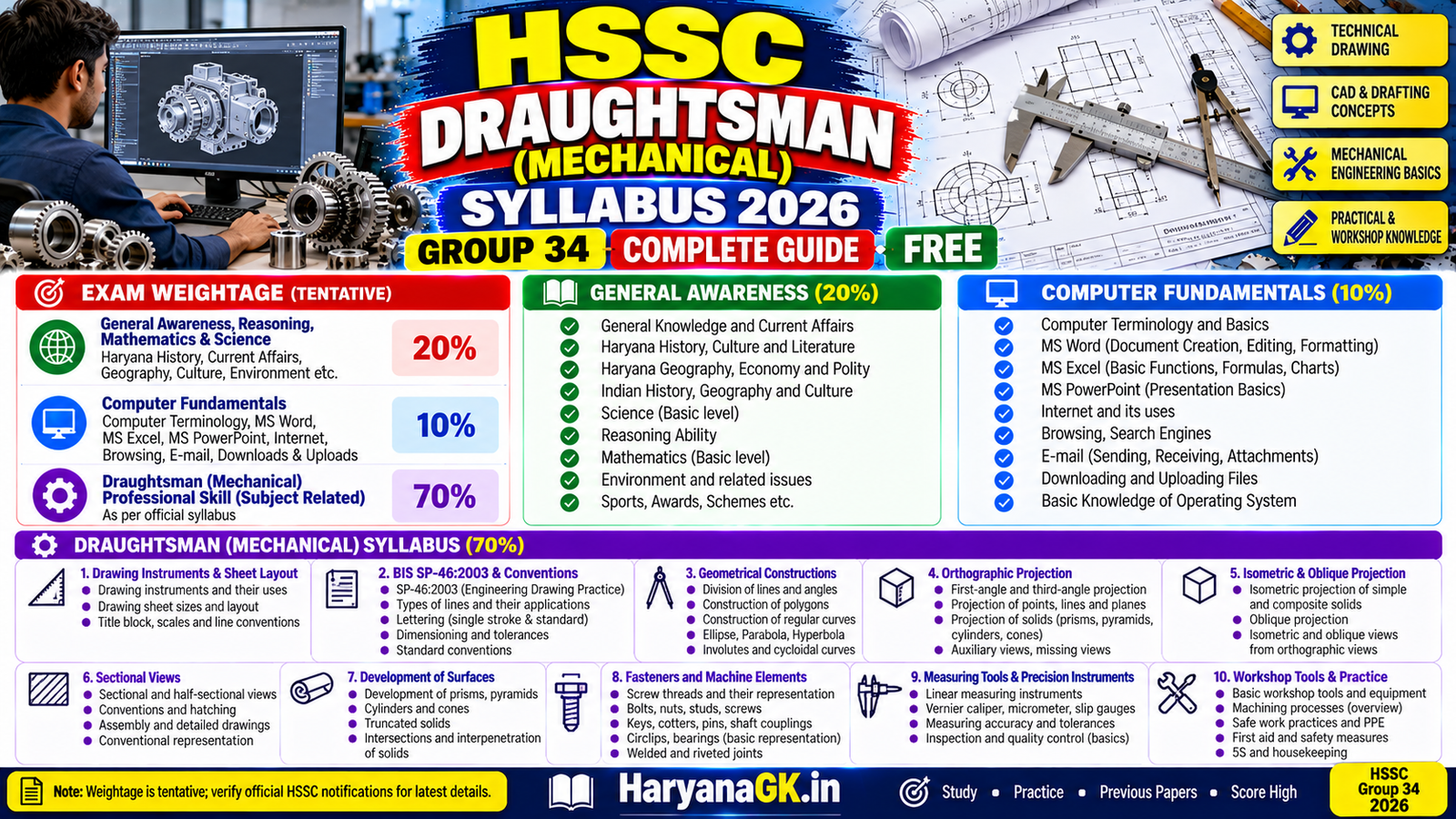
The HSSC Draughtsman (Mechanical) Syllabus 2026 covers Group 34 recruitment for Draughtsman (Mechanical) posts under the Haryana Staff Selection Commission. This HSSC Draughtsman (Mechanical) Syllabus guide breaks down the exam pattern and the full subject-wise topic list, straight from the official syllabus published at hssc.gov.in, so you know exactly what to study before you open a single PDF.
| HTET Previous Year Exam Papers |
HTET Previous Year Sample Exam Papers 2024 – 2014  |
HSSC Draughtsman (Mechanical) Syllabus Exam Pattern
Group 34 recruitment follows the standard two-stage HSSC process. Stage one is the Common Eligibility Test (CET) — 100 questions, 100 marks, roughly 90–105 minutes, covering general awareness, reasoning, Hindi, English and quantitative aptitude. Clearing CET plus the socio-economic criteria stage qualifies you for the group-specific written exam, which is where the HSSC Draughtsman (Mechanical) Syllabus below actually applies.
The HSSC Draughtsman (Mechanical) Syllabus for the written exam splits into weighted parts:
- Draughtsman (Mechanical) – LEVEL – Matric + Dip. in Draughtsman (Mech.) 1) General awareness, reasoning, mathematics, science, history (including Haryana-related history), current affairs, literature, geography, civics, environment, culture, etc.—20% weightage
HSSC notes on the official document that this weightage is tentative and may vary, so treat it as a study-time guide rather than a locked question count.
HSSC Draughtsman (Mechanical) Syllabus 2026 (Subject-Wise)
The subject-specific block of the HSSC Draughtsman (Mechanical) Syllabus spans the following areas. Here is the complete breakdown.
2) Computer terminology, fundamentals, word software, Excel software, PowerPoint, internet, web browsing, communication, emails, downloading and uploading data on websites, etc.
Common Sections
Subject-related syllabus
Soft Skills: its importance and job area after completion of training. Introduction of first aid. Operation of electrical mains. Introduction of PPEs. Introduction to the 5S concept & its application. Response to emergencies, e.g., power failure, fire, and system failure,
Nomenclature, description and use of drawing instruments & various equipment used in the drawing office. Their care and maintenance lay out and designation of a drawing sheet as per Sp -46: 2003 Recommended scale of engineering drawing as per SP-46: 2003 Types of Lines and their Application.
Folding of prints for filing cabinets or binding as per SP: 46-2003, type of lettering proportion and spacing of letters and words, definition of ellipse, parabola, and hyperbola, and different methods of their construction. Definition & method of drawing involutes, cycloid curves, helices & spirals,
Terminology – feature, functional feature, functional dimension, datum dimension, principles. Units of dimensioning, system of dimensioning, method of dimensioning & common features,
Methods of obtaining orthographic views. Position of the object, selection of the views, and three views of the drawing. Planes and their normal projections, orthographic projection. First angle and third angle projection. Principal of orthographic projection. Projection of solids like prisms, cones, pyramids and their frustums, Methods of freehand sketching for machine parts,
Knowledge of different types of scales, scales of cords, their appropriate uses, the principle of R.F., diagonal & vernier,
Knowledge of solid section. Types of sectional views & their uses. Cutting plane and its representation. Parts not shown in the section. Conventional signs, symbols, abbreviations & hatching for different materials. Solution of problems to find out the true shape of surfaces when solids are cut by different cutting planes,
Definition of development, its need in industry & different methods of developing the surfaces. Development of surfaces bounded by plane of revolution intersecting each other. Development of an oblique cone with an elliptical base, etc., calculation of developed lengths of geometrical solids,
Definition of intersection & interpenetration curves. A common method to find out the curve of interpenetration. Solution of problems on interpenetration of prisms, cones & pyramids with their axes intersecting at an angle. Intersection of cylinder,
Principle of isometric projection and isometric drawing. Methods of isometric projection and dimensioning. Isometric scale. Difference between isometric drawing & isometric projection, and principles of making orthographic views from isometric drawing. Selection of views for construction of orthographic drawings for clear description of the object,
Principles and types of oblique projection. Advantage of oblique projection over isometric. Projection,
Different types of fasteners, welds and locking devices
Screw threads, terms and nomenclature, types of screw threads, proportions and their uses, and threads as per SP46:2003 conventions.
Types of bolts, nuts and studs, and their proportion and uses. Different types of locking devices. Different types of machine screws, cap screws, and set screws as per specification. Different types of foundation bolts and their uses,
Description of Welded Joints and their representation (Actual and Symbolic) Indication of the welding symbol on the drawing as per SP-46,
Different types of keys (heavy-duty and light-duty), cotters, splined shafts, pins and circlips. Calculation of sizes and proportions of keys,
Pipe Joints: selection of materials as per carrying fluid and conditions. Description of different pipe joints fitted on pipe. Expansion joint, loop and other pipe fittings,
Types of rivets, their size proportions and uses. Types of riveted joints, terms and proportions of riveted joints. Conventional representation. Relation between rivet size and thickness of plates and calculation for arrangement of rivet position. Causes of failure of riveted joint efficiency of riveted joints.
Tools and equipment and their application in Allied trades: Description and application of simple measuring tools.
Description of vices, hammers, cold chisels, files, drills, etc. – proper method of using them.
Method of using a precision measuring instrument.
Maintaining a sequence of operations in a fitting shop and safety precautions,
Safety precautions for lathes,
Description of parts of the lathe & its accessories.
Method of using precision measuring instruments such as inside & outside micrometres, depth gauges, vernier callipers, dial indicators, slip gauges, sine bars, universal bevel protractors, etc.
Brief Description of milling, shaping, slotting and planning machines. Quick return mechanism of these machines. Maintaining a sequence of operations in a machine shop and safety precautions,
Brief description of common equipment required for sheet metal work. Different types of joints are used in sheet metal work, maintaining the sequence of operation in a machine shop and safety precautions.
Brief description of the hand tools used for gas & arc welding. Different types of welded joints and necessary preparation are required for these. Safety precautions,
Hand tools are used for moulding. The description, use and care of safety precautions are maintained in the electrician shop.
A.C. & D.C. Motors Generators of common types and their uses and a brief description of common equipment necessary for sheet metal work.
Electrical units and quantities. Laws of electricity. Simple examples of calculation of current voltage and resistance in series and parallel connections (D.C. circuit).
Brief description of internal combustion engines, such as cylinder block piston, carburettor spark plug, camshaft, crankshaft, injector fuel pump, etc., indicating surface finish symbol
Limits, fit, tolerance. Tolerance dimensioning, geometrical tolerance. Indications of symbols for machining and surface finishes on drawing (grades and micron values)
Production of interchangeable parts, geometrical tolerance.
Familiarisation with IS: 919, IS: 2709,
Couplings, the necessity of coupling, and the classification of couplings. Uses and proportions of different types of couplings. Materials used for couplings,
Knowledge of bearings to reduce friction, types of bearings, frictional and anti-frictional bearings. Material used for frictional bearings. Properties of frictional bearing (sliding bearing) materials. Parts of anti-frictional bearings (ball, roller, thrust ball, needle & taper roller). Materials and proportion of parts. Difference between frictional and anti-frictional bearings. Advantages of anti-frictional bearings,
Gears and gear drives – uses, types, nomenclature and tooth profiles.
Computer Application in Drawings
Introduction to computers, Windows operating system, and file management system. Computer hardware and software specification. Knowledge of the installation of application software,
Introduction to CAD Advantages of using CAD, the CAD main menu, the screen menu, the command line, model space, and layout space. Drawing layouts, toolbars, file creation, saving, opening existing drawings, creation of drawing sheets as per ISO, absolute coordinate system, polar coordinate system, and relative coordinate system
Create Line, Break, Erase, Undo.
Unit, Fractions Classification of unit system Fundamental and Derived units F.P.S., C.G.S., M.K.S. and SI units Measurement units and conversion Factors, HCF, LCM and problems Fractions – Addition, subtraction, multiplication & division Decimal fractions – Addition, subtraction, multiplication & division Solving problems by using a calculator Square root, ratio and proportions, percentage Square and square root Simple problems using a calculator Applications of Pythagoras’ theorem and related problems Ratio and proportion Ratio and proportion – Direct and indirect proportions Percentage – Changing percentage to decimal and fraction,
Material Science: Types of metals, types of ferrous and nonferrous metals Physical and mechanical properties of metals Introduction of iron and cast iron Difference between iron & steel, alloy steel and carbon steel Properties and uses of rubber, timber and insulating materials
Mass, weight, volume and density: mass, volume, density, weight and specific gravity
Heat & Temperature and Pressure Concept of heat and temperature, effects of heat, difference between heat and temperature, boiling point & melting point of different metals and non-metals
Mensuration Area and perimeter of square, rectangle and parallelogram Area and perimeter of triangles, area and perimeter of circles, semi-circles, circular rings, sectors of circles, hexagons and ellipses Surface area and volume of solids – cube, cuboid, cylinder, sphere and hollow cylinder Finding the lateral surface area, total surface area and capacity in litres of hexagonal, conical and cylindrical shaped vessels
Trigonometry: Measurement of angles, trigonometrical ratios, and trigonometrical tables.
Centre of Gravity – Centre of Gravity and its practical application
Area of cut-out regular surfaces and area of irregular surfaces
Area of cut-out regular surfaces – circle, segment and sector of circle Related problems of the area of cut-out regular surfaces – circle, segment and sector of circle Area of irregular surfaces and application related to shop problems
Estimation and Costing Estimation and costing – Simple estimation of the requirement of material, etc., as applicable to the trade Estimation and costing – Problems on estimation and costing.
Projection views of geometrical figures with dimension and annotation on CAD
Drawing of line, polyline, ray, polygon, circle, rectangle, arc, and ellipse using different options, trim, offset, fillet, chamfer, arc, and circle under modify commands. Move, copy, array, insert block, make block, scale, rotate, hatch commands, create templates, insert drawings, layers, modify layers, format dimension style, create new dimension style, and modify styles in dimensioning.
Writing text on the dimension line and on the leader, Edit text dimension, Knowledge of shortcut keyboard commands. Customisation of keyboard command. Customisation of drafting, settings, and changing orthographic snap to isometric snap. Procedure to create a viewport in the layout space in the zooming scale.
Machine parts, viz., pulleys, pipe fittings, gears and cam belt drives.
Materials of belts, slip and creep, Velocity of belt. Arc of contact. Simple exercise in calculation of belt speeds, no. of belts needed in V-belt drive, velocity, pulley ratio, etc. Standard pulley width of pulley face, velocity ratio chain drive,
Knowledge of different pipe materials and specifications of steel, W.I. & PVC pipes.
Brief description of different types of pipe joints. Pipe threads. Pipe fittings (threaded, welded and pressed). Specifications of pipe fittings.
Different types of valves,
Gear drive – Different types of gears. Cast gears and machined gears. Knowledge of the profile of gears, etc.
Use of cams in industry. Types of cams, kinds of motion in cams, and displacement diagrams. Terms used in cam. Types of followers.
Engine parts with detailed assembly in template layout Knowledge of engine mechanism. Transmission of motion from reciprocating to circular through eccentric, crank and connecting rod, Knowledge of the fuel injection system in petrol and diesel engines,
Introduction to 3D modelling, 3D primitives (viz. box, sphere, cylinder, mesh and poly-solids), solid figure by extrude, revolve, sweep and loft commands, and solid editing: fillet, offset, taper, shell and slice commands. Setting of user coordinate systems, rotating, print preview and plotting.
Tools & Mechanical Systems
Working principle of valves and their description, knowledge of simple stationary fire tube boilers, and boiler mountings. Function and purpose of blow-off cock,
Brief description of a typical hydraulic system, components, working principle and function of a hydraulic jack. Different types of hydraulic actuators. Symbol and working of hydraulic DC valve, non-return valve and throttle valve,
Knowledge of typical pneumatic systems, FRL or air service units and pneumatic actuators,
Different types of pump systems. Characteristics of a pump system: pressure, friction and flow. Energy and head in pump systems,
Different clamping devices on the lathe, Description of different job holding devices in lathe operation, Different clamping devices in milling operation, Different clamping devices for shaping operation,
Knowledge of accuracy and interchangeability in the manufacturing of products,
Knowledge of various parts of press tools and their function,
Knowledge of different moulding processes.
Introduction to die casting, gating system design, force calculation, defects and remedies and estimation,
Description of different parts of a petrol engine,
Knowledge of the design, manufacture, and operation of pressure vessels,
Proper measurement practice in the workshop. Principles of good measurement results: right measurement, right tools, right sketching, review and right procedures,
Lay out the machine foundations. Brief treatment of the principle Involved and the precautions to be observed. Lay out the machine foundation.
Consideration of ergonomics (human factor) for shop layout.
Introduction to SolidWorks/AutoCAD Inventor/ 3D Modelling User Interface – Menu Bar – Command Manager – Feature Manager – Design Tree – Settings on the Default Options – Suggested Settings – Keyboard Shortcuts.
Create the best profile – create a sketch – create a new part, extrude bosses and cuts, add fillets, and chamfer changing dimensions.
Revolved features using axes, circular patterning changes and rebuild problems,
bottom-up assembly modelling Components configuration in an assembly, insert subassemblies, interference detection,
Drawings & Detailing: create drawing sheets, add drawing items, named views, std. 3 views, auxiliary views, section views, and detail views.
Drawings & Detailing: create drawing sheets, add drawing items, named views, standard 3 views, auxiliary views, section views, detail views,
Difference between sweep and loft. Exploded views – Configuration manager, Animation controller.
Annotating Holes and Threads, Creating Centrelines, Symbols and Leaders, Simulation.
Introduction to plot & different ways of plotting,
Knowledge of production drawings, nameplates and bills of materials, etc.
Study of production drawing.
Procedure of preparing revision drawing: putting revision marks and writing remarks in the table as per the checklist
हरियाणा जीके – चरखी दादरी जिला
| HTET PRT Syllabus 2026 | |
| Subject | Syllabus Link |
| PRT Syllabus (All Subjects) | View Syllabus  |
| HTET TGT Syllabus 2026 (Subject-Wise) | |
| Subject | Syllabus Link |
| Art | View Syllabus |
| English | View Syllabus |
| Hindi | View Syllabus |
| Home Science | View Syllabus |
| Mathematics | View Syllabus |
| Music | View Syllabus |
| Physical Education | View Syllabus |
| Punjabi | View Syllabus |
| Sanskrit | View Syllabus |
| Science | View Syllabus |
| Social Studies | View Syllabus |
| Urdu | View Syllabus |
| HTET PGT Syllabus 2026 (Subject-Wise) | |
| Subject | Syllabus Link |
| Biology | View Syllabus |
| Chemistry | View Syllabus |
| Commerce | View Syllabus |
| Economics | View Syllabus |
| English | View Syllabus |
| Fine Arts | View Syllabus |
| Geography | View Syllabus |
| Hindi | View Syllabus |
| History | View Syllabus |
| Home Science | View Syllabus |
| Mathematics | View Syllabus |
| Music | View Syllabus |
| Physical Education | View Syllabus |
| Political Science | View Syllabus |
| Psychology | View Syllabus |
| Punjabi | View Syllabus |
| Sanskrit | View Syllabus |
| Sociology | View Syllabus |
| Urdu | View Syllabus |
आधिकारिक स्रोत
इस पेज का सिलेबस हरियाणा कर्मचारी चयन आयोग (HSSC) के आधिकारिक दस्तावेज़ से लिया गया है। ताज़ा संस्करण और भर्ती सूचनाएँ hssc.gov.in/examsyllabus पर देखें।
दूसरे सभी HSSC पदों के सिलेबस और भर्ती प्रक्रिया हमारे HSSC गाइड पेज पर एक जगह दिए गए हैं।